Wat Lok Moli: Chiang Mai's Quietly Extraordinary Lanna Temple
Wat Lok Moli stands just outside Chiang Mai's north gate as one of the oldest and most architecturally significant Lanna temples in the city. Far less visited than the famous temples inside the Old City walls, it rewards those who seek it out with remarkable chedis, serene grounds, and a genuine sense of living religious practice.
Quick Facts
- Location
- Mani Nopharat Road, just outside Chang Phuak (North) Gate, Chiang Mai Old City
- Getting There
- 5-minute walk west of Chang Phuak Gate; songthaew or bicycle from Old City center
- Time Needed
- 30–50 minutes
- Cost
- Free entry (donations welcome)
- Best for
- Temple enthusiasts, architecture lovers, quiet contemplation, photography
What Is Wat Lok Moli?
Wat Lok Moli is a Buddhist temple of considerable historical and architectural weight, sitting just outside Chiang Mai's north gate on Mani Nopharat Road. Its name is often interpreted as relating to the 'world' (loka) rather than having a precise standard English translation, a designation that hints at its former prestige. First mentioned in historical records in 1367 and closely associated with the Mengrai dynasty that established Chiang Mai itself, this is a temple with deep roots in northern Thai royal history. Despite that pedigree, it receives a fraction of the visitors that crowd Wat Phra Singh or Wat Chedi Luang, making it one of the more rewarding temple visits in the city for those who prefer atmosphere over foot traffic.
The compound is a working monastery with resident monks, so the atmosphere here is genuinely devotional rather than tourist-oriented. You may arrive to find monks chanting in the ordination hall, novices sweeping the grounds at first light, or local families making merit offerings at the main shrine. That ordinariness, the sense that this place exists primarily for its community rather than for cameras, is exactly what makes it feel special.
💡 Local tip
Dress modestly before you arrive: covered shoulders and knees are required. There are no sarong rentals here as at some larger temples, so plan your outfit in advance.
The Architecture: Lanna Style at Its Most Concentrated
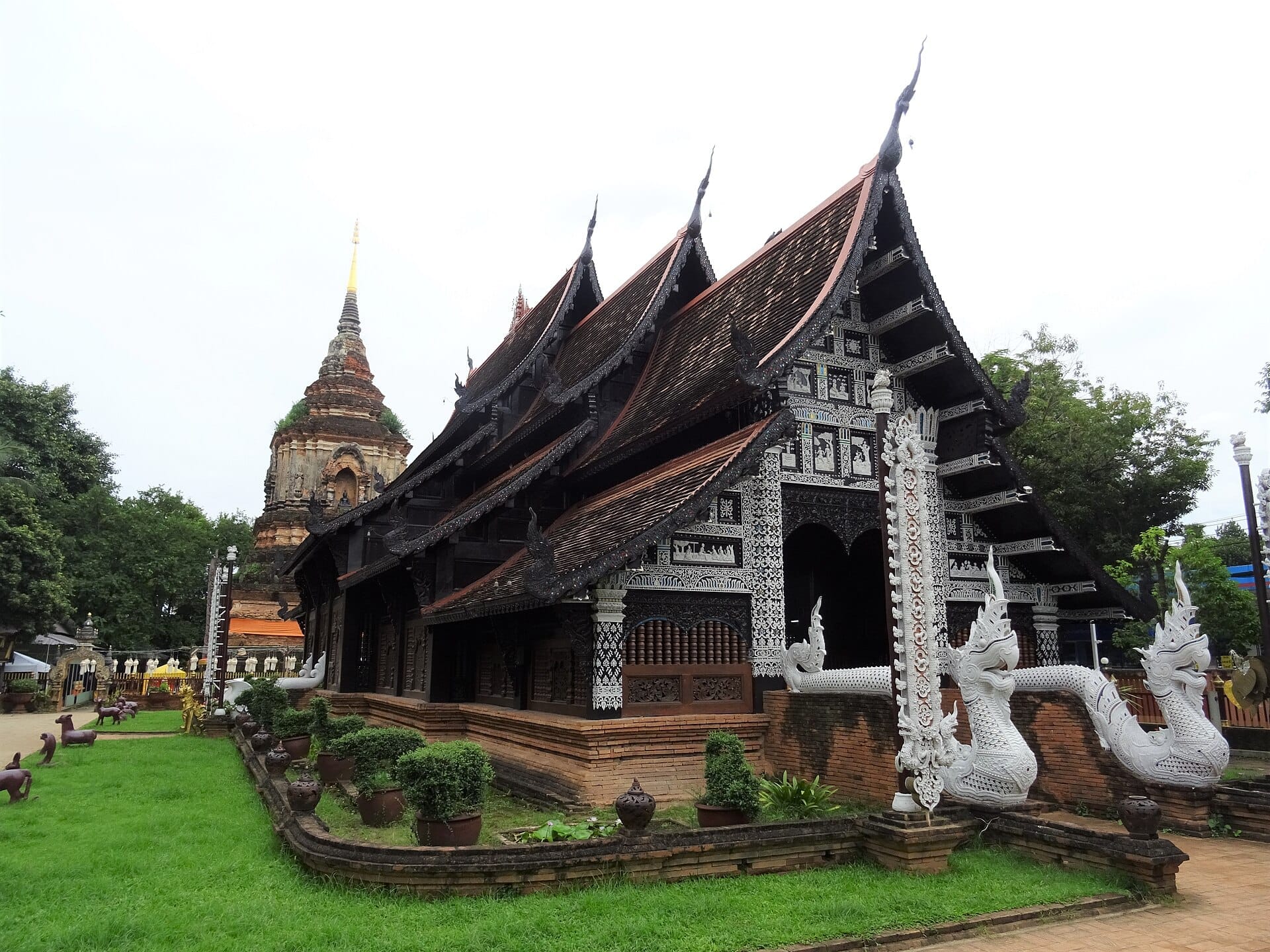
The most striking element of Wat Lok Moli is its large Lanna-style chedi, or stupa, which dominates the rear of the compound. Dating to the mid-16th century, likely during the reign of King Mekuti, the chedi is a tapering octagonal structure rising on a tiered base, its proportions characteristic of the northern Thai Lanna school rather than the bulbous chedis common in central Thailand. The surface glows a warm ochre-gold in the afternoon light, particularly in the hour before sunset when the angle of the sun picks out the texture of the stonework.
The viharn (assembly hall) at the front of the compound is a more recent reconstruction but maintains traditional Lanna proportions: a low, multi-tiered roof with distinctive flame-shaped decorative finials known as bai raka, carved wooden fascia boards, and a cool, dim interior housing a principal Buddha image in the Chiang Saen style. The wooden doors and carved details on the exterior eaves are worth examining closely; this kind of craftsmanship is becoming increasingly rare even in Chiang Mai.
The compound also contains smaller shrine structures and open-sided sala pavilions used for community gatherings. For broader context on Lanna temple architecture across the city, the Chiang Mai temples guide covers the defining stylistic features you'll encounter throughout the region.
Tickets & tours
Live prices and dates from our booking partner. If you book, we may earn a commission at no extra cost to you.
Doi Inthanon National Park small group guided tour
From 34 €Instant confirmationFree cancellationHalf-day tour to admire elephants and enjoy Thai nature
From 48 €Instant confirmationFree cancellationChiang Mai - Chiang Dao Cave and 5 Hill Tribe villages
From 42 €Instant confirmationFree cancellationArt in Paradise Chiang Mai 3D Art Museum entrance tickets
From 8 €Instant confirmationFree cancellation
Historical Significance: Royal Patronage and Princely Remains
Wat Lok Moli's history intertwines with the royal lineage of the Lanna Kingdom. The temple served as a royal monastery for Lanna kings during periods of political turbulence, and historically it was used as a place for the cremation of Lanna royal family members. The large chedi is believed to enshrine the ashes of King Mekuti, who ruled Chiang Mai during the 16th century under Burmese suzerainty. This connection to royal cremation rites elevated the temple's status considerably within the Lanna religious hierarchy.
Chiang Mai changed hands multiple times between Thai and Burmese forces over two centuries, and like many temples in the Old City and its surroundings, Wat Lok Moli fell into disrepair during periods of abandonment before being restored during the 19th and 20th centuries. The layered quality of the architecture you see today, some ancient, some restored, some rebuilt entirely, reflects that complicated regional history. Visiting here with that context in mind transforms what might otherwise seem like a modest compound into a legible record of northern Thai dynastic history.
Wat Lok Moli sits just outside the Chiang Mai Old City, whose walls and moat were themselves constructed during the original founding of the city in 1296. The location outside the north gate was not incidental: royal and religious buildings of particular significance were often deliberately placed at cardinal approaches to the city.
The Experience by Time of Day
Early morning, between 6:30 and 8:30am, is the most atmospheric time to visit. The air is cool, the light is soft, and the grounds are occupied primarily by monks and local devotees rather than tourists. The smell of incense drifts from the interior of the viharn, mixed with the faint scent of fresh jasmine garlands left at the entrance shrine. You can hear chanting if the monks are in session, a low, resonant sound that carries across the otherwise quiet compound.
Midday brings harsher light and slightly more visitors, though numbers here never approach the congestion at Wat Phra Singh a few streets south. The courtyard stone reflects heat strongly in the dry season months of March and April, so bring water if you plan to linger. Late afternoon, from around 4pm onward, brings the chedi into its best photographic light and often coincides with the arrival of local residents making evening merit offerings, creating a quietly active scene.
⚠️ What to skip
During the burning season (roughly February to April), haze can significantly dull the golden tones of the chedi and flatten photographs. If photography is your priority, aim for the cooler months of November through January for the clearest light and air.
Getting There and Exploring the Surrounding Area
Wat Lok Moli is an easy walk from the Chang Phuak Gate at the north end of the Old City, roughly five minutes on foot heading west along Mani Nopharat Road. If you are cycling, the road is flat and manageable. Red songthaew shared taxis can drop you near Chang Phuak Gate from most parts of the city.
The temple pairs naturally with a broader exploration of the Old City's northern section. Nearby, the Wat Chiang Man, the oldest temple within the city walls, is a ten-minute walk southeast and provides an illuminating contrast in style and scale. For an efficient itinerary combining Wat Lok Moli with other key sites, the Chiang Mai 3-day itinerary offers a logical sequence that avoids backtracking.
The area immediately north of Chang Phuak Gate is also home to the Chang Phuak night market, a small street food market that operates in the evening and is primarily used by locals rather than tourists. If you time your temple visit for late afternoon, a post-visit meal there makes for a thoroughly local evening.
Photography at Wat Lok Moli
The chedi is the primary photographic subject here. For the best compositions, position yourself toward the rear of the compound where the chedi rises unobstructed above the lower shrine structures. Late afternoon provides warm directional light from the west. The carved wooden detailing on the viharn eaves and doors rewards close-up work. If you are building a broader photography portfolio of Chiang Mai's temples, the Chiang Mai photography guide covers optimal timing and locations across the city.
Always ask before photographing monks at close range. In this smaller, community-oriented compound, discretion matters more than at heavily touristed temples where photography is implicitly normalized. Point your camera at architecture, not at people engaged in private devotional acts, unless you have been invited otherwise.
Honest Assessment: Who Will Love This, and Who May Not
Wat Lok Moli is not a spectacle. It does not have the scale of Wat Phra That Doi Suthep, the polished museum-quality presentation of Wat Phra Singh, or the dramatic ruined chedi of Wat Chedi Luang. What it offers is authenticity, architectural coherence in the Lanna style, and a low-pressure environment where you can observe living Buddhist practice without the management infrastructure of a major tourist site.
Travelers who are temple-fatigued and looking for something to check off a list will probably find this underwhelming. The compound is compact, the English-language signage is minimal, and there is no gift shop or guided tour infrastructure. But for anyone with a genuine interest in Lanna history, Buddhist architecture, or simply finding a quiet courtyard in a busy city, this temple delivers something that most of the more famous sites in Chiang Mai cannot.
If you are working through Chiang Mai's broader temple circuit, pairing Wat Lok Moli with Wat Phan Tao and Wat Suan Dok gives you a well-rounded sense of the range of Lanna religious architecture across different periods and patronage contexts.
Insider Tips
- Visit on a Buddhist holy day (Wan Phra) when local worshippers fill the compound with offerings of flowers, incense, and gold leaf. The atmosphere is noticeably more active and devotional than on ordinary days. The Thai lunar calendar determines these dates, but they occur roughly every two weeks.
- The chedi is most photogenic from the inside-rear corner of the compound, where you can frame it against the sky without surrounding structures cluttering the background. Most visitors photograph it from the front approach and miss this angle entirely.
- Wat Lok Moli has minimal English interpretation on-site. Download or photograph a brief overview of Lanna architectural features before your visit; it dramatically increases what you notice and understand while walking the grounds.
- The temple is only five minutes north of Chang Phuak Gate, but most tuk-tuk drivers will try to redirect you to better-known temples. Walk or cycle rather than relying on a driver who may claim the temple is closed or suggest alternatives.
- Combine a visit here with the Chang Phuak night market one street north for an evening that feels entirely removed from the tourist circuit. Arrive at the temple around 4:30pm, spend 45 minutes, then head to the market as it opens around 6pm.
Who Is Wat Lok Moli For?
- Architecture and history enthusiasts interested in Lanna Buddhist heritage
- Photographers seeking dramatic chedis without tourist crowds in the frame
- Travelers who want to observe genuine religious practice in a non-staged setting
- Repeat visitors to Chiang Mai who have already covered the major temples
- Anyone building a focused Old City walking itinerary covering lesser-known sites
Nearby Attractions
Other things to see while in Old City (Chiang Mai Old Town):
- Chang Phuak Night Market (North Gate Food Market)
Chang Phuak Night Market, known to locals as the North Gate Food Market, is a compact open-air street food gathering outside Chiang Mai's ancient city walls. Night after night, it draws a faithful crowd of students, office workers, and savvy travelers in search of authentic northern Thai cooking at prices that haven't caught up with the tourist economy.
- Chiang Mai City Arts and Cultural Centre
Housed in a beautifully restored colonial-era building on the edge of the Old City's Three Kings Monument plaza, the Chiang Mai City Arts and Cultural Centre offers one of the most accessible and well-curated introductions to Lanna history and northern Thai culture. It rewards both first-time visitors and those who want genuine context before exploring the city's temples and neighborhoods.
- Chiang Mai City Walls and Moat
The rectangular moat and surviving brick walls of Chiang Mai's Old City are the physical outline of a 700-year-old Lanna capital. Free to explore at any hour, they offer one of the most atmospheric walks in northern Thailand, framing temples, corner bastions, and four ceremonial gates.
- Chiang Mai National Museum
The Chiang Mai National Museum offers one of the clearest introductions to northern Thailand's Lanna Kingdom, covering 700 years of history through royal artifacts, Buddhist sculpture, ceramics, and ethnographic collections. It's calm, well-organized, and genuinely undervisited compared to the temples nearby.
Planning a trip? Discover personalized activities with the Nomado app.