Wabash Arts Corridor: Chicago's Mile of Large-Scale Street Art
The Wabash Arts Corridor stretches roughly a mile through Chicago's South Loop, showcasing dozens of large-scale murals on building facades and in alleys. Founded in 2013 by Columbia College Chicago, it has grown into one of the country's most intentional public art districts, with a strong focus on works by women and BIPOC artists. Entry is free, and the streets are accessible around the clock.
Quick Facts
- Location
- Wabash Avenue from Van Buren St to Roosevelt Rd, South Loop, Chicago, IL 60605
- Getting There
- Roosevelt (Red/Orange/Green Lines) or Harold Washington Library–State/Van Buren (Brown/Purple/Pink); walk north along Wabash Ave
- Time Needed
- 45 minutes (self-guided stroll) to 2 hours (guided tour or thorough exploration)
- Cost
- Free to walk. Optional guided tours from ~US$35 (check Chicago Architecture Center for current prices)
- Best for
- Street art enthusiasts, photographers, architecture lovers, budget travelers
- Official website
- loopchicago.com/listings/wabash-arts-corridor
What Is the Wabash Arts Corridor?
The Wabash Arts Corridor (WAC) is a planned outdoor public art district running roughly a mile along Wabash Avenue in Chicago's South Loop, between Van Buren Street and Roosevelt Road. The project was founded in 2013 by Columbia College Chicago, which occupies several buildings along this stretch, and it has since expanded into one of the most deliberately curated street art environments in any American city.
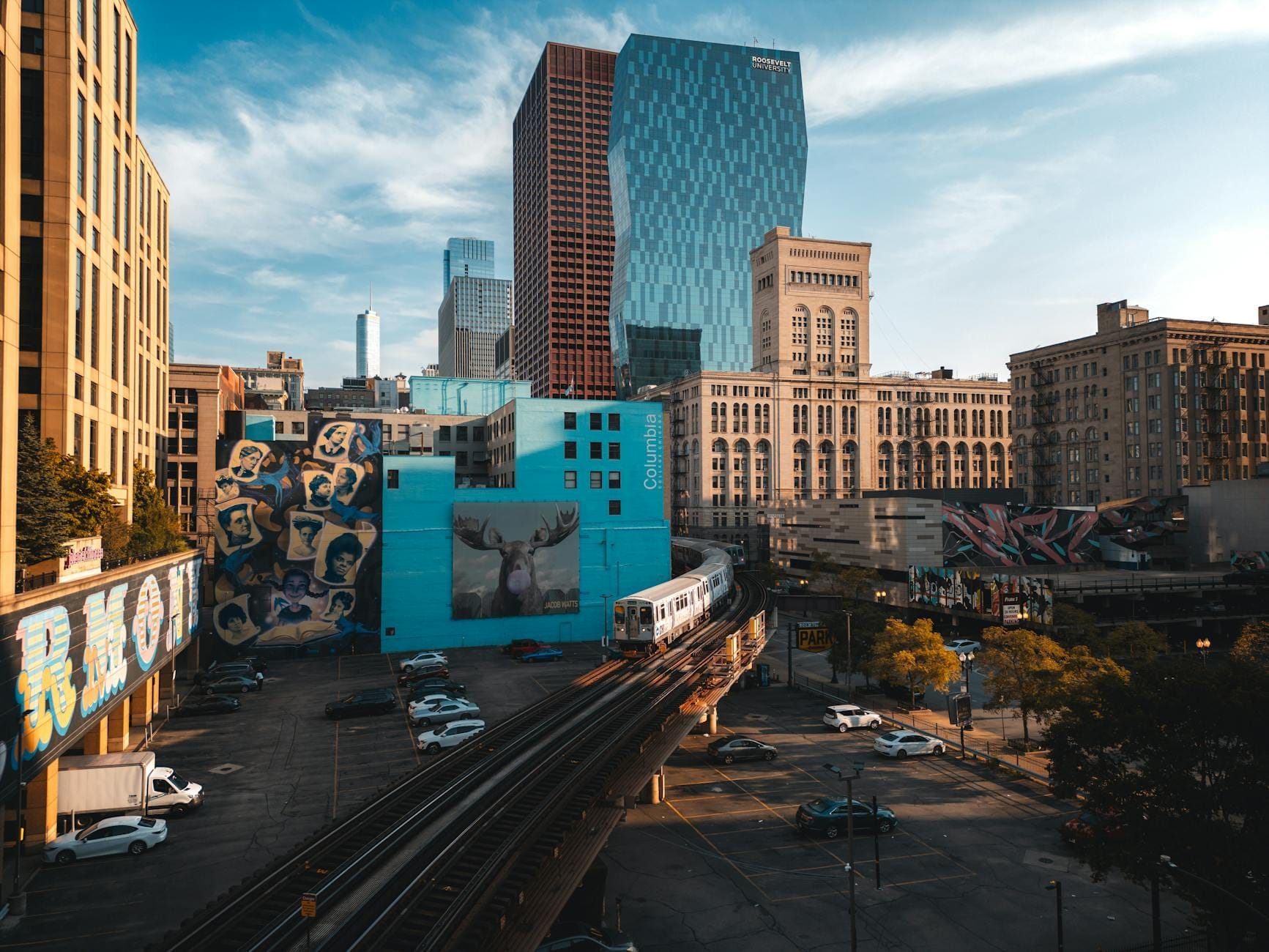
Dozens of large-scale murals cover building facades, parking garage walls, and the sides of elevated train structures throughout the corridor. The scale of individual works is genuinely impressive: many span multiple stories, and several occupy entire building sides that become visible from blocks away. This is not a loose cluster of tagged walls. Each piece is commissioned, and the curatorial direction since 2016 has prioritized diversity, equity, and inclusion, resulting in one of the largest concentrated collections of public art by women and BIPOC artists in the United States.
💡 Local tip
Download a walking map before you go. Columbia College Chicago and the Chicago Loop Alliance both publish route maps showing mural locations. Without one, it is easy to miss works tucked into side alleys off Wabash.
Walking the Corridor: What You Will Actually See
Start at the Roosevelt CTA station (Red, Orange, and Green Lines) and walk north along Wabash Avenue. Within the first block, large-format works begin appearing on the east and west sides of the street. The most striking murals are on the upper floors of mid-rise buildings, where Chicago's flat light hits them cleanly at midday. At street level, look for works in the alleys running parallel to Wabash, particularly between Michigan Avenue to the east and State Street to the west.
The alleyways deserve particular attention. They are standard Chicago service alleys, meaning they are public and entirely walkable, but the transition from the busy boulevard into a quieter, walled space where a massive painted figure occupies the entire wall above a dumpster has a specific kind of jolt to it. The contrast between the mundane urban infrastructure and the deliberate, high-quality artwork is part of what makes WAC different from a conventional gallery or sculpture park.
As you move north toward the Harold Washington Library end of the corridor, the elevated train structure running above Wabash creates a rhythmic grid of steel columns and shadows. Some murals are positioned to be seen through that structure, making them shift as you walk. The rumble and screech of the 'L' trains passing overhead is constant and worth factoring in: it gives the walk an industrial texture that quieter art districts lack.
Tickets & tours
Hand-picked options from our booking partner. Prices are indicative; availability and final rates are confirmed when you complete your booking.
Go City | Chicago All-Inclusive Pass
From 127 €Instant confirmationFree cancellationiFLY Chicago Lincoln Park indoor skydiving experience
From 126 €Instant confirmationFree cancellationiFLY Chicago Rosemont indoor skydiving tickets
From 117 €Instant confirmationFree cancellationChicago lakefront neighbourhood bike tour
From 18 €Instant confirmationFree cancellation
Time of Day and Seasonal Considerations
The corridor is accessible 24 hours a day, 365 days a year, as all works are on public streets and building exteriors. That said, time of day makes a meaningful difference to the experience. Midday light, especially in the warmer months, brings out color saturation in the murals most effectively. Morning visits, before the foot and vehicle traffic picks up, make it easier to stop and photograph without people constantly crossing the frame.
Evening visits offer a different reading of the corridor. Several murals are lit at night, and the contrast between illuminated artwork and the dark gaps of unlit alley sections creates a more dramatic atmosphere. However, the alleys themselves are less comfortable to walk at night, particularly alone, and some sections between buildings have limited lighting. This is not an inherently dangerous area, but it is worth sticking to the main Wabash sidewalk after dark rather than exploring every alley.
Winter does not close the corridor, but a January visit with wind off Lake Michigan cutting down the cross streets requires real commitment. The upside: fewer pedestrians, and the flat gray light of a Chicago winter can actually make certain monochromatic or earthy-toned murals read with unusual clarity. Summer and early autumn are the most comfortable seasons for a long, unhurried walk.
⚠️ What to skip
The elevated 'L' tracks over Wabash create shadow patterns that can flatten mural colors in photography. If shooting with a phone, aim for late morning when light angles under the tracks. Overcast days can work well for even, diffused color.
History and Cultural Significance
Columbia College Chicago, whose campus occupies much of the south end of the Loop along Wabash, initiated the WAC in 2013 as a way to activate a stretch of the city that had long been underused at street level. Unlike the more commercially polished parts of the Loop to the north, Wabash between Van Buren and Roosevelt was characterized by service entrances, parking garages, and the steel underside of the elevated tracks. The college used its position as property manager and institutional connector to broker mural commissions on surrounding buildings.
The strategic shift in 2016 toward centering women and BIPOC artists gave WAC a more explicit identity than many street art programs. Rather than simply commissioning technically skilled muralists regardless of background, the program became an intentional platform. That decision is reflected in the content of the work itself: many murals engage directly with themes of identity, ancestry, and urban belonging in ways that are more layered than purely decorative street art.
WAC sits within the Loop, Chicago's central business district, which also contains major institutions like the Art Institute of Chicago just a few blocks northeast. The proximity to one of the world's great encyclopedic art museums, combined with the free and genuinely democratic nature of the corridor, makes the pairing unusually rewarding for a single afternoon.
Practical Guide: Getting There, Moving Around, and Photographing Well
The most direct CTA access is the Roosevelt station on the Red, Orange, and Green Lines, which deposits you at the southern end of the corridor. From here, you walk north through the full length of the route. Alternatively, exiting at Harold Washington Library–State/Van Buren on the Brown, Purple, or Pink Lines places you at the northern boundary; from there you walk south, which means the light on the facades ahead of you changes as you go. Neither direction is clearly better, but starting at Roosevelt and walking north keeps the wind at your back in cold months.
Wear comfortable walking shoes. The sidewalks are standard Chicago concrete, the alleys are uneven in places, and you will want to stop and backtrack repeatedly. Carrying a portable phone charger is worthwhile given how many times you will stop to photograph. There are no dedicated restrooms within the corridor itself; the nearest public facilities are inside Columbia College buildings and nearby coffee shops along the route.
If you prefer a structured experience, the Chicago Architecture Center offers a guided tour of the Wabash Avenue Arts Corridor. Prices have been listed at approximately US$35 for general admission and US$10 for members, though these are subject to change and should be verified directly before booking. The tour provides curatorial context that a self-guided walk cannot replicate.
Accessibility along the corridor follows standard downtown Chicago street conditions. Most murals are visible from the sidewalk without needing to enter any private property. The main Wabash Avenue sidewalk is paved and continuous. Some alley sections have uneven surfaces or raised drainage grates that are worth noting for visitors using mobility aids, though the primary mural viewing experience on the main street does not require entering alleys.
Honest Assessment: What Works and What Doesn't
The Wabash Arts Corridor is genuinely worth a visit, but it rewards engagement rather than passive walking. If you move through quickly without a map or any background on the artists, it is possible to come away with the impression of a somewhat random collection of large paintings on walls. The more you know about individual artists and the corridor's intentional programming, the more the walk reveals.
The quality of individual works varies, as it does in any open-air art program. Not every mural is equally compelling, and a few show the effects of weather and age. The corridor is also working within the constraints of existing urban infrastructure, so some works are in awkward positions relative to parked delivery trucks, signage, and the general visual noise of a working city street. That friction is arguably part of its character, but visitors expecting the curated serenity of a sculpture garden will find it more chaotic.
Travelers who want complementary public art experiences should also consider the nearby Cloud Gate and Crown Fountain in Millennium Park, about 15 minutes north on foot, or the Chicago Cultural Center, which hosts rotating free exhibitions and is on the way between the two districts.
ℹ️ Good to know
The corridor is an evolving program: murals are periodically replaced or updated as new commissions are completed. A wall that appears on an older map or photo may look different by the time you visit. This is a feature, not a flaw, but it means no two visits are identical.
Who Should Skip It
Travelers with very limited time in Chicago who are trying to move through major paid attractions efficiently may find that a self-guided mural walk does not compete well for time against the Art Institute, the Field Museum, or an architecture boat tour. The corridor is most satisfying as a complement to a broader day in the Loop rather than a standalone destination if you have only 24 hours in the city.
Visitors primarily interested in Chicago's architectural heritage might get more from a focused Chicago architecture guide or the Chicago Architecture Foundation River Cruise than from WAC, though the corridor does sit within one of the city's most architecturally layered streets.
Insider Tips
- Pick up a printed mural map from the Chicago Loop Alliance's information kiosk in the Loop or download the PocketSights route before your visit. Several works are in alleys that you will simply walk past without a map.
- The parking garage walls along the alley between Wabash and Michigan, south of Balbo Drive, contain some of the most striking works in the corridor. They are easy to miss on a casual walk.
- Visit on a weekday morning to avoid delivery truck congestion. Wabash is an active commercial street and large vehicles frequently block sightlines to lower portions of murals during the midday rush.
- If you are serious about photography, an overcast day often produces better results than direct summer sun. The steel L-track overhead creates harsh contrast shadows that can be difficult to manage in bright light.
- Combine the corridor with Columbia College Chicago's campus galleries, which are free and open to the public during school hours. They often show work by the same artists represented on the exterior walls.
Who Is Wabash Arts Corridor For?
- Street art and mural enthusiasts who want context and scale beyond typical urban art districts
- Photographers looking for large-format subjects with diverse compositions and urban texture
- Budget travelers: the entire experience is free and walkable from multiple transit stops
- Visitors with a specific interest in art by women and BIPOC artists, where the WAC has built a meaningful collection
- Anyone pairing a Loop afternoon with the Art Institute or Millennium Park who wants to use walking time productively
Nearby Attractions
Other things to see while in The Loop:
- Art Institute of Chicago
One of the largest and most visited art museums in the United States, the Art Institute of Chicago anchors the eastern edge of the Loop with a collection of over 300,000 works spanning 5,000 years. From Georges Seurat's pointillist masterpiece to Grant Wood's American Gothic, the highlights alone demand the better part of a day.
- Buckingham Fountain
The Clarence Buckingham Memorial Fountain is one of the largest decorative fountains in the world, sitting at the heart of Grant Park since 1927. Free to visit during its seasonal run from spring through mid-October, it puts on hourly water displays and a nightly illuminated show that draws crowds from across the city.
- Chicago Architecture Center
Housed in Mies van der Rohe's One Illinois Center on the Chicago River, the Chicago Architecture Center packs nearly 10,000 square feet of exhibition space, a landmark scale model of the city, and access to some of the country's most informative architecture tours. It's the most comprehensive entry point into understanding what makes Chicago's skyline one of the world's most significant.
- Chicago Architecture Foundation River Cruise
The Chicago Architecture Center River Cruise aboard Chicago's First Lady is the most authoritative way to read the city's skyline. In 90 minutes, trained docents walk you through more than 40 landmark buildings across all three branches of the Chicago River, connecting architectural styles to the human decisions that shaped them.