Pathé Tuschinski Theater: Amsterdam's Most Spectacular Cinema
The Pathé Tuschinski Theater is one of the most architecturally extraordinary cinemas in the world. Opened in 1921 on Reguliersbreestraat, this Royal Theatre blends Art Deco, Amsterdam School, and Jugendstil styles into a movie palace that rewards visitors whether or not they ever buy a ticket to a film.
Quick Facts
- Location
- Reguliersbreestraat 26–34, 1017 CN Amsterdam (Canal Ring, between Muntplein and Rembrandtplein)
- Getting There
- Metro Rokin (~5–7 min walk) or Waterlooplein (~10–12 min walk); approximately 2 km from Amsterdam Centraal Station
- Time Needed
- 30–45 min for a lobby visit or exterior viewing; 1.5–2 hours for a guided morning tour plus a film screening
- Cost
- Free to view the exterior; film tickets priced in EUR by show and seat type; morning audio tours available at a separate fee — check official Pathé site for current prices
- Best for
- Architecture lovers, film fans, design and craft enthusiasts, couples, curious walkers on the Reguliersbreestraat
- Official website
- www.pathe.nl/bioscoop/tuschinski
What Is the Tuschinski Theater?
The Pathé Tuschinski Theater, officially known as Koninklijk Theater Tuschinski (Royal Theatre Tuschinski), is an active cinema on Reguliersbreestraat in the heart of Amsterdam's Canal Ring. It opened in 1921, built by Abraham Icek Tuschinski, a Polish-Jewish immigrant who had survived a pogrom and arrived in the Netherlands with an ambition to create something Amsterdam had never seen: a movie palace that elevated cinema into an experience worthy of the grandest European opera houses.
That ambition is visible on every surface. The building is a singular architectural statement that fuses Amsterdam School expressionism, Jugendstil ornament, and Art Deco geometry into a style that defies simple categorization. More than a century later, it is still operating as a cinema under the French group Pathé, which has operated the venue since the late 20th century. Watching a film here is a genuinely different experience from watching one anywhere else in the city.
💡 Local tip
You do not need a film ticket to appreciate the building. The ornate facade on Reguliersbreestraat is publicly visible at all hours and free to photograph. The lobby interior is generally accessible to ticket holders; morning audio tours (typically offered around 09:30–11:30 on selected days) allow non-film visitors to explore the interior properly. Confirm tour dates and prices on the official Pathé website before your visit.
The Architecture: A Building That Earns Its Reputation
Standing on Reguliersbreestraat, the Tuschinski facade commands the street in a way that makes adjacent buildings recede into irrelevance. The exterior rises in a tower-like composition with two flanking turrets, faced in dark brick and ornamented with carved stone, wrought ironwork, mosaic tilework, and colored glass. The forms are simultaneously heavy and intricate: broad Amsterdam School massing covered in the fine surface detail characteristic of Jugendstil craft.
The main entrance, set between the towers, draws visitors through a sequence of escalating richness. Each layer, from the pavement to the ticket counters to the stairs leading upward, is more ornamented than the last. Carpets of deep red and gold cover the floors. Painted ceilings curve overhead. Ironwork banisters catch the light from elaborate chandeliers. This was a building designed to make ordinary people feel they had stepped into somewhere extraordinary, which in 1921 was a radical democratic impulse applied to the new art form of cinema.
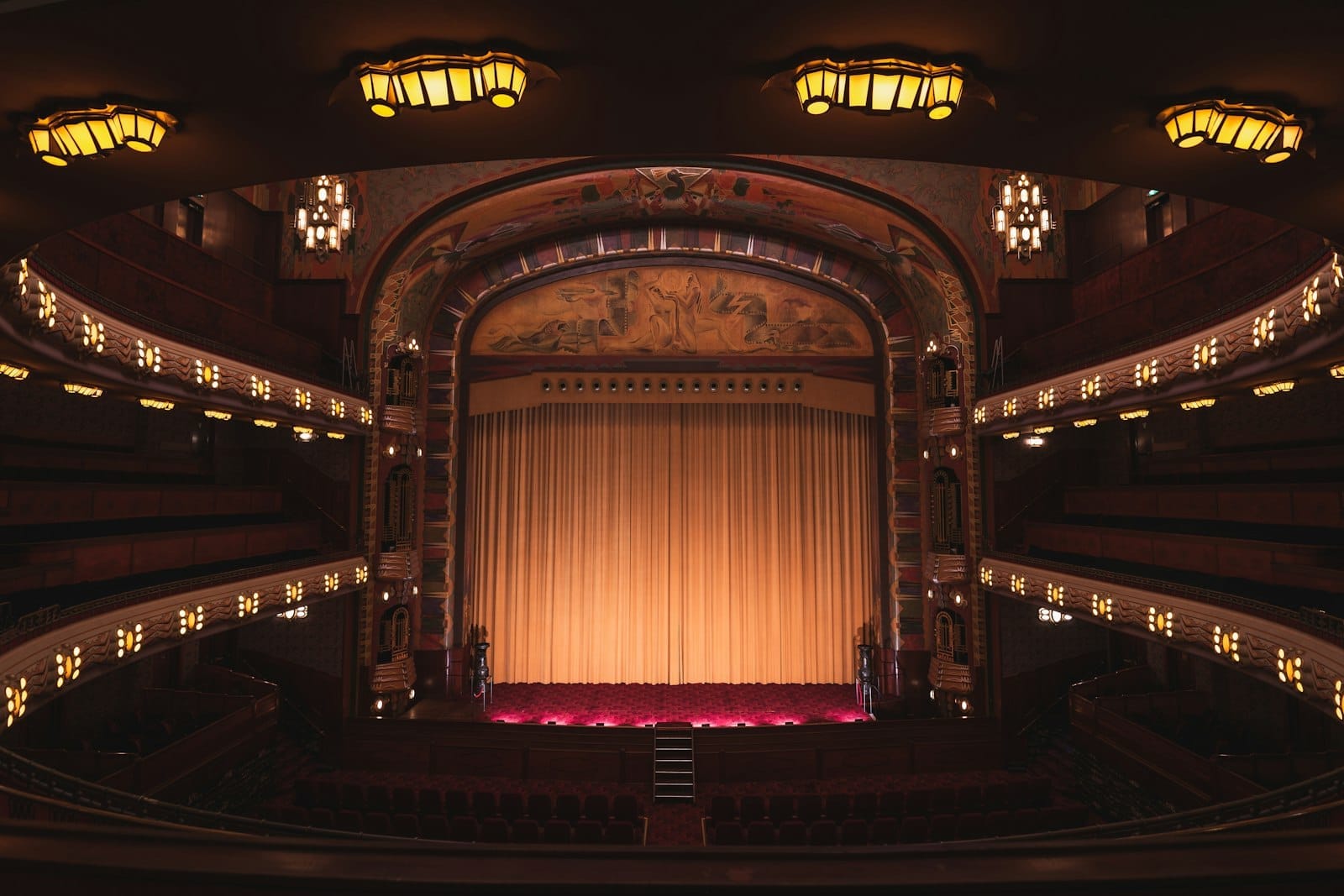
The main auditorium, Tuschinski 1, seats several hundred visitors and is recognized as one of the most beautiful cinema screens in Europe. The ceiling is a shallow dome ringed with painted panels and theatrical lighting. The original organ, used in the silent film era, is still present. Sitting in this space before a film begins, with the house lights slowly dimming over the ornamented walls, is an experience that straightforwardly justifies the visit.
Tickets & tours
Live prices and dates from our booking partner. If you book, we may earn a commission at no extra cost to you.
Gray Line Canal Cruise with snackbox & Heineken Experience
From 48 €Instant confirmationFree cancellationAmsterdam evening canal cruise
From 18 €Instant confirmationFree cancellationJewish Museum and Portuguese Synagogue entrance ticket
From 20 €Instant confirmationFree cancellationAdmission ticket for Artis Royal Zoo and Micropia
From 39 €Instant confirmationFree cancellation
History: From Immigrant Dream to National Monument
Abraham Tuschinski commissioned the theater on a bombed-out site in the city centre, financing a building of extraordinary ambition for a cinema of the era. It opened on October 28, 1921, with a program of live variety acts alongside film screenings. The building was immediately recognized as exceptional, drawing visitors as much for the space itself as for what was being shown inside.
The theater's history carries a weight that is impossible to separate from the building's identity. During the Nazi occupation of the Netherlands in World War II, Tuschinski himself was deported and murdered at Auschwitz in 1942. The theater was renamed during the occupation and returned to its original name after the war. Today, a small memorial inside the building acknowledges this history. Knowing it does not diminish the theater's beauty; it deepens it.
The building is listed as a national monument in the Netherlands. It sits within the UNESCO-listed Canal Ring district, a neighborhood whose 17th-century street plan and dense heritage architecture surround the theater on all sides. Walking to the Tuschinski from the nearby Rembrandtplein takes less than two minutes and routes through one of the most historically layered parts of central Amsterdam.
Visiting in Practice: Times of Day and What Changes
Morning is the most rewarding time to visit if architecture is your primary interest. Before the afternoon and evening film crowds arrive, Reguliersbreestraat is relatively quiet. The facade catches direct morning light from the east, which illuminates the mosaic and ironwork detail far better than the flat midday or artificial evening light. The street smells of coffee from neighboring cafes, and the ambient noise level is low enough to actually stop and look upward without feeling pressured.
By early evening, particularly on weekends, the street transforms. Queues form outside. The interior is alive with the particular smell of warm velvet and popcorn that belongs to grand old cinemas. The chandeliers are fully lit. The lobbies fill with conversation. This is the version of Tuschinski that most visitors encounter, and it has its own charm, though quiet contemplation of the architecture is harder to achieve.
If you plan to watch a film, aim for one of the larger auditoriums, particularly Tuschinski 1, for the full spatial experience. Smaller screening rooms in the building are pleasant but do not carry the same architectural impact. Booking in advance online is advisable for popular showings and weekends.
ℹ️ Good to know
Morning audio tours are offered on selected mornings, typically between 09:30 and 11:30. These are the best way to access the full interior without a film ticket. Availability varies by day and season, so check the official Pathé Tuschinski page before planning your visit around a tour.
Getting There and Getting Around
The theater is located at Reguliersbreestraat 26–34, midway between Muntplein and Rembrandtplein in central Amsterdam. The nearest metro stations are Rokin (around 5–7 minutes on foot) and Waterlooplein (around 10–12 minutes on foot). From Amsterdam Centraal Station, the walk takes around 25 minutes through the city centre, or you can take a tram toward the Munt and approach on foot from there.
Amsterdam's central tram network connects most of the city to this part of the Canal Ring efficiently. If you are planning a full day in the area, the guide to getting around Amsterdam covers tram routes, day passes, and the GVB system in practical detail.
Cycling is a natural option for most Amsterdam visitors. The street itself has a cycle lane, and bike parking is available in the surrounding area, though Reguliersbreestraat itself is narrow enough that parking directly outside can involve some maneuvering. Arriving on foot from Rembrandtplein or Muntplein is the simplest approach for first-time visitors.
⚠️ What to skip
Accessibility varies across the building's different auditoriums and levels. The Tuschinski is a heritage building with original staircases and split-level design, which can present challenges for visitors with mobility requirements. Contact the venue directly via the official Pathé website before your visit to confirm step-free access, wheelchair seating availability, and accessible facilities for the specific event or tour you are planning.
Photography, Practical Tips, and Who This Is Not For
Photography in the lobby and common areas is generally tolerated for personal use. The exterior at dusk, when the building's illuminated signage contrasts with the deep brick facade, produces particularly strong images. A wide-angle lens is useful for the exterior given the narrow street width; stepping back toward the opposite pavement gives you the full height of the towers. Inside, low-light performance matters because flash photography is generally discouraged in operational cinemas.
The Tuschinski is not the right visit for travelers who are primarily looking for contemporary art spaces or cutting-edge design. Amsterdam has strong options in those categories, from the Stedelijk Museum to the EYE Filmmuseum in Amsterdam Noord. The Tuschinski is specifically for people who respond to the density and craft of early 20th-century decorative art, to the theatricality of a grand public space, or to the idea of watching a contemporary film inside a building of genuine historical and aesthetic weight.
Visitors expecting a quiet museum experience will find the evening version of Tuschinski louder and more commercial than anticipated. The cinema operates as a fully functioning multiplex alongside its heritage identity, which means current blockbusters share the schedule with arthouse films. The building transcends its programming, but it helps to be aware that this is not a frozen-in-time monument. It is a living, working cinema that happens to be one of the most extraordinary buildings in Amsterdam.
For context on how the Tuschinski fits into Amsterdam's broader architectural story, the Amsterdam architecture guide covers the Amsterdam School movement, the Canal Ring's UNESCO designation, and other key buildings worth visiting alongside the theater.
Insider Tips
- Book a seat in Tuschinski 1 for any screening rather than the smaller halls. The architectural experience of the main auditorium is the entire point, and it does not cost more than other screens at the same cinema.
- Morning audio tours (typically around 09:30–11:30 on selected days) are significantly less crowded than any evening visit and give you access to spaces you cannot reach as a standard filmgoer. Check the Pathé website at least a few days in advance because tour slots fill up.
- The best exterior photography happens at dusk when the building's illuminated facade contrasts with the darkening sky. Stand on the opposite side of Reguliersbreestraat and use the full width of the pavement to get both towers in the frame.
- If you are combining the visit with nearby attractions, Rembrandtplein is under two minutes away on foot and has a high concentration of bars and restaurants for a post-film drink. The square itself is worth a brief look for its bronze recreation of Rembrandt's Night Watch group.
- Dress comfortably but smartly if visiting for an evening film. The Tuschinski has an atmosphere that makes people naturally dress slightly better than they would for an ordinary cinema, and it adds to the experience to lean into that.
Who Is Pathé Tuschinski Theater For?
- Architecture and design enthusiasts who appreciate early 20th-century decorative craft
- Film fans who want to watch a current release in a genuinely historic setting
- Couples looking for an atmospheric and unusual evening out in central Amsterdam
- Travelers with an interest in Amsterdam's Jewish history and World War II heritage
- Photographers seeking one of the most ornate and distinctive building exteriors in the city
Nearby Attractions
Other things to see while in Canal Ring (Grachtengordel):
- Anne Frank House
The Anne Frank House on Prinsengracht 263 preserves the hidden rooms where Anne Frank and seven others lived in concealment from 1942 to 1944. One of the most significant memorial sites in Europe, it requires advance planning but rewards visitors with an experience that stays with them long after they leave Amsterdam.
- Bloemenmarkt (Floating Flower Market)
The Bloemenmarkt sits on a row of fixed barges along the Singel canal, operating since 1862 as the world's only floating flower market. Free to enter and open daily, it sells tulip bulbs, cut flowers, and souvenirs in the heart of Amsterdam's Canal Ring. Here is what you will actually find there.
- Amsterdam Canal Cruises
A canal cruise is one of the most efficient ways to understand Amsterdam's layout and its 17th-century heritage. This guide covers the main operators, departure points, what you'll actually see, and how to pick the right cruise for your trip.
- FOAM Photography Museum
Housed in a 17th-century canal house on Keizersgracht, FOAM Photography Museum (Fotografiemuseum Amsterdam) has been one of Europe's leading photography institutions since it opened in December 2001. Four floors of rotating exhibitions cover documentary work, fine art photography, fashion, and emerging talent, making it a serious cultural stop that rewards repeat visits.
Planning a trip? Discover personalized activities with the Nomado app.