Rembrandtplein: Amsterdam's Square That Never Sleeps
Rembrandtplein is one of Amsterdam's most recognizable public squares, anchored by a 19th-century statue of the city's most famous painter and surrounded by café terraces, bars, and cinemas. Free to enter at any hour, it shifts character dramatically from a relaxed afternoon gathering spot to one of the city's primary nightlife hubs after dark.
Quick Facts
- Location
- Rembrandtplein, 1017 CT Amsterdam (Canal Ring)
- Getting There
- Tram to Rembrandtplein stop (lines 4, 14); or walk about 5 min from Waterlooplein metro
- Time Needed
- 15–30 min to see the square; several hours if staying for food and drinks
- Cost
- Free to enter; bars and terraces are priced at standard Amsterdam rates
- Best for
- Nightlife seekers, history browsers, photography, people-watching
What Is Rembrandtplein?
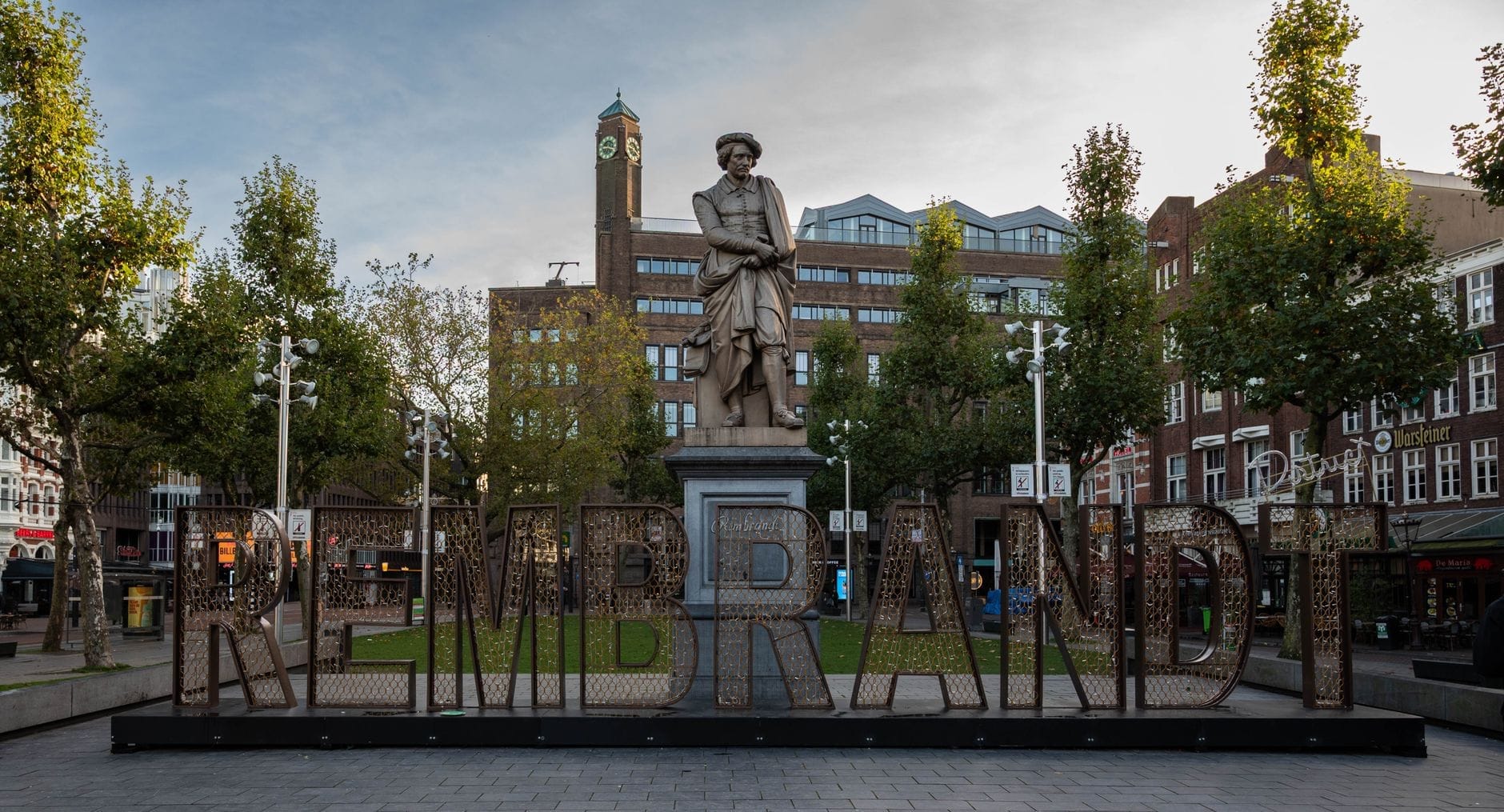
Rembrandtplein, or Rembrandt Square, is a large rectangular public plaza in the heart of Amsterdam's Canal Ring district. It is one of the busiest squares in the city, functioning simultaneously as a cultural landmark, a transit node, and the starting point for Amsterdam's most concentrated stretch of bars and late-night venues. The square is free to visit and open 24 hours a day, every day of the year.
At the center of the square stands a bronze statue of Rembrandt van Rijn, unveiled in 1852, making it one of the oldest surviving public statues in Amsterdam. The painter is depicted in a relaxed, contemplative pose, palette in hand. Surrounding the statue's base, a collection of bronze figures (which have been periodically removed and reinstalled) represents characters from Rembrandt's most celebrated work, The Night Watch. These life-sized sculptures were first installed in 2006, created by Russian artists Mikhail Dronov and Alexander Taratynov, and they have the unusual effect of bringing the painting's frozen composition into three-dimensional street-level space.
💡 Local tip
The Night Watch bronze figures make for striking photographs, especially in the evening when the square's lighting catches the metalwork. Morning visits before 9am offer the clearest shots without crowds.
A Square With a Longer History Than Its Name Suggests
Before it was named after Amsterdam's most famous painter, Rembrandtplein served a far more practical purpose. For much of the 17th and 18th centuries, the site operated as a butter and dairy market, known as the Botermarkt. Farmers and traders brought their goods into the city along this route, and the square's broad, flat proportions reflect the spatial requirements of a working market rather than a purely ceremonial plaza.
The renaming in honor of Rembrandt van Rijn, who was born in Leiden in 1606 and spent much of his professional life in Amsterdam, came in the 19th century as part of a broader civic effort to commemorate the city's Golden Age heritage. The 1852 statue predates many of the surrounding café buildings, most of which were constructed or refaced in the late 19th and early 20th centuries, giving the square its current character: a mix of ornate, slightly theatrical facades that reflect the confidence of that era.
Rembrandtplein sits within the Canal Ring, Amsterdam's UNESCO-listed historic district, though the square itself is more commercial than the quieter stretches of the grachtengordel. It connects naturally to Muntplein, about ten minutes on foot to the west, and to the Amstel river to the south.
Tickets & tours
Live prices and dates from our booking partner. If you book, we may earn a commission at no extra cost to you.
Cheese tasting at Henri Willig Rembrandtplein Amsterdam
From 23 €Instant confirmationFree cancellationGray Line Canal Cruise with snackbox & Heineken Experience
From 48 €Instant confirmationFree cancellationAmsterdam evening canal cruise
From 18 €Instant confirmationFree cancellationJewish Museum and Portuguese Synagogue entrance ticket
From 20 €Instant confirmationFree cancellation
How the Square Changes Through the Day
Visit Rembrandtplein at 10am on a weekday and the atmosphere is almost subdued. The terrace chairs are being set out, delivery vans are moving through the surrounding streets, and a handful of tourists are photographing the Rembrandt statue in clear morning light. This is the best time to absorb the square's proportions and examine the Night Watch sculptures without navigating around groups.
By early afternoon, the terraces fill. The square is well-positioned for sunshine on clear days and its café culture kicks in fully from around noon. This is a good moment to sit with a coffee and observe the foot traffic, which mixes local office workers with tourists moving between the Rijksmuseum area and the Dam. The smell of frying from nearby snack bars and the low hum of conversation from the terraces give it a distinctly neighborhood feel that contrasts with the more tourist-saturated streets closer to the Dam.
After dark, especially on weekends, the square transforms almost entirely. The terraces stay busy well past midnight, bass from the surrounding clubs bleeds into the open air, and the illuminated facades reflect in the wet cobblestones on rainy nights. It is genuinely loud, genuinely crowded, and genuinely energetic. If that is not your preference, visiting between 9am and noon is the practical compromise.
⚠️ What to skip
Friday and Saturday nights from around 10pm onward see heavy crowds, significant noise, and slow movement through the surrounding streets. Travelers seeking a quiet evening experience should plan accordingly, or visit on a weekday evening when the square is lively but not overwhelming.
What to Actually Do at Rembrandtplein
The square itself is primarily a place to pause, observe, and orient rather than a destination with structured activities. Walking the perimeter takes about five minutes. Spending time with the Night Watch bronze figures takes another ten. Beyond that, the draw is the surrounding infrastructure: the terrace bars that spill across the paving in warmer months, the cinemas on adjacent streets, and the range of restaurants that cater to almost every budget.
Rembrandtplein is also a useful geographic anchor. From here, it is a short walk to several of Amsterdam's better-known cultural sites and one of the best starting points for an evening that moves between drinks, dinner, and further exploration of the Canal Ring.
For nightlife specifically, Amsterdam's nightlife scene extends well beyond Rembrandtplein, but the square remains one of the most accessible entry points, particularly for first-time visitors. The venues here tend toward mainstream rather than underground, which may or may not suit your preference.
If you are combining a visit with a canal experience, canal cruises depart from several points within easy walking distance of the square, and an evening cruise followed by drinks at Rembrandtplein is a common and effective itinerary.
Getting There and Getting Around
The square has its own tram stop, Rembrandtplein, served by multiple GVB tram lines including lines 4 and 14 at time of writing. Check the GVB network map for current routes, as Amsterdam's tram network has undergone changes. The stop deposits you directly at the edge of the square, making this one of the more straightforward transit arrivals in the city.
If you are coming from Amsterdam Centraal or the Waterlooplein area, the metro to Waterlooplein (lines 51, 53, 54) followed by a 5 to 10 minute walk is a reliable alternative. On foot from Dam Square, allow about 10–15 minutes via Rokin. From the Museumplein area, tram is faster than walking.
Rembrandtplein is a natural waypoint on a longer walk through central Amsterdam. If you are exploring on foot, consider pairing it with nearby Magere Brug, the narrow 17th-century drawbridge over the Amstel, which is about a 10-minute walk south.
ℹ️ Good to know
Cyclists should note that the streets immediately around Rembrandtplein are shared with trams and pedestrians, and can be congested during peak evening hours. Several bike parking racks are available around the square's perimeter.
Practical Notes and Who Might Want to Skip It
Accessibility to the square itself is generally good. The paving is mostly level, curb ramps are present, and the central area around the statues is walkable without steps. Individual venues vary significantly in accessibility, and anyone with specific mobility requirements should check their intended bars or restaurants in advance.
Photography works best in low light conditions: early morning for clean architectural shots, or evening for the atmospheric reflections and illuminated facades. Midday can be harsh and the terrace furniture obstructs sightlines to the sculptures.
Travelers who prioritize quiet, authentically local, or culturally immersive experiences may find Rembrandtplein underwhelming or overly commercial. The square is unambiguously oriented toward entertainment and hospitality, and does not offer the layered historical atmosphere of quieter parts of the Canal Ring. It also lacks the green space of nearby squares like Leidseplein. If you are looking for something that feels less like a nightlife district and more like a historic neighborhood, the streets around the Jordaan or the Begijnhof are closer to that register.
For a more complete picture of what the Canal Ring area offers beyond the main squares, the lesser-known Amsterdam attractions guide covers several quieter stops within easy walking distance.
Insider Tips
- The Night Watch bronze sculptures are often overlooked by visitors passing through quickly. Spend a few minutes locating all the figures, which are arranged around the statue base to recreate the spatial composition of Rembrandt's painting. It rewards close attention.
- If you want terrace seating at one of the more established cafés on a summer weekend, arrive by 1pm. By 3pm, most terraces are full and waits can be long.
- The side streets immediately off Rembrandtplein, particularly toward the Amstel, contain smaller, less crowded bars that draw more local clientele. Reguliersdwarsstraat, one street over, is Amsterdam's main LGBTQ+ nightlife strip and worth knowing if that is relevant to your plans.
- For the clearest view of the Rembrandt statue with minimal pedestrian traffic, visit on a weekday morning between 8am and 9:30am. The golden-hour light from the east catches the bronze particularly well in spring and summer.
- Avoid the tourist-oriented restaurants directly bordering the square if food quality matters to you. The best eating options are a 5 to 10 minute walk away in any direction.
Who Is Rembrandtplein For?
- First-time visitors wanting a quick orientation to central Amsterdam's atmosphere
- Nightlife and bar-hopping itineraries, especially on weekday evenings when crowds are manageable
- History and art enthusiasts interested in the Rembrandt statue and Night Watch sculptures
- Travelers building a walking route through the Canal Ring and needing a central anchor point
- Photography focused on urban night scenes and illuminated café architecture
Nearby Attractions
Other things to see while in Canal Ring (Grachtengordel):
- Anne Frank House
The Anne Frank House on Prinsengracht 263 preserves the hidden rooms where Anne Frank and seven others lived in concealment from 1942 to 1944. One of the most significant memorial sites in Europe, it requires advance planning but rewards visitors with an experience that stays with them long after they leave Amsterdam.
- Bloemenmarkt (Floating Flower Market)
The Bloemenmarkt sits on a row of fixed barges along the Singel canal, operating since 1862 as the world's only floating flower market. Free to enter and open daily, it sells tulip bulbs, cut flowers, and souvenirs in the heart of Amsterdam's Canal Ring. Here is what you will actually find there.
- Amsterdam Canal Cruises
A canal cruise is one of the most efficient ways to understand Amsterdam's layout and its 17th-century heritage. This guide covers the main operators, departure points, what you'll actually see, and how to pick the right cruise for your trip.
- FOAM Photography Museum
Housed in a 17th-century canal house on Keizersgracht, FOAM Photography Museum (Fotografiemuseum Amsterdam) has been one of Europe's leading photography institutions since it opened in December 2001. Four floors of rotating exhibitions cover documentary work, fine art photography, fashion, and emerging talent, making it a serious cultural stop that rewards repeat visits.
Planning a trip? Discover personalized activities with the Nomado app.