Magere Brug (Skinny Bridge): Amsterdam's Most Photographed Bridge
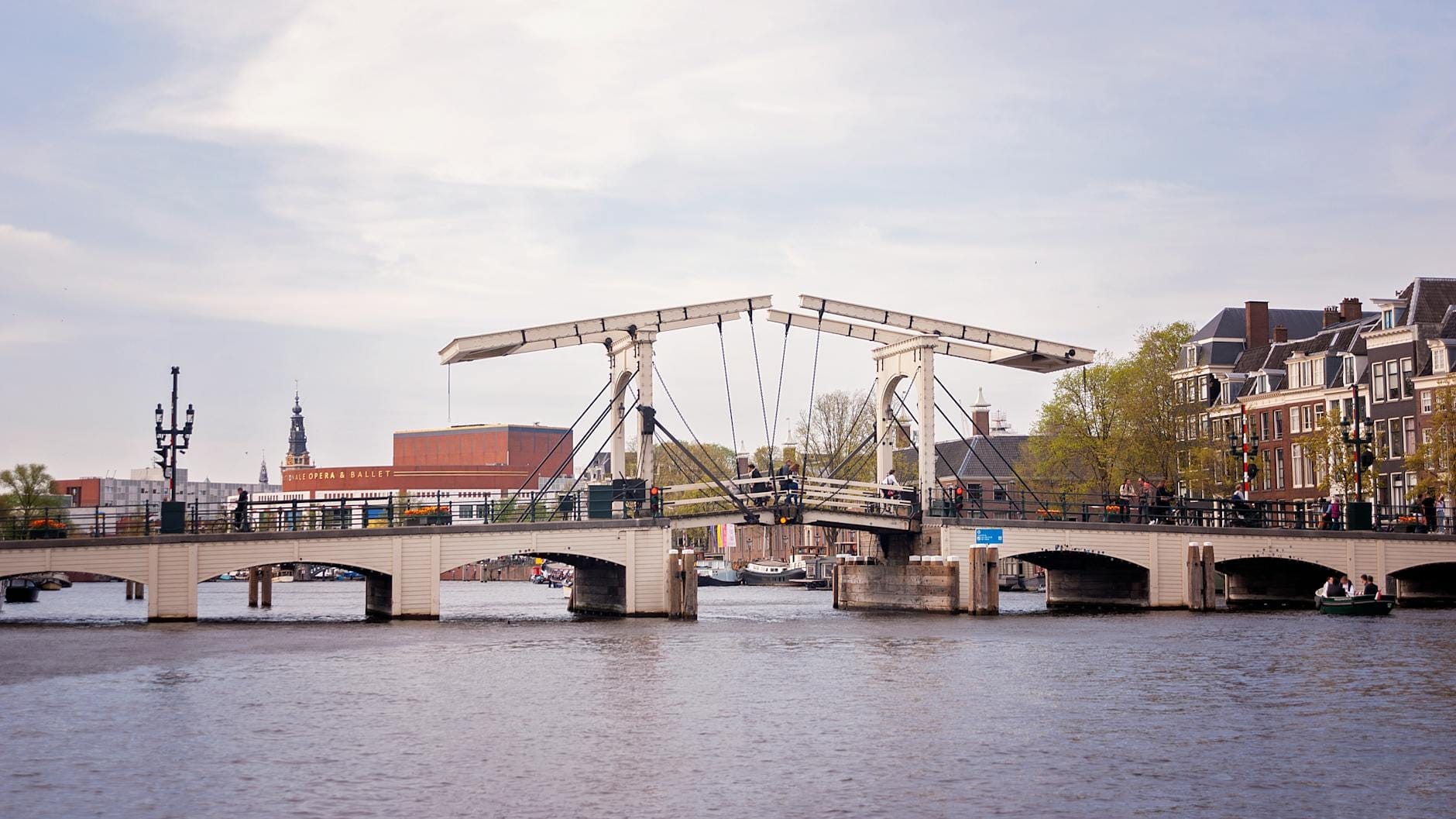
The Magere Brug, or Skinny Bridge, is a white-painted wooden bascule drawbridge spanning the Amstel river near Kerkstraat. Free to cross day and night, it's at its most striking after dark when hundreds of small lights outline the structure against the water. A landmark drawbridge on a site dating to 1691, with the current wooden structure from 1934; the bascule has been automated since 1994.
Quick Facts
- Location
- Amstel river at Kerkstraat, 1018 EK Amsterdam
- Getting There
- Waterlooplein or Weesperplein metro stations, approx. 6–7 min walk
- Time Needed
- 15–30 minutes to cross, photograph, and take in the Amstel views
- Cost
- Free — public bridge, no ticket required
- Best for
- Evening photography, canal walks, architecture lovers, couples
What Is the Magere Brug?
The Magere Brug — Dutch for 'Skinny Bridge' — is a white-painted wooden bascule drawbridge crossing the Amstel river at Kerkstraat, between the Keizersgracht and Prinsengracht canals in Amsterdam's historic Canal Ring. It is one of the most recognizable structures in the city: narrow, symmetrical, and lined with small electric lights that trace its arched silhouette after dark. The bridge sits in a part of Amsterdam where the Amstel widens noticeably, which means the views from either side reach further down the river than you might expect.
The central bascule section can be raised to allow taller vessels through; openings have been automated since 1994, replacing the earlier hand-operated mechanism. When it opens, you can watch the wooden leaves rise on their counterweights — a mechanical detail that makes the structure feel both functional and theatrical. Since 2003, the bridge has been reserved for pedestrians and cyclists only; no cars cross it.
💡 Local tip
The bridge is free to cross and open 24 hours a day. You don't need to plan around opening times — just show up, ideally after sunset when the lights come on and the Amstel reflects the whole structure.
History: From 1691 to Today
The first bridge at this location was built in 1691, when it was known as the Kerkstraatbrug (Church Street Bridge). That original structure was reportedly so narrow it could barely fit two people side by side, which is the most commonly cited origin of the 'skinny' nickname. A wider replacement was constructed in 1871, though it retained the informal name. The current wooden structure dates to 1934 and underwent a significant renovation around 1969.
The bridge sits just east of Amsterdam's UNESCO-listed Canal Ring, the 17th-century urban expansion that gave the city its characteristic horseshoe layout of concentric waterways. The Amstel itself predates the canal system — the city's name derives from a dam built on the Amstel in the 13th century. Standing on the Magere Brug, you're looking at a river that has been at the center of Amsterdam's identity for over 700 years.
For a broader sense of how the canal system was designed and why it still shapes daily life in the city, the Amsterdam canals guide covers the engineering and history behind the grachtengordel in detail.
Tickets & tours
Live prices and dates from our booking partner. If you book, we may earn a commission at no extra cost to you.
Day trip to Bruges from Amsterdam
From 54 €Instant confirmationFree cancellationBruges excursion from Amsterdam
From 79 €Instant confirmationFree cancellationBrussels and Bruges from Amsterdam guided tour
From 199 €Instant confirmationFree cancellationLuxury sightseeing tour of Bruges with private transportation from Amsterdam
From 900 €Instant confirmationFree cancellation
The Experience: What It's Actually Like to Visit
During the day, the Magere Brug is a working piece of city infrastructure as much as it is a sightseeing stop. Cyclists roll across it constantly, pedestrians cut through on their way between the Amstel neighborhood and Kerkstraat, and tour boats pass underneath on the river. The wooden planks have a particular sound underfoot — a low, hollow knock — and they can be noticeably slippery after rain. The white paint on the ironwork picks up light well in the afternoon, making it photogenic even in flat overcast conditions that are common in Amsterdam for much of the year.
The real transformation happens in the evening. Hundreds of small bulbs outline the entire bridge from the lamp posts to the handrails, and the Amstel below becomes a mirror for the light. On still nights the reflection is almost perfect. On weekends, small groups gather on both banks of the river specifically to photograph the scene, and it's common to see photographers with tripods set up on the eastern embankment where the sightline is clearest. Weekday evenings are noticeably quieter and often more atmospheric.
If you happen to be present when the bridge opens for river traffic, it's worth stopping to watch. The opening is slow and deliberate, and the movement of the counterweights has a rhythm that draws a crowd even among locals. Openings are not scheduled for tourists, so it's a matter of timing and luck.
⚠️ What to skip
The wooden deck becomes genuinely slippery when wet. If you're cycling across in rain, approach slowly — the surface has less grip than asphalt, particularly near the central bascule section where the planks are more worn.
Best Time to Visit
Sunset and the first hour after dark give the best of both worlds: enough ambient light to see the Amstel landscape, combined with the bridge's illumination beginning to assert itself. In summer this means arriving around 9–10 PM; in winter, the lights come on much earlier, and you can experience the full illuminated effect by 5:30 PM without staying out late.
Midday on weekends brings the heaviest foot traffic, with tour groups crossing alongside locals and cyclists. If you want the bridge more to yourself for photography, early mornings (before 8 AM) are reliably quiet throughout the week. The light on the water is soft and directional in the early morning, which suits wide shots of the full bridge from the riverbank.
Amsterdam's climate is oceanic and overcast for much of the year. If you're planning your trip around photography and open skies, the best time to visit Amsterdam breaks down seasonal conditions in practical terms.
Getting There and Getting Around
The Magere Brug is located at Amstel/Kerkstraat, postcode 1018 EK. The nearest metro stations are Waterlooplein (M51, M53, M54) and Weesperplein (M51, M53); from either station it's a walk of roughly 6 to 7 minutes along the Amstel riverbank. Trams on several routes stop closer still on the Utrechtsestraat or Frederiksplein corridors.
On foot, the bridge fits naturally into a longer walk through the southern Canal Ring. You can approach from Rembrandtplein (about 10 minutes northwest), or continue south from the bridge toward the Amstel Hotel area. For a structured walk that takes in the area's highlights, see the Amsterdam walking tours guide.
Cycling is arguably the most natural way to arrive. The bridge sits on a popular cycling route between central Amsterdam and the Pijp district, and locking your bike on either bank takes seconds. Amsterdam's cycling infrastructure makes the bridge easy to reach from almost any direction; the cycling in Amsterdam guide covers route logic and bike hire options for visitors.
Architecture and Structure
The Magere Brug is a symmetrical double-leaf bascule drawbridge, meaning both halves of the central span pivot upward on counterweights to allow river traffic through. The main structure is painted white wood over an iron frame, with decorative lamp posts at regular intervals along the railings. The bridge has a gentle arch rather than a flat profile, which gives it a slightly elevated midpoint and contributes to the characteristic silhouette visible in almost every photograph taken from the Amstel banks.
At roughly 50 metres in total length and only about 5 metres wide, the bridge lives up to its name. Two cyclists passing in opposite directions requires coordination and a degree of goodwill. This narrowness, combined with the white paintwork and the river setting, is what gives the Magere Brug a presence disproportionate to its actual scale.
If Amsterdam's bridge and canal architecture interests you beyond the Magere Brug itself, the Amsterdam architecture guide covers the Canal Ring's urban design and how it earned its UNESCO designation.
Photography Tips
The best shooting position for the full bridge is from the eastern bank of the Amstel, looking west. From here the bridge is centered in the frame with the Kerkstraat running away behind it, and in the evening the lit structure reflects cleanly in the water below. A wide-angle lens captures the full span; a short telephoto compresses the reflection and the lamp posts into a tighter composition.
For a different angle, cross to the middle of the bridge and look north or south along the Amstel. At dusk the river takes on a steel-grey color with warm orange light from the embankment buildings, and the view in both directions is free of the crowds that gather on the banks. Boat wakes create interesting patterns in the reflected light in the minutes after a tour vessel passes.
ℹ️ Good to know
Smartphone cameras handle the evening illumination reasonably well in Night Mode. For best results, brace against one of the lamp post bases on the bridge railing rather than trying to handhold in the low light.
Accessibility and Practical Notes
The bridge has a gentle arch, which means there is a slight incline from either end to the midpoint. The surface is wooden planking, which can have minor gaps and uneven sections, particularly near the central bascule mechanism. No official step-free accessibility information is published for the Magere Brug. Visitors with significant mobility limitations or who use wheelchairs should be aware that the wooden deck and incline may present difficulty.
There are no toilets, ticket booths, or staffed facilities at the bridge itself. The nearest public facilities are in the Waterlooplein area or in the cafes along Utrechtsestraat. The bridge is part of the city's street network and there is no visitor center or dedicated signage beyond standard city wayfinding.
Insider Tips
- Wednesday and Thursday evenings tend to be the quietest weekday nights for photography — fewer weekend visitors and tour groups, but the same illumination as any other night.
- If you want to watch the bridge open for river traffic, position yourself on the east bank rather than trying to cross — the mechanism is more clearly visible from a distance, and you won't be asked to wait mid-crossing.
- The cafe terraces on Amsteldijk just south of the bridge have direct sightlines to the illuminated structure from table level, making this one of the few places in Amsterdam where you can photograph an iconic canal landmark while sitting down with a drink.
- In winter, the Magere Brug is at its most dramatic when light mist sits on the Amstel. Fog is common in November and December, and it turns the bridge lights into soft halos that make for unusually evocative photographs.
- The bridge is on the route between Rembrandtplein and the Albert Cuyp Market in De Pijp — combining these three stops makes for a logical half-day walk through the southern Canal Ring without backtracking.
Who Is Magere Brug (Skinny Bridge) For?
- Photographers looking for Amsterdam's most illuminated evening subject
- Couples on an evening canal walk who want a landmark without a ticket queue
- Architecture and engineering enthusiasts interested in Amsterdam's drawbridge heritage
- Cyclists using the bridge as a natural waypoint between the city center and De Pijp
- Travelers building a self-guided walk through the Canal Ring's southern reaches
Nearby Attractions
Other things to see while in Canal Ring (Grachtengordel):
- Anne Frank House
The Anne Frank House on Prinsengracht 263 preserves the hidden rooms where Anne Frank and seven others lived in concealment from 1942 to 1944. One of the most significant memorial sites in Europe, it requires advance planning but rewards visitors with an experience that stays with them long after they leave Amsterdam.
- Bloemenmarkt (Floating Flower Market)
The Bloemenmarkt sits on a row of fixed barges along the Singel canal, operating since 1862 as the world's only floating flower market. Free to enter and open daily, it sells tulip bulbs, cut flowers, and souvenirs in the heart of Amsterdam's Canal Ring. Here is what you will actually find there.
- Amsterdam Canal Cruises
A canal cruise is one of the most efficient ways to understand Amsterdam's layout and its 17th-century heritage. This guide covers the main operators, departure points, what you'll actually see, and how to pick the right cruise for your trip.
- FOAM Photography Museum
Housed in a 17th-century canal house on Keizersgracht, FOAM Photography Museum (Fotografiemuseum Amsterdam) has been one of Europe's leading photography institutions since it opened in December 2001. Four floors of rotating exhibitions cover documentary work, fine art photography, fashion, and emerging talent, making it a serious cultural stop that rewards repeat visits.
Planning a trip? Discover personalized activities with the Nomado app.