The O2 Arena, London: The Complete Visitor's Guide
One of the world's highest-capacity indoor arenas, The O2 arena on Greenwich Peninsula draws millions of visitors a year for concerts, sports, comedy, and more. This guide covers how to get there, what the experience is actually like, and what to know before you arrive.
Quick Facts
- Location
- Peninsula Square, London SE10 0DX (Greenwich Peninsula)
- Getting There
- North Greenwich Underground Station (Jubilee line) — directly adjacent. DLR connections available via Canary Wharf or Canning Town.
- Time Needed
- 2–4 hours for an event; allow extra time for pre-show dining or queuing at peak hours
- Cost
- Event-dependent; tickets sold via AXS in GBP. No fixed admission price — check the official site for current listings.
- Best for
- Concert-goers, sports fans, large-group nights out, and arena-scale comedy or theatre events
- Official website
- www.theo2.co.uk
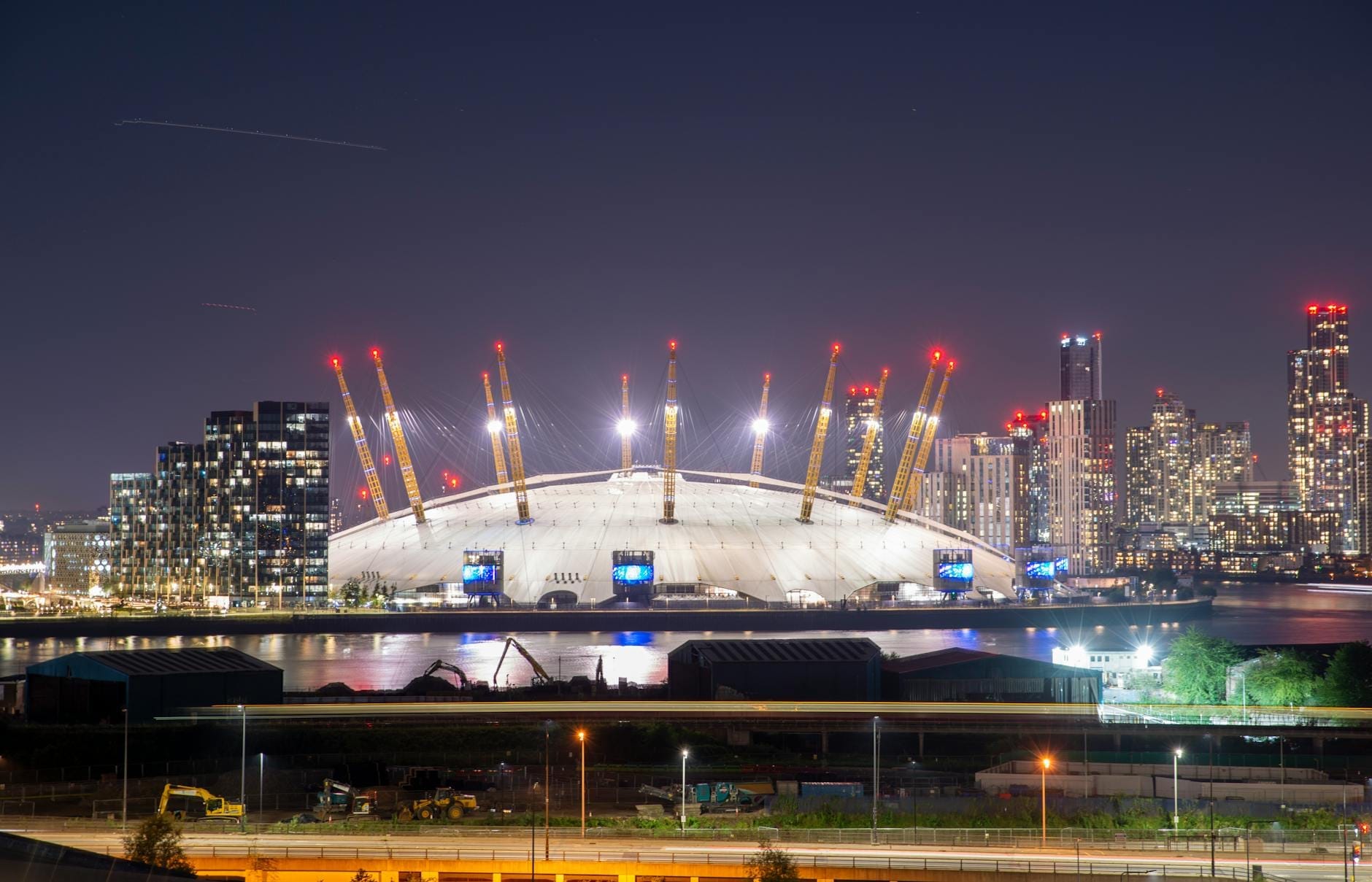
What The O2 Arena Actually Is
The O2 arena is the main performance venue inside The O2 entertainment complex on Greenwich Peninsula in southeast London. With a capacity of 20,000 and more than 200 events each year, it consistently ranks among the busiest indoor arenas in the world by ticket sales. This is not a quiet cultural venue or a specialist music hall — it is a large-format, all-purpose arena designed for stadium-scale concerts, international sporting events, comedy tours, and major award ceremonies.
The structure itself is hard to miss. The O2's distinctive white dome — actually a repurposed Millennium Dome, originally built for the year 2000 celebrations — sits on the southern bank of the River Thames, visible from a distance across the water and from above on the Jubilee line approach. Its naming rights were sold in May 2005, and the venue was transformed under AEG Europe into its current form. What was briefly an embarrassment of national ambition became one of the country's most commercially successful entertainment venues.
ℹ️ Good to know
The O2 arena is cashless. Bring a contactless card or digital wallet for food, drinks, and merchandise inside the venue. Cash is not accepted at most points of sale.
Getting There: Easier Than You Think
The venue describes itself as 15 minutes from central London, and on the Jubilee line, that claim holds up. North Greenwich Underground Station sits directly adjacent to the main entrance, making this one of the most straightforward large-venue arrivals in London. The Jubilee line runs between Westminster, Waterloo, London Bridge, Canary Wharf, and North Greenwich in a clean, frequent sequence. From central stations like Waterloo, the journey is around 15 minutes.
If you are coming from further east or using the DLR network through Canary Wharf and the Docklands, you can connect to the Jubilee line at Canary Wharf station and be at North Greenwich within a few minutes. There is also an Uber Boat by Thames Clippers stop at North Greenwich pier, which adds a scenic option on event nights — particularly worthwhile in summer when the river is at its most photogenic.
⚠️ What to skip
After major events, North Greenwich station can become extremely congested as thousands of people leave at the same time. If you can stay for 20–30 minutes after a show ends — grab a drink or browse the concourse — you will likely walk straight onto a train rather than joining a packed platform queue.
Tickets & tours
Hand-picked options from our booking partner. Prices are indicative; availability and final rates are confirmed when you complete your booking.
Soho Instagram a self-guided walking tour to top photo spots
From 6 €Instant confirmationFree cancellationTootbus London by Night: Bus tour
From 32 €Instant confirmationFree cancellationIFS Cloud Cable Car Ride and Uber Boat Hop-on Hop-off 1 Day Ticket
From 38 €Instant confirmationFree cancellationThe Making of Harry Potter Guided Tour of London Warner Bros. Studio
From 201 €Instant confirmationFree cancellation
The Experience Before the Show Starts
Arriving at The O2 complex before an event has its own rhythm. The wider entertainment district around the arena includes restaurants, bars, a cinema, and a bowling alley, all housed under the dome's outer ring. On event nights, the entire complex fills steadily from around 5pm, with the pre-show peak hitting between 6pm and the doors-open time of approximately 18:30 for most events. The restaurants and bars get loud and service slows considerably — if you plan to eat before a show, booking a table well in advance is not optional, it is essential.
Outside the dome, the Greenwich Peninsula has been undergoing significant urban development. The area around Peninsula Square is cleaner and more polished than it was a decade ago, with wide pedestrianised walkways linking the tube station to the arena entrance. In the evening, the dome's illuminated facade and the reflective surface of the Thames nearby create a striking arrival experience, particularly in autumn and winter when darkness falls early and the lights have more impact.
Inside the Arena: Sightlines, Sound, and Scale
The arena's circular layout means that sightlines from most seating positions are reasonably good, though the upper tier can feel distant from the stage depending on how a particular event configures the floor. For concerts, the ground floor is typically set up as either a standing area or tiered seating, with fixed seating in the lower and upper bowl surrounding it. The acoustic environment is what you would expect from an arena of this size: powerful and immersive at its best, prone to some muddiness in the upper reaches for certain acts.
The concourses inside are wide and reasonably well-organised, with food and drink concessions arranged around the full perimeter. At half-time during sporting events or interval during longer shows, these areas become intensely crowded very quickly. The venue is large enough that moving between sections during a performance is feasible, but plan any concourse trips for natural breaks rather than mid-performance.
Photography conditions inside vary by event — many artists and promoters restrict professional camera equipment and telephoto lenses, though smartphones are generally permitted. If photography is your main reason for visiting London, the best viewpoints in London guide covers the city's outdoor and architectural photography spots, many of which offer the kind of access and light that an arena interior simply cannot replicate.
Up at The O2: The Roof Climb
Separate from the arena events, The O2 offers a guided roof climb experience — Up at The O2 — where visitors walk across the outer surface of the dome along a specially constructed walkway to reach a viewing platform at the top. The climb itself takes around 90 minutes and offers an unusual elevated perspective across the Thames, the Docklands towers, and, on clear days, the London skyline to the west and the Kent countryside to the southeast.
Tickets for the roof climb are sold separately from arena event tickets and must be booked in advance through the official site. Participants are provided with a harness and grip shoes. The experience is not suitable for those with limited mobility or a serious fear of heights. Weather affects the climb directly: it operates in most conditions but may be cancelled in high winds or lightning, and an overcast day significantly reduces the view quality. If a panoramic London experience is your goal, it is worth comparing this with options like The Shard's observation deck, which offers a more central vantage point regardless of whether an event is on.
Historical Context: From Millennium Dome to World Arena
The dome structure was built as the centrepiece of the UK's Millennium Experience, a government-backed exhibition that opened on 1 January 2000 and ran through the year. The exhibition was widely criticised as expensive and poorly attended relative to its ambitions, and the dome stood largely unused for several years afterward as attempts to find a buyer or use dragged on publicly. The transformation into a commercial entertainment venue under AEG Europe was completed in 2007, and the arena has since operated as one of the busiest venues of its type in the world.
The dome's location on Greenwich Peninsula is significant in another way: Greenwich is the home of the Prime Meridian and has been central to British maritime and scientific history for centuries. The arena sits just a short distance from the Old Royal Naval Collegeand the wider UNESCO-listed Maritime Greenwich World Heritage Site — a fact that can feel slightly surreal when you are surrounded by 20,000 people watching a stadium rock concert. The contrast between the neighbourhood's historic character and the arena's sheer modernity is a interesting piece of London urban geography.
Practical Details: What to Know Before You Go
Show start times are listed on the individual event page for that specific date. For most events, doors open at 18:30 and shows typically conclude between 22:30 and 23:00, though this varies by event type. Always check the event page directly rather than relying on a general estimate.
Tickets are sold through AXS, the venue's official ticketing partner. Prices vary considerably depending on the act, the seat location, and how far in advance you book. There is no single standard admission price. Be cautious about secondary market tickets: the venue recommends purchasing only through official channels to avoid issues at the gate.
- The venue is entirely cashless — contactless payment or digital wallets only.
- A BSL interpreting service is available via SignVideo for accessibility support.
- Large bags may be subject to security checks; check the current bag policy on the official site before your visit, as restrictions can vary by event.
- There are no cloakroom facilities at many arena events — travel light if possible.
- The venue app is recommended for live updates on timings, queuing, and any changes to arrangements on the day.
💡 Local tip
If you are attending an event in winter, the walk from North Greenwich station to the entrance is exposed to wind off the Thames. It is short but noticeable on cold nights — keep a jacket accessible rather than packing it in a bag you will need to queue to check.
For a broader sense of what to do in the east London and Docklands area around your visit, the things to do in London guide covers the full range of options across the city, including how to build a multi-day itinerary that combines an O2 event night with daytime sightseeing in the area.
Insider Tips
- Book pre-show dining well before the event date, not on the night. The restaurants inside the O2 complex fill quickly on event evenings and service slows considerably after 6pm.
- The Jubilee line runs frequently but platform queues after a sold-out show can be 20–30 minutes long. Staying inside the complex for a short time after the show ends — even just for a drink at the concourse bar — usually means you walk straight onto the next train.
- For the roof climb, morning slots on clear days offer the sharpest visibility and the fewest other climbers on the walkway. Check the weather forecast 48 hours ahead and reschedule if heavy cloud is expected.
- If you are arriving by Uber Boat from central London, the North Greenwich pier is a short walk from the main entrance and the river approach gives you one of the better visual first impressions of the dome structure — particularly at dusk when the dome is lit.
- Seat location matters more than you might expect in a circular arena. For concerts, centre-floor standing or lower-bowl seats directly facing the stage are consistently rated highest. Upper tier side-on positions can feel remote from the action even at full volume.
Who Is The O2 Arena For?
- Concert and live music fans attending specific touring acts — this is one of the largest and most accessible indoor venues in Europe for major artists.
- Sports spectators: the arena hosts boxing, gymnastics, basketball, and other events where the bowl format creates a atmospheric crowd experience.
- Groups of friends or colleagues looking for a shared large-scale event night out in east London, with dining and entertainment options in the surrounding complex.
- Families attending age-appropriate shows — the venue has clear accessibility provisions and the Jubilee line connection makes it straightforward to reach from most of London.
- Visitors who want to combine an event night with a daytime exploration of the Greenwich and Docklands area.
Nearby Attractions
Other things to see while in Canary Wharf & Docklands:
- Crossrail Place Roof Garden
Perched above one of London's most architecturally ambitious railway stations, the Crossrail Place Roof Garden is a free, publicly accessible garden designed by Foster + Partners. Its planting scheme, split by hemisphere to reflect the area's maritime trading past, offers a surprising counterpoint to the glass towers of Canary Wharf.
- London Cable Car
The IFS Cloud Cable Car carries passengers 90 metres above the River Thames between Greenwich Peninsula and Royal Docks, offering unobstructed views of east London's skyline. The crossing takes up to 10 minutes each way and works as a scenic detour or a useful river crossing depending on where you're headed.
- Museum of London Docklands
Housed in a Grade I listed sugar warehouse built in 1802, London Museum Docklands tells the story of the River Thames, the Port of London, and the area's deep ties to the Atlantic slave trade. Entry is free, it opens daily 10:00–17:00, and the building alone is worth the trip.