London Museum Docklands: What to Expect, See, and Know Before You Go
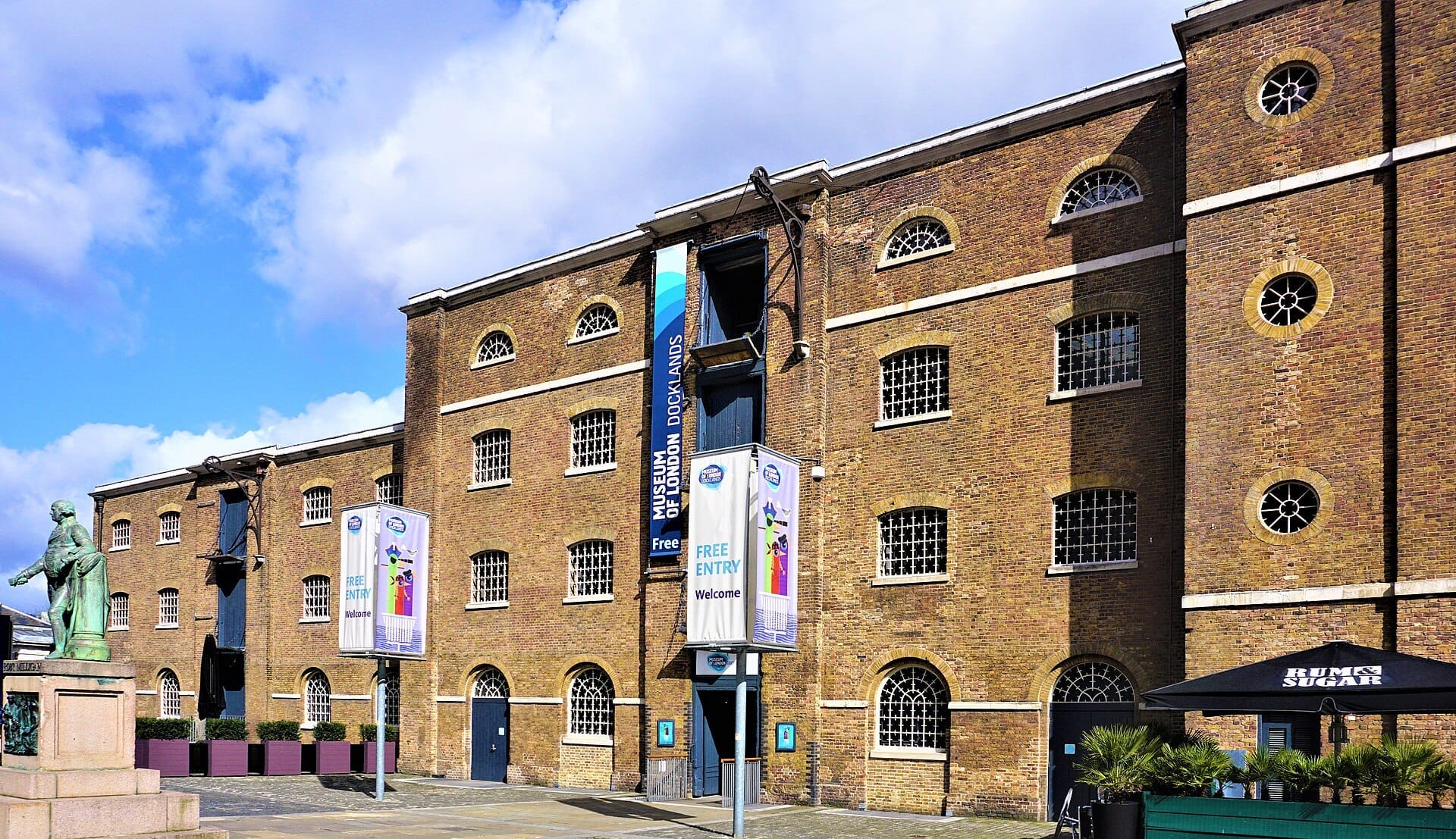
Housed in a Grade I listed sugar warehouse built in 1802, London Museum Docklands tells the story of the River Thames, the Port of London, and the area's deep ties to the Atlantic slave trade. Entry is free, it opens daily 10:00–17:00, and the building alone is worth the trip.
Quick Facts
- Location
- No. 1 Warehouse, West India Quay, London E14 4AL
- Getting There
- West India Quay DLR (3-min walk); Canary Wharf DLR/Jubilee/Elizabeth line (7-min walk)
- Time Needed
- 2–3 hours
- Cost
- Free entry
- Best for
- History, maritime heritage, families, rainy days
- Official website
- www.londonmuseum.org.uk/docklands
Why London Museum Docklands Deserves More Attention
London Museum Docklands (formerly Museum of London Docklands) sits in one of the most historically loaded spots in the entire city. The building is No. 1 Warehouse at West India Quay, a Georgian sugar warehouse completed in 1802 and now Grade I listed. From the outside, it looks exactly like what it is: thick, low, utilitarian, built to store colonial cargo on an industrial scale. Step inside and that weight becomes the point.
Most visitors to Canary Wharf drift between glass towers and chain restaurants without realising they are standing on the site of one of the busiest commercial ports in 19th-century Britain. This museum corrects that gap in a way that feels neither dry nor preachy. It is also completely free, open every day except over Christmas, and undervisited compared to its quality.
For context on how this fits into the broader Canary Wharf area, see the Canary Wharf and Docklands neighbourhood guide.
The Building: A Warehouse That Is Itself an Exhibit
Before you look at a single display case, take a moment to look up and around. The warehouse was built in 1802 on the north side of the newly constructed West India Docks, which at the time were among the most secure and advanced dock facilities in the world. The thick brick walls, low ceilings with heavy timber beams, and the sheer scale of the floor space all speak to a time when goods moving through London represented imperial trade on a global scale.
The conversion into a museum, which opened in 2003, was done with enough restraint that the industrial character survives intact. There is no glass atrium grafted onto the front, no attempt to modernise the shell. The temperature inside stays noticeably cool even in summer, and the old floors creak in places. These are not design flaws; they are the texture of a building that has been standing for over 200 years.
💡 Local tip
Arrive within the first hour of opening at 10:00 and the ground floor galleries are often nearly empty. By midday, school groups and lunchtime visitors from Canary Wharf offices fill the central spaces. Morning light also enters more dramatically through the quayside windows.
Tickets & tours
Hand-picked options from our booking partner. Prices are indicative; availability and final rates are confirmed when you complete your booking.
Cruise of London's Docklands in a hot tub boat
From 45 €Instant confirmationFree cancellationTootbus London by Night: Bus tour
From 32 €Instant confirmationFree cancellationThe Making of Harry Potter Guided Tour of London Warner Bros. Studio
From 201 €Instant confirmationFree cancellationWarner Bros. Studio Tour London - The Making of Harry Potter and Oxford guided tour
From 157 €Instant confirmationFree cancellation
What the Museum Covers: Galleries Floor by Floor
The permanent collection moves roughly chronologically from the earliest Thames settlements through to the 20th-century decline and redevelopment of the docks. The scope is wider than the name suggests: this is not just a docklands history museum, it is a portrait of London as a river city, and the Thames as the artery through which the city's wealth, trade, and at times its cruelty flowed.
One of the most significant and carefully curated sections deals with London, Sugar and Slavery. It confronts the port's direct role in the Atlantic slave trade with primary documents, merchant records, and personal testimonies. This is not easy material, and the museum does not present it softly. Allow at least 30–40 minutes here rather than treating it as a brief stop.
Other galleries trace the lives of dockers and port workers, the impact of both World Wars on the Port of London, and the eventual closure of the upstream docks in the 1960s and 1970s as containerisation moved trade downstream to Tilbury. The Sailor Town recreation is a particular highlight: a mock-up of the narrow, gritty streets around Wapping that existed in the 18th and 19th centuries, complete with sounds and dim lighting that actually evoke a sense of place rather than feeling theme-park artificial.
Temporary exhibitions are staged regularly and tend to focus on aspects of east London's social history or contemporary themes connected to the port and river. Check the museum's website before visiting to see what is currently running, as these often require no extra admission cost.
Time of Day and Crowd Patterns
Weekday mornings between 10:00 and 11:30 are the quietest window. The museum draws school groups, particularly on weekday mornings from October through June, so if you want the slavery galleries to yourself for quiet reflection, a weekend morning or a late afternoon visit (arriving around 14:30) often works better.
Afternoons on weekends can see a steady stream of families with young children, which suits the more tactile ground-floor galleries well but makes the upper galleries noisier than usual. Galleries are cleared from 16:40 onward, so a late afternoon arrival will give you less than 90 minutes inside. Plan accordingly.
ℹ️ Good to know
The museum is closed on 24, 25, and 26 December. All other days it opens at 10:00 and closes at 17:00. No timed entry tickets are required.
Getting There and the Walk from West India Quay
The easiest approach is the DLR to West India Quay, which is literally a 3-minute walk from the museum entrance. The station sits directly above the quay, and when you descend the steps you can already see the warehouse facade. If you are coming from central London on the Jubilee or Elizabeth line, alight at Canary Wharf and walk north along the waterfront for around 7 minutes. The route passes along the dock edge and gives you the first sense of the scale of the old dock basin.
If you prefer arriving by river, Uber Boat by Thames Clippers stops at Canary Wharf Pier, which is roughly an 8-minute walk from the museum. Bus routes 135, 277, D3, D7, D8, N277, N550 and SL4 stop nearby for those coming from elsewhere in east London.
The museum entrance faces the quayside and is not accessible directly by car. There is a public car park on Hertsmere Road via the A1206 and Ontario Way, but given the DLR connection is so straightforward, driving here is unnecessary.
Combining this visit with a walk across to the Cutty Sark in Greenwich via the Thames Clipper makes for a strong maritime-themed half-day, since both attractions deal with different aspects of London's seafaring history.
Accessibility and Practical Details
Step-free access is available throughout the museum. Given the building's age and industrial origins, this required some thoughtful adaptation, but level access and lifts mean that wheelchairs and pushchairs can navigate all main gallery floors without issue. The welcome desk at the entrance can provide accessibility maps and guide information.
There is a cafe on site for drinks and light meals. The quayside outside has benches and a pleasant walking surface along the dock edge, which is a good option for a short break if the weather allows. Lockers are available for coats and bags, useful if you are arriving mid-day with luggage.
⚠️ What to skip
Photography is allowed in the permanent galleries but some temporary exhibitions may have restrictions. Check with staff at the entrance if you are planning to photograph specific installations.
Worth Knowing: What Works and What Does Not
The museum's main strength is the quality and honesty of its slavery and colonial trade content, which handles difficult material with more directness than many comparable institutions. The building itself adds an authenticity that no amount of interior design can manufacture.
Where the experience is weaker: some of the 20th-century dock decline galleries feel less visually compelling than the earlier sections, relying more heavily on text panels than on objects or spatial storytelling. And the gift shop is small, which will disappoint those hoping to leave with books or prints on London's maritime history.
Visitors expecting the grandeur of the nearby Canary Wharf skyline or a modern, flashy museum experience will need to adjust expectations. This is a thoughtful, slightly austere historical space. That is its strength, not a failing.
For visitors who want to extend their understanding of London's history across the river, the National Maritime Museum in Greenwich covers overlapping themes at greater scale and is also free to enter.
If you are planning a wider history-focused day in London, the guide to the best museums in London gives a good framework for deciding how to prioritise your time.
Insider Tips
- The Sailor Town recreation on the upper floors uses sound design to add atmosphere. Pause in the narrower passages and listen rather than rushing through — the ambient noise layers build a surprisingly convincing sense of 18th-century street life.
- The quayside outside the museum is one of the more photogenic spots in the Docklands area. The warehouse facade reflected in the dock water looks best in the early morning when the Canary Wharf towers behind it catch the light.
- The museum runs regular evening events, talks, and late openings tied to specific themes or temporary exhibitions. These are often free and significantly less crowded than weekend daytime visits. Check the events calendar on the official website before your trip.
- If you are visiting with children, ask at the front desk about the family trail resources. These are designed to engage younger visitors with the gallery content and are available at no extra cost.
- The West India Quay area just outside has several waterside restaurants and bars in the converted warehouses adjacent to the museum. These get very busy from 18:00 onward on weekdays when city workers arrive, but in the early afternoon they are quiet and offer a good post-visit stop.
Who Is Museum of London Docklands For?
- History enthusiasts interested in maritime trade, empire, and the Atlantic slave trade
- Families looking for a free, accessible indoor activity in east London
- Visitors on a budget who want substantive cultural content without an admission fee
- Anyone combining a Docklands or Greenwich day with multiple waterfront sites
- Photographers interested in industrial architecture and dock reflections
Nearby Attractions
Other things to see while in Canary Wharf & Docklands:
- Crossrail Place Roof Garden
Perched above one of London's most architecturally ambitious railway stations, the Crossrail Place Roof Garden is a free, publicly accessible garden designed by Foster + Partners. Its planting scheme, split by hemisphere to reflect the area's maritime trading past, offers a surprising counterpoint to the glass towers of Canary Wharf.
- London Cable Car
The IFS Cloud Cable Car carries passengers 90 metres above the River Thames between Greenwich Peninsula and Royal Docks, offering unobstructed views of east London's skyline. The crossing takes up to 10 minutes each way and works as a scenic detour or a useful river crossing depending on where you're headed.
- The O2 Arena
One of the world's highest-capacity indoor arenas, The O2 arena on Greenwich Peninsula draws millions of visitors a year for concerts, sports, comedy, and more. This guide covers how to get there, what the experience is actually like, and what to know before you arrive.