The Bentway: Toronto's Unexpected Public Space Under the Gardiner
The Bentway transforms 1.75 km of underpass space beneath the Gardiner Expressway into one of Toronto's most distinctive public spaces. Free to enter year-round, it hosts a winter skate trail, outdoor art, community events, and a multi-use trail connecting the waterfront to Exhibition GO Station.
Quick Facts
- Location
- 250 Fort York Blvd (Strachan Gate), under the Gardiner Expressway, Toronto Waterfront
- Getting There
- Exhibition GO Station (500 m trail connection); TTC streetcar routes on Bathurst St and Fort York Blvd nearby
- Time Needed
- 30–90 minutes for a walk; longer if attending an event or skating
- Cost
- Free public access. Skate rentals from CAD $12.99 (adult); helmets CAD $5 (2025/26 season rates)
- Best for
- Walkers, cyclists, architecture enthusiasts, winter skaters, families
- Official website
- thebentway.ca
What Is The Bentway?
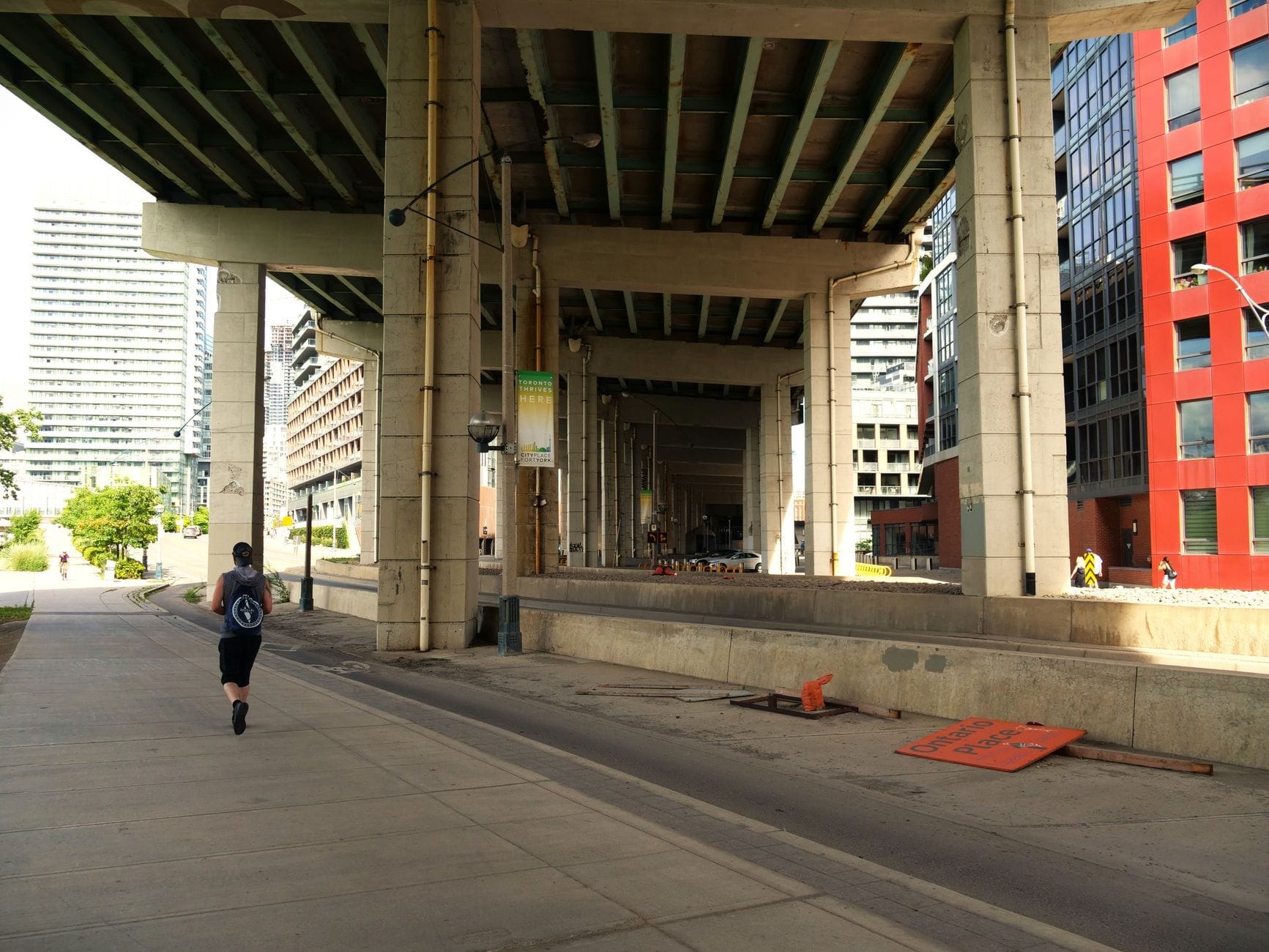
The Bentway is a 1.75 km public trail and event space built beneath the Gardiner Expressway, running roughly between Strachan Avenue and Bathurst Street in Toronto's waterfront district. Launched in November 2015 as Project: Under Gardiner, it opened its first phase in 2018, transforming what had long been a dark, neglected strip of pavement under a highway into more than four hectares of active public space.
The project takes its name from the structural 'bents' of the Gardiner: the concrete column-and-beam frames that hold the expressway overhead. Around 55 of these bents define a series of distinct 'civic rooms' along the route, each with slightly different character, sight lines, and programming possibilities. It is, in essence, a linear park divided by concrete architecture that most people spent decades ignoring.
The Bentway sits within a broader network of waterfront improvements near Fort York and connects directly to Canoe Landing Park. The organization operates a Studio at 55 Fort York Blvd and runs year-round programming that ranges from winter skating to outdoor film screenings and large-scale art installations.
💡 Local tip
The Bentway's outdoor public areas are accessible at all times, free of charge. No ticket or registration is needed to walk or cycle the trail. Check thebentway.ca before visiting if you're interested in attending a specific event or using the skate trail, as programming has seasonal hours.
Walking the Trail: What You Actually See
The experience of walking The Bentway is genuinely unlike any other trail in Toronto. You are always aware of the highway above: the rumble of traffic overhead is constant, somewhere between ambient noise and mild industrial percussion. The underside of the Gardiner is not prettified or hidden. Exposed concrete, steel joints, and drainage infrastructure are all visible, and that industrial frankness is part of the appeal for visitors who appreciate adaptive reuse over decorative concealment.
The path itself is paved and level, making it accessible for strollers, wheelchairs, and cyclists. Along the route you'll pass open plazas suitable for events, stretches of public art installations that rotate seasonally, and quieter segments where the sound of nearby Fort York and the surrounding neighbourhood filters in from the edges. The concrete bents overhead create a rhythmic visual structure: each one frames a different view out to the street or green space beyond.
The trail connects to Canoe Landing Park to the west and extends toward Exhibition GO Station, giving it real utility as a commuter and leisure route, not just a destination in itself. In summer months, cyclists use it to cut through the area without competing with car traffic. Joggers tend to appear early in the morning, when the traffic noise overhead is lower and the light along the edges of the underpass is at its best.
Tickets & tours
Live prices and dates from our booking partner. If you book, we may earn a commission at no extra cost to you.
Toronto Old Town: Dark Side Exploration Game and Tour
From 12 €Instant confirmationFree cancellationLEGOLAND Discovery Centre Toronto tickets
From 16 €Instant confirmationFree cancellationToronto 'Little Canada' entrance tickets
From 27 €Instant confirmationFree cancellationNiagara Falls evening tour with boat, dinner and Illumination Tower
From 77 €Instant confirmationFree cancellation
The Winter Skate Trail: The Bentway at Its Most Distinctive
For many Torontonians, The Bentway's winter skate trail is the defining reason to visit between December and March. The trail winds beneath the Gardiner's bents in a narrow serpentine loop, lit at night with warm overhead lighting that reflects off the ice and gives the industrial setting an unexpectedly atmospheric quality. Skating here feels nothing like skating at Nathan Phillips Square or an arena: the combination of low ceilings, concrete columns, and open edges creates an enclosed but outdoor experience.
For the 2025/26 season, the trail operates from December 20 through approximately March 1. Hours vary across the season: daily operation from 12:00 to 21:00 during the holiday period (December 20 to January 4), with adjusted hours after that. Skate rentals are available on-site. Adult skate rentals are CAD $12.99; youth skates are CAD $12; helmet-only rentals are CAD $5. The ice surface itself is free to use.
⚠️ What to skip
Skating hours and rental prices change each season. Verify current hours and pricing at thebentway.ca/event/winter-skating before planning a winter visit. The trail is weather-dependent and may close temporarily during heavy thaw or maintenance periods.
Weekend evenings, particularly between 6:00 and 9:00 pm, draw the largest crowds: families with children, couples, and groups who treat it as a social outing rather than athletic exercise. If you want quieter ice, arrive on a weekday afternoon. The ambient highway noise actually recedes somewhat in winter when you're focused on the ice and the light, and the experience is more meditative than you'd expect given the setting.
Time of Day and Seasonal Character
The Bentway changes considerably depending on when you visit. Early mornings on weekdays are the quietest: dog walkers, commuter cyclists, and the occasional runner moving through on their way to the lakefront. The light in summer comes in low from the east and west ends of the underpass, creating long shadow lines across the paved surface. The air under the expressway smells faintly of concrete and exhaust in warm weather, which is honest rather than pleasant, though it fades quickly in a breeze.
Midday in summer is when programming and casual visitors overlap. If there's a pop-up market, outdoor art opening, or community event scheduled, it will typically run from late morning through the afternoon. The space handles events well because the overhead structure provides partial shade even in July heat, and the open sides allow airflow.
Evening visits in fall, when the event calendar is still active but the summer crowds have thinned, offer some of the most interesting encounters with the space. The lighting under the Gardiner transitions from natural to artificial in a way that makes the concrete bents look quite striking. For photographers, the repeating column geometry offers strong compositional opportunities at any hour, but particularly at dusk when the contrast between the lit underpass and the darkening sky outside creates distinct depth.
The Bentway is part of the broader transformation of Toronto's waterfront. If you're exploring the area, the trail connects logically to a walk along the Martin Goodman Trail and to Fort York National Historic Site to the north, which provides valuable historical context for this entire stretch of the city.
History and Architectural Context
The Gardiner Expressway was built between 1955 and 1966, cutting the city off from its lakefront for decades. The section above The Bentway runs east-west through what is now an intensely redeveloped part of the waterfront, bordered by new condominium towers and the historic Fort York to the north. For most of the Gardiner's existence, the space beneath it was a no-man's land: used for parking, storage, or simply avoided.
The idea of activating this space emerged through Waterfront Toronto's long-term lakefront revitalization work, with the project launching formally in 2015 and Bentway 1.0 opening in 2018. The design approach, led by landscape architecture firm PUBLIC WORK, was deliberately non-interventionist in one key respect: the Gardiner's structure was left visible and legible rather than decorated or disguised. The concrete bents, which gave the project its name, became the organizing architectural logic of the entire space.
Understanding the Gardiner debate helps contextualize The Bentway's existence. Toronto spent years debating whether to tear down, rebuild, or simply maintain the elevated highway. The Bentway's success has become part of the argument that the space below can be activated regardless of what happens above. For more on how this fits into Toronto's broader urban landscape, the Toronto waterfront guide covers the full scope of waterfront redevelopment from the Islands to the Port Lands.
Practical Information for Visitors
Getting to The Bentway by public transit is straightforward. The trail connects directly to Exhibition GO Station via a 500-metre path, making it accessible on GO Transit from Union Station. TTC routes on Bathurst Street and Fort York Boulevard also serve the area. The core entrance at Strachan Gate (250 Fort York Blvd) is where the skate trail and washroom facilities are located.
Washrooms at 250 Fort York Blvd are open seasonally, typically Monday to Friday, 11:00 to 17:30 starting in late April. During the winter skating season, the facilities have extended access aligned with skating hours. Outside of those periods, plan accordingly before arriving.
For cycling visits, The Bentway is part of a connected multi-use trail network. Bike parking is available near the main entrances. The paved surface handles most standard bicycles without difficulty, and the flat grade makes it suitable for families with cargo bikes or trailers.
ℹ️ Good to know
The Bentway Studio at 55 Fort York Blvd (Canoe Landing Park) serves as the organization's programming and administrative hub. It is where some indoor events and workshops are hosted. Check thebentway.ca for the current events calendar before visiting, as programming varies significantly by season.
Photography: The repeating bent structure is the obvious compositional draw, and it rewards patience. Wide-angle shots looking down the length of the underpass work well in the morning when light enters from the east. In winter, the reflection of skate trail lighting on ice creates unusual low-light photography opportunities. The space is publicly accessible and no permits are required for personal or journalistic photography.
If you're combining The Bentway with a broader waterfront day, pair it with a visit to Harbourfront Centre to the east or walk south through Canoe Landing Park toward the Humber Bay Arch Bridge for a longer lakefront loop. The area is covered in the Toronto waterfront guide with route options for different time budgets.
Who Should Skip This Attraction
The Bentway is not for visitors who want a polished, curated experience. The Gardiner overhead is loud, the aesthetic is industrial, and there is no green canopy, lake view, or historic architecture in the conventional sense. If your priority is scenery, the lakefront paths to the south or High Park to the west will serve you better.
Visitors with young children who want a nature-focused outdoor experience will find more to engage them at Corktown Common or along the waterfront parks. The Bentway is at its best for those who appreciate urban design, adaptive reuse, and a slightly unconventional approach to public space.
Insider Tips
- The skate trail is quietest on weekday afternoons, typically between 1:00 and 4:00 pm, when school groups and evening visitors have not yet arrived. This is the best window for unhurried skating.
- Bring your own skates if you have them: the rental queue during peak weekend evenings can add 20–30 minutes to your arrival experience.
- The east-facing entrance near Strachan Gate catches the best morning light along the full length of the underpass. If you're photographing the space architecturally, arrive before 9:00 am in summer.
- The Bentway's events calendar includes programming that is not widely advertised outside of their own mailing list and social channels. Subscribe at thebentway.ca to catch outdoor film nights, art installations, and community markets that do not appear in mainstream tourism listings.
- In winter, the section closest to Strachan Gate tends to be slightly sheltered from wind compared to the more open western end near Bathurst. If it's a cold evening, start your skate from that end and adjust accordingly.
Who Is The Bentway For?
- Urban design and architecture enthusiasts who appreciate adaptive reuse of infrastructure
- Winter visitors looking for a skating experience beyond the standard rink
- Cyclists and joggers wanting a protected, car-free route through the waterfront area
- Families with older children interested in art events and outdoor programming
- Photographers drawn to industrial geometry, strong repeating lines, and unusual light conditions
Nearby Attractions
Other things to see while in Toronto Waterfront:
- BMO Field
BMO Field at Exhibition Place is Toronto's premier outdoor soccer stadium, home to Toronto FC and the Toronto Argonauts. Originally built in 2007 and expanded since, it will serve as a FIFA World Cup 2026 venue. Here is everything a first-time visitor needs to know before heading to a match or event.
- Budweiser Stage
Formerly known as Budweiser Stage, the RBC Amphitheatre is a major outdoor concert venue on the Lake Ontario waterfront at Ontario Place. With a capacity of around 16,000, it draws major international acts from May through October each year. Here is everything you need to know before attending a show.
- Exhibition Place
A 192-acre event and heritage campus on Toronto's western waterfront, Exhibition Place has anchored the city's civic and cultural life since 1879. Home to the Canadian National Exhibition, major concerts, trade shows, and several sports venues, the grounds offer free outdoor access year-round with a remarkable collection of early 20th-century buildings.
- Harbourfront Centre
Harbourfront Centre is a 10-acre arts and cultural campus on Toronto's waterfront, open year-round with free public access to outdoor spaces, plus ticketed performances, exhibitions, and events. It sits about a 15-minute walk from Union Station and offers a direct view across Lake Ontario.
Planning a trip? Discover personalized activities with the Nomado app.