Exhibition Place: Toronto's Lakefront Event Campus
A 192-acre event and heritage campus on Toronto's western waterfront, Exhibition Place has anchored the city's civic and cultural life since 1879. Home to the Canadian National Exhibition, major concerts, trade shows, and several sports venues, the grounds offer free outdoor access year-round with a remarkable collection of early 20th-century buildings.
Quick Facts
- Location
- Toronto's western waterfront, southwest of downtown along Lake Ontario
- Getting There
- TTC Exhibition Loop (streetcar/bus); GO Transit Exhibition Station on the Lakeshore West line
- Time Needed
- 1–3 hours for a grounds walk; full day during major events like the CNE
- Cost
- Outdoor grounds free year-round; ticketed admission required for individual events and venues
- Best for
- Architecture walkers, event-goers, waterfront strollers, families during the CNE
- Official website
- www.explace.on.ca
What Is Exhibition Place?
Exhibition Place is a 192-acre event campus on the north shore of Lake Ontario, just west of Toronto's downtown core. Established in 1879, it is one of North America's oldest continuously operating exhibition grounds. The site is administered by the Board of Governors of Exhibition Place, an agency of the City of Toronto, and functions as a hybrid: part public greenspace, part major-events venue, part architectural heritage site.
On any given weekday outside of major events, the grounds are genuinely quiet. You can walk the broad tree-lined avenues between pavilions, read the historical plaques, and have the place almost to yourself. Then, during the Canadian National Exhibition each August, or on a Saturday night when a stadium concert is underway at Budweiser Stage, the same grounds draw tens of thousands of people. Understanding this contrast is key to getting the most from a visit.
💡 Local tip
The outdoor grounds are free to enter year-round. You only need a ticket when attending a specific event or entering a paid venue. For casual architectural walks or waterfront access, no admission is required.
History and Architecture Worth Noticing
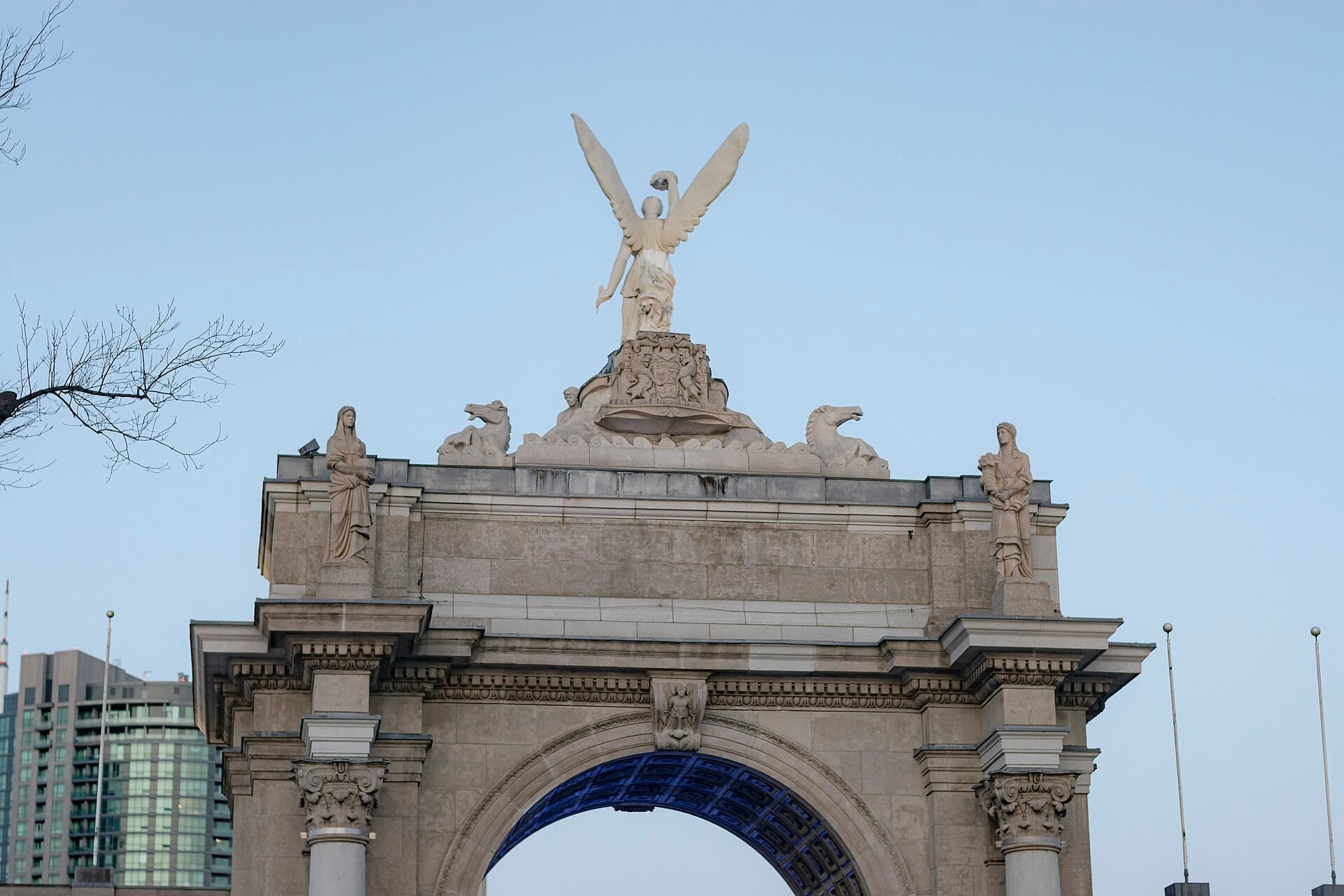
The grounds were developed progressively from the late 19th century through the 1920s and 1930s, and several of the major pavilions reflect the Beaux-Arts and Art Deco civic confidence of those eras. The Princes' Gates, formally opened in 1927 to commemorate the Diamond Jubilee of Confederation, stand at the eastern entrance and remain one of the most photographed structures on the waterfront. The triumphal arch form, topped by the figure of Winged Victory, sets an appropriately grand tone for a site built to celebrate Canadian industry and culture.
The Automotive Building, completed in 1929, is a particularly fine example of the period's commercial-civic architecture. Its scale and ornamental detailing are easy to miss if you're simply passing through, but standing at the foot of its main facade gives a clear sense of the ambition behind these structures. The building continues to host large-scale exhibitions and consumer shows throughout the year.
Alongside these heritage structures, the site also contains more modern additions including the Enercare Centre (a large convention facility), BMO Field (the home stadium of Toronto FC and the Toronto Argonauts), and Budweiser Stage, one of the city's major outdoor concert venues. The coexistence of 1920s stone pavilions and modern stadium infrastructure gives the site an unusual, layered quality that rewards a slow walk.
For visitors who want to understand how Toronto's architectural heritage extends beyond the downtown core, pairing a visit here with the broader waterfront trail systemToronto architecture guide provides useful context.
Tickets & tours
Live prices and dates from our booking partner. If you book, we may earn a commission at no extra cost to you.
Toronto Old Town: Dark Side Exploration Game and Tour
From 12 €Instant confirmationFree cancellationLEGOLAND Discovery Centre Toronto tickets
From 16 €Instant confirmationFree cancellationToronto 'Little Canada' entrance tickets
From 27 €Instant confirmationFree cancellationNiagara Falls evening tour with boat, dinner and Illumination Tower
From 77 €Instant confirmationFree cancellation
The Canadian National Exhibition: What to Expect
The Canadian National Exhibition (CNE), held annually at Exhibition Place across the final two to three weeks of August, is one of the largest annual fairs in North America. Since its founding in 1879, it has served as both a showcase for agriculture and industry and, over the decades, an entertainment event with rides, food vendors, a midway, live performances, and air shows. For many Torontonians, attending the CNE is a late-summer ritual that marks the unofficial end of summer.
The CNE is separately ticketed from the grounds themselves. Admission prices, discount days, and specific programming are published annually on the CNE's own website and change each year, so check directly before planning a visit. Crowds are significant on weekends, particularly in the final days before Labour Day; weekday mornings offer a noticeably calmer experience if you want shorter lines and easier navigation.
ℹ️ Good to know
The CNE food building is a genuine institution. New deep-fried novelty foods debut here every year and generate considerable media coverage. Arrive hungry if you go. The International Building, running the length of the central grounds, is where most cultural showcases and consumer exhibits are concentrated.
Outside of the CNE period, Exhibition Place hosts a continuous rotation of trade shows, consumer expos, sporting events, and cultural festivals. The schedule spans the full calendar year. Checking the events page at explace.on.ca before visiting is the most reliable way to know what is on any given week.
The Grounds as a Waterfront Walk
One underappreciated aspect of Exhibition Place is its position within the broader Toronto waterfront. The site's southern edge fronts Lake Ontario, and from there the waterfront path connects westward to Humber Bay and eastward along the lakeshore toward the central harbourfront. This makes Exhibition Place a logical stop on a longer waterfront walking or cycling route.
The Martin Goodman Trail runs along the waterfront just south of the grounds, connecting the site to a broader 56-kilometre recreational corridor. If you arrive by bicycle from the east, passing through the Exhibition grounds is a natural way to break up a longer waterfront ride. The combination of open space, tree cover, and relative quiet outside of event days makes it a pleasant rest stop.
Just west of the site, the Humber Bay Arch Bridge and Humber Bay Park provide additional lakefront destinations for those continuing the walk. For a full picture of what Toronto's waterfront has to offer, the Toronto waterfront guide covers the full stretch from the eastern beaches to the Humber River.
Getting There and Moving Around the Site
Exhibition Place is straightforward to reach by public transit. GO Transit's Lakeshore West line stops at Exhibition Station, which deposits you at the western edge of the grounds. From downtown, TTC streetcars and buses serve the Exhibition Loop at the eastern entrance near the Princes' Gates. Travel time from Union Station is typically under 15 minutes by transit in normal conditions.
Driving to Exhibition Place during major events like the CNE or a BMO Field match is not recommended. Parking exists on site but fills quickly, and Lake Shore Boulevard West becomes congested before and after large events. Transit is substantially faster under those conditions. Outside of major events, parking is generally available without difficulty.
The grounds themselves are flat and walkable, with wide paved avenues connecting the major buildings. Accessible routes connect all principal venues. During large events, wayfinding signage is deployed throughout the site; on quiet days, the grid layout of the central avenues is easy to navigate without a map.
⚠️ What to skip
On CNE days and during large concerts at Budweiser Stage, Lake Shore Boulevard West can back up significantly from around 5 PM onward. If you're arriving for an evening event, build in extra time or arrive early. GO Transit's Exhibition Station is the most reliable option for avoiding traffic delays.
Photography, Timing, and Practical Details
For architectural photography, the Princes' Gates photograph well in the late afternoon when the western light catches the limestone facade. The main avenue running west from the gates, lined with heritage pavilions, works best in the morning before shadows from adjacent buildings become harsh. On event-free weekdays, you can set up a composition without crowds or security restrictions.
Winter visits have their own character. The site is snow-cleared and accessible, and the heritage buildings read differently against a grey winter sky. The Ontario winter brings temperatures that can fall below -5°C, so dress accordingly if you plan to spend time photographing or walking outdoors. The grounds are at lake level, which means wind off Lake Ontario can make it feel colder than the ambient temperature suggests.
Visitors with limited mobility will find the central grounds largely accessible, with paved surfaces throughout the main event areas. Individual venues vary in their internal accessibility provisions; contacting the specific event or venue in advance is the most reliable way to confirm details.
Who Might Want to Skip This
Exhibition Place is not a compact attraction with a clear narrative beginning and end. If you are working through a tight two-day Toronto itinerary focused on museums, the waterfront islands, and the major downtown landmarks, this site may not compete with alternatives. On a day with no particular event scheduled, the grounds offer atmosphere and architecture but not a programmed visitor experience.
Visitors primarily interested in nature and green space will find High Park or the Toronto Islands more rewarding. Those focused on contemporary culture or nightlife have more concentrated options elsewhere. Exhibition Place rewards the curious walker with an interest in urban history, large-scale events, or the evolution of Toronto's waterfront rather than the traveler looking for a single defining experience.
Insider Tips
- The Princes' Gates are often overlooked as a photography subject because most visitors enter the site by transit from the west. Walk around to the eastern entrance specifically to see the gates from the outside, facing Lake Shore Boulevard, for the most dramatic angle.
- GO Transit's Exhibition Station on the Lakeshore West line is often faster from Union Station than the TTC options during peak event times, and the platform deposits you directly on the western edge of the grounds with no street crossing required.
- During the CNE, discount admission days (historically including a seniors day, a kids day, and select weekday mornings) can significantly reduce entrance costs. These are announced annually on the CNE website, not through Exhibition Place's own pages.
- If you visit during a non-event period, the area immediately south of the Automotive Building and along the internal avenues offers genuinely quiet urban walking with good architectural detail. Few tourists and no queues.
- The site connects directly to the Martin Goodman Trail on its southern side. Cyclists can enter the grounds from the trail, lock bikes at pavilion racks, and explore on foot without navigating Lake Shore Boulevard.
Who Is Exhibition Place For?
- Visitors attending a specific event: the CNE, a TFC match at BMO Field, a major trade show, or a concert at Budweiser Stage
- Architecture and urban history enthusiasts interested in Toronto's early 20th-century civic buildings
- Waterfront walkers and cyclists using the Martin Goodman Trail corridor
- Families visiting Toronto in August who want the full CNE experience
- Travelers building a longer waterfront itinerary that connects Humber Bay to Harbourfront
Nearby Attractions
Other things to see while in Toronto Waterfront:
- BMO Field
BMO Field at Exhibition Place is Toronto's premier outdoor soccer stadium, home to Toronto FC and the Toronto Argonauts. Originally built in 2007 and expanded since, it will serve as a FIFA World Cup 2026 venue. Here is everything a first-time visitor needs to know before heading to a match or event.
- Budweiser Stage
Formerly known as Budweiser Stage, the RBC Amphitheatre is a major outdoor concert venue on the Lake Ontario waterfront at Ontario Place. With a capacity of around 16,000, it draws major international acts from May through October each year. Here is everything you need to know before attending a show.
- Harbourfront Centre
Harbourfront Centre is a 10-acre arts and cultural campus on Toronto's waterfront, open year-round with free public access to outdoor spaces, plus ticketed performances, exhibitions, and events. It sits about a 15-minute walk from Union Station and offers a direct view across Lake Ontario.
- Humber Bay Arch Bridge
The Humber Bay Arch Bridge spans the mouth of the Humber River along Toronto's Lake Ontario waterfront, connecting the Martin Goodman Trail across a graceful double-ribbed steel arch. Free to access at any hour, it offers some of the city's most dramatic skyline views and carries quiet but significant cultural meaning in its design.
Planning a trip? Discover personalized activities with the Nomado app.