Tempio di Antas: Sardinia's Most Dramatic Roman Sanctuary
Rising from a wooded valley in the Sulcis-Iglesiente hills, the Tempio di Antas is one of Sardinia's most evocative archaeological sites. A Roman-period temple built over layers of Nuragic and Carthaginian worship, it stands largely intact among centuries-old holm oaks, offering a rare sense of genuine antiquity well away from the island's coastal crowds.
Quick Facts
- Location
- SS 126 km 54,100, Località Antas, Fluminimaggiore, Sud Sardegna
- Getting There
- Car only: SS 130 from Cagliari to Iglesias, then SS 126 to km 54,100; signed turn leads ~3 km to the site
- Time Needed
- 1.5 to 2.5 hours including the walk from the car park
- Cost
- Full price €6; reduced and combined tickets available. Verify current prices before visiting.
- Best for
- Archaeology enthusiasts, history travellers, photographers, hikers combining with Porto Flavia
- Official website
- startuno.it/tempio-di-antas
What Is the Tempio di Antas?
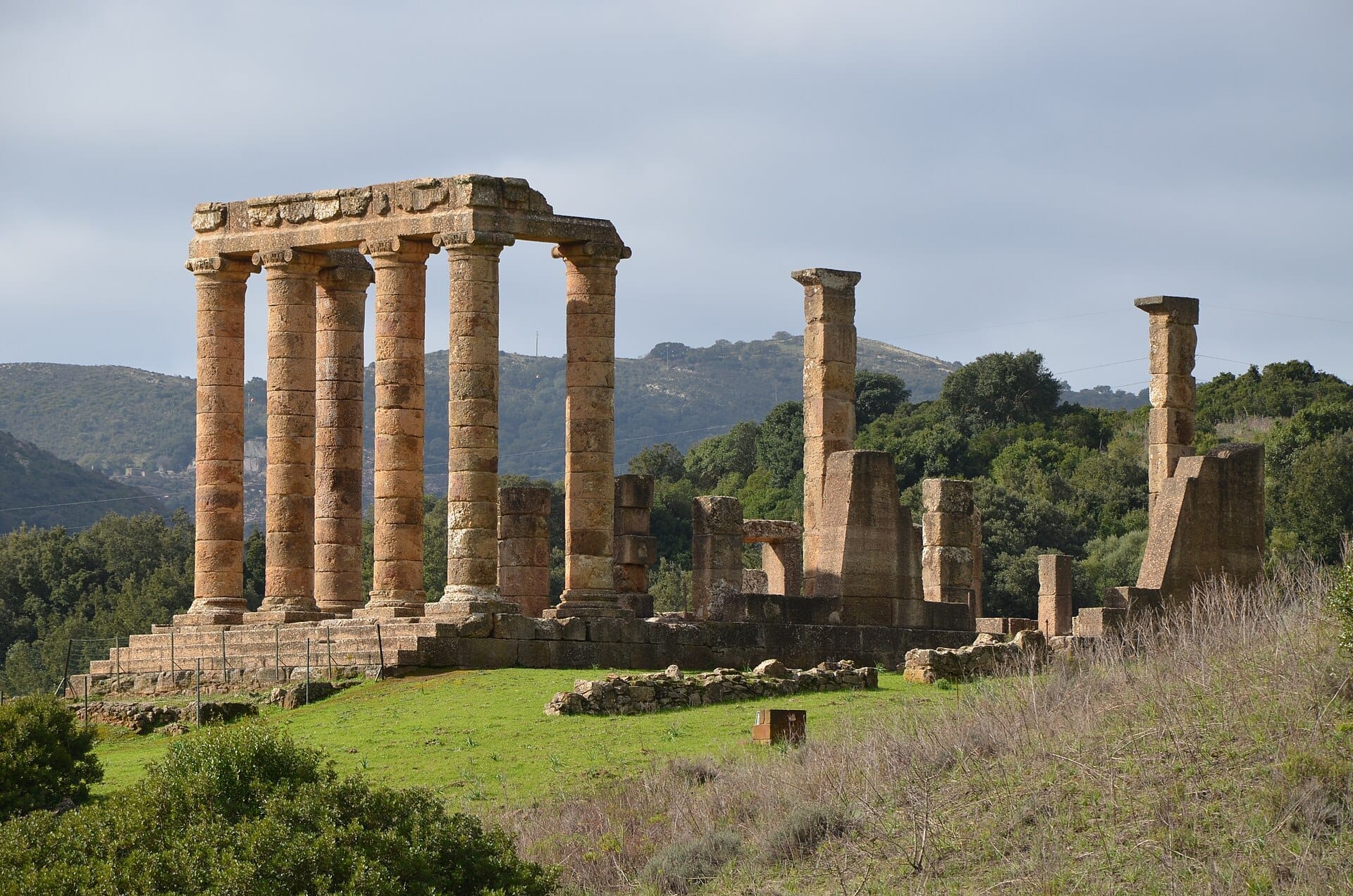
The Tempio di Antas is a Roman-period sanctuary located in a narrow valley in the Sulcis-Iglesiente mountains of southwest Sardinia, about 10 kilometres from the small town of Fluminimaggiore. It is not a ruin in the usual sense: four Ionic columns still stand upright beneath a partial entablature, the steps leading to the pronaos are intact, and the overall silhouette of the structure is immediately legible. That degree of preservation, in a setting surrounded by ancient holm oaks and maquis scrub, makes it one of the most visually arresting archaeological sites on the island.
What makes the site significant is not just its Roman shell but the layered history beneath it. Archaeological evidence shows that the valley was already a place of ritual during the Nuragic period, long before Carthaginian settlers formalised worship here, and long before Rome rebuilt the sanctuary in the Imperial era and dedicated it to Sardus Pater, a deity identified with the mythical ancestor of the Sardinian people. Three distinct civilisations, over roughly fifteen centuries, considered this particular valley sacred.
💡 Local tip
The site is signed from SS 126 at kilometre marker 54,100. A paved road, suitable for both cars and coaches, leads approximately 3 kilometres from the main road to the ticket office and car park. Do not rely on GPS alone; follow the brown archaeological signs.
The Archaeology: Three Civilisations in One Valley
The earliest evidence of use dates to the Nuragic period, suggesting the valley held religious significance for Sardinia's Bronze Age inhabitants well before any Mediterranean colonial presence. Carthaginian settlers later established a formal sanctuary here, likely between the 5th and 4th centuries BCE, worshipping a deity scholars associate with a Semitic father-god figure. Votive objects, inscriptions, and architectural fragments from this phase have been recovered during excavations.
The structure visitors see today is essentially Roman, built in the early Imperial period over the Carthaginian foundations. It follows a tetrastyle plan: four columns across the front facade, a rectangular cella, and a raised podium reached by a broad frontal staircase. The columns are Ionic, a relatively unusual choice for a provincial Roman sanctuary, and their fluted shafts show the quality of craft that Rome invested in this remote site. The temple was dedicated to Sardus Pater Babai, a Romanised version of the indigenous deity, revealing the typical Roman strategy of absorbing rather than erasing local cults.
The temple was excavated and substantially restored between 1966 and 1968. That restoration work, while necessary to prevent further collapse, means some visitors will note the difference between original Roman stonework and later consolidation. For those wanting the broader context of Sardinia's pre-Roman religious world, the sacred well of Santa Cristina near Oristano and the nuraghe complex at Barumini offer complementary perspectives on Nuragic spiritual architecture.
Tickets & tours
Hand-picked options from our booking partner. Prices are indicative; availability and final rates are confirmed when you complete your booking.
Catamaran excursion to La Maddalena from Santa Teresa di Gallura
From 118 €Instant confirmationFree cancellationQuad biking tour from Santa Teresa di Gallura
From 0 €Instant confirmationFree cancellationSanta Teresa di Gallura hiking tour of Valle della Luna
From 30 €Instant confirmationFree cancellationSailboat trip to Maddalena archipelago from Santa Teresa Gallura
From 167 €Instant confirmationFree cancellation
What It Feels Like to Visit
From the car park, a short path through Mediterranean scrub leads down toward the valley floor. The temple does not appear until you round a bend in the trail, at which point it emerges suddenly between the trees: four columns against a hillside backdrop, the stone warm-coloured and solid, the scale more intimate than photographs suggest. The approach is theatrical, even if it is entirely accidental.
The immediate surroundings are quiet in a way that few Sardinian archaeological sites manage. There is only a small chiosco bar and ticket/bookshop at the entrance rather than a strip of food stalls or souvenir stands, and on weekday mornings in spring or autumn you may have the entire area to yourself for stretches of an hour or more. The silence is punctuated by birdsong and, if there has been rain recently, the sound of water from a small stream running through the valley. The stone underfoot is uneven in places, and the path around the temple perimeter is not paved, so footwear with some grip is appropriate.
In midsummer, the valley can become hot by late morning. The tree cover offers some shade along the approach path, but the area immediately around the temple is exposed. Visiting before 10:00 or after 17:00 in July and August makes the experience significantly more comfortable. In spring, particularly April and May, the surrounding scrub flowers and the whole valley carries the scent of cistus and wild rosemary, which is arguably the best time to visit from a purely sensory point of view.
Opening Hours and Tickets (check official site for seasonal changes)
The site operates on a seasonal timetable. During July, August, and early September, opening hours run daily from 09:30 to 19:30, with closing at 18:30 from 16 September. From April through June and again in October, the hours are 09:30 to 17:30 daily. In November the site is closed on Mondays and Tuesdays; it opens Wednesday to Friday from 10:00 to 14:00 and Saturday and Sunday from 09:30 to 16:30. From December through February it opens Friday from 10:00 to 14:00 and Saturday and Sunday from 09:30 to 16:30. In March it is closed on Mondays and open Tuesday to Friday from 10:00 to 14:00 and Saturday and Sunday from 09:30 to 16:30. The site is closed on 25 December. On 1 January it opens with reduced hours of 10:30 to 16:30.
⚠️ What to skip
Full admission is €6; reduced and combined tickets are also available. A combined ticket with the Antico Mulino ad Acqua Licheri is offered on some days — verify the current tariff on the official site (startuno.it/tempio-di-antas) or by calling ahead, particularly in low season when staffing may be reduced.
Guided visits are available by reservation in some periods. If you want contextual interpretation of the Carthaginian and Nuragic layers, a guide is strongly recommended: the site itself has limited on-site interpretive panels, and the architectural distinctions between historical phases require explanation to read clearly.
Getting There and Planning Your Day
The Tempio di Antas is not served directly by public transport to the site itself. A car is essential. From Cagliari, the most direct route follows the SS 130 westward to Iglesias, then the SS 126 north toward Fluminimaggiore. The turn for the site is signed at kilometre marker 54,100; from there, a paved road descends into the valley for approximately 3 kilometres to the ticket office and parking area. The drive from Cagliari takes around 90 minutes under normal conditions.
The southwest coast combines well with the Tempio di Antas for a full-day itinerary. The coastal mine viewpoint at Porto Flavia is approximately 20 kilometres away on the SS 126, and the dramatic sea stacks of Pan di Zucchero near Masua are visible from the same coastal road. The archaeological site at Nora is a longer detour toward Cagliari, but fits a more dedicated archaeological day.
There are no restaurants or cafes at or immediately adjacent to the site. Fluminimaggiore village, a few kilometres away, has basic facilities. Bring water, especially in summer, and pack a snack if you are combining the visit with outdoor exploration in the valley.
Photography and Practical Notes
The temple faces roughly south-east, which means morning light still strikes the columns frontally, making the first two hours after opening the most rewarding time for photography. By midday the light is flat and harsh. Late afternoon, when the sun drops toward the hills to the west, creates strong side-lighting on the column shafts that brings out the texture of the stone.
The site is small enough to explore thoroughly on foot in under an hour, but the valley and its immediate surroundings reward slower exploration. The stream bed, the old tree roots near the temple perimeter, and the view back toward the columns from the hillside above all offer perspectives that the central axis photograph does not capture. A wide-angle lens handles the temple frontally with ease, but a short telephoto pulls interesting detail from the column capitals and the frieze fragments.
ℹ️ Good to know
Accessibility: The approach path from the car park is mostly unpaved and mildly uneven. The temple podium is accessed by stairs. The site is not suitable for wheelchair users without assistance. Comfortable, closed-toe shoes are strongly recommended for all visitors.
Is It Worth the Detour?
Honestly, this depends on what you are looking for. Visitors with a genuine interest in Mediterranean archaeology will find the Tempio di Antas one of the most satisfying sites in Sardinia: the preservation is good, the setting is extraordinary, and the historical layering from Nuragic through Carthaginian to Roman is intellectually rich. The relative obscurity of the site compared to more marketed attractions in northern Sardinia means the experience is uncrowded and unhurried.
Travellers whose primary interest is beaches or scenic coast might find the inland detour hard to justify unless they are already driving through the Sulcis-Iglesiente region. In that case, the site makes obvious sense alongside the nearby coastal and mining heritage. For those constructing a broader itinerary around Sardinia's ancient past, the Nuragic sites guide sets this temple within a much larger pattern of sacred and defensive architecture across the island.
The one limitation worth stating plainly: the on-site interpretation is minimal. Without contextual knowledge or a guided visit, the significance of what you are looking at does not communicate itself automatically. A short read before you arrive, even a few paragraphs on Sardus Pater and the Carthaginian presence in southwestern Sardinia, will transform the experience from interesting to moving.
Insider Tips
- The valley around the temple is also appreciated by visitors for birdwatching, particularly in spring migration. Bring binoculars if you have them: short-toed eagles, hoopoes, and a variety of warblers use the wooded slopes.
- The combined ticket covering both the Tempio di Antas and the Antico Mulino ad Acqua Licheri (an old water mill nearby) represents good value if you have time for both. Ask at the ticket desk.
- If you arrive and find the gate closed outside of scheduled closure days, a phone number is typically posted at the entrance for the site management. It is worth calling: staff are sometimes on site even during informal closures.
- There is a stone cistern and the remains of a smaller structure slightly downhill from the main temple that most visitors walk past without stopping. These are associated with the Punic-Carthaginian phase of the sanctuary and are worth pausing over.
- The road from the SS 126 to the site is paved but narrow in sections. If you encounter a coach coming the other way, the passing places are obvious but require patience. Arriving early avoids the small peak of coach groups that sometimes appear around late morning in July and August.
Who Is Tempio di Antas For?
- Archaeology and ancient history enthusiasts who want depth over crowds
- Photographers seeking textured Roman stonework in a natural landscape setting
- Road-trippers driving the SS 126 coastal and inland route through southwest Sardinia
- Travellers combining cultural heritage with outdoor stops at Porto Flavia or Pan di Zucchero
- Families with older children interested in how different civilisations used the same sacred space
Nearby Attractions
Other things to see while in Sulcis & the Southwest Coast:
- Carloforte (Isola di San Pietro)
Carloforte is the sole inhabited centre on Isola di San Pietro, a small island off Sardinia's southwestern coast with a strikingly un-Sardinian character. Founded in 1738 by Ligurian settlers from Tabarka, it retains its own dialect, cuisine, and urban architecture — a place that rewards slow exploration rather than quick sightseeing.
- Costa Verde
Costa Verde is a 47-kilometre arc of coastline in the Comune di Arbus, in Sardinia's southwest, running from Capo Frasca to Capo Pecora. It holds some of the most remote beaches on the island, including Piscinas, where dunes reach up to 60 metres high, making it one of the largest dune systems in Europe. There are no entry fees, minimal resort infrastructure directly on the beaches, and no public transport. That combination is exactly why it rewards visitors who make the effort to get here.
- Is Zuddas Caves (Santadi)
Carved into 530-million-year-old Cambrian dolomite beneath Monte Meana, the Is Zuddas Caves near Santadi are among the most geologically significant showcaves in Sardinia. Guided tours of a flat 500-metre route reveal towering stalactites, aragonite helictites, and chambers that once served as an alabaster quarry before local speleologists rescued them for science and tourism in 1971.
- Isola di Sant'Antioco
Sant'Antioco Island sits off Sardinia's southwest coast, connected to the mainland by a bridge over an ancient isthmus. With roots stretching back to Phoenician colonizers in the 8th century BC, it pairs serious archaeology with quiet beaches, a still-functioning fishing port, and some of the least-crowded coastline in the region.