Nora Archaeological Site: Sardinia's Ancient City by the Sea
Nora is one of the oldest and best-preserved ancient cities in Sardinia, occupying a dramatic coastal promontory near Pula. Founded by the Phoenicians in the 8th century BC and later shaped by Carthaginian and Roman hands, it holds the earliest known written record of the name 'Sardinia' and preserves Roman mosaics, baths, streets, and a theatre that still faces the open Mediterranean.
Quick Facts
- Location
- Località Nora, 09010 Pula (SU), Sardinia — approx. 30 km southwest of Cagliari
- Getting There
- By car: SS195 from Cagliari toward Pula, then follow signs to Nora (30–35 min). By bus: ARST from Cagliari Piazza Matteotti to Pula, then local shuttle ('pollicino') to Nora (~10 min). No direct train.
- Time Needed
- 2–3 hours for the site alone; half a day if combining with the nearby beach and Pula town
- Cost
- Approx. €8 adults, €4.50 under-18, free under 6 (verify current prices on-site or via the official Direzione Regionale Musei Sardegna portal before visiting)
- Best for
- History enthusiasts, archaeology fans, travellers combining culture with coast
- Official website
- musei.sardegna.beniculturali.it/musei/10381
Why Nora Stands Apart from Other Ancient Sites
Most Roman ruins in the Mediterranean sit in dusty fields surrounded by fencing and signposts. The Nora Archaeological Site is different. It occupies the full length of a narrow rocky promontory that juts into the sea near Pula, roughly 30 kilometres southwest of Cagliari, so that at almost every turn, ancient stone is framed by blue water. You can stand in the cavea of the Roman theatre and watch waves break below the stage. You can trace a mosaic floor while a sea breeze moves through the grass between the column stumps. The combination of genuine historical depth and physical setting makes Nora one of the more rewarding archaeological experiences in Sardinia.
The site covers multiple civilisations in sequence: Phoenician foundations from the early 8th century BC, a Carthaginian city that developed from around the 6th century BC, and a substantial Roman municipium that flourished well into Late Antiquity. A small stele found here, dated to roughly the mid-8th century BC, contains the earliest known written appearance of the name 'Sardinia' in Phoenician script — making Nora not just important for local history, but for the documented history of the island as a whole. The stele itself is now housed in the Museo Archeologico Nazionale di Cagliari, where it is one of the collection's most significant objects.
💡 Local tip
Opening hours change by season and are published in Italian on the official Direzione Regionale Musei Sardegna page. Check before you travel — summer hours are typically longer, and the site sometimes closes earlier on weekdays outside peak season.
A Brief History: Three Civilisations on One Promontory
The Capo di Pula promontory attracted Phoenician traders because of its natural harbour potential — sheltered anchorage on multiple sides depending on wind direction. Settlement traces from the early 8th century BC place Nora among the earliest Phoenician foundations in the western Mediterranean. The Carthaginians consolidated and expanded the city from the 6th century BC onward, and it became an important node in the Punic trade network that linked North Africa, the Iberian coast, and the central Mediterranean islands.
Rome absorbed Sardinia in 238 BC following the First Punic War, and Sardinia et Corsica became a Roman province from 227 BC. Nora was recognised as a municipium in the early Imperial period, and it is the Roman layers that visitors see most clearly today: the street grid, the forum, the Terme (baths) with their preserved mosaic floors, the temple podiums, and the theatre. The city was occupied through the Vandal incursion of 455 AD and subsequent Byzantine rule, before gradual abandonment by around the 8th century AD. Today, a significant portion of the ancient city lies submerged in the shallow bay to the west of the promontory — a reminder that sea levels and coastlines have shifted over the fifteen centuries since Nora was last inhabited.
Tickets & tours
Hand-picked options from our booking partner. Prices are indicative; availability and final rates are confirmed when you complete your booking.
Excursion to the Archaeological site of Nora
From 70 €Instant confirmationFree cancellationGuided tour of Nora archaeological site from Cagliari
From 90 €Instant confirmationFree cancellationGuided tour through historical and archaeological sites of Olbia
From 78 €Instant confirmationFree cancellationSmall Group Tour to Su Nuraxi Unesco Site From Cagliari
From 90 €Instant confirmationFree cancellation
What You Actually See: Walking the Site
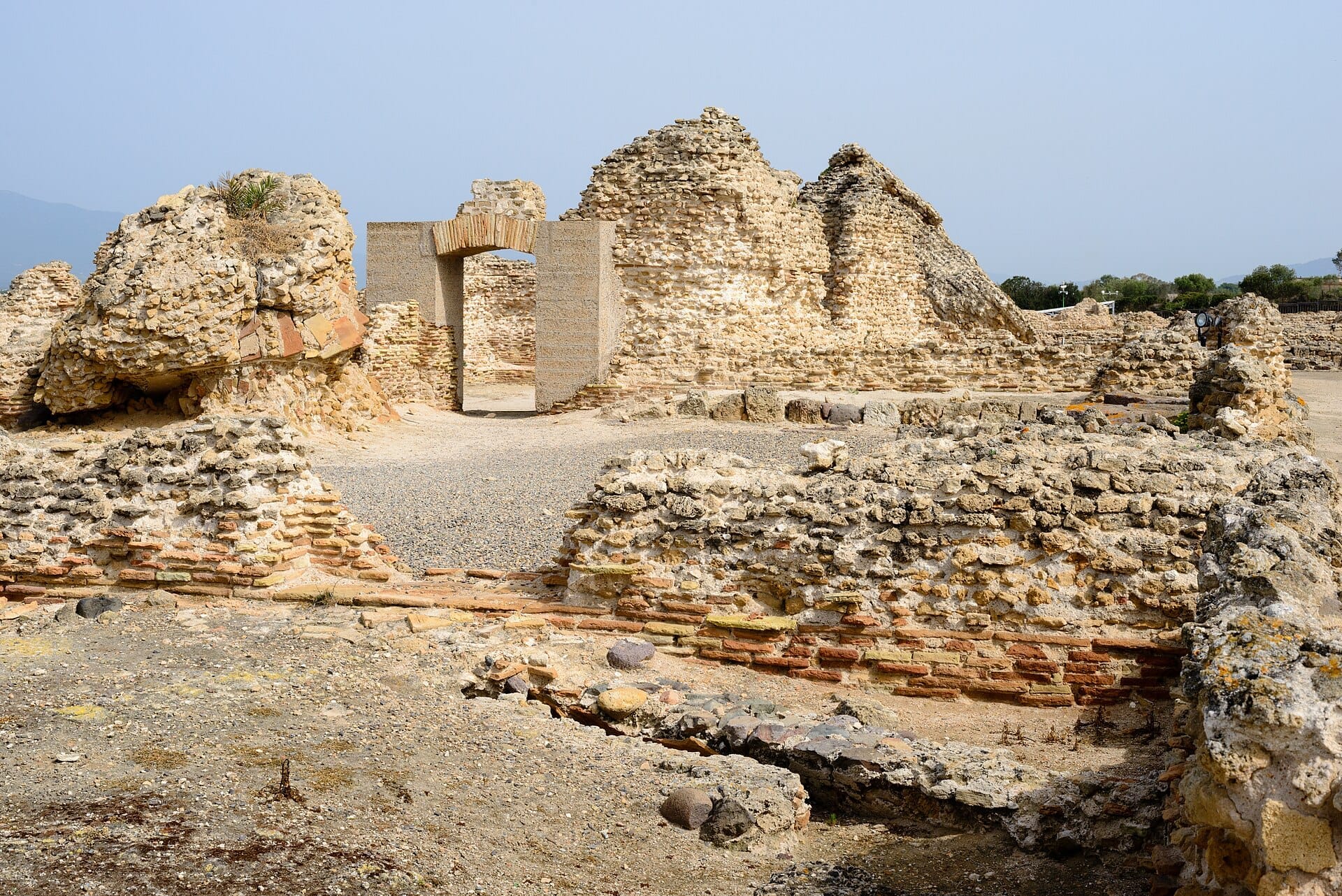
The entrance to the site is at the base of the promontory, a short walk from the small parking area near the beach of Torre del Coltellazzo. From the moment you step inside, the scale of what remains is striking. The paved Roman streets, wide enough for carts, run in clear directions, and the foundations of insulae (residential blocks) line them on both sides. You can follow the logic of urban planning even where the walls have fallen to ankle height.
The baths are the highlight for most visitors. Several rooms of the Terme di Levante retain intact or near-intact mosaic floors in black and white geometric patterns, some of the best-preserved Roman mosaics in Sardinia. Walkways guide you around them, and the request not to step on the mosaics is taken seriously by site staff. Look at the threshold strips and the variation in tessera size between decorative and functional zones — the craftsmanship is precise even in the utility areas.
The theatre sits at the far tip of the promontory. It is a Roman theatre of modest proportions, but its orientation means that the stage faces the water, and on clear days the horizon fills the background where a painted scaenae frons once stood. In July and August, the theatre is used for evening performances as part of the Estate Nora festival, which typically runs at night, lit by stage lights against the dark sea. The stage structure visible today is a partial reconstruction that helps visitors understand the original layout, though this is clearly marked.
Elsewhere on the promontory you will find the remains of two temples, sections of the forum, cisterns, and stretches of Punic-era walls that predate the Roman street grid. The Spanish Torre del Coltellazzo, a 16th-century watchtower at the tip of the headland, is visible from within the site and serves as an inadvertent timeline marker — it was built from salvaged ancient stone, and its presence underlines how long this promontory has been used and reused.
Time of Day: How the Experience Changes
Morning visits, especially before 10am, are noticeably quieter. The light is lower and more directional, which brings out texture in the stone pavements and throws the mosaic patterns into sharper relief. The sea in the bay to the west catches the early sun and the water reads a deep blue-green that turns milky white by midday. If photography is important to you, the first two hours after opening are the best window.
By late morning in July and August the site fills considerably. Tour groups arrive on a schedule, typically midmorning, and the theatre and baths become crowded. The open promontory offers little shade, and by noon the heat radiating from the ancient stone can be intense — temperatures in this part of Sardinia regularly exceed 30°C in summer and can reach 35°C or higher. A hat, sun cream, and water are not optional.
Late afternoon, from around 4pm onward, sees a second quieter window as day-trippers depart and the light softens again. The sea smell becomes more pronounced toward evening — salt, dried seaweed on the rocks below, the faint resinous scent of the macchia scrub that fills gaps between the ruins. This is when the site rewards slow walking more than rapid sightseeing.
⚠️ What to skip
There is almost no natural shade on the promontory. Wear sun protection regardless of the season, bring at least one litre of water per person, and wear closed shoes with grip — the ancient stone surfaces are uneven and can be slippery after rain.
Practical Walkthrough: Getting There and Getting In
The most straightforward approach is by car. From Cagliari, take the SS195 southwest toward Pula and Teulada. After roughly 30 kilometres, follow the brown archaeological signs toward Nora, which add another 3–4 kilometres past the town of Pula. The road ends near a small beach and parking area at Torre del Coltellazzo. Parking space is limited in summer and fills quickly by mid-morning in July and August — arriving by 9am will reliably secure a spot.
Without a car, take an ARST bus from Cagliari's Piazza Matteotti to Pula, then the local 'pollicino' minibus shuttle from Pula to Nora (approximately 10 minutes). Timetables vary seasonally and should be checked on the ARST website before travel. If you are basing yourself in Cagliari and want to combine Nora with other southwest coastal stops, the day trips from Cagliari guide covers practical routing options.
Admission is purchased at the ticket office near the entrance. Guided tours in Italian (and sometimes English) depart at set times — some visitor reports indicate that the ticket price includes a guided tour rather than independent entry; confirm this on arrival, as the format has varied over recent seasons. The guided tour takes approximately 90 minutes at a measured pace, covers the key structures with contextual commentary, and is worth taking if your Italian is serviceable or a multilingual guide is available.
Dogs are permitted on a lead. Pushchairs can manage parts of the site, but the ancient paving is uneven throughout and there are no smooth accessible routes across the whole promontory. Visitors with significant mobility limitations should contact the site in advance via the official museum portal to discuss what is practically accessible.
Combining Nora with the Surrounding Area
The beach immediately adjacent to the archaeological site, Spiaggia di Nora, is a calm sandy bay with shallow, clear water and is popular with local families. It makes a natural complement to a morning at the ruins. The town of Pula, 3–4 kilometres away, has a good selection of restaurants for lunch and a small archaeological museum that displays finds from the Nora excavations, providing context for what you see on the promontory. The broader southwest coast of Sardinia offers further ancient sites, dramatic coastal scenery, and beaches that see fewer visitors than the island's northeast.
If your interest in Sardinian antiquity extends further, the Sardinia nuragic sites guide covers the Bronze Age towers and complexes that predate the Phoenician settlement at Nora by several centuries. The nuraghe culture produced the megalithic structures scattered across the island's interior and coast, and pairing a Nora visit with a nuraghe site gives a more complete picture of the island's layered past.
Is It Worth the Trip?
Nora is not the most spectacular Roman site you will ever visit. The walls rarely stand above waist height, there are no triumphal arches or intact colonnaded streets, and a significant part of the ancient city is permanently underwater. Visitors who arrive expecting the scale of Pompeii or the visual drama of Segesta will be underwhelmed.
What Nora offers instead is rarity and authenticity: the chance to walk a Phoenician-Carthaginian-Roman city that has not been heavily reconstructed, in a coastal setting that makes the experience atmospheric rather than purely academic. The mosaics are among the finest in situ Roman floors in Sardinia. The historical continuity from the 8th century BC to the early medieval period is documented and visible in the stratigraphy of the ruins. And the Nora Stele connection gives the site an outsize significance for anyone interested in the documented history of the Mediterranean world.
Travellers who prefer curated museum displays to open-air ruins, who struggle with uneven ground and sun exposure, or who are travelling primarily for beaches rather than history may find two or three hours a long commitment. For those with even a moderate interest in antiquity, the site consistently rewards the visit.
Insider Tips
- The Pula Civic Museum (Museo Civico di Pula), a few kilometres from the site, holds finds from the Nora excavations including ceramics, glass, and jewellery from the Phoenician through late Roman periods. Visiting it before the archaeological site gives you a mental framework for what you are looking at on the promontory.
- If you visit in July or August, check whether the Estate Nora evening performance programme is running. Attending an outdoor event in the Roman theatre at night — lit against the sea — is a qualitatively different experience from the daytime archaeological visit.
- The western bay of the promontory has shallow, clear water with ancient submerged structures visible just below the surface. Snorkelling here (from the beach, outside the fenced site boundary) gives a sense of how much of the ancient city is now underwater.
- Early September is arguably the best time to visit: the light is still strong, the sea is warm for a post-visit swim, the tour groups have thinned noticeably, and the site staff are less rushed — which sometimes means more informal conversation about the excavations.
- The stone paving on the Roman streets can be highly reflective in direct midday sun and slippery after any rain. Sandals with grip or light walking shoes work better here than flat-soled footwear.
Who Is Nora Archaeological Site For?
- Archaeology and ancient history enthusiasts who want a site with genuine Phoenician, Carthaginian, and Roman layers
- Travellers combining culture with coast — the adjacent beach makes a full half-day easy to fill
- Photographers working in early morning light, when the site is quiet and the sea provides a clean background
- Families with children aged 8 and above who can engage with ruins and handle the walking distance
- Visitors based in Cagliari looking for a manageable and rewarding day trip on the southwest coast
Nearby Attractions
Other things to see while in Sulcis & the Southwest Coast:
- Carloforte (Isola di San Pietro)
Carloforte is the sole inhabited centre on Isola di San Pietro, a small island off Sardinia's southwestern coast with a strikingly un-Sardinian character. Founded in 1738 by Ligurian settlers from Tabarka, it retains its own dialect, cuisine, and urban architecture — a place that rewards slow exploration rather than quick sightseeing.
- Costa Verde
Costa Verde is a 47-kilometre arc of coastline in the Comune di Arbus, in Sardinia's southwest, running from Capo Frasca to Capo Pecora. It holds some of the most remote beaches on the island, including Piscinas, where dunes reach up to 60 metres high, making it one of the largest dune systems in Europe. There are no entry fees, minimal resort infrastructure directly on the beaches, and no public transport. That combination is exactly why it rewards visitors who make the effort to get here.
- Is Zuddas Caves (Santadi)
Carved into 530-million-year-old Cambrian dolomite beneath Monte Meana, the Is Zuddas Caves near Santadi are among the most geologically significant showcaves in Sardinia. Guided tours of a flat 500-metre route reveal towering stalactites, aragonite helictites, and chambers that once served as an alabaster quarry before local speleologists rescued them for science and tourism in 1971.
- Isola di Sant'Antioco
Sant'Antioco Island sits off Sardinia's southwest coast, connected to the mainland by a bridge over an ancient isthmus. With roots stretching back to Phoenician colonizers in the 8th century BC, it pairs serious archaeology with quiet beaches, a still-functioning fishing port, and some of the least-crowded coastline in the region.