Carloforte: Sardinia's Ligurian Island Town
Carloforte is the sole inhabited centre on Isola di San Pietro, a small island off Sardinia's southwestern coast with a strikingly un-Sardinian character. Founded in 1738 by Ligurian settlers from Tabarka, it retains its own dialect, cuisine, and urban architecture — a place that rewards slow exploration rather than quick sightseeing.
Quick Facts
- Location
- Carloforte, Isola di San Pietro, South Sardinia — approx. 7 km off the south‑western coast
- Getting There
- Ferry from Portovesme/Portoscuso or from Calasetta on Isola di Sant'Antioco
- Time Needed
- Half day for the town; a full day or overnight to explore the island properly
- Cost
- Free to walk the town; ferry ticket cost varies by operator and season — verify before travel
- Best for
- History enthusiasts, slow travellers, food lovers, off-season visitors
- Official website
- www.carloforteturismo.it
What Makes Carloforte Different
Most Sardinian coastal towns have roots stretching back through Nuragic settlements, Phoenician trading posts, and Roman occupation. Carloforte does not. The town was founded in 1738 on a uninhabited island, when King Carlo Emanuele III of Sardinia granted Isola di San Pietro to a community of coral fishermen from Tabarka, a small island off the Tunisian coast. These settlers were themselves originally from Pegli, near Genoa — which is why the language still spoken in Carloforte, known as Tabarchino, is a Ligurian dialect rather than Sardinian or Italian.
That layered origin — Ligurian roots, North African sojourn, Sardinian legal status — gives Carloforte a character that feels distinct. The street grid follows a different logic from mainland Sardinian towns, the painted facades have a faded Mediterranean-port quality, and the food is built around tuna in ways that predate the island's recent culinary fame. This is not a themed experience. It is a living town of around 6,000 residents that happens to have an unusual history.
ℹ️ Good to know
Carloforte is the only inhabited town on Isola di San Pietro. The island sits about 7 km off the south‑western coast of Sardinia and is part of the Sulcis archipelago, accessible only by ferry.
Getting There: The Ferry Crossing
There is no bridge or tunnel to Isola di San Pietro. The two ferry connections are from Portovesme (near Portoscuso) on the Sardinian mainland, and from Calasetta on the neighbouring Isola di Sant'Antioco. Both crossings are short — roughly 30 to 40 minutes — and are currently operated by Delcomar, though schedules and frequency change seasonally. Ferries run more often in summer; off-season crossings can be infrequent, so checking timetables in advance is essential.
Most visitors arrive by car, but there is little reason to bring one onto the island unless you plan to explore the wilder parts of the coastline. Carloforte's historic centre is entirely walkable, and the town is compact enough that a bicycle covers the main points of interest easily. Bicycle rentals are available near the harbour.
If you are travelling from Cagliari, the drive to Portovesme takes roughly 80 to 90 minutes. This makes Carloforte a natural candidate for a full-day trip from the regional capital, and it is often suggested in day trip itineraries from Cagliari. The road passes through the industrial outskirts of Carbonia and Portoscuso, which is not particularly scenic, but the landscape changes sharply once you are on the ferry.
⚠️ What to skip
Ferry schedules change significantly between summer and winter. Always verify times directly with SAREMAR or Delcomar before your visit, and factor in the last departure back to the mainland when planning your day.
Tickets & tours
Hand-picked options from our booking partner. Prices are indicative; availability and final rates are confirmed when you complete your booking.
Vineyard Guided Tour and 7 Wine Tasting in Palau
From 84 €Instant confirmationFree cancellationFull-Day Sailboat Tour in La Maddalena Archipelago from Cannigione
From 112 €Instant confirmationFree cancellationHiking excursion to the Devil's Saddle
From 35 €Instant confirmationFree cancellationExcursion to the Archaeological site of Nora
From 70 €Instant confirmationFree cancellation
Walking the Town: What You Actually See
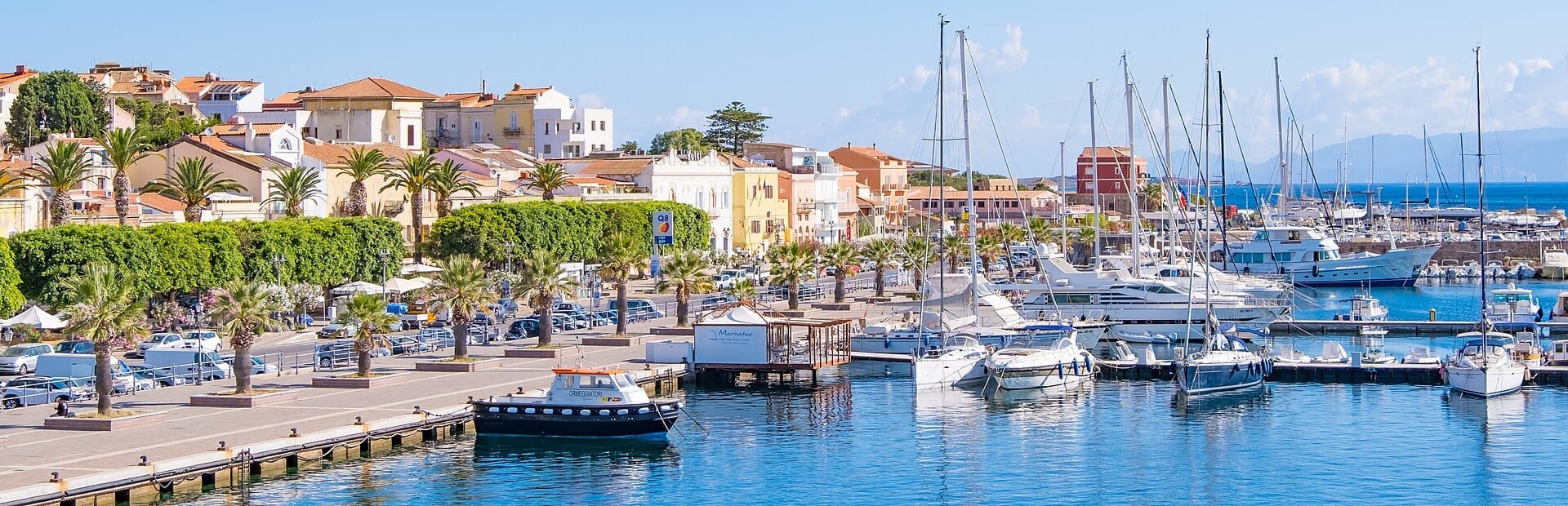
Carloforte's harbour front is the natural starting point. The lungomare is lined with fishing boats and small pleasure craft, backed by a row of trattorias and bars that animate from late morning onwards. In the early hours, the smell of coffee and diesel from outboard motors drifts together along the quay. By 10am in summer the waterfront fills with day-trippers from the ferries, but the narrow streets behind the harbour remain quiet for much of the morning.
Moving inland from the port, the caruggi — the term for the narrow alleyways inherited from Ligurian urban planning — slope upward through blocks of yellow and ochre buildings. Laundry is strung between windows. Cats occupy the steps of unremarkable doorways with complete authority. The architecture here is not monumental; there are no grand palaces or famous churches in the art-historical sense. The appeal is cumulative: the coherence of the urban fabric, the painted window frames, the sense that the settlement has aged on its own terms rather than for tourism.
The upper part of the town offers views back over the harbour and across to the Sardinian coast. The old defensive towers and the remains of the town's fortifications are visible from here, though they require no particular effort to find — Carloforte is small enough that wandering without a map is a reasonable strategy.
The Tuna Tradition and What to Eat
Isola di San Pietro was historically the site of a tonnara — a fixed tuna trap — and the island's identity remains inseparable from bluefin tuna. The mattanza, the traditional tuna hunt that once took place in late spring, has declined sharply as a commercial practice due to reduced tuna stocks, but the culinary tradition built around it survives intact. In Carloforte's restaurants, tuna appears in forms that go well beyond the grilled steak: tuna bottarga (cured roe), tuna in olive oil preserved in the old Tabarchino style, tuna heart, tuna stomach. This is nose-to-tail cooking applied to a fish.
The local cuisine also carries traces of the North African passage in the settlers' history. Cascà, a dish based on couscous, is considered a Carloforte speciality and is unlike anything else in standard Sardinian cooking. It is typically served at restaurants in the old town rather than the harbour-front places aimed at ferry traffic. Asking specifically for cascà, or for the catch-of-the-day preparations rather than the tourist menu, generally yields the best results.
Food is one of the stronger reasons to spend a full day on the island rather than passing through. For a broader context on what to eat across the island, the Sardinia food guide covers regional specialities including those of the southwest coast.
Beyond the Town: The Island's Coastline
Isola di San Pietro's coastline varies considerably depending on which direction you head from Carloforte. The eastern side of the island, facing the Sardinian mainland, is calmer and more sheltered, with small rocky inlets and a few sandy stretches. The western coast, exposed to the open sea and the prevailing winds, is rockier and more dramatic, with reddish cliffs and the lighthouse at Capo Sandalo marking the westernmost point of Italy.
The area around Capo Sandalo is particularly valued by birdwatchers during spring and autumn migration periods. The island sits on a migratory route, and Eleonora's falcons, a species that nests on Mediterranean islands, are known to be present during the summer months. The coastal path near the cape requires decent footwear rather than dedicated hiking equipment, but it is not a paved walk either.
The southwest of Sardinia has several other natural and coastal attractions within reach. The dramatic sea stack of Pan di Zucchero and the mining heritage site at Porto Flavia are both reachable from the same general area on the mainland. The wider context of the Sulcis and southwest coast makes this a productive area to base yourself for several days.
When to Visit and What Changes by Season
Carloforte in July and August is a different place from Carloforte in October. In high summer, the town is busy with Italian domestic tourists, the harbour bars stay open late, and finding a restaurant table for dinner without a reservation becomes difficult. The ferry queues at Portovesme can be long on summer weekends. The heat is significant — temperatures regularly reach 30°C or above — but the sea breeze on the island moderates things somewhat compared to inland Sardinia.
May, June, and September offer the most comfortable conditions. The water is warm enough to swim from late May onwards, the town is quieter, and the light at these times of year has a quality that photographers tend to prefer: longer mornings, softer evenings. September in particular sees the fishing activity increase again after the summer lull, and the harbour has more working character than it does in July when it is crowded with leisure boats.
Winter visits are possible but require realistic expectations. Some restaurants reduce hours or close entirely between November and March. The ferry still runs but less frequently. The town retreats to its actual self: residents, fishermen, and a very small number of visitors. The upside is complete freedom of movement through the streets, and a quality of quiet that the summer months do not offer.
For a fuller picture of seasonal conditions across Sardinia, the best time to visit Sardinia guide covers month-by-month considerations in detail.
Practical Notes for Visitors
Carloforte does not have a large hotel infrastructure compared to Sardinia's beach resorts, but there are several small hotels, bed-and-breakfasts, and holiday apartments in and around the town. Staying overnight is worth considering: the town is noticeably calmer after the day-trippers leave on the last afternoon ferry, and the evening passeggiata along the harbour is one of the more pleasant social rituals on the island.
The town centre is walkable and largely flat along the waterfront, though the upper streets involve uphill gradients on uneven paving. Cobblestones and stepped alleyways can present challenges for pushchairs or wheelchairs; the harbour promenade itself is more accessible. No formal accessibility statement was available at time of writing.
💡 Local tip
Bring cash. While cards are increasingly accepted in restaurants and larger shops, smaller bars and some market stalls in Carloforte operate cash-only, and there are a limited number of ATMs on the island.
Insider Tips
- The morning fish market near the harbour operates early — arrive before 9am if you want to see the day's catch being sorted, and well before the day-trip ferry crowd arrives from Portovesme.
- Ask restaurants specifically for 'cascà' rather than settling for the tourist-facing menu. It is made with couscous, vegetables, and fish, and it is the clearest single taste of what makes Carloforte culinarily distinct from the rest of Sardinia.
- The last ferry back to Portovesme in summer typically departs late evening, but in shoulder season and winter it can be considerably earlier. Missing it means finding accommodation — not always easy on short notice in low season.
- Capo Sandalo, at the western tip of the island, is best visited in the late afternoon when the light falls across the reddish cliffs. It is roughly a 15-to-20 minute drive from Carloforte, so factor that into your timing.
- If you are visiting in late May or early June, the Girotonno festival — a tuna-centred food and music event — brings chefs from around the Mediterranean to Carloforte. It transforms the town significantly; book accommodation well in advance and expect larger crowds than usual.
Who Is Carloforte (Isola di San Pietro) For?
- Slow travellers who want a genuine small-town Italian island experience without the infrastructure of a resort
- Food enthusiasts interested in Tabarchino cuisine and the bluefin tuna culinary tradition
- History and culture visitors drawn to the unusual Ligurian-North African-Sardinian heritage story
- Birdwatchers, particularly during spring and autumn migration or summer for Eleonora's falcons
- Off-season travellers looking for quiet, authentic character and easy access from Cagliari
Nearby Attractions
Other things to see while in Sulcis & the Southwest Coast:
- Costa Verde
Costa Verde is a 47-kilometre arc of coastline in the Comune di Arbus, in Sardinia's southwest, running from Capo Frasca to Capo Pecora. It holds some of the most remote beaches on the island, including Piscinas, where dunes reach up to 60 metres high, making it one of the largest dune systems in Europe. There are no entry fees, minimal resort infrastructure directly on the beaches, and no public transport. That combination is exactly why it rewards visitors who make the effort to get here.
- Is Zuddas Caves (Santadi)
Carved into 530-million-year-old Cambrian dolomite beneath Monte Meana, the Is Zuddas Caves near Santadi are among the most geologically significant showcaves in Sardinia. Guided tours of a flat 500-metre route reveal towering stalactites, aragonite helictites, and chambers that once served as an alabaster quarry before local speleologists rescued them for science and tourism in 1971.
- Isola di Sant'Antioco
Sant'Antioco Island sits off Sardinia's southwest coast, connected to the mainland by a bridge over an ancient isthmus. With roots stretching back to Phoenician colonizers in the 8th century BC, it pairs serious archaeology with quiet beaches, a still-functioning fishing port, and some of the least-crowded coastline in the region.
- Museo dell'Arte Mineraria (Iglesias)
Housed in a 1911 Liberty-style technical institute and extending into a real underground training mine, the Museo dell'Arte Mineraria in Iglesias preserves the tools, machinery, and human story of Sardinia's centuries-old mineral industry. It is one of the few places in Europe where you can walk through actual mine tunnels beneath a working school building.