Is Zuddas Caves (Grotte Is Zuddas): Southwest Sardinia's Underground Wonder
Carved into 530-million-year-old Cambrian dolomite beneath Monte Meana, the Is Zuddas Caves near Santadi are among the most geologically significant showcaves in Sardinia. Guided tours of a flat 500-metre route reveal towering stalactites, aragonite helictites, and chambers that once served as an alabaster quarry before local speleologists rescued them for science and tourism in 1971.
Quick Facts
- Location
- Località Is Zuddas, 09010 Santadi (SU), Sulcis, southwest Sardinia — about 6 km from Santadi village along SP70 toward Teulada
- Getting There
- Car essential. From Cagliari (~65–70 km): SS130 south, then SS293 to Santadi, then SP70 to the caves. No reliable public transport to the site.
- Time Needed
- 1–1.5 hours including the guided tour (about 45 minutes underground) and time at the visitor area
- Cost
- €13 adult / €9 children / free for visitors with disabilities and one companion
- Best for
- Geology enthusiasts, families with older children, day-trippers from Cagliari, visitors escaping summer heat
- Official website
- www.grotteiszuddas.com/en-gb
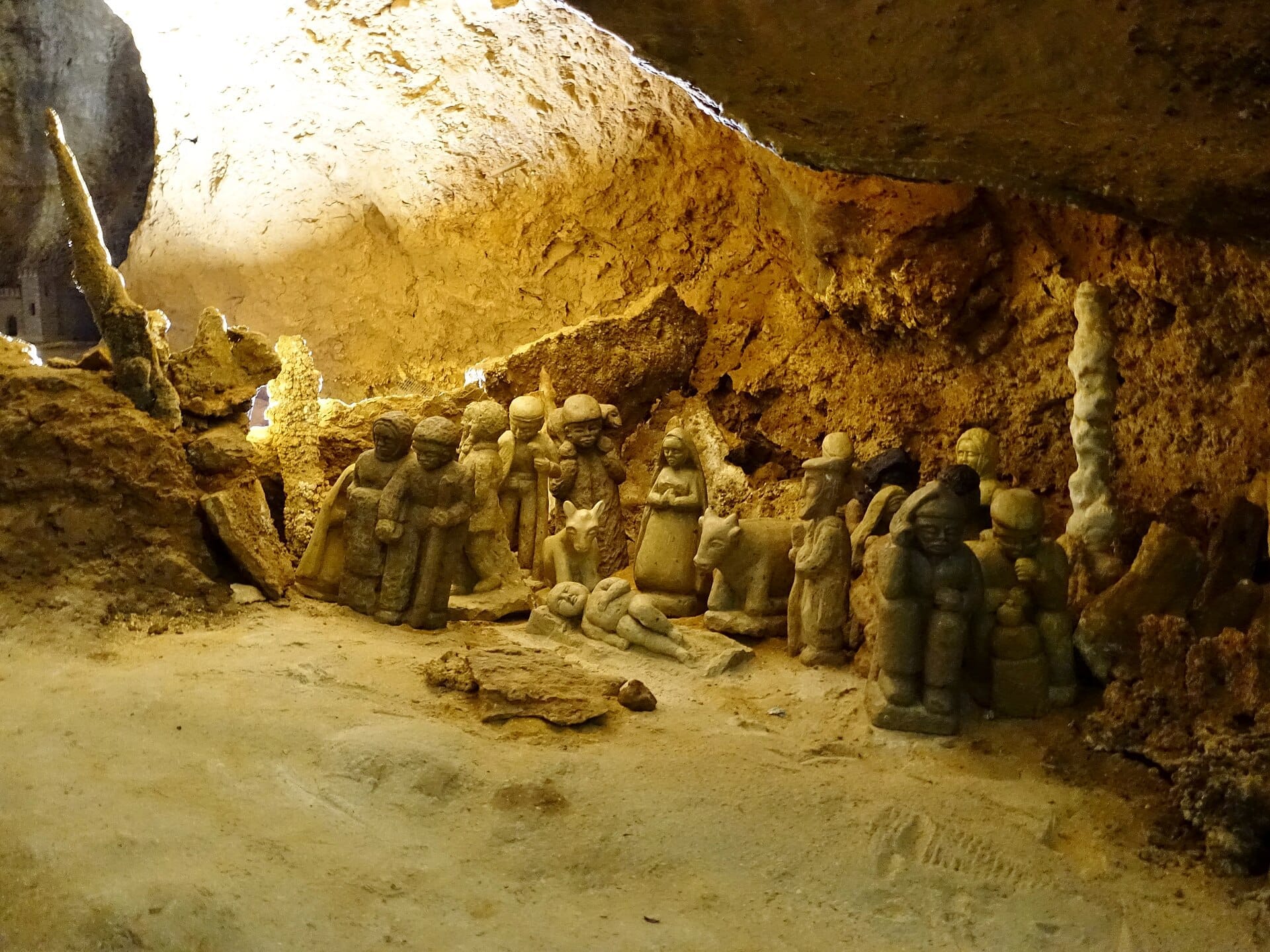
What Makes Is Zuddas Caves Worth the Drive
The Is Zuddas Caves are not just another karst attraction tacked onto a beach itinerary. They sit inside Monte Meana, a hill of dolomitic limestone whose geological clock started ticking roughly 530 million years ago during the Cambrian period — long before even the oldest dinosaurs appeared. That age alone places these rocks in a different category from most cave systems visitors encounter in the Mediterranean.
The cave system extends for about 1,650 metres in total, but the tourist route covers approximately 500 metres of this, looping through a sequence of chambers that range from intimate, low-ceilinged passages to tall halls where stalactites have had millennia to reach impressive proportions. What distinguishes Is Zuddas from other Sardinian show caves is the concentration of rare aragonite formations: helictites that grow sideways and upward in defiance of gravity, coral-like cave flowers, and aragonite frostwork that coats surfaces in a pale, crystalline crust. These structures are exceptionally sensitive to temperature and humidity changes, which is one reason access is exclusively by guided tour.
ℹ️ Good to know
The cave interior maintains a constant temperature of 16°C with humidity close to 100%, year-round. Even in August, you will feel cold and damp within minutes. Bring a light jacket or fleece regardless of the outside temperature, and wear closed shoes with grip — the path is mostly flat but the wet atmosphere makes surfaces slippery.
A Brief History: From Quarry to Conservation
This is not a cave that was always admired. During the 1960s, the chambers of Is Zuddas were actively worked as an alabaster and marble quarry, and the marks of industrial extraction are still visible in some sections of the walls. It is a sobering detail — the same formations now protected behind guided-tour protocols were once being blasted and hauled out for decorative stone.
The transformation came in 1971, when members of the local Speleo Club Santadese intervened, effectively ending quarrying operations and beginning the work of preparing the cave for responsible tourism. The club documented the formations, mapped the accessible route, and established the framework for the guided visits that continue today. It is one of the cleaner examples of grassroots speleological conservation in Italy, and the cave's current condition reflects that careful stewardship.
Is Zuddas sits within the broader landscape of southwest Sardinia, a region defined by the former mining towns of the Sulcis-Iglesiente and a rugged interior that most visitors pass through quickly on their way to beaches. For context on the wider area's character, the Sulcis and southwest coast holds some of Sardinia's most undervisited historical and natural assets, and Is Zuddas fits squarely into that pattern.
Tickets & tours
Hand-picked options from our booking partner. Prices are indicative; availability and final rates are confirmed when you complete your booking.
Vineyard Guided Tour and 7 Wine Tasting in Palau
From 84 €Instant confirmationFree cancellationFull-Day Sailboat Tour in La Maddalena Archipelago from Cannigione
From 112 €Instant confirmationFree cancellationHiking excursion to the Devil's Saddle
From 35 €Instant confirmationFree cancellationExcursion to the Archaeological site of Nora
From 70 €Instant confirmationFree cancellation
The Guided Tour: What You Actually See
All visits are guided — there is no option to explore independently. Tours are available in Italian, English, and German, with brochures in French and Russian. Groups move together at a measured pace, stopping at key formations while the guide explains the geology and the cave's history. The tone is informative without being overly academic, and guides generally field questions well on the science of speleothem formation.
The route begins in a relatively narrow entrance gallery and opens progressively into wider chambers. The lighting has been designed to highlight specific formations without oversaturating the space: tall stalactite columns catch warm amber light, while the aragonite helictites are often lit from below to show their contorted, spiral growth patterns. One chamber features a large pool of completely still, reflective water — one of those striking underground moments that photographs rarely do justice to.
The 500-metre path involves a maximum elevation change of only 15 metres, so the physical demands are minimal. You walk slowly, stopping frequently, and the tour takes around 45 minutes underground. The main challenge is the cold and damp rather than any physical exertion. Children who are comfortable in enclosed spaces generally handle the tour well; toddlers and very young children can find the darkness disorienting.
⚠️ What to skip
No wheelchair accessibility information is provided in official sources. The path is flat and paved for most of its length, but the entrance and some transitions between chambers may pose obstacles. Contact the cave directly at the official website before visiting if accessibility is a concern.
Opening Hours and When to Visit
Is Zuddas operates on a seasonal schedule with fixed tour departure times rather than continuous admission. The timetable breaks down roughly as follows: from 1 April to 30 June, tours depart at 11:00, 12:15, 15:00, 16:15, and 17:30. From 1 July to 30 September, the high season schedule offers more frequent departures between 10:00 and 12:15 and again between 14:30 and 18:00. From 1 to 31 March and from 1 to 31 October, and during the Christmas and New Year holiday period (20 December to 6 January), tours run at 12:00 and 16:00 only. The cave closes entirely from 1 November to 19 December and from 7 January to the end of February.
These hours are subject to change. Always verify the current schedule via the official website before making the drive, especially if visiting in shoulder months or during Italian public holidays when hours may be adjusted.
Practically speaking, the best time to visit is on a weekday morning in late spring or early autumn. In July and August, tour groups can be large, the car park gets crowded around midday, and the queues at the ticket window are longest. The cave temperature never changes, but the crowd experience certainly does. Arriving for the first morning tour of the day also means you enter ahead of the bulk of arrivals, particularly coach groups from the southern coast resorts.
💡 Local tip
Is Zuddas makes an excellent escape from summer beach heat. While the coast bakes at 32–35°C in July and August, the cave interior holds steady at 16°C. The contrast is sharp enough to be refreshing — though you will want dry clothes and a snack waiting for you in the car afterward.
Getting There and Practical Logistics
A car is effectively essential. The cave sits 6 kilometres from the village of Santadi along the SP70 provincial road toward Teulada. There is a signposted car park on site. From Cagliari, the most direct route is approximately 60 kilometres: take the SS130 south from the city, follow signs for Siliqua, then pick up the SS293 toward Santadi, and from Santadi follow SP70 to the caves. An alternative route via the coastal SS195 to Teulada and then SP70 adds distance but passes through more scenic coastal terrain.
Is Zuddas pairs naturally with other southwest Sardinia destinations on a full day out from Cagliari. The archaeological site at Nora lies along the coastal route, and the dramatic sea stack of Pan di Zucchero near Masua is roughly an hour's drive to the north through the Sulcis mining landscape. Planning Is Zuddas as a morning stop before heading to the coast or the mining heritage sites of Iglesias makes efficient use of a long day.
If you are building a longer southwest Sardinia itinerary, the day trips from Cagliari guide covers the logistics of combining several sites in the region.
Photography Inside the Cave
Photography is generally permitted without flash. The cave lighting is artfully placed but dim by photographic standards, so a smartphone with a capable night mode will outperform most compact cameras. A small tripod or a steady surface is useful: shutter speeds in the slower chambers can drop to half a second or longer to capture the aragonite details. The reflective underground pool offers one of the better compositional opportunities, particularly if you position yourself at the edge of the viewing area and shoot across the water surface toward the illuminated stalactites above.
The cold and humidity will cause lenses to fog immediately upon entry from warm outside air. Give your camera a few minutes to acclimatise before trying to shoot. Bringing your camera in a bag and removing it slowly helps, though condensation is largely unavoidable for the first few minutes.
Is This Worth the Detour?
Is Zuddas is a impressive cave, but it does not have the name recognition of the Grotte di Nettuno near Alghero or the coastal drama of the Bue Marino caves in the Golfo di Orosei. It attracts a local and regional audience rather than the international tour-bus circuit, which is partly what keeps the experience manageable.
For travellers who are already exploring the Sulcis region or want a half-day excursion that takes them away from the beach, Is Zuddas is worth planning around. For travellers based in northern Sardinia near the Golfo di Orosei, the cave systems of Grotte del Bue Marino or Grotte di Ispinigoli are closer and equally compelling. Is Zuddas is not a cave you should cross the entire island to visit in isolation, but within a southwest Sardinia itinerary it earns its place clearly.
Visitors who dislike confined spaces, who travel with very restless toddlers, or who are primarily interested in beaches and outdoor scenery will find limited value here. The guided format does not allow dawdling or independent exploration, which can feel restrictive to experienced cavers — but it is appropriate for protecting the aragonite formations.
Insider Tips
- Arrive 15 minutes before your target tour time rather than at departure time. The ticket window can be slow with larger groups, and if you miss a departure you may wait 75 minutes or more for the next one in low season.
- The small bar and picnic area near the entrance is a good place to wait if you have time before your tour. Bring snacks from Santadi village or Cagliari — there is no restaurant on site.
- If you are visiting in summer and planning a beach afternoon afterward, leave your beach bag in the car and bring only a jacket and closed shoes for the cave. The 100% humidity inside will soak through light fabric, and sandy sandals become slippery immediately on the cave path.
- The aragonite helictites are at their most visually striking under the guide's handheld spotlight. Ask your guide to hold the light at a low angle to one of the helictite clusters — the refraction through the crystal structures is noticeably different and worth the request.
- Santadi village itself has a small ethnographic museum and a decent local wine cooperative (Cantina di Santadi), which produces some of the Sulcis region's most respected Carignano del Sulcis wines. Combining the caves with a quick stop at the cantina for a tasting makes for a rounded half-day.
Who Is Is Zuddas Caves (Santadi) For?
- Families with children aged 6 and above who can handle 45 minutes of focused walking in cold, dim conditions
- Geology and speleology enthusiasts interested in rare aragonite formations and Cambrian-age dolomite
- Day-trippers from Cagliari looking for something substantive beyond beach and archaeological sites
- Travellers visiting in summer who want a cool, worthwhile interlude from the coastal heat
- Anyone building a multi-stop southwest Sardinia itinerary through the Sulcis-Iglesiente region
Nearby Attractions
Other things to see while in Sulcis & the Southwest Coast:
- Carloforte (Isola di San Pietro)
Carloforte is the sole inhabited centre on Isola di San Pietro, a small island off Sardinia's southwestern coast with a strikingly un-Sardinian character. Founded in 1738 by Ligurian settlers from Tabarka, it retains its own dialect, cuisine, and urban architecture — a place that rewards slow exploration rather than quick sightseeing.
- Costa Verde
Costa Verde is a 47-kilometre arc of coastline in the Comune di Arbus, in Sardinia's southwest, running from Capo Frasca to Capo Pecora. It holds some of the most remote beaches on the island, including Piscinas, where dunes reach up to 60 metres high, making it one of the largest dune systems in Europe. There are no entry fees, minimal resort infrastructure directly on the beaches, and no public transport. That combination is exactly why it rewards visitors who make the effort to get here.
- Isola di Sant'Antioco
Sant'Antioco Island sits off Sardinia's southwest coast, connected to the mainland by a bridge over an ancient isthmus. With roots stretching back to Phoenician colonizers in the 8th century BC, it pairs serious archaeology with quiet beaches, a still-functioning fishing port, and some of the least-crowded coastline in the region.
- Museo dell'Arte Mineraria (Iglesias)
Housed in a 1911 Liberty-style technical institute and extending into a real underground training mine, the Museo dell'Arte Mineraria in Iglesias preserves the tools, machinery, and human story of Sardinia's centuries-old mineral industry. It is one of the few places in Europe where you can walk through actual mine tunnels beneath a working school building.