Syracuse Cathedral (Duomo di Siracusa): Where Ancient Greece Meets Baroque Sicily
Built into the bones of a 5th-century BC Greek temple, the Cathedral of Syracuse is one of the most layered religious buildings in the Mediterranean. Its Baroque facade conceals Doric columns still standing in the walls, making it a rare place where you can literally touch 2,500 years of history in a single building.
Quick Facts
- Location
- Piazza Duomo 5, Ortigia, Siracusa, Sicily
- Getting There
- Walk from the bridges into Ortigia (about 10–15 min on foot from the mainland); nearby bus stops are available
- Time Needed
- 45–90 minutes, including the piazza
- Cost
- €2 per person
- Best for
- History lovers, architecture enthusiasts, photography
What Makes This Cathedral Unlike Any Other in Sicily
The Cattedrale metropolitana della Natività di Maria Santissima, known simply as the Duomo di Siracusa, is not a typical Italian cathedral. Step inside and you will notice something that most churches cannot offer: the original fluted Doric columns of a Greek temple, still standing, now embedded in the side walls of the nave. These columns belonged to the Temple of Athena, built in the early 5th century BC, around 480 BC. The temple was one of the most celebrated in the ancient world, described by the Roman writer Cicero as magnificent.
When the Byzantine bishop Zosimo converted the structure into a Christian church in the 7th century AD, he worked with rather than against the existing architecture. The spaces between the columns were filled with stone walls, the colonnade became the nave, and the Greek cella became the central body of the church. The result is a building that has absorbed more than two millennia of history without losing the trace of any particular era.
ℹ️ Good to know
The Temple of Athena dates to around 480 BC. The cathedral conversion happened in the 7th century AD. The Baroque facade was added between 1725 and 1753. All three layers are visible during a single visit.
The Facade and Piazza Duomo: First Impressions
Piazza Duomo is the civic and spiritual heart of Ortigia, the small island that forms Syracuse's historic center. The square is long and relatively narrow, flanked by Baroque palaces and the Bishop's Palace, and it slopes gently toward the cathedral's facade. In the morning, low light catches the warm limestone facade from an angle that makes the columns and carved figures appear almost three-dimensional. By midday, the square fills with tour groups and the light becomes flat, so early morning or the hour before sunset is when the piazza looks its best.
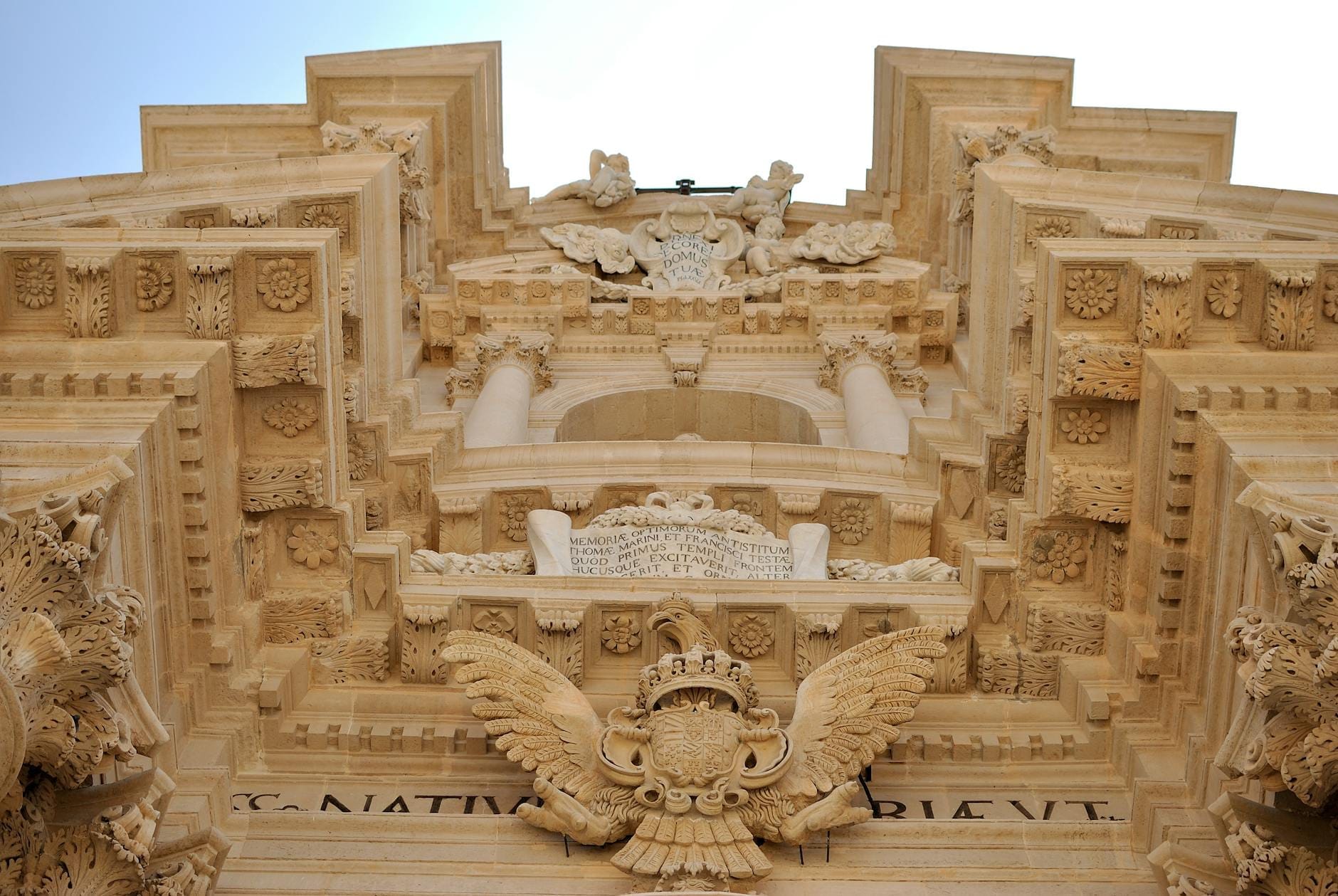
The current Baroque facade was designed by Andrea Palma and completed between 1725 and 1753, replacing the earlier facade damaged in the 1693 earthquake that flattened much of eastern Sicily. Palma's design follows the theatrical Sicilian Baroque style, with curved pediments, sculpted figures, and layered columns, but it manages restraint compared to the more extravagant facades in Noto or Catania. The statues in the upper niches represent various saints, and the central portal is framed by twisted columns that draw the eye upward.
If you are interested in how this earthquake reshaped the UNESCO-listed Val di Noto sites bookarchitecture of southeastern Sicily, the Baroque Sicily guide covers the broader context across the region, including Noto, Ragusa, and Catania.
Tickets & tours
Hand-picked options from our booking partner. Prices are indicative; availability and final rates are confirmed when you complete your booking.
Syracuse and Ortygia Island guided tour from Taormina
From 65 €Instant confirmationFree cancellationMonreale day trip from Palermo
From 20 €Instant confirmationFree cancellationPalermo Cathedral rooftop ticket with audio guide
From 15 €Instant confirmationFree cancellationSyracuse, Ortygia and Noto tour from Catania
From 109 €Instant confirmationFree cancellation
Inside the Cathedral: Reading the Layers
The interior is cooler and darker than you expect, which is a relief on warm days. Your eyes adjust slowly, and as they do, the Greek columns emerge from the walls on both sides of the nave. There are 24 Doric columns in total, still carrying the weight of the structure above them. Running your hand along one of these columns is an odd sensation: the stone has a slightly rough texture from centuries of plaster applications and removal, and the fluting is partially obscured but unmistakable. The sheer scale of them, and the fact that they are still load-bearing elements in a working cathedral, is quietly extraordinary.
The nave is divided into three aisles by these ancient columns. The side chapels are mainly Baroque in decoration, with gilded altarpieces and paintings. One of the most notable is the Chapel of Santa Lucia, dedicated to Syracuse's patron saint, which contains a silver statue of the saint that is paraded through the city each December 13 during the Feast of Santa Lucia. The chapel and the silver statue are significant to local residents in a way that goes beyond tourism, and you will sometimes find Syracusans praying quietly here while visitors circulate nearby.
The Norman period also left its mark: look for the font near the entrance, carved from a single block of stone, which dates to the Norman era and sits on a base of Greek architectural fragments. The overall effect of the interior is less of a unified decorative scheme and more of an archaeological accumulation, which is either fascinating or slightly chaotic depending on your preferences.
💡 Local tip
Bring a small flashlight or use your phone torch to see the column fluting clearly in the dimmer side aisles. The lighting inside, while atmospheric, leaves the ancient stonework in partial shadow.
How the Experience Changes by Time of Day
The cathedral opens in the morning, and the first thirty minutes are the quietest. Groups from cruise ships and organized tours typically do not arrive at Piazza Duomo before 10:00 or 10:30 am, so the early slot gives you more space inside and a calmer atmosphere in the square outside. The sound inside is the echo of your own footsteps on stone floors, with occasional murmured Italian from the few locals attending morning prayers in a side chapel.
By late morning, the piazza is at full tourist capacity and the interior can feel crowded, particularly around the main altar and the Santa Lucia chapel. Early afternoon in summer is uncomfortably hot on the piazza itself, though the cathedral interior stays cool. Late afternoon, from around 4:30 pm onward, is another good window: the light on the facade turns golden, the cruise ship visitors have often left, and the piazza takes on a more local character as residents come out for the early evening passeggiata.
Getting There and Practical Logistics
The cathedral is in Ortigia, the historic island district of Siracusa. Ortigia is connected to the mainland by two bridges; the main pedestrian access is via the bridge into Ortigia. From the bridge, it is a ten to fifteen minute walk through the tight streets of the old town to Piazza Duomo. The square itself is pedestrianized, so there is no vehicle access. If you are driving, park on the mainland side near the bridge and walk across.
Admission is €2, which is low enough that it rarely feels like a deterrent, though the price should be verified before your visit as it may change. Dress code is enforced: shoulders and knees must be covered to enter. Scarves or sarongs are not available for loan at the entrance, so bring your own if you are visiting in summer with bare arms or shorts.
Ortigia pairs naturally with the Cathedral of Syracuse museum,broader Ortigia island, the nearby Fonte Aretusa, the Palazzo Beneventano, and in the afternoon, a walk along the sea walls. If you are planning a full day in Syracuse, the Neapolis Archaeological Park on the mainland adds the Greek Theatre and the Ear of Dionysius to a very full but rewarding day.
⚠️ What to skip
The cathedral is still an active place of worship. Entry may be restricted or suspended during Mass, which typically takes place in the morning and on Sundays. Check locally before planning a tight schedule around a specific visit time.
Photography Considerations
The exterior photographs best in the first hour after sunrise or the last hour before sunset, when the angle of light picks out the relief carving on the facade. The interior is dim and photography is allowed, though flash is generally discouraged around the altars. The Greek columns photograph well with a wide-angle lens or phone camera in portrait mode, with available light from the high windows above. One underused shot is standing at the far end of the nave and framing the ancient columns receding toward the entrance, which gives a sense of scale that single-column close-ups do not.
Piazza Duomo itself is one of the more photographed squares in Sicily. To get a clean shot of the facade without tourists, arrive before 9:30 am when the piazza is empty. The long axis of the square also allows wide compositions that include the entire facade, the flanking palaces, and the open sky.
Who Will Enjoy This Most, and Who Might Not
The Syracuse Cathedral rewards visitors who are willing to read what they see rather than simply admire surface decoration. The embedded Greek columns are not immediately spectacular in the way a gilded Baroque altarpiece is; they require a moment of context to understand why they matter. Travelers with a strong interest in classical antiquity, in architectural continuity across civilizations, or in the Arab-Norman-Byzantine heritage of Sicily will find this one of the most intellectually satisfying stops on the island.
Visitors looking for a visually overwhelming interior in the style of the Palatine Chapel in Palermo or the mosaic-encrusted Monreale Cathedral may find the Duomo di Siracusa relatively spare by comparison. It is not a building that shouts. Families with very young children will find the visit brief and the piazza a better draw than the interior. And if cobblestoned historic centers, modest entry fees, and small-scale sacred spaces are not your preference, this may not justify a detour on its own, though most visitors to Ortigia will find themselves at Piazza Duomo regardless.
Insider Tips
- Walk around to the outer walls of the cathedral where you can see the original Greek columns from outside the building, protruding slightly from the cathedral walls. This view makes the architectural layering immediately legible in a way the interior alone does not.
- The piazza is quietest on weekday mornings outside July and August. If you are visiting in peak summer, arriving before 9:30 am when the cathedral opens is the only reliable way to have the space to yourself.
- The Feast of Santa Lucia on December 13 transforms Piazza Duomo into the center of one of Sicily's most atmospheric religious festivals. The silver statue of the saint is carried through the streets, and the piazza fills with Syracusans rather than tourists.
- There is a small cafe on the south side of Piazza Duomo that opens early. A coffee there before the cathedral opens, watching the light move across the facade, is one of the more pleasurable ways to start a morning in Syracuse.
- The ticket desk is inside the entrance; the €2 fee supports maintenance of the building. Ask for the printed information leaflet available in several languages, which maps the key architectural features and their historical periods.
Who Is Syracuse Cathedral For?
- History and archaeology enthusiasts who appreciate layered, multi-era sites
- Architecture lovers interested in the transition from classical to early Christian to Baroque
- Photographers working in available light with interest in ancient stonework
- Travelers spending a full day in Ortigia who want cultural depth alongside the sea walls and market
- Visitors following Sicily's Arab-Norman and classical heritage trail
Nearby Attractions
Other things to see while in Siracusa (Syracuse):
- Catacombs of San Giovanni
The Catacombs of San Giovanni are among the largest and best-preserved early Christian burial sites in Sicily, carved into the rock beneath a ruined 6th-century basilica near Syracuse's Neapolis archaeological zone. With over 10,000 tombs cut along a grid of Roman-planned tunnels, the site offers a rare, unhurried look at late antique funerary culture — guided, atmospheric, and genuinely unlike anything above ground.
- Ear of Dionysius
Carved into the limestone cliffs of Syracuse's Neapolis Archaeological Park, the Ear of Dionysius is a 65-metre limestone cave with a distinctive S-shaped curve and acoustics so remarkable that a whisper near the entrance can be heard clearly at the far end. Named by Caravaggio in 1608, it is one of Sicily's most genuinely surprising ancient sites.
- Neapolis Archaeological Park
Neapolis Archaeological Park in Syracuse contains one of the best-preserved Greek theatres in the world, a massive Roman amphitheatre, the sacrificial Altar of Hieron II, and the haunting Latomia del Paradiso quarries. Together they span centuries of Sicilian history carved directly into the Temenite hill.
- Ortigia Island
Ortigia is the historic core of Syracuse, a compact limestone island barely one kilometer long, where Greek temples, Baroque facades, and Arab-Norman traces stack up on top of each other across 2,700 years of history. Access is free, the streets are walkable, and almost every corner produces something unexpected.