Sydney Harbour Bridge: What to Know Before You Visit
Sydney Harbour Bridge is one of the world's great pieces of civil engineering and the most recognisable landmark on the Australian skyline. Whether you cross it on foot, climb to the pylon museum, or simply photograph it from below, this guide covers everything you need to plan your visit.
Quick Facts
- Location
- Dawes Point/The Rocks (south) to Milsons Point (north), Sydney NSW
- Getting There
- Circular Quay Station (train); Wynyard Station (train); Milsons Point Station (north side)
- Time Needed
- 30 min to walk across; 1.5–2 hrs with BridgeMuseum; half-day for BridgeClimb
- Cost
- Pedestrian walkway: free. BridgeMuseum: A$39.95 adult / A$22.95 child (prices as of Oct 2026; verify before visiting). BridgeClimb: separate operator pricing.
- Best for
- Architecture lovers, view seekers, first-time visitors, photographers
- Official website
- www.bridgemuseum.com.au
What the Sydney Harbour Bridge Actually Is
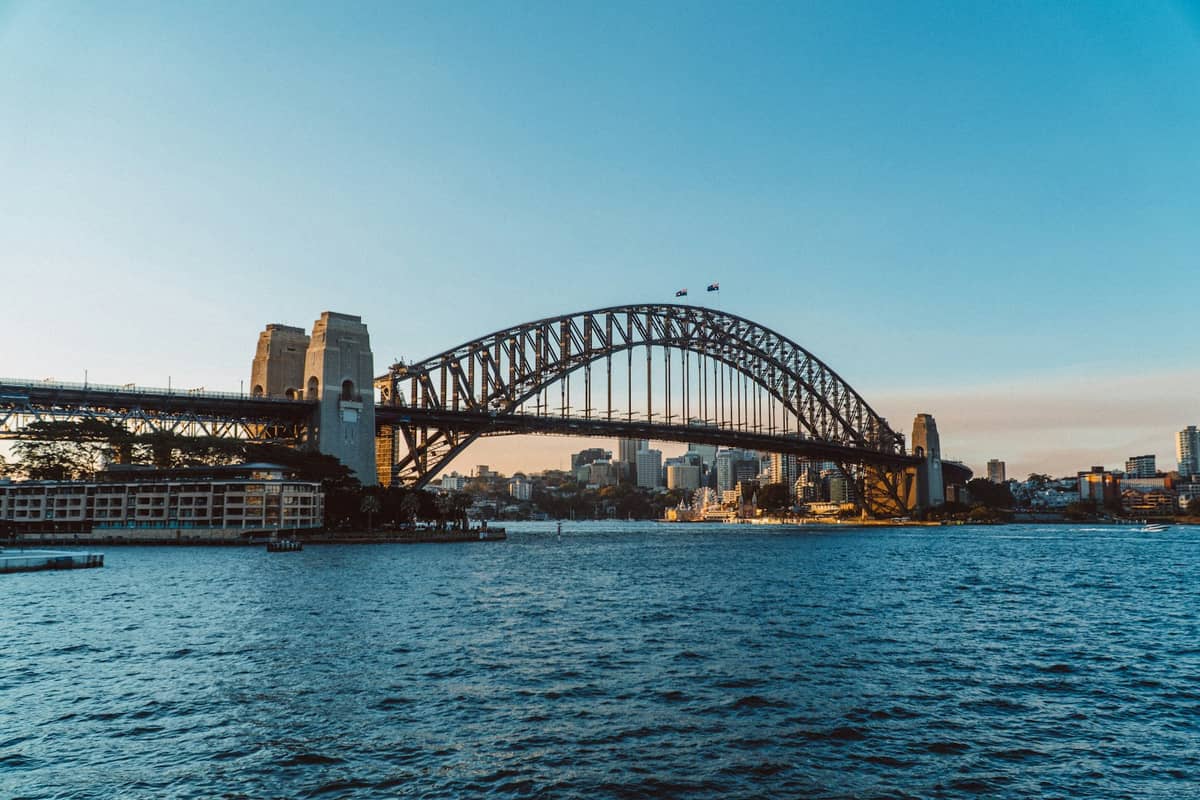
The Sydney Harbour Bridge is a steel through-arch bridge that spans 503 metres across the central channel of Sydney Harbour, connecting The Rocks on the southern shore to Milsons Point on the north. From end to end the structure measures 1,149 metres. It opened on 19 March 1932 and, more than ninety years later, it still carries eight lanes of road traffic, two railway lines, a pedestrian footpath, and a dedicated cycleway simultaneously. That combination of size, age, and continuous operational intensity makes it unlike most landmark bridges in the world.
The bridge carries the nickname 'the Coathanger' among Sydneysiders, a reference to the shape of its arches rather than any affection for clothing. Stand on the southern foreshore near Dawes Point and the name makes immediate sense. The arch sweeps up from both sides in a parabolic curve so uniform it looks almost too deliberate, too geometric to be made of steel and granite and rivets.
ℹ️ Good to know
The pedestrian walkway across the bridge is free at any time of day or night. The pedestrian footpath runs along the eastern side. Access from the south is via the stairs or lift on Cumberland Street in The Rocks.
The Pedestrian Walk: What to Expect
The eastern footpath is the most accessible and widely used way to experience the bridge directly. The walk from the Cumberland Street access point in The Rocks to the north end at Milsons Point is a little over 1 kilometre on the bridge itself. Expect a modest climb on the approach ramp before the path levels out across the arch. The footpath is reasonably wide but enclosed by metal fencing on both sides, so those with a strong fear of heights may find the sensation more contained than they expect.
The experience changes significantly by time of day. Early morning, before 8 am, the footpath is shared mostly with commuter cyclists and the occasional jogger. The harbour below catches the low eastern light and the Opera House tiles illuminate in a way that photographs well without crowds in the frame. By mid-morning on weekdays, tourist foot traffic builds steadily. Weekend afternoons in summer can feel genuinely congested at the midpoint, where nearly everyone stops to photograph the Opera House to the east.
At dusk, particularly in the shoulder seasons of March to May and September to November, the light over the harbour turns the kind of amber that makes even phone cameras produce images worth keeping. Wind is the variable that most visitors underestimate. At the midpoint of the bridge, even moderate breezes at ground level translate into sustained gusts. A light layer is advisable regardless of the season.
💡 Local tip
Photography tip: the best framing of both the arch and the Opera House together is from the midpoint of the eastern footpath. Shoot south-east for the Opera House, north-west for the arch structure itself. Morning light falls on the Opera House; afternoon light catches the arch.
The walk connects naturally to the broader harbour foreshore. On the southern side you are already in Circular Quay and The Rocks, with ferry terminals, heritage laneways, and the Opera House all within a ten-minute walk. On the northern side, Milsons Point has direct train access back to the city and is a short walk from Kirribilli, a quiet residential suburb with harbour views worth exploring if you have the time.
Tickets & tours
Live prices and dates from our booking partner. If you book, we may earn a commission at no extra cost to you.
Sydney Harbour scenic flight - private 20 minutes tour
From 404 €Instant confirmationFree cancellationSydney Harbour long lunch or dinner cruise
From 0 €Instant confirmationSydney harbour 20 minutes scenic flight
From 147 €Instant confirmationFree cancellationSydney Harbour long lunch or dinner cruise
From 0 €Instant confirmation
The BridgeMuseum: Inside the South-East Pylon
The south-east pylon houses the BridgeMuseum, a visitor attraction operated independently of Transport for NSW. The pylon looks like a structural element from the outside, and in engineering terms it largely is decorative rather than load-bearing. The museum inside covers the history of the bridge's construction, the workers who built it, and the engineering context of its era.
Access is from the pedestrian footpath, about 300 metres north of the Cumberland Street access point. Visitors climb a substantial number of stairs to reach the top platform. The BridgeMuseum is explicit that the pylon interior is stairs-only and is not suitable for prams; visitors must be able to climb stairs unaided. There is no lift. The view from the top of the pylon is legitimately excellent and distinct from the footpath level: you look down at the arch structure itself and across at the full sweep of the harbour.
As of October 2026, day-session tickets are listed at A$39.95 for adults and A$22.95 for children. An after-hours experience is available at A$79.95. Prices and availability should be confirmed directly with the operator before visiting, as they are subject to change. Booking ahead online is recommended, especially during school holidays and peak summer weeks.
⚠️ What to skip
The BridgeMuseum is entirely stair-dependent. If mobility, fitness, or health conditions limit stair climbing, this experience is not suitable. The pedestrian walkway across the bridge remains accessible and free.
Historical and Engineering Context
Construction of the bridge began in 1923 and took nearly nine years. At the time of its opening in 1932, it was the widest long-span bridge in the world, a distinction it held for decades. The arch alone weighs roughly 39,000 tonnes and is built from steel fabricated primarily in Middlesbrough, England, though the granite cladding on the pylons came from Moruya in regional New South Wales. Over 1,400 workers were employed during construction, and 16 workers died during the build.
The opening ceremony on 19 March 1932 became an episode that still circulates in Australian political history. Premier Jack Lang was moments from cutting the ceremonial ribbon when Francis de Groot, a cavalry officer with political objections to Lang's government, rode forward on horseback and slashed the ribbon with his sword, declaring the bridge open in the name of 'the decent and respectable people of New South Wales.' Lang's team hastily re-tied the ribbon and proceeded. De Groot was arrested and fined.
The bridge predates the Sydney Opera House by four decades and is woven into the city's identity in a different way: functional, civic, and structurally straightforward compared to the Opera House's contested geometry. Together they form what most visitors and many Sydneysiders treat as an inseparable pair. The Sydney Opera House is visible from the bridge's midpoint and is best photographed from there in morning light.
How to Get There
From the city centre, the southern pedestrian access is a fifteen-minute walk from Circular Quay station or Wynyard station. From Circular Quay, walk west along the waterfront past the ferry terminals and through the lower end of The Rocks, then follow the signs up to Cumberland Street. The lift on Cumberland Street provides step-free access to the footpath level for the bridge crossing itself, though not to the BridgeMuseum pylon interior.
From the north, Milsons Point station on the T1 North Shore Line sits at the bridge's northern approach. This is a practical option if you want to walk the bridge from north to south and arrive in The Rocks, rather than retracing your steps.
For a broader orientation to public transport options across the city, the getting around Sydney guide covers trains, ferries, and buses in detail.
Viewing the Bridge From Ground Level and the Water
The pedestrian walk gives you the bridge from the inside. For the full visual impact of the structure as a whole, several vantage points work better than the footpath itself.
- Dawes Point Park: directly beneath the southern arch, a small foreshore park where you can look straight up at the steelwork. The scale only becomes clear this close.
- Mrs Macquaries Chair: across the harbour to the east, this is the classic postcard position that frames both the bridge and the Opera House in the same shot.
- Milsons Point foreshore: on the north side, a short walk from the station gives a clean low-angle view of the arch with the city skyline behind it.
- By ferry: crossing the harbour on any ferry route that passes under the bridge, particularly the Manly or Parramatta River services, gives you a passing view from the water that is hard to replicate from land.
Mrs Macquaries Chair is covered in more detail in the Mrs Macquaries Chair guide. For ferry routes with harbour views, the Sydney ferry guide is the most practical starting point.
Who Should Manage Expectations
Visitors who arrive expecting the bridge walk to feel like a dramatic, open-sky experience sometimes find the enclosed fencing underwhelming. The footpath is functional, not scenic in the way an open cliff-top walk would be. If elevated open-air views are the goal, the BridgeMuseum pylon top is more satisfying, but requires stair fitness and a ticket. BridgeClimb, a separate commercial operator, offers guided climbs to the arch summit and provides the most dramatic aerial perspective, though it is a premium-priced experience that requires booking well in advance.
Visitors with limited mobility who can use the Cumberland Street lift can still cross the bridge on the footpath, which is a worthwhile experience in itself. Those looking for Sydney's full range of elevated views might also consider the Sydney Tower Eye, which provides 360-degree city views from a different vantage point entirely.
💡 Local tip
If visiting Sydney in late May or June, the Vivid Sydney festival illuminates the bridge with large-scale light projections after dark. The foreshore parks and Circular Quay ferry wharves are the best viewing positions for the light shows.
Insider Tips
- Use the eastern footpath walking north to south so the Opera House stays on your left: you face the Opera House and the morning sun the entire crossing, which is far more photogenic than the industrial view from the western footpath.
- The Cumberland Street lift is open 24 hours a day, though it is sensible to check for any temporary service updates before travelling. The stairs from Cumberland Street are steep.
- Weekday mornings before 9 am are the quietest time on the footpath. By 10:30 am on most days, the midpoint viewing area becomes crowded enough to make photography of the Opera House difficult without strangers in frame.
- The BridgeMuseum recommends booking tickets online. Walk-up availability on weekends and school holidays is genuinely limited, and the experience does not improve by arriving without a confirmed time slot.
- For the best ground-level photograph of the full arch, position yourself in Dawes Point Park at the southern foreshore, looking north-west. This angle shows the arch at full height against the sky without foreground clutter.
Who Is Sydney Harbour Bridge For?
- First-time visitors to Sydney wanting direct contact with the city's defining structure
- Architecture and engineering enthusiasts interested in 1930s steel construction at scale
- Photographers working the harbour foreshore at dawn or dusk
- Walkers looking for a short, free crossing that connects The Rocks to Milsons Point on foot
- Families with older children who can manage stairs and are ready for the BridgeMuseum climb
Nearby Attractions
Other things to see while in Circular Quay & The Rocks:
- Barangaroo Reserve
Once a concrete wharf, Barangaroo Reserve is now a six-hectare sandstone headland park hugging Sydney's western harbour foreshore. Open around the clock and free to enter, it offers coastal walking paths, sweeping views of the harbour bridge and North Shore, and a quietly powerful connection to the Gadigal and Cammeraygal peoples whose Country this has always been.
- Cockatoo Island
Cockatoo Island sits in the middle of Sydney Harbour, free to enter and reachable by public ferry. It holds 150 years of convict and industrial history across shipyards, sandstone buildings and water-level dockworks — and the views back toward the CBD are quietly spectacular.
- Justice and Police Museum
Housed in a 19th-century court complex one block from Circular Quay, the Justice & Police Museum unpacks colonial Sydney's criminal underbelly through real evidence, mugshots, and courtroom drama. Entry is free, the building is atmospheric, and the exhibits are far more confronting than most museum visitors expect.
- Museum of Contemporary Art Australia (MCA)
The Museum of Contemporary Art Australia sits at the edge of Sydney Harbour in The Rocks, offering rotating exhibitions of Australian and international contemporary art, a rooftop cafe with Opera House views, and free admission for under-18s. It rewards a few hours of unhurried looking, especially on a Thursday evening when the crowds thin and the harbour light shifts.
Planning a trip? Discover personalized activities with the Nomado app.