Sydney Tower Eye: The Complete Visitor Guide to Sydney's Highest Viewpoint
Sydney Tower Eye rises 309 metres above the CBD, with the observation deck about 250 metres up and its highest public observation point. This guide covers what you actually see from the top, when to go, how much it costs, and whether it earns its ticket price against Sydney's free view alternatives.
Quick Facts
- Location
- Level 5, Westfield Sydney, 108 Market Street, Sydney CBD NSW 2000
- Getting There
- Town Hall, St James or Martin Place train stations (all within 5 min walk); Gadigal Metro station approx 7 min walk
- Time Needed
- 45–90 minutes for observation deck; longer if dining at the revolving restaurant
- Cost
- A$29 adult online (weekdays) / A$34 online (weekends) / A$39 on the day. Prices are subject to capacity and may fluctuate — verify at sydneytowereye.com.au before visitingverify at sydneytowereye.com.au before visiting
- Best for
- First-time visitors wanting a geographic overview of Sydney; families with children; sunset and night photography
- Official website
- www.sydneytowereye.com.au
What Sydney Tower Eye Actually Is
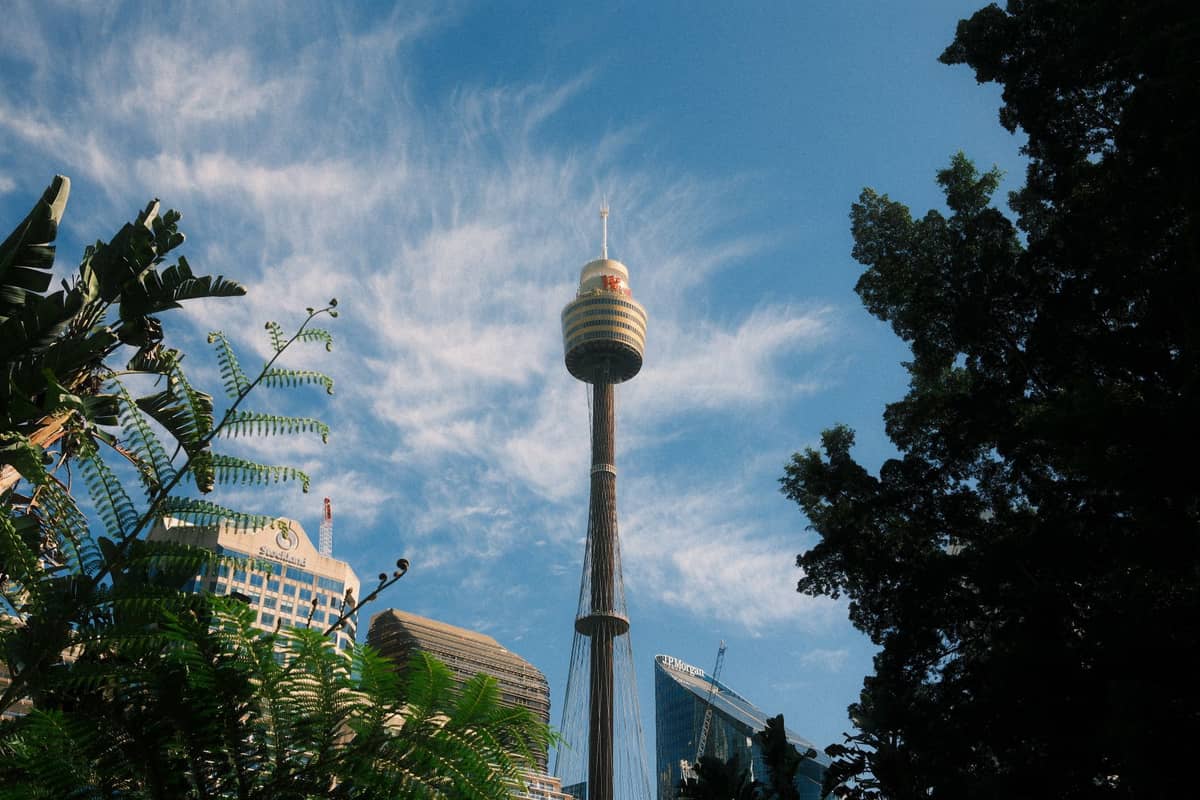
Sydney Tower Eye is the observation attraction housed near the top of Sydney Tower, the turret-shaped structure rising 309 metres above Market Street in the heart of the CBD. The tower itself opened to the public in September 1981 and remains the tallest structure in the city. You may also see it called Centrepoint Tower, a legacy name that dates to its original anchor shopping centre. The operator uses 'Sydney Tower Eye' specifically for the observation experience; the broader tower complex also contains a revolving restaurant and, for the brave, an outdoor skywalk experience on a glass-floored platform outside the turret.
The observation deck is accessed through Level 5 of Westfield Sydney. You ride a high-speed lift that takes roughly 40 seconds to reach the observation level. The observation deck is accessed through Level 5 of Westfield Sydney. You ride a high-speed lift that takes roughly 40 seconds to reach the observation level. The indoor observation deck has 360-degree views and is enclosed and climate-controlled, which matters more than you might expect on a Sydney summer afternoon when temperatures in the mid-20s°C combine with direct sun on glass.
💡 Local tip
Book online in advance. The on-the-day price is A$39 for adults; booking ahead online drops that to A$29 on weekdays or A$34 on weekends. Book online in advance. The on-the-day price is A$39 for adults; booking ahead online drops that to A$29 on weekdays or A$34 on weekends. The difference is real money, and advance booking can help guarantee entry.
The View: What You Can (and Can't) See
On a clear day, the panorama from Sydney Tower Eye is genuinely sweeping. To the east, you can trace the full arc of Sydney Harbour from the Bridge to the Heads, with the white shells of the Opera House sitting below at Bennelong Point. Beyond the harbour, the Pacific coastline stretches toward the Ku-ring-gai Chase plateau in the north. On particularly clear mornings, the Blue Mountains are visible as a faint blue ridge about 70 kilometres to the west, confirming exactly how the range got its name.
The CBD grid is directly below you, which gives the view a different character to elevated lookouts like Mrs Macquarie's Chair or the Bridge climb. You are looking down onto rooftops rather than across at the skyline, so the composition is more urban geography than picture-postcard. Orientation panels around the windows identify landmarks, which is useful because at this height, distances compress and some landmarks are harder to locate than expected.
What you cannot see is partly obscured by the turret's structural supports and window frames, which create occasional blind spots. If perfect photographic angles are the priority, the Mrs Macquaries Chair vantage point gives the classic Opera House and Bridge composition at ground level and for free. Sydney Tower Eye's strength is panoramic breadth rather than any single iconic frame.
Tickets & tours
Live prices and dates from our booking partner. If you book, we may earn a commission at no extra cost to you.
How the Experience Changes Through the Day
Morning visits, roughly between opening and 10am, offer the clearest atmospheric visibility. Sydney's coastal air is freshest before the afternoon sea breeze fully kicks in, and the low eastern sun casts long shadows across the CBD grid that make the city's street pattern surprisingly legible from above. The observation deck is also at its quietest at this time, which means you can move freely around the full 360 degrees without waiting for a window gap.
Midday and early afternoon bring peak visitor numbers, particularly during school holidays and summer weekends. The harbour still looks spectacular in flat white light, but the experience on the deck can feel crowded around the most popular window positions facing east toward the Harbour Bridge. If you visit midday, aim for a weekday.
Sunset is the most sought-after time slot, and for good reason. As the sun drops toward the western suburbs, the harbour turns copper and the Opera House shells glow. City lights begin to appear before the sky is fully dark, producing the layered effect that works well in photography. The practical caveat is that everyone else has the same idea: sunset slots book quickly and the deck is at full capacity. Booking online for a specific arrival window ahead of time is effectively mandatory if sunset is the goal.
Night visits after 8pm have a distinct character. The harbour lights reflect on the water, and the CBD office windows create a dense grid of illumination below. It is quieter than sunset, and the temperature inside the enclosed deck is comfortable year-round. If dazzling views are less important than a calmer experience, a mid-evening visit in autumn or winter is often the most relaxed option.
Getting There and Practical Logistics
The tower entrance is at Level 5 of Westfield Sydney on Market Street, between Pitt and Castlereagh Streets. Town Hall station is the most convenient train station, roughly a three-to-four minute walk north on George Street. The tower entrance is at Level 5 of Westfield Sydney on Market Street, between Pitt and Castlereagh Streets. Town Hall station is the most convenient train station, roughly a three-to-four minute walk north on George Street. St James station (on the Eastern Suburbs line) and Martin Place station are each five minutes in the other direction. If you are travelling by metro, Gadigal station on the Sydney Metro City & Southwest line is approximately seven minutes on foot. Bus stops on George, Castlereagh and Elizabeth Streets serve a wide range of routes. For a broader overview of navigating the city's network, see the guide to . and Martin Place station are each five minutes in the other direction. If you are travelling by metro, Gadigal station on the Sydney Metro City & Southwest line is approximately seven minutes on foot. Bus stops on George, Castlereagh and Elizabeth Streets serve a wide range of routes. For a broader overview of navigating the city's network, see the guide to getting around Sydney.
Parking in the immediate vicinity is limited and expensive. Arriving by public transport is the practical default for most visitors, and the location inside Westfield means the entry hall is sheltered regardless of weather.
Accessibility: the observation deck is reached by lift and the operator confirms wheelchair access Accessibility: the observation deck is reached by lift and the operator confirms wheelchair access. Depending on size, large motorised wheelchairs may not be able to access the Sydney Tower lifts; check the official accessibility guide before visiting if you have specific mobility requirements.
⚠️ What to skip
Opening hours vary throughout the year and can change for special events. Last admission is generally one hour before closing. Check the current hours at sydneytowereye.com.au before making travel plans — do not rely on third-party listings.
Is It Worth the Ticket Price? An Honest Assessment
Sydney Tower Eye costs more than most of Sydney's equivalent city-view experiences, and it is worth being honest about the comparison. The Harbour Bridge climb offers a moving outdoor experience at height with arguably more dramatic perspectives, though at a significantly higher price point. Free alternatives like Mrs Macquaries Chair and the best free viewpoints in Sydney provide strong compositions from ground level without the ticket cost.
What Sydney Tower Eye offers that ground-level vantage points cannot is the full 360-degree aerial perspective: you can understand the entire layout of the city and its harbour in a single visit. For first-time visitors who want spatial orientation before exploring individual neighbourhoods, that context has real value. The experience is also entirely weather-independent given the enclosed deck, which matters in a city where afternoon storms can develop quickly in summer.
Families with children generally get strong value here. The lift ride is an experience in itself for younger visitors, the orientation panels engage curious minds, and the physical format is straightforward with no lengthy walking or fitness requirements. Families with children generally get strong value here. The lift ride is an experience in itself for younger visitors, the orientation panels engage curious minds, and the physical format is straightforward with no lengthy walking or fitness requirements. The Skywalk add-on is a separately ticketed outdoor walk on the tower's exterior, but check the official website for current operating status before planning around it; it is temporarily unavailable until 12 November 2026.
Repeat visitors to Sydney, or travellers who have already spent time on the Harbour or at elevated points around the city, may find the observation deck covers familiar ground. If you have already done the Sydney Harbour Bridge walk or toured the city extensively, the incremental value of Sydney Tower Eye is lower.
Photography Tips
The biggest practical challenge for photography at Sydney Tower Eye is reflection from the internal lighting. During the day, minimising reflections means pressing your lens hood or a dark cloth against the glass and shielding the frame from internal light sources. Polarising filters have limited effect on already-tinted glass. At night, the enclosed deck's interior lights create more significant reflections, so positioning matters more than any filter.
Wide-angle lenses (roughly 16–24mm equivalent on full frame) suit the panoramic sweep of the view. Telephoto compression works well for isolating the Harbour Bridge or Opera House against the harbour. A tripod is impractical on a crowded deck and the structure itself has micro-vibrations from the turret's rotation systems; image stabilisation is your practical alternative. For the sharpest results, shoot during the blue hour around sunset or sunrise when ambient light is balanced and exposure times remain short.
The Tower in Context: History and Architecture
Sydney Tower was completed and opened to the public in September 1981, making it one of the defining elements of the CBD skyline for over four decades. Standing 309 metres from street level to the top of its spire, it was built during a period of significant commercial development in Sydney's city centre. The turret's distinctive gold-coloured exterior and tapered shaft have made it one of the most recognisable silhouettes in any aerial or harbour-facing photograph of the city.
The tower sits on top of Westfield Sydney, a multi-level shopping complex that occupies the block between Market, Pitt, Castlereagh and King Streets. The ground-level entry experience passes through an active commercial shopping centre, which can feel incongruous given the destination above. Visitors who prefer self-contained attraction entries sometimes find the mall transit surprising. For context on the surrounding CBD precinct, the Sydney CBD area guide covers what else is within easy walking distance.
Insider Tips
- Book a weekday morning slot online for the cheapest ticket (A$29) and the quietest conditions on the deck. The difference in crowd density between a Tuesday at 9am and a Saturday at 4pm is substantial.
- If visibility is your priority, check the Bureau of Meteorology forecast for the Sydney CBD before booking. Days following a southerly change or a rain event often produce the clearest air and the longest sightlines to the Blue Mountains.
- Check the official Sydney Tower Eye website for current restaurant offerings, operating status, and pricing before booking.
- The gold external cladding of the turret means Sydney Tower Eye is identifiable from across the city and from the harbour. Learning to locate it before your visit helps you orient yourself when navigating the CBD on foot.
- Last admission is typically one hour before closing. If you want to catch sunset from the deck, check the listed closing time for that date and count back — arriving just before the last admission and finding sunset has already passed is a common visitor frustration.
Who Is Sydney Tower Eye For?
- First-time Sydney visitors wanting a geographic overview of the city and harbour before exploring individual areas
- Families with children aged 5 and up, for whom the lift ride and aerial perspective are genuinely exciting
- Photography enthusiasts targeting blue-hour and night cityscapes with the full 360-degree composition
- Travellers visiting on a rainy or overcast day who want a weather-independent indoor experience with views
- Anyone combining a CBD shopping day with a time-efficient attraction that shares the same building
Nearby Attractions
Other things to see while in Sydney CBD:
- ANZAC Memorial
Standing at the southern end of Hyde Park, the ANZAC Memorial is one of Sydney's most significant commemorative sites. Free to enter and open daily, it combines powerful Art Deco architecture with thoughtful exhibitions tracing Australia's wartime history from the First World War to recent conflicts.
- Art Gallery of New South Wales
The Art Gallery of New South Wales spans two architecturally distinct buildings on The Domain, offering free access to one of Australia's most significant art collections. From colonial-era Australian works to contemporary Pacific and Aboriginal art, the gallery rewards visitors who know where to look.
- Australian Museum
The Australian Museum is Sydney's oldest museum, founded in 1827, with free general admission and collections spanning science, culture, and nature. Located opposite Hyde Park in the CBD, it suits curious travellers with two to three hours to spend indoors.
- Sydney Chinatown
Sydney Chinatown occupies the Haymarket precinct around Dixon Street, a pedestrianised mall bookended by ornate gates and lined with restaurants, bakeries, and produce shops. Free to enter and accessible by train, it rewards visitors who know when to go and what to look for.
Planning a trip? Discover personalized activities with the Nomado app.