Sydney Chinatown: A Guide to Dixon Street and the Haymarket Precinct
Sydney Chinatown occupies the Haymarket precinct around Dixon Street, a pedestrianised mall bookended by ornate gates and lined with restaurants, bakeries, and produce shops. Free to enter and accessible by train, it rewards visitors who know when to go and what to look for.
Quick Facts
- Location
- Dixon Street, Haymarket, Sydney NSW 2000
- Getting There
- Central Station or Town Hall Station (~10-min walk each)
- Time Needed
- 1.5 to 3 hours depending on how much you eat
- Cost
- Free to enter; food and shopping vary by vendor
- Best for
- Food lovers, weekend explorers, families, budget travellers
- Official website
- http://www.chinatownsydney.com.au
What Sydney Chinatown Actually Is
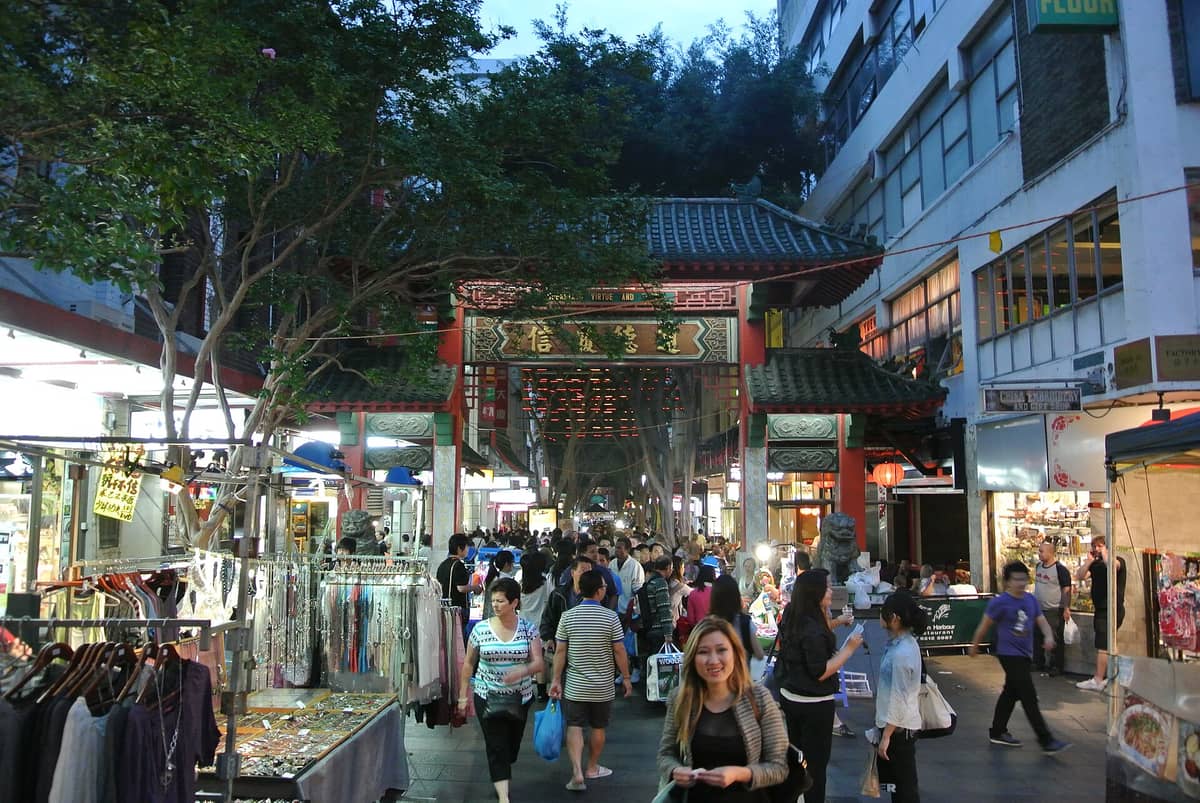
Sydney Chinatown is not a theme park version of a Chinese neighbourhood. It is a functioning commercial and community precinct in Haymarket that has been the economic and cultural centre of Sydney's Chinese community since at least the 1920s. The heart of it is Dixon Street, a pedestrian mall that runs between Hay Street to the south and Goulburn Street to the north, flanked by two ornate ceremonial gates that frame the strip in red and gold lacquer.
Dixon Street itself was pedestrianised on 15 October 1980, which gave the precinct its current character as a walkable, browsable corridor. But the broader Haymarket area extends well beyond those two blocks. Sussex Street, Thomas Street, Little Hay Street, and the surrounding arcade buildings all form part of the precinct, and some of the best eating happens off the main drag entirely.
ℹ️ Good to know
The precinct has no single set of opening hours. Individual businesses set their own schedules. Most restaurants and bakeries open from late morning and trade until late evening, but some specialty shops close by early afternoon. Coming on a weekday morning will show you a quieter, more local side of the precinct.
The Sensory Experience: What You'll See, Hear, and Smell
Walking through the Hay Street gate into Dixon Street on a Saturday afternoon is an exercise in controlled overstimulation. The smell hits first: char siu pork roasting in glass-fronted windows, fresh egg tarts cooling on bakery racks, dried seafood and herbs from the specialty grocers. Red lanterns hang overhead regardless of the season, and the sound mix is a combination of Mandarin and Cantonese conversations, the clatter of wok burners from kitchen extraction vents, and the occasional pop of firecrackers during festival periods.
The visual density is high. Shop frontages compete aggressively with signage in both Chinese and English. Hand-painted price boards advertise roast duck by the half. Stacked crates of produce on the footpath narrow the walking space. This is not a sanitised eating precinct; it has the texture of a place that has been working hard for a long time.
Early weekday mornings shift the register considerably. By 8 or 9am, the produce suppliers and wholesale traders are active, but the tourist-facing restaurants are mostly still preparing. The gates are unlit, the lanterns hang still, and the street has the particular quiet of a place between performances. If you want to see the precinct as locals experience it day-to-day, this is the window.
Tickets & tours
Live prices and dates from our booking partner. If you book, we may earn a commission at no extra cost to you.
Sydney's Chinatown history and food tour
From 40 €Instant confirmationFree cancellationSydney whale-watching cruise with breakfast or lunch
From 62 €Instant confirmationFree cancellationBlue Mountains guided tour with Sydney Zoo and Scenic World visit
From 134 €Instant confirmationFree cancellationSydney Harbour scenic flight - private 20 minutes tour
From 404 €Instant confirmationFree cancellation
Historical Context: From Gold Rush to Haymarket
The Chinese community's presence in Sydney dates to the mid-nineteenth century, with significant migration during the gold rush era. Haymarket became a consolidated social, cultural, and economic hub for Chinese residents in New South Wales by the 1920s, shaped partly by discriminatory housing policies that concentrated the community in specific areas, and partly by the organic clustering of businesses serving Chinese-speaking residents.
The City of Sydney's Haymarket and Chinatown Revitalisation Strategy documents this history in detail The City of Sydney's Haymarket and Chinatown Revitalisation Strategy documents this history in detail and acknowledges the precinct's ongoing role as a cultural anchor. The demographic reality of the street today reflects decades of subsequent migration waves; the food options on a single block might span Cantonese roast meats, Vietnamese pho, Korean barbecue, and Taiwanese bubble tea.. The demographic reality of the street today reflects decades of subsequent migration waves; the food options on a single block might span Cantonese roast meats, Vietnamese pho, Korean barbecue, and Taiwanese bubble tea.
This layering makes Sydney Chinatown worth understanding in relation to broader city history. For deeper cultural context, the Sydney Aboriginal culture guide provides useful background on the land the precinct occupies, which is Gadigal Country.
How to Move Through the Precinct
Start at the Hay Street gate, which is the more photogenic of the two entrances and where most first-time visitors orient themselves. Walk the length of Dixon Street slowly, resisting the impulse to commit to a restaurant immediately. The windows tell you a lot: look for roasting ducks hanging in the glass, tanks of live seafood, and bakeries with fresh trays of goods visible from the street. These are reasonable indicators of a kitchen that is actually producing food rather than reheating it.
Once you reach the Goulburn Street end, turn left or right and explore the connecting lanes. Sussex Street, one block west, has a different character: more wholesale suppliers, a few longer-established restaurants that pre-date the pedestrianisation of Dixon Street, and less foot traffic. The Capitol Square complex and the Market City shopping centre on the south side of the precinct contain additional food vendors, with Market City particularly worth checking on weekends when its food court fills up.
Paddy's Markets, which operates within the Haymarket precinct at the corner of Thomas Street and Hay Street, is a separate but related attraction. It operates on Fridays, Saturdays, and Sundays. If you plan to combine both, budget an extra hour. You can read more in the dedicated Paddy's Markets guide.
💡 Local tip
The best roast duck and char siu windows typically sell out by early afternoon on weekends. If you want roast meats, aim to arrive before 1pm.
Getting There and Getting Around
Both Central Station and Town Hall Station are approximately a 10-minute walk from the Dixon Street mall. From Central, walk north up George Street or cut through the Capitol Theatre precinct. From Town Hall, head south along George Street. Neither route is complicated, and both are flat. The light rail also stops at Central and connects to the inner west.
If you are combining Chinatown with Darling Harbour, the walking distance between the two is around 10 minutes westward through the Capitol Square precinct. The getting around Sydney guide covers public transport options in more detail, including the Opal card system used across metro, trains, buses, ferries, and light rail.
Dixon Street itself is a pedestrian mall, which makes it straightforward to navigate on foot. Accessibility notes from the City of Sydney indicate that planned revitalisation works aim to improve accessibility in the public space, though step-free routes through the surrounding arcade buildings should be verified on site. Vehicles do not pass through Dixon Street, so there is no traffic conflict in the main corridor.
When to Go and What to Expect by Season
The precinct operates year-round, but the experience changes significantly around the Lunar New Year period, which falls between late January and mid-February depending on the year. During this time, Dixon Street hosts lion dances, fireworks, and organised festivities that draw large crowds. The atmosphere is genuinely spectacular, but the street becomes extremely congested and some restaurants require bookings weeks in advance.
Outside of festival periods, weekday lunchtimes offer a sweet spot: restaurants are open, the food is fresh, and the crowds are manageable. Sydney's shoulder seasons of March to May and September to November bring mild temperatures (roughly 20 to 26 degrees Celsius in autumn, 21 to 24 in spring) that make the outdoor sections of the precinct comfortable to linger in. Summer afternoons can be hot, and the outdoor mall sections offer limited shade.
⚠️ What to skip
Saturday evenings from around 6pm onward are the busiest point of the week. Queues form at popular restaurants, parking in the surrounding streets is extremely limited, and the mall becomes congested enough that it is difficult to move at a comfortable pace. If you dislike crowds, Friday lunch or a weekday evening are better options.
For travellers planning a broader Sydney itinerary that includes Chinatown, the Sydney food guide covers the city's wider dining landscape and can help contextualise where Chinatown fits within the overall eating scene.
Honest Assessment: What Works and What Does Not
Sydney Chinatown is a genuine cultural precinct with real history and genuinely good food. It is not, however, a manicured experience. Some of the shops on Dixon Street are gift merchants selling the same ceramic cats and silk fans you would find anywhere. A few of the restaurants in the highest-traffic positions on the mall lean on tourist throughput rather than quality. The gate architecture is photogenic but the immediate surrounds can look worn.
Visitors who want a curated, atmospheric destination with controlled aesthetics may find the precinct underwhelming compared to expectations set by images of more formally designed Chinatowns elsewhere. Visitors who want real food, community activity, and a place that has not been flattened into a tourism product will find plenty to work with.
Travellers who are not interested in food and have no particular connection to the cultural history of the precinct may find an hour sufficient. The street itself is short enough to walk end-to-end in five minutes; the time investment is really about what you choose to eat, buy, and explore in the surrounding blocks.
Insider Tips
- The basement food court inside the Market City shopping centre on Hay Street has lower prices and shorter queues than most street-level restaurants on Dixon Street, and the quality is comparable or better at several stalls.
- Lunar New Year is spectacular but extremely crowded. If you plan to visit during that period, book any sit-down restaurant at least two weeks in advance and arrive for lion dances at least 30 minutes before the scheduled time.
- The wholesale produce shops on the side streets sell fresh fruit, Asian vegetables, and specialty ingredients at prices well below supermarket rates. Worth a detour if you are self-catering.
- Many of the bakeries do not display English menus for their full range. Pointing at items in the glass case is entirely normal and welcomed; staff in most shops are accustomed to mixed-language interactions.
- If you are visiting on a Friday, Saturday, or Sunday, combine the trip with Paddy's Markets next door, which opens from 10am. The fresh produce section inside the market is cheaper than most of the surrounding precinct's shops.
Who Is Sydney Chinatown For?
- Food-focused travellers who want to eat well on a budget
- Families with older children who are comfortable in busy urban environments
- Travellers visiting Sydney during Lunar New Year who want to experience the city's celebrations
- Independent explorers who prefer working-neighbourhood character over polished tourist precincts
- Visitors combining a half-day with Darling Harbour or Paddy's Markets
Nearby Attractions
Other things to see while in Sydney CBD:
- ANZAC Memorial
Standing at the southern end of Hyde Park, the ANZAC Memorial is one of Sydney's most significant commemorative sites. Free to enter and open daily, it combines powerful Art Deco architecture with thoughtful exhibitions tracing Australia's wartime history from the First World War to recent conflicts.
- Art Gallery of New South Wales
The Art Gallery of New South Wales spans two architecturally distinct buildings on The Domain, offering free access to one of Australia's most significant art collections. From colonial-era Australian works to contemporary Pacific and Aboriginal art, the gallery rewards visitors who know where to look.
- Australian Museum
The Australian Museum is Sydney's oldest museum, founded in 1827, with free general admission and collections spanning science, culture, and nature. Located opposite Hyde Park in the CBD, it suits curious travellers with two to three hours to spend indoors.
- Government House Sydney
Government House Sydney is the official residence of the Governor of New South Wales, set inside the Royal Botanic Gardens on Macquarie Street. Free guided tours run on Fridays and weekends through State Rooms filled with colonial-era furniture, portraits, and silverware. It is one of the few active vice-regal residences in Australia that regularly opens its doors to the public at no cost.
Planning a trip? Discover personalized activities with the Nomado app.