Paddy's Markets Haymarket: A Sydney Market with Roots in 1834
With origins dating to 1834, Paddy's Markets Haymarket is a sprawling indoor market in central Sydney where hundreds of stalls sell fresh produce, discount clothing, electronics, and tourist souvenirs. Free to enter, open Wednesday to Sunday, and a five-minute walk from Central Station.
Quick Facts
- Location
- 9–13 Hay Street, Haymarket NSW 2000
- Getting There
- Light rail: Paddy's Markets stop. Train: Central Station (~5 min walk). Buses serve Haymarket.
- Time Needed
- 45 minutes to 2 hours
- Cost
- Free entry. Prices vary by stall.
- Best for
- Bargain hunters, foodies, families, and budget travellers
- Official website
- www.paddysmarkets.com.au
What Paddy's Markets Actually Is
Paddy's Markets Haymarket is one of Australia's oldest markets, with origins tracing back to 1834 when traders were relocated to the Haymarket area. Nearly two centuries later, it occupies a large indoor space beneath the Market City shopping centre, just south of the Sydney CBD. The scale surprises first-time visitors: stalls spread across a covered floor, selling everything from fresh produce to clothing, phone accessories, and tourist souvenirs.
This is not a curated artisan market with letterpress cards and handmade ceramics. Think closer to a permanent discount bazaar with a fresh produce section attached. The mix is part of its character: a wholesaler offloading excess stock next to a florist next to a stall piled with knockoff sunglasses. If that sounds chaotic, it is, a little. It is also genuinely useful and occasionally surprising.
ℹ️ Good to know
Entry is free. The market is open Wednesday to Sunday, 10:00 am to 6:00 pm. It is closed Monday and Tuesday.
How the Market Feels at Different Times of Day
Arriving at opening time on a Wednesday or Thursday gives you a quieter, more manageable experience. Stall holders are still arranging produce, and there is room to move. The smell at this hour is mostly fruit and vegetables — citrus, stone fruit in summer, earthy root vegetables in autumn — with coffee drifting in from the food stalls near the entrance.
Saturday and Sunday afternoons are a different proposition. By midday, the floor fills with families, local residents doing weekly grocery runs, and tourists working through souvenir lists. The noise level rises considerably: stall holders calling out prices, trolleys navigating narrow gaps, children. Weekends are the best time to feel the market at full energy, but also the most physically demanding if you dislike crowded spaces.
The produce section, towards the rear and sides of the floor, tends to draw a noticeably local crowd regardless of the day. You will hear Cantonese, Vietnamese, Arabic, and Mandarin as often as English, which reflects both the neighbourhood's makeup and the market's long history as a practical food-shopping destination for Sydney's diverse communities.
Tickets & tours
Live prices and dates from our booking partner. If you book, we may earn a commission at no extra cost to you.
The Rocks historic walking tour
From 20 €Instant confirmationFree cancellationBeginner surf lesson at Bondi Beach
From 79 €Instant confirmationFree cancellationSydney whale-watching cruise with breakfast or lunch
From 62 €Instant confirmationFree cancellationBlue Mountains Waterfalls Full-Day Tour with Lunch and Dinner
From 171 €Instant confirmationFree cancellation
What to Buy and What to Skip
Fresh fruit and vegetables offer consistently good value. Prices undercut major supermarkets, and the selection is broad, particularly for Asian vegetables: bitter melon, bok choy varieties, lotus root, and fresh herbs that are hard to find in standard grocery stores. If you are self-catering or cooking during your stay, this is the most useful section of the market.
Souvenirs here are among the cheapest in Sydney. Keyrings, stubby holders, stuffed kangaroos, Aboriginal-design merchandise (quality varies widely), and Opera House paraphernalia are sold in bulk at prices noticeably lower than harbour-side tourist shops. For practical gifts or stocking fillers, the value is reasonable. For anything representing genuine Aboriginal art or craft, seek out dedicated Indigenous art galleries instead.
Clothing and accessories run the gamut from unbranded basics to discounted sportswear. Electronics stalls sell cables, chargers, and phone accessories at low prices. The quality is variable, so inspect before buying. For comparison shopping in the surrounding precinct, note that Chinatown and the Dixon Street food corridor are a short walk away. For a sense of how Paddy's Markets fits into Sydney's broader market scene, see our guide to Sydney's best markets.
💡 Local tip
Bring cash. While some stalls accept card, many prefer cash, and ATMs inside can carry fees. There are bank ATMs on George Street and nearby Dixon Street.
Getting There and Arriving Orientated
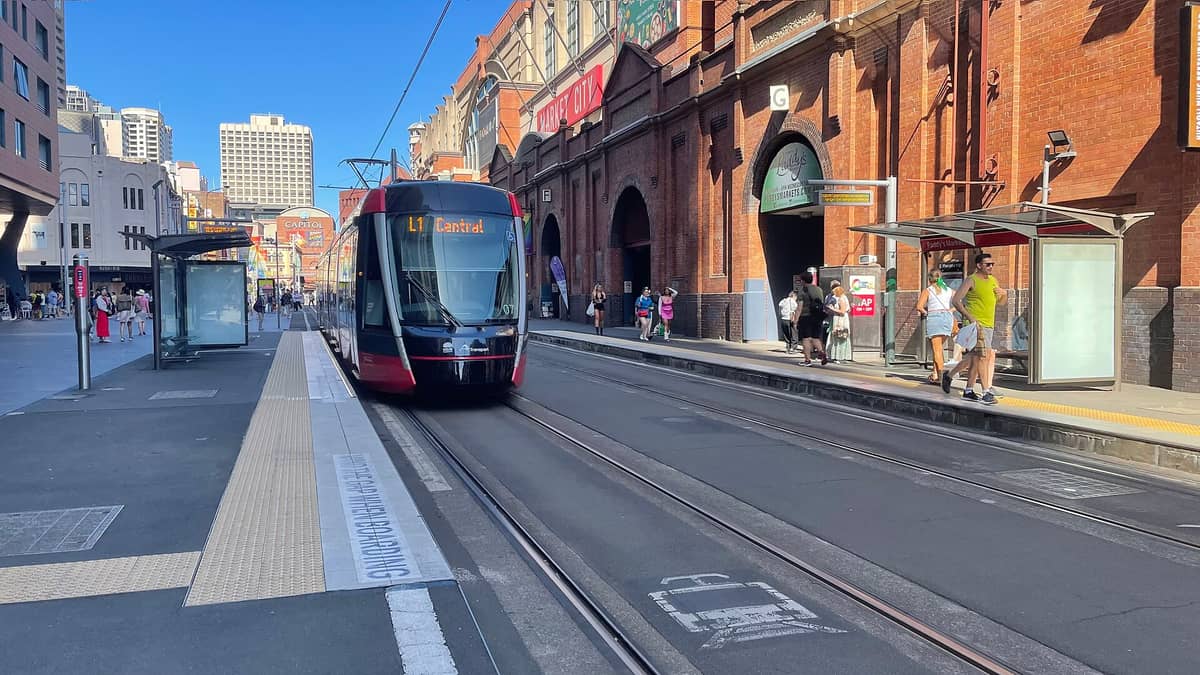
The light rail is the most direct option: the Paddy's Markets stop on the L1 Dulwich Hill Line deposits you at the market's front entrance. Central Station, served by most Sydney train lines and the Sydney Metro, is roughly a five-minute walk south along George Street and Hay Street. Buses serving the Haymarket area stop nearby on George and Hay Streets.
Driving is possible but rarely worth it. Parking in Haymarket is expensive and limited. The Transport for NSW trip planner at transportnsw.info can calculate the best route from your accommodation. If you are already exploring Darling Harbour, Paddy's Markets is a short walk east, making it easy to combine both in one loop.
On arrival, orient yourself at the main Hay Street entrance. The fresh produce section runs along the far wall and wraps around the sides. The centre and front sections are predominantly general merchandise and souvenirs. Food stalls cluster near the entrances. The floor plan is intuitive once you are inside, though the density of stalls can make it feel larger than it is.
Historical Context Worth Knowing
Markets in the Haymarket area date to 1834, when traders were relocated there from earlier locations. The origin of the name 'Paddy's' is obscure; the market's official history says it was most likely borrowed from Liverpool, England. The market has been associated with the Haymarket area for generations, through economic downturns, urban redevelopment, and relocations within the precinct.
Today's market sits beneath the Market City shopping centre, which was developed above it in the 1990s. Market City itself hosts outlet stores and a food court popular with Sydney's Korean and broader Asian community. If the market floor itself is not sufficient, the floors above offer additional shopping options. For more context on the surrounding neighbourhood, see our overview of Sydney's Chinatown, which borders the market directly to the north.
Practical Considerations Before You Go
Accessibility
The market operates on a single level, which is accessible from the street. The official transport information confirms public-transport access but does not provide detailed step-free route information. If you have specific accessibility requirements, contacting the market directly before visiting is advisable.
Photography
The covered, artificially lit environment means natural light is absent. A phone camera set to a slightly higher ISO handles the conditions adequately for casual shots. Some stall holders are happy to be photographed; others prefer you do not. Ask before pointing a camera at anyone directly.
Who Should Consider Skipping This
Travellers with only a day or two in Sydney and a focus on iconic sights may find Paddy's Markets a poor use of limited time. The experience is everyday rather than exceptional, and there is nothing here that could not be found at a large discount market anywhere. If your Sydney itinerary is short, the 3-day Sydney itinerary prioritises the experiences that are genuinely unique to the city. Paddy's Markets works best as part of a Haymarket neighbourhood wander rather than a destination in its own right.
⚠️ What to skip
The market is closed Monday and Tuesday. Arriving on these days is a common mistake for visitors who assume it operates daily.
Combining Paddy's Markets with the Surrounding Area
The market's location in Haymarket makes it a natural anchor for a broader neighbourhood visit. Dixon Street, the pedestrianised core of Sydney's Chinatown, is literally adjacent, with barbecue duck shops, noodle restaurants, bubble tea, and bakeries operating from early morning into the night. For a budget meal before or after the market, the options here are some of the best value in central Sydney. Our Sydney food guide covers the neighbourhood's dining options in more detail.
A short walk west reaches Darling Harbour and the Chinese Garden of Friendship, which offers a calm counterpoint to the market's noise and density. Families with children can continue to the Sea Life Sydney Aquarium on the Darling Harbour foreshore. The geography connects naturally into a half-day loop that covers the area without requiring a car or significant additional transit.
Insider Tips
- Arrive on a Wednesday or Thursday morning for the thinnest crowds and the freshest produce delivery days. Weekend afternoons are the busiest period by a significant margin.
- The produce prices displayed are often negotiable if you are buying in quantity. Buying a full tray of fruit rather than individual pieces typically unlocks a better rate without asking.
- The Market City food court on the floors above the market is popular with Sydney's Korean community for authentic Korean fried chicken and Korean-Chinese dishes. It is consistently busy at lunch but worth the wait.
- Souvenir prices at Paddy's Markets are typically the lowest you will find in central Sydney. If you are buying multiple items from the same stall, a polite ask for a combined price usually yields a small discount.
- The light rail stop named 'Paddy's Markets' is on the L1 Dulwich Hill Line, which connects to Central and the inner west. It is a convenient way to continue toward Newtown after your visit.
Who Is Paddy's Markets For?
- Budget travellers stocking up on cheap souvenirs or groceries
- Families looking for a low-cost, covered activity
- Food shoppers seeking fresh produce at lower-than-supermarket prices
- Visitors exploring the Haymarket and Chinatown precinct
- Anyone curious about a slice of everyday Sydney commercial life
Nearby Attractions
Other things to see while in Sydney CBD:
- ANZAC Memorial
Standing at the southern end of Hyde Park, the ANZAC Memorial is one of Sydney's most significant commemorative sites. Free to enter and open daily, it combines powerful Art Deco architecture with thoughtful exhibitions tracing Australia's wartime history from the First World War to recent conflicts.
- Art Gallery of New South Wales
The Art Gallery of New South Wales spans two architecturally distinct buildings on The Domain, offering free access to one of Australia's most significant art collections. From colonial-era Australian works to contemporary Pacific and Aboriginal art, the gallery rewards visitors who know where to look.
- Australian Museum
The Australian Museum is Sydney's oldest museum, founded in 1827, with free general admission and collections spanning science, culture, and nature. Located opposite Hyde Park in the CBD, it suits curious travellers with two to three hours to spend indoors.
- Sydney Chinatown
Sydney Chinatown occupies the Haymarket precinct around Dixon Street, a pedestrianised mall bookended by ornate gates and lined with restaurants, bakeries, and produce shops. Free to enter and accessible by train, it rewards visitors who know when to go and what to look for.
Planning a trip? Discover personalized activities with the Nomado app.