Chinese Garden of Friendship: Sydney's Classical Retreat in Darling Harbour
The Chinese Garden of Friendship is a 1.03-hectare classical Chinese garden in Darling Harbour, opened in 1988 as a symbol of the sister-city relationship between New South Wales and Guangdong Province. With ornate pavilions, willow-edged ponds, and a deliberate quietness that contrasts sharply with the surrounding precinct, it offers one of Sydney's most distinctive cultural experiences.
Quick Facts
- Location
- Pier Street at Harbour Street, Darling Harbour, NSW 2000 (entrance on Tumbalong Boulevard)
- Getting There
- Light rail to Convention; train to Town Hall or Central, then a short walk
- Time Needed
- 45 minutes to 1.5 hours
- Cost
- Adults A$12 | Children (5–11) A$8 | Under 5s free | Family (2 adults, 3 children) A$30 | Concession/Senior A$8
- Best for
- Cultural history, quiet reflection, photography, families, couples
- Official website
- www.darlingharbour.com/precincts/chinese-garden
What the Chinese Garden of Friendship Actually Is
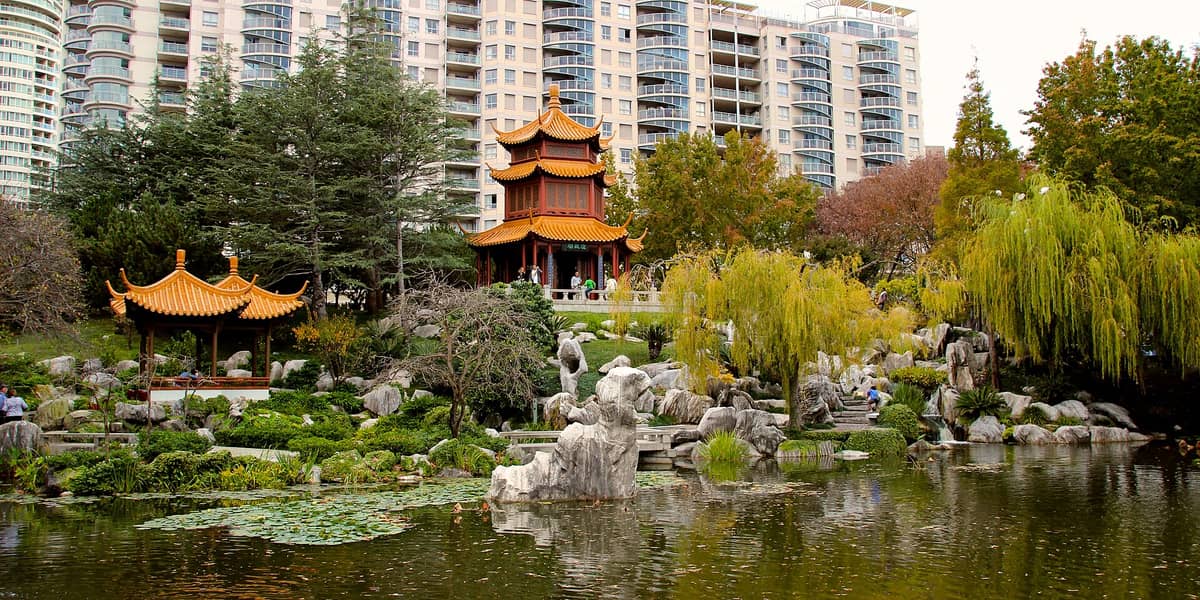
The Chinese Garden of Friendship (谊园 in simplified Chinese, 誼園 in traditional) is a formal classical garden built according to the principles of southern Chinese garden design, specifically the style of Guangdong Province. It sits on 1.03 hectares at the southern edge of Darling Harbour, enclosed by low stone walls that do a surprisingly effective job of muffling the traffic and crowds outside. Opened on 17 January 1988 as part of Sydney's Bicentennial celebrations, the garden was a gift from Guangdong Province to New South Wales, reflecting the sister-state relationship between the two regions.
The design was the work of landscape architects from Guangzhou, and the materials, including the rocks, carved timber, and ceramic roof tiles, were largely sourced from China. This is not a decorative theme park interpretation of Chinese aesthetics. The garden's layout follows genuine principles: asymmetrical pathways that reveal new views incrementally, covered walkways (known as corridors) that frame the landscape as you move, and deliberate contrasts between open water and dense planting, stillness and sound.
ℹ️ Good to know
The garden is open daily from 10 am to 5 pm, closing on Christmas Day and Good Friday. Arrive before 11 am on weekends to have the main lake area largely to yourself.
Entering the Garden: First Impressions and the Lay of the Land
You enter through a ceremonial gateway on Tumbalong Boulevard. The transition is immediate. Within a few steps the noise of Darling Harbour softens, replaced by the sound of water trickling through carved stone channels and, depending on the season, the occasional deep croak of frogs near the pond edges. The air carries the faint green smell of lotus and still water.
The garden divides roughly into a lower section around the main lake and a more elevated rocky landscape above. The lower paths are paved, flat, and wide enough for wheelchairs, prams, and buggies. The upper section involves stone steps and uneven rocky terrain that can be genuinely difficult to navigate without good footing, particularly after rain when the stones become slippery.
The main lake is the garden's centrepiece: a still body of water crossed by zigzag bridges, ringed with weeping willows, and populated by large koi that cluster near the bridge edges expecting to be fed. Pavilions sit at intervals around the perimeter, each named and built for a specific purpose, from the Tea House to the Lotus Pavilion. The rock formations in the upper section, made from Lake Tai stones sourced in China, are sculpted by natural erosion into jagged, organic shapes that have symbolic meaning in classical Chinese garden tradition.
💡 Local tip
The zigzag bridges over the lake are a genuine design feature, not just decorative. In traditional belief, evil spirits can only travel in straight lines, so the bridges' angles were meant to prevent their crossing. Pausing mid-bridge gives the best unobstructed view of the main pavilion reflected in the water.
Tickets & tours
Live prices and dates from our booking partner. If you book, we may earn a commission at no extra cost to you.
The Rocks historic walking tour
From 20 €Instant confirmationFree cancellationBeginner surf lesson at Bondi Beach
From 79 €Instant confirmationFree cancellationSydney whale-watching cruise with breakfast or lunch
From 62 €Instant confirmationFree cancellationBlue Mountains Waterfalls Full-Day Tour with Lunch and Dinner
From 171 €Instant confirmationFree cancellation
How the Garden Changes Through the Day
Morning visits, particularly on weekdays, are the quietest. Between 10 am and midday, you may have entire sections of the garden to yourself. The light falls at a low angle through the willow fronds onto the lake surface, and the koi move slowly in the cooler temperature. The Tea House, which operates inside the garden, is usually calm at this hour, making it a good time to sit with a pot of tea and look out across the water without distraction.
By midday and into early afternoon, school groups and tour parties arrive, particularly on weekdays. The garden is small enough that a single large group changes the atmosphere considerably. Paths near the main lake fill with people photographing the koi, and the pavilion interiors become crowded. If you visit during these hours, moving to the upper rock garden tends to thin the crowd, as fewer visitors make the effort to climb the steps.
Afternoons after 3 pm see the crowds ease again. The light becomes warmer and lower from the west, and photographers will find the pavilion rooflines and the reflective lake surface more interesting in this light. In summer (December to February), afternoon temperatures in the garden can be warm given the limited shade in some sections; the covered corridors and the Tea House provide relief.
The Tea House and the Practical Walkthrough
The Chinese Garden Tea House operates inside the garden and is included within your entry. It serves traditional Chinese teas alongside yum cha items, sesame balls, and other snacks. The tea service is unhurried and follows a proper steeping process, which means it suits a longer stop rather than a quick break. Seating is limited, and it fills quickly on weekends. If tea is a priority, either arrive early or plan to visit late in the afternoon.
A full circuit of the garden, including the upper section, typically takes 45 minutes to an hour at a comfortable pace. If you spend time in the Tea House, allow 1.5 hours total. The garden is compact enough that doubling back to re-examine a pavilion or a specific rock formation is easy without the walk becoming tedious.
Accessible toilet facilities and baby-change rooms are available on site. Photography is freely permitted throughout the garden, and no tripods or professional permits are required for personal or travel photography. The garden's enclosed walls and consistent framing of views make it one of the more reliably photogenic sites in the Darling Harbour precinct, regardless of the time of year.
💡 Local tip
For photography, the best single composition in the garden is the pavilion reflected in the main lake, shot from the far side of the zigzag bridge in morning light. Use a slower shutter speed if conditions are still, the reflection can be near-perfect on calm mornings.
Cultural and Historical Context
The garden's formal name in Chinese, 谊园 (Yì Yuán), translates roughly as Garden of Friendship, a direct reference to its diplomatic origins. The sister-state relationship between New South Wales and Guangdong Province, formalised in 1980, was one of the first such agreements made by an Australian state with a Chinese province. The garden was a tangible expression of that relationship, constructed using artisans and materials from Guangdong, and it opened during Sydney's Bicentennial year, when the city was engaged in large-scale cultural commemoration.
The design tradition it draws from, southern Chinese literati garden design, is the same tradition behind the famous private gardens of Suzhou, which are listed as UNESCO World Heritage Sites. Guangdong garden design tends to be slightly more open and less densely planted than the Suzhou style, favouring wider water features and more direct sightlines, which is visible in the Chinese Garden of Friendship's generous lake proportions. For those interested in Sydney's broader relationship with Chinese history and culture, the nearby Chinatown precinct provides useful context around the patterns of Chinese migration and settlement in the city over more than 150 years.
Getting There and Practical Notes
The garden's entrance on Tumbalong Boulevard is straightforward to reach by public transport. The light rail (Convention stop) brings you to within a few minutes' walk. From the CBD, the walk from Town Hall station takes around 10–15 minutes depending on your pace through Darling Harbour. Paid parking is available at the ICC Sydney car park nearby if you are driving, though parking rates in the precinct are standard Sydney CBD pricing.
The garden is entirely outdoors and exposed to Sydney's weather. On rainy days the covered walkways and pavilions provide shelter, and the garden actually looks striking in wet conditions, the stones darken and the water surfaces reflect dramatically. Wet paths in the upper section do become slippery, so shoes with grip are worth considering if rain is forecast. In summer, light clothing and sun protection are advisable for the sections without shade cover.
The garden is not an appropriate visit for people who have limited time and are prioritising Sydney's headline attractions. It is small, it takes under two hours at most, and its appeal is quiet and contemplative rather than spectacular. People who find formal gardens dull, or who are travelling with children too young to walk the full circuit, may find the entry cost hard to justify. That said, children who engage with the koi feeding and the bridges often enjoy it more than adults expect.
⚠️ What to skip
The upper garden section involves uneven rocky steps and natural stone paths that become slippery after rain. Wheelchair and pram users should note this section is not accessible; the lower paths and pavilions are fully accessible.
Fitting the Garden Into a Darling Harbour Visit
The Chinese Garden of Friendship sits at the southern edge of the Darling Harbour precinct, which makes it easy to combine with other nearby attractions. The SEA LIFE Sydney Aquarium and the Australian National Maritime Museum are both within a 10-minute walk. For families spending a full day in the precinct, the garden works well as a quieter interval between more intensive attractions. For visitors doing a broader overview of Sydney's cultural sites, pairing the garden with the Museum of Contemporary Art Australia on the same day is a reasonable combination, though they require separate transit to connect.
If you are building an itinerary around Darling Harbour and want a structured framework, the 3 days in Sydney guide covers how to organise the precinct alongside the city's other major areas.
Insider Tips
- The Tea House has a limited number of window seats overlooking the lake. If you want one, arrive before 11 am on weekends or ask the staff directly whether a lakeside table is available before you are seated.
- The garden's enclosed walls make it one of the few places in Darling Harbour where you can take a photograph without cranes, hotel towers, or signage in the background. For clean architectural shots, the internal corridors and moon gates frame themselves.
- Koi in the main lake are most active and visible in the morning when the water is cooler and the fish move near the surface. By afternoon on hot days, they sink deeper and are harder to spot from the bridges.
- If you visit during the Lunar New Year period, the garden often holds special programming and is decorated accordingly. Check the Darling Harbour events calendar in advance; the garden can be significantly busier during these periods.
- The garden's stone moon gates, circular openings cut through walls that frame a view, are deliberately positioned to align with specific garden features. Pause at each one and look through rather than walking straight past.
Who Is Chinese Garden of Friendship For?
- Travellers who want a genuine cultural experience that contrasts with Sydney's more obvious attractions
- Photography enthusiasts looking for composed, architectural, and reflective-water shots
- Couples seeking a quiet and unhurried stop in an otherwise busy precinct
- Families with children aged 5 and older who are engaged by the koi, bridges, and rock formations
- Visitors with an interest in Chinese history, garden design tradition, or NSW-China diplomatic ties
Nearby Attractions
Other things to see while in Darling Harbour:
- Australian National Maritime Museum
Sitting on the waterfront at Darling Harbour, the Australian National Maritime Museum is one of Sydney's most substantial cultural institutions. Permanent galleries are free to enter, and several historic vessels moored at the wharf, including a destroyer and a submarine, can be explored for an additional fee.
- SEA LIFE Sydney Aquarium
SEA LIFE Sydney Aquarium sits on the edge of Darling Harbour and packs an enormous range of marine life into one compact building. From dugongs and sharks to sea dragons and penguins, it offers a solid half-day of genuinely impressive exhibits, particularly for families and first-time visitors to Sydney.
- WILD LIFE Sydney Zoo
WILD LIFE Sydney Zoo brings together some of Australia's most iconic animals under one roof in Darling Harbour. It is compact, well-organised, and designed for visitors who want an authentic encounter with Australian wildlife without travelling far from the city centre. Whether it earns its ticket price depends largely on how you approach it.
Planning a trip? Discover personalized activities with the Nomado app.