ANZAC Memorial, Sydney: What to Expect, See, and Know Before You Go
Standing at the southern end of Hyde Park, the ANZAC Memorial is one of Sydney's most significant commemorative sites. Free to enter and open daily, it combines powerful Art Deco architecture with thoughtful exhibitions tracing Australia's wartime history from the First World War to recent conflicts.
Quick Facts
- Location
- Hyde Park South, Sydney CBD NSW 2000 (between Elizabeth and Liverpool Streets)
- Getting There
- Museum Station (Sydney Trains), approx. 160 m walk; buses on Elizabeth and Liverpool Streets
- Time Needed
- 45 minutes to 1.5 hours depending on how closely you engage with the exhibitions
- Cost
- Free (AUD $0); no booking required
- Best for
- History lovers, architecture enthusiasts, families seeking meaningful experiences, solo travellers
- Official website
- www.anzacmemorial.nsw.gov.au
What the ANZAC Memorial Actually Is
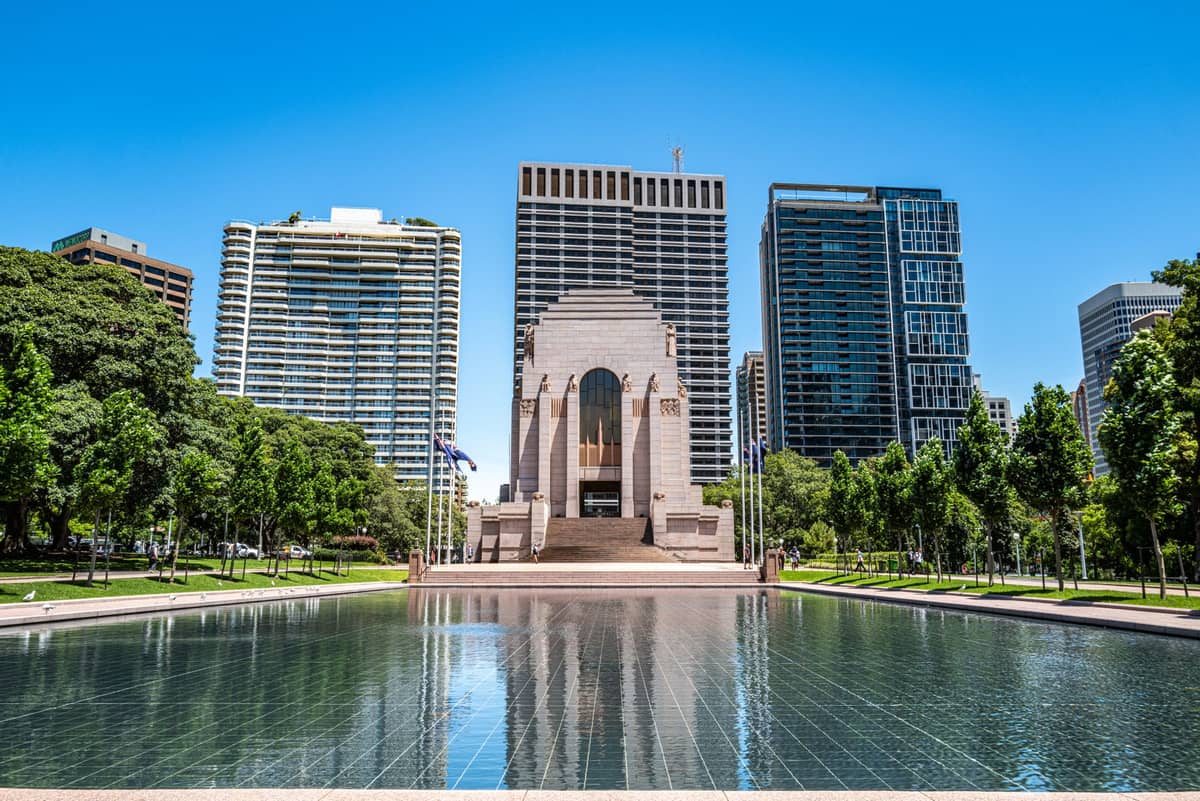
The ANZAC Memorial is a purpose-built commemorative building in the southern section of Hyde Park, opened on 24 November 1934. It serves as both a war memorial and a museum, dedicated to the men and women of New South Wales who served in the First World War. The building stands approximately 100 feet high on a base measuring 150 by 90 feet, making it a genuine civic monument rather than a token plaque or statue.
Admission is free and the memorial is open daily from 9 am to 5 pm, closed only on Christmas Day and Good Friday. Verify current hours at the official website before visiting, as occasional commemorative events may cause brief closures. There is no queuing system, no timed entry, and no need to book in advance.
💡 Local tip
Museum Station is the closest train stop, roughly 160 metres from the memorial entrance. From the station, walk south through Hyde Park and the domed building appears at the end of the tree-lined avenue.
The Architecture: Art Deco Done Seriously
The memorial was designed by Sydney architect C. Bruce Dellit and represents one of the finest examples of Art Deco civic architecture in Australia. From the outside, the building reads as restrained and monumental: smooth sandstone faces, vertical fins, and geometric detailing that strips ornament down to its structural essentials. It does not look like a church, a government office, or a gallery. It looks exactly like what it is: a place built to carry weight.
The exterior sculpture programme was carried out by Rayner Hoff, whose figures appear around the memorial. High above street level, the facade features sculpted figures representing units of the Australian Imperial Force, and bronze bas-reliefs depict scenes from the First World War. Up close, the figures have real specificity: the weight of kit, the posture of the marching line. Standing on the Elizabeth Street side and looking up at the full facade in the late afternoon, when the sandstone picks up the warm light, gives a sense of the building's original ambition.
Inside, the dome is the first thing that stops most visitors. The ceiling is perforated with 120,000 stars, said to represent the number of New South Wales men and women who embarked for overseas service in the First World War. At the centre of the Hall of Silence, directly below the Hall of Memory, is Rayner Hoff's sculpture 'Sacrifice': a bronze figure of a fallen warrior lying on a shield supported by three women. The light condition inside shifts through the day as sunlight tracks across the dome's openings, making a midday visit feel quite different from one in early morning.
Tickets & tours
Live prices and dates from our booking partner. If you book, we may earn a commission at no extra cost to you.
The Rocks historic walking tour
From 20 €Instant confirmationFree cancellationBeginner surf lesson at Bondi Beach
From 79 €Instant confirmationFree cancellationSydney whale-watching cruise with breakfast or lunch
From 62 €Instant confirmationFree cancellationBlue Mountains Waterfalls Full-Day Tour with Lunch and Dinner
From 171 €Instant confirmationFree cancellation
The Exhibition Floors: More Than a Memorial
Below the Hall of Memory, a lower gallery holds permanent and temporary exhibitions tracing New South Wales' wartime history across multiple conflicts, from Gallipoli and the Western Front through to more recent deployments. The exhibitions use personal objects, photographs, letters, and recorded testimonies rather than large hardware displays, which keeps the focus on individual experience rather than military spectacle.
The tone throughout is sober without being heavy-handed. Exhibition text is accessible to adults and older children alike, and the personal stories woven through the displays make the history legible to visitors who have no prior knowledge of Australian military history. Families with children tend to engage well here, partly because the scale of the building holds attention and partly because the storytelling format connects figures and facts to specific people.
If you want to build broader context before visiting, the Museum of Sydney covers the city's colonial and social history, while the Australian Museum focuses on natural history and culture. The ANZAC Memorial occupies its own distinct lane: it is specifically a site of commemoration, and the exhibition design reflects that priority.
How the Experience Changes by Time of Day
Arriving at 9 am, shortly after opening, means having the Hall of Memory almost to yourself. The interior is quiet in a way that feels appropriate rather than empty: the stone floors and domed ceiling carry sound differently from most Sydney attractions, and the absence of background music or audio guides is deliberate. Early visitors can spend time with Hoff's central sculpture without other groups pressing in.
By midday, particularly on weekdays, school groups arrive and the lower gallery becomes busier. The building handles this well structurally, as the upper hall and the exterior terraces offer space to step aside. During the lunch hour on weekdays, visitors may pause at the memorial precinct's Pool of Reflection, north of the building. The water surface, framed by trees, makes for a calming passage even if you do not enter the building.
Late afternoon, from around 3 pm, brings lower crowd numbers and the best exterior light for photographs. The sandstone facade catches the western sun and the dome becomes more readable against the sky. On ANZAC Day (25 April), the site takes on an entirely different character: the Commemoration Service at the ANZAC Memorial is one of Sydney's major public gatherings, and the memorial is the focal point of the ceremony. If you happen to be in Sydney on that date, arriving well before the service is advisable.
ℹ️ Good to know
The reflection pool north of the memorial is part of the designed precinct. Stand at the pool's edge and look north toward the building for the most composed view of the facade and dome together.
Getting There and Accessibility
Museum Station is the most direct transit option, approximately 160 metres from the memorial entrance. From the station concourse, walk south through the park. Multiple bus routes stop on both Elizabeth Street and Liverpool Street, which flank Hyde Park on either side. The surrounding CBD grid makes the memorial easy to incorporate into a walking route between other attractions.
Hyde Park itself is a pleasant transit corridor. The Hyde Park precinct connects the memorial to the city's central blocks, and walking the full length of the park from the Archibald Fountain in the north to the memorial in the south takes about ten minutes at a relaxed pace.
Accessibility is well managed. The accessible entry is from Liverpool Street, with a ramp also available on the Elizabeth Street side. Lifts and inclinators provide access between the Hall of Memory and the lower exhibition gallery. Pram and wheelchair access throughout the building is workable. Check the official accessibility page for current details before visiting if you have specific requirements.
Photography, Etiquette, and Practical Notes
Photography is permitted throughout the building, and the interior offers some genuinely rewarding compositions: the dome and its star perforations, the bronze sculpture from below, and the light falling through the openings onto the stone floor. A wide-angle lens or phone camera in portrait mode handles the interior scale well. Tripods are unlikely to be permitted given the public nature of the space, so rely on natural light and steady hands.
The building functions as an active commemorative site, not just a heritage attraction. Keeping voices low in the Hall of Memory is the general expectation of most visitors, and the atmosphere naturally encourages this. Groups with young children occasionally find the quiet of the upper hall challenging to maintain for more than a few minutes, which is fine: the lower exhibition gallery is somewhat less formal in atmosphere.
The ANZAC Memorial sits within the broader context of Sydney's free attractions, making it an easy inclusion in a budget itinerary. No entry cost, no booking friction, and a central location mean there is genuinely no practical barrier to visiting.
Who Should Skip This
Visitors primarily looking for interactive, high-stimulation experiences may find the memorial understated. The exhibitions are engaging but not immersive in the digital or theatrical sense. There are no large vehicle or weapons displays. If your main interest is a broad overview of Australian natural history or Indigenous culture, other institutions serve that need more directly.
Travellers with very limited time in the city who are prioritising major harbour landmarks might find the memorial competes with Sydney Opera House or the Sydney Harbour Bridge for that time. That said, the memorial's CBD location and zero-cost entry mean it can realistically be added to a morning without significantly affecting the rest of an itinerary.
Insider Tips
- Visit on a weekday morning before 10 am if you want the Hall of Memory with minimal company. The dome's star perforations are most atmospheric in the quieter light of early opening.
- The reflection pool on the northern approach is the best spot for exterior photographs of the full building. Crouch slightly to capture both the pool surface and the dome in a single frame.
- Check the memorial's events calendar before visiting: commemorative ceremonies, particularly around ANZAC Day (25 April), draw significant crowds and may briefly close parts of the building.
- The Hyde Park trees that line the path from the Archibald Fountain to the memorial are part of the park's mid-to-late-1930s landscaping. Walking the full length of the park to arrive at the memorial gives the building a proper sense of approach that you miss if you enter directly from Liverpool Street.
- If you are travelling with children, begin in the lower exhibition gallery rather than the Hall of Memory. The personal stories and objects in the lower level tend to hold attention better before the upstairs sculpture.
Who Is ANZAC Memorial For?
- History and military history enthusiasts who want personal-scale storytelling rather than hardware displays
- Architecture lovers interested in Australian Art Deco civic design
- Families with older children (roughly 8 and up) looking for a meaningful cultural stop
- Budget and free-entry travellers: no cost, no booking, central location
- Visitors attending ANZAC Day ceremonies or seeking to understand the significance of April 25 in Australian life
Nearby Attractions
Other things to see while in Sydney CBD:
- Art Gallery of New South Wales
The Art Gallery of New South Wales spans two architecturally distinct buildings on The Domain, offering free access to one of Australia's most significant art collections. From colonial-era Australian works to contemporary Pacific and Aboriginal art, the gallery rewards visitors who know where to look.
- Australian Museum
The Australian Museum is Sydney's oldest museum, founded in 1827, with free general admission and collections spanning science, culture, and nature. Located opposite Hyde Park in the CBD, it suits curious travellers with two to three hours to spend indoors.
- Sydney Chinatown
Sydney Chinatown occupies the Haymarket precinct around Dixon Street, a pedestrianised mall bookended by ornate gates and lined with restaurants, bakeries, and produce shops. Free to enter and accessible by train, it rewards visitors who know when to go and what to look for.
- Government House Sydney
Government House Sydney is the official residence of the Governor of New South Wales, set inside the Royal Botanic Gardens on Macquarie Street. Free guided tours run on Fridays and weekends through State Rooms filled with colonial-era furniture, portraits, and silverware. It is one of the few active vice-regal residences in Australia that regularly opens its doors to the public at no cost.
Planning a trip? Discover personalized activities with the Nomado app.