Sydney Opera House: What to See, How to Visit, and What's Worth the Ticket
The Sydney Opera House at Bennelong Point is one of the most recognisable buildings on earth, but there is far more to the visit than a photograph from the forecourt. This guide covers the guided tour, how the building changes by time of day, practical access details, and who will genuinely love it versus who can save the entry fee.
Quick Facts
- Location
- Bennelong Point, Sydney NSW 2000 (Circular Quay & The Rocks)
- Getting There
- 7–10 min walk from Circular Quay train, ferry, and light rail interchange
- Time Needed
- 30 min (exterior only) to 3+ hours (guided tour plus a performance)
- Cost
- Exterior free. Sydney Opera House Tour: A$50 adult pre-booked (A$55 on the day), A$30 child (A$35 on the day), A$40 concession (A$45 on the day), A$130 family (A$145 on the day). Prices as of October 2026; verify when booking.
- Best for
- Architecture enthusiasts, performing arts fans, first-time Sydney visitors
- Official website
- www.sydneyoperahouse.com
What You're Actually Looking At
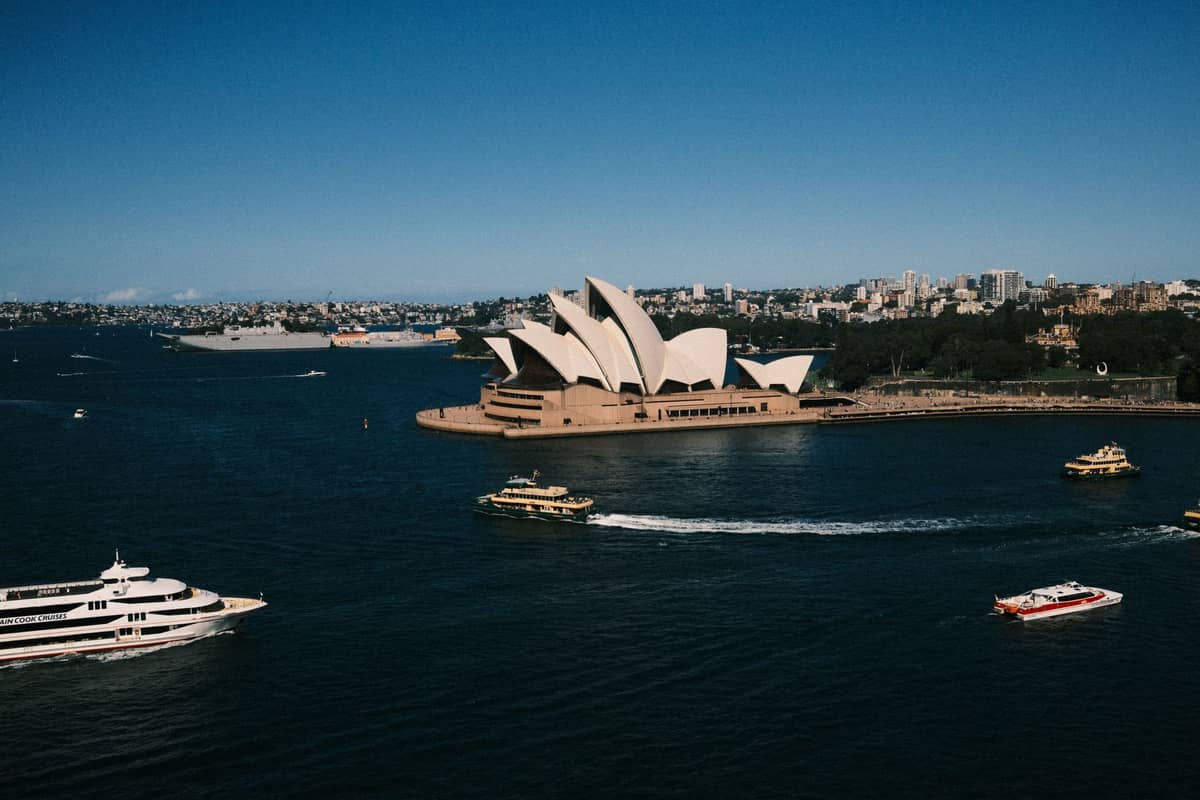
The Sydney Opera House sits at the tip of Bennelong Point, a narrow peninsula that juts into Sydney Harbour with water on three sides. From almost any angle it reads differently: from the Harbour Bridge walkway the shells compress into overlapping white fans; from a ferry arriving at Circular Quay they peel apart and reveal depth and shadow; from the pedestrian forecourt you crane your neck to follow the ribbed concrete fins upward. No photograph quite replicates the disorientation of standing beneath them for the first time.
Danish architect Jørn Utzon won the international design competition in 1957, and construction began on 2 March 1959. The building opened in 1973 after a notoriously complex construction process that ultimately led to Utzon's resignation before completion. The structural engineering solution that made the shells buildable, a system of precast concrete ribs derived from sections of a sphere, was not resolved until well into the design process. UNESCO recognised the result as a World Heritage Site in 2007, describing it as a masterpiece of 20th-century architecture.
The shells are not roofing a single large hall. The building contains multiple performance venues: the Concert Hall (the largest, with roughly 2,700 seats), the Joan Sutherland Theatre (the main opera and ballet stage), the Drama Theatre, the Playhouse, the Studio, the Utzon Room, and several outdoor performance spaces. Understanding this complexity is part of what makes the guided tour worthwhile.
ℹ️ Good to know
The exterior is freely accessible at any hour, every day. If your budget or schedule does not allow for a tour, the forecourt, the promenade, and the lower concourse give you close access to the shells, the harbour views, and the monumental staircase at no cost.
How the Experience Changes by Time of Day
Early morning, before 8am, is genuinely different from any other time. The cruise ships and ferries have not filled the harbour yet, the tour groups have not arrived, and the forecourt belongs mostly to joggers, dog walkers, and the occasional photographer with a tripod. The shells in morning light are a warm cream, not the bleached white of midday images. The granite paving on the promenade is cool underfoot, and you can hear the water lapping against the seawall below.
Midday brings the most predictable crowds, particularly in school holidays and the January–February summer peak. The monumental staircase fills with people eating, photographing, and queuing for tours. This is not the worst time to visit, but it is the least intimate. The shells in flat overhead light lose some of their surface texture.
Late afternoon, roughly from 4pm onward, the low western sun catches the ceramic tile surface of the shells and throws the ribbed structure into sharp relief. The colour shifts noticeably toward gold before sunset. This is consistently the most photogenic window, and if you are visiting purely for photographs, positioning yourself on the western promenade or at Mrs Macquaries Chair across the water will give you the best results.
At night, during a performance, the building operates in a completely different register. The foyers glow amber and the shells are lit from below, reflecting off the water. Arriving for an evening show means you walk through a crowd that is dressed for it, there is wine in the foyer, and the harbour behind the glass walls is black and glittering. If the Sydney Opera House is on your shortlist, attending even a single performance, whether a touring orchestra, an opera, or one of the contemporary programming streams, makes the experience dimensional in a way a daytime tour cannot. Check current programming at the official Sydney Opera House website or through what to do in Sydney guides well in advance, as popular shows sell out weeks ahead.
Tickets & tours
Live prices and dates from our booking partner. If you book, we may earn a commission at no extra cost to you.
The Guided Tour: What It Actually Covers
The standard Sydney Opera House Tour runs approximately one hour and costs A$50 per adult pre-booked, or A$55 purchased on the day. Children pay A$30 pre-booked (A$35 on the day), concession holders A$40 pre-booked (A$45 on the day), and families A$130 pre-booked (A$145 on the day). Prices were confirmed in October 2026; verify directly with the Opera House before booking as prices can change.
Tours run daily from 9am; the building is generally open to visitors 9am to 5pm, with closures on Christmas Day and New Year’s Eve. The tour takes you through the foyers, into the Concert Hall to see the Australian wood pipe organ (the largest mechanical tracker-action organ in the world, with 10,244 pipes), and often into the Joan Sutherland Theatre, though access to specific venues depends on the day's rehearsal and performance schedule. No two tours are guaranteed to be identical.
⚠️ What to skip
The standard one-hour tour involves approximately 300 stairs and is not suitable for visitors using a wheelchair or walking frame. A separate Mobility Access Tour is available. All foyers are accessible via lifts. Check the official accessibility page before you travel.
If you book the tour, arrive a few minutes early and check in at the tour desk inside the main entrance on the western side. Guides vary in style, from brisk and factual to theatrical and anecdote-heavy, and this does affect the experience. The best guides connect the architectural constraints to the acoustic decisions and bring in the human drama of Utzon's resignation. The building's interior is notably darker than the exterior suggests: the timber-lined concert hall ceiling is a deep ochre wood, and the scale of the organs against the seating bowl takes most visitors by surprise.
Navigating the Precinct Without a Tour
Even without a tour ticket, the Opera House precinct rewards time. The promenade that wraps around the base of the building to the north and east offers unobstructed harbour views toward the bridge and Garden Island. The lower concourse, reached by descending the stairs from the main forecourt, brings you to water level with the shells overhead. The textures here are worth noticing: the underside of the shells is raw board-marked concrete, rough and industrial in a way that contrasts with the polished tile surface above.
The area immediately to the west connects naturally to the Royal Botanic Garden, which begins at the eastern edge of the forecourt. A short walk east along the waterfront brings you to Mrs Macquaries Chair, the carved sandstone seat that gives one of the most reproduced views of the Opera House and Harbour Bridge together. This walk is flat, shaded in sections, and free.
In the other direction, heading west from the main staircase takes you along the waterfront toward Circular Quay in under ten minutes. From there you are one short walk from The Rocks, Sydney's oldest European-settled neighbourhood, with its sandstone laneways, weekend markets, and the southern pylon of the Harbour Bridge.
Getting There and Moving Around
Circular Quay is the logical entry point. Trains on the City Circle stop at Circular Quay station; ferries from Manly, Parramatta, and the inner harbour arrive at the Circular Quay wharves; Circular Quay is the logical entry point. Trains on the City Circle stop at Circular Quay station; ferries from Manly, Parramatta, and the inner harbour arrive at the Circular Quay wharves; the light rail connects Circular Quay with Central Station; and bus routes converge on Alfred Street. From any of these you are 7 to 10 minutes on foot from the Opera House main entrance. For a detailed breakdown of ferry routes, the Transport for NSW website covers timetables, fares, and which wharf to use.; and bus routes converge on Alfred Street. From any of these you are 7 to 10 minutes on foot from the Opera House main entrance. For a detailed breakdown of ferry routes, the Sydney ferry guide covers timetables, fares, and which wharf to use.
If you are arriving by ferry specifically to see the Opera House, the approach from the water is arguably the best introduction the city offers. The building reveals itself as the vessel rounds into the Quay, growing from a distant silhouette into full scale in a matter of minutes. This is not a detour; it is a genuinely different experience of the building.
There is paid parking beneath the Opera House, accessible from Macquarie Street, but driving is rarely the practical choice here given traffic and the quality of public transport connections. Cycling is possible; the area has secure bicycle parking near the forecourt.
Photography, Honesty, and Who Should Skip the Tour
The exterior of the Sydney Opera House is, without qualification, one of the great architectural photographs in the world. The interior is a different matter. The concert hall is impressive in scale and the organ is genuinely extraordinary, but photographing it under tour conditions, often with low available light and a group moving at pace, produces mediocre results. If photography is your primary goal, spend your time on the exterior at golden hour and skip the tour.
The tour is worthwhile for people who care about architecture, acoustics, or the history of large infrastructure projects. It is not worth the ticket price for visitors who are primarily checking a box or who have limited tolerance for standing in relatively dim interiors listening to detailed explanations of construction chronology. Those visitors are better served spending an hour on the waterfront promenade, walking to the Sydney Harbour Bridge for a different perspective, then returning for the view at dusk.
Visitors with young children should note that the standard tour's 300 stairs and one-hour duration is challenging with toddlers. The exterior and the lower concourse are much more manageable, and the sight lines down to the water hold children's attention well.
💡 Local tip
Pre-book your tour online to save A$5 per adult and secure your preferred time slot. Weekend morning tours fill quickly during summer and school holidays. The Opera House booking page is at sydneyoperahouse.com.
Insider Tips
- The western promenade, running between the main staircase and the lower concourse, is almost always less crowded than the main forecourt. Walk it before your tour to orient yourself and get close to the base of the shells without the staircase scrum.
- If you want the postcard shot of both the Opera House and Harbour Bridge in one frame, position yourself on the lower concourse looking northwest in the late afternoon. The angle from the forecourt level includes too much concrete in the foreground.
- The Opera House Bar and Grill and the Opera Bar on the lower concourse are full-service venues with some of the most expensive harbourside drinks in Sydney. For a less expensive option with the same views, buy a takeaway coffee from one of the kiosks and drink it on the promenade steps.
- During the annual Vivid Sydney festival (typically May to June), the shells are used as projection surfaces for large-scale light art installations. The building looks radically different at night during this period, and the precinct is significantly more crowded than usual. Plan to arrive by 9pm at the latest to avoid the peak crush.
- The Utzon Room, a small function space designed with Utzon's direct involvement after his return to the project in 1999, is sometimes accessible on tours but not guaranteed. Ask your guide specifically about it; seeing any space with Utzon's completed interior vision makes the tour significantly more worthwhile.
Who Is Sydney Opera House For?
- Architecture and design enthusiasts who want to understand how the building actually works from the inside
- First-time visitors to Sydney who want to anchor their sense of the city from its most iconic viewpoint
- Performing arts travellers planning to attend a concert, opera, or theatre performance in one of the main halls
- Photographers willing to time their visit for golden hour on the western promenade
- Travellers using Vivid Sydney as a reason to visit, who will see the shells transformed into a projection canvas
Nearby Attractions
Other things to see while in Circular Quay & The Rocks:
- Barangaroo Reserve
Once a concrete wharf, Barangaroo Reserve is now a six-hectare sandstone headland park hugging Sydney's western harbour foreshore. Open around the clock and free to enter, it offers coastal walking paths, sweeping views of the harbour bridge and North Shore, and a quietly powerful connection to the Gadigal and Cammeraygal peoples whose Country this has always been.
- Cockatoo Island
Cockatoo Island sits in the middle of Sydney Harbour, free to enter and reachable by public ferry. It holds 150 years of convict and industrial history across shipyards, sandstone buildings and water-level dockworks — and the views back toward the CBD are quietly spectacular.
- Justice and Police Museum
Housed in a 19th-century court complex one block from Circular Quay, the Justice & Police Museum unpacks colonial Sydney's criminal underbelly through real evidence, mugshots, and courtroom drama. Entry is free, the building is atmospheric, and the exhibits are far more confronting than most museum visitors expect.
- Museum of Contemporary Art Australia (MCA)
The Museum of Contemporary Art Australia sits at the edge of Sydney Harbour in The Rocks, offering rotating exhibitions of Australian and international contemporary art, a rooftop cafe with Opera House views, and free admission for under-18s. It rewards a few hours of unhurried looking, especially on a Thursday evening when the crowds thin and the harbour light shifts.
Planning a trip? Discover personalized activities with the Nomado app.