Museum of Sydney: Colonial Ruins, Aboriginal Stories, and the City's Origins
The Museum of Sydney sits on the site of the archaeological remains of Australia's first Government House, built in 1788–89. It traces the layered history of the city from deep Indigenous time through to the colonial era and beyond, in a compact, thoughtful space one block from Circular Quay.
Quick Facts
- Location
- Corner of Phillip and Bridge Streets, Sydney NSW 2000 (Sydney CBD)
- Getting There
- Circular Quay station (trains, buses, ferries) — approximately one block away
- Time Needed
- 1.5 to 2.5 hours for a thorough visit
- Cost
- Check official website for current pricing; online booking recommended
- Best for
- History enthusiasts, architecture lovers, travellers curious about Sydney's colonial and Aboriginal heritage
- Official website
- mhnsw.au/visit-us/museum-of-sydney
What the Museum of Sydney Actually Is
The Museum of Sydney on the site of first Government House is not a conventional city museum packed with dioramas and scale models. It is, at its core, a building constructed around an absence: the sandstone footings of the house built for Governor Arthur Phillip between 1788 and 1789, now visible through a viewing portal in the forecourt. That archaeological layer sets the tone for everything inside.
Opened in 1995, the museum occupies a modern building beside the excavated foundations. The result is an unusual dialogue between the contemporary structure and what lies beneath it — you are literally standing on the ground floor of Australian colonial history, and the building makes no effort to let you forget it.
The museum is managed by Museums of History NSW and sits within a dense cluster of significant sites. The Rocks precinct is a short walk to the north-west, and Circular Quay is one block away. For visitors spending serious time in the CBD, the museum integrates naturally into a morning or afternoon itinerary.
💡 Local tip
Book online before you visit. The official plan-your-visit page recommends advance booking, and it also gives you the most current ticket prices, which are not published in fixed third-party sources.
The Forecourt: Archaeology You Can Walk Around
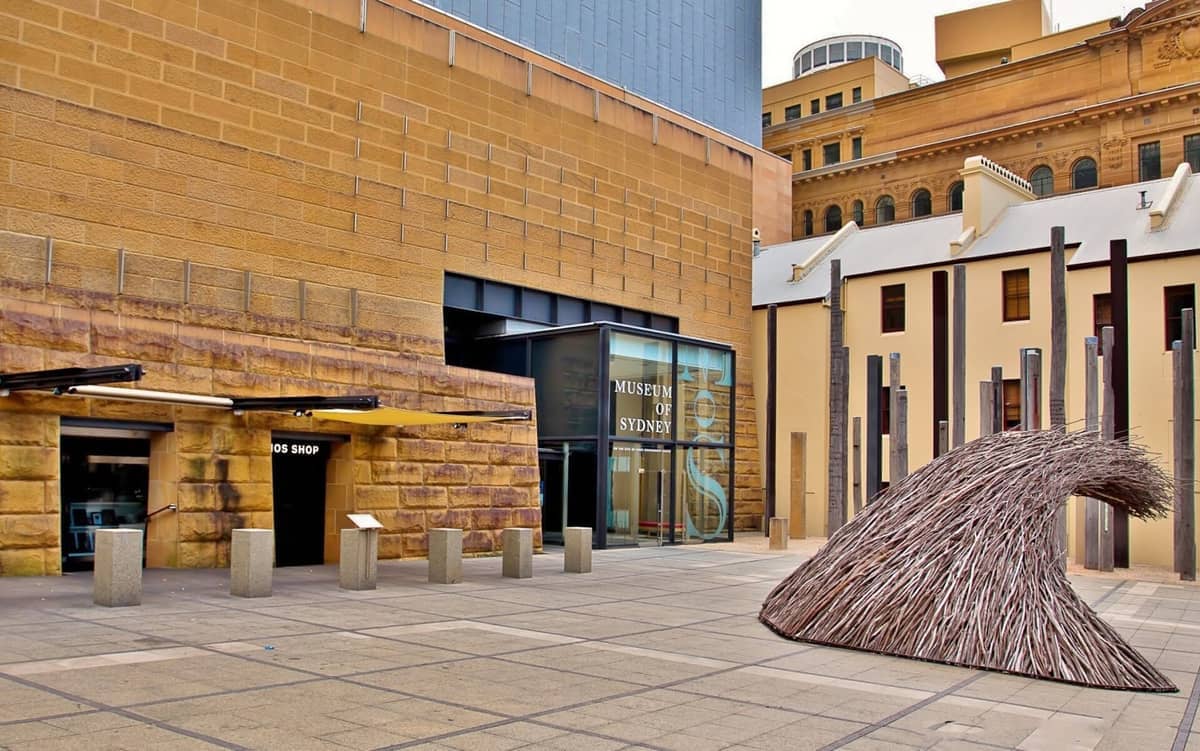
Before you even enter the building, the forecourt rewards attention. Embedded in the paved surface are the exposed sandstone foundations of the first Government House, Australia's earliest government building. The installation called 'Edge of the trees' by Janet Laurence and Fiona Foley also occupies the forecourt — a series of poles and glass panels that references early colonial trade and Indigenous presence simultaneously. It is one of those public artworks that reads differently at different times of day.
In the early morning, before the lunchtime office crowd filters through, the forecourt is relatively quiet. The foundations are easy to study without navigating around other visitors. By midday, especially on weekdays, the surrounding area fills with people from nearby offices, and the space becomes a thoroughfare. If archaeology is your primary interest, aim for a 10 am arrival when the museum opens.
Visitors can glimpse the excavated areas through a viewing portal in the forecourt. Archaeological finds from the site appear in the museum's galleries, giving the collection an immediate material connection to the ground beneath your feet.
Tickets & tours
Live prices and dates from our booking partner. If you book, we may earn a commission at no extra cost to you.
Sydney whale-watching cruise with breakfast or lunch
From 62 €Instant confirmationFree cancellationBlue Mountains guided tour with Sydney Zoo and Scenic World visit
From 134 €Instant confirmationFree cancellationSydney Harbour scenic flight - private 20 minutes tour
From 404 €Instant confirmationFree cancellationSydney's Razor Gangs true crime tour
From 21 €Instant confirmationFree cancellation
Inside the Museum: What the Exhibitions Cover
The permanent collection focuses on Sydney's history from Indigenous occupation through the colonial encounter and into the modern city. The depth given to Aboriginal perspectives is more substantive than at many comparable institutions — the Gadigal and Cadigal peoples of the Eora Nation are treated as the opening chapter of the city's story, not an afterword. Visitors interested in this subject will find the museum a useful counterpart to a broader reading of Sydney's Aboriginal heritage.
For a fuller context on the Aboriginal history woven through Sydney's landscape, the Sydney Aboriginal culture guide covers sites and experiences across the city that extend well beyond a single museum.
The colonial period is covered through objects, documents, and interpretive panels that focus on the practicalities and tensions of early settlement rather than straightforward celebration. The collection includes items relating to the first fleet, the early colony's material culture, and the development of the town that would become a major Pacific city. Temporary exhibitions rotate and often address specific periods or themes in Sydney's social history, so even repeat visitors can find new content.
The museum is compact by international standards. There are no sprawling gallery wings to lose yourself in for hours. Most visitors will feel they have seen the permanent collection thoroughly in under two hours. This is not a criticism — the curation is selective and coherent rather than exhaustive — but it does mean the museum works best as part of a wider day in the CBD rather than as a standalone full-day destination.
Practical Walkthrough: Getting There and Moving Around
The museum is at the corner of Phillip and Bridge Streets in the Sydney CBD, one block back from Circular Quay. Circular Quay is served by Sydney Trains, multiple bus routes, and ferry services from across the harbour — making it one of the easiest attractions in Sydney to reach by public transport. There is no dedicated parking at the museum, and street parking in this part of the CBD is scarce and expensive during business hours.
If you are arriving by ferry from Manly or another harbour destination, the walk from Circular Quay Wharf takes under five minutes. For a broader understanding of how to use Sydney's ferry network to connect different parts of the city, the Sydney ferry guide is worth consulting before you plan your day.
The museum opens daily at 10 am and closes at 5 pm. It is closed on Good Friday and Christmas Day. Level entry is available from Bridge Street, which is the most accessible approach. The Phillip Street entrance involves steps or a moderately steep paved gradient. A lift connects all floors inside the building. Wheelchairs and other accessibility supports may be available; contact the museum in advance about specific requirements.
ℹ️ Good to know
Accessibility note: If you have mobility considerations, use the Bridge Street entrance for level access. The Phillip Street side involves a gradient that some visitors find challenging.
Photography, Light, and What to Expect Visually
The museum's interior is relatively dim in places, consistent with conservation requirements for historic objects. Photography is generally permitted in the permanent galleries, but flash use and tripods may be restricted — check at the front desk on arrival. The most photogenic element is the glass-floored forecourt area, where the sandstone foundations photograph well in the flat, even light of overcast mornings.
The exterior of the building itself has a certain restraint that rewards attention: the materials and massing are deliberately understated, allowing the exposed archaeological remains in the forecourt to command focus rather than the architecture. If you are composing shots of the forecourt installations, late afternoon light from the west catches the glass panels of the Bond Store artwork usefully.
How It Fits Into a Broader Sydney Itinerary
The Museum of Sydney pairs naturally with a walk through The Rocks and along the harbour foreshore. The The Rocks Discovery Museum nearby covers archaeological finds from The Rocks precinct itself, and together the two institutions give a more complete picture of early colonial Sydney than either does alone. Budget roughly half a day for both.
For visitors working through Sydney's wider museum landscape, the best museums in Sydney guide places the Museum of Sydney in context alongside the Australian Museum, the Art Gallery of NSW, and other major collections — useful if you are trying to allocate limited time across the city.
Travellers who find the colonial history angle engaging might also consider the Justice and Police Museum, a short walk away on Phillip Street, which addresses a later but connected chapter of Sydney's social history. Those with a particular interest in maritime history can continue to Circular Quay and across to the Australian National Maritime Museum at Darling Harbour.
⚠️ What to skip
Who should skip it: If you are primarily interested in art, natural history, or contemporary culture, the Museum of Sydney's specific focus on colonial and urban history may not reward your time as well as the Art Gallery of NSW or the Australian Museum. It is also a short visit — not appropriate if you need to fill a full day.
Honest Assessment: Is It Worth Your Time?
The Museum of Sydney is not one of Sydney's headline attractions in the way that the Opera House or the Harbour Bridge are. It does not draw enormous crowds, and on quieter weekdays the galleries can feel almost intimate. That is part of its appeal. The quality of the interpretation is high, the connection to the physical site is genuinely unusual, and the Aboriginal history content is handled with more care than many visitors will expect.
For travellers with a genuine interest in how Sydney came to be — the Indigenous custodianship of the land, the mechanics of early colonial settlement, and the archaeology that underpins the modern city — the museum offers a compact and thoughtful two hours. For visitors on a tight itinerary who want spectacle, scale, or interactive experiences, there are other options in the CBD that will likely satisfy more.
If your time in Sydney is limited to a few days, the 3-day Sydney itinerary can help you decide where the Museum of Sydney fits relative to higher-priority stops.
Insider Tips
- Arrive at 10 am on a weekday to have the forecourt archaeological remains almost entirely to yourself. The lunchtime crowd from surrounding CBD offices changes the atmosphere significantly from around noon.
- The Edge of the trees forecourt artwork by Janet Laurence and Fiona Foley is an important work in Australian public art history — read the interpretive panel before moving on, rather than treating the forecourt as a passage to the entrance.
- Check the museum's website for current temporary exhibitions before visiting. The permanent collection is concise, and an interesting temporary show can meaningfully extend your visit and justify the entry cost.
- The Bridge Street entrance gives you level access from the street. If you are arriving from Circular Quay, approach from Bridge Street rather than Phillip Street to avoid the gradient at the Phillip Street side.
- Combine this visit with the Justice and Police Museum on Phillip Street for a coherent half-day focused on Sydney's colonial and civic history. Both are compact institutions that work well together without causing museum fatigue.
Who Is Museum of Sydney For?
- History enthusiasts who want to understand Sydney's origins beyond the postcard imagery
- Travellers with an interest in Australian Aboriginal culture and the colonial encounter
- Architecture and archaeology fans drawn to the unusual integration of ruins into a modern building
- Visitors who prefer quiet, thoughtful institutions over crowded major attractions
- Those building a half-day itinerary around Circular Quay and The Rocks
Nearby Attractions
Other things to see while in Sydney CBD:
- ANZAC Memorial
Standing at the southern end of Hyde Park, the ANZAC Memorial is one of Sydney's most significant commemorative sites. Free to enter and open daily, it combines powerful Art Deco architecture with thoughtful exhibitions tracing Australia's wartime history from the First World War to recent conflicts.
- Art Gallery of New South Wales
The Art Gallery of New South Wales spans two architecturally distinct buildings on The Domain, offering free access to one of Australia's most significant art collections. From colonial-era Australian works to contemporary Pacific and Aboriginal art, the gallery rewards visitors who know where to look.
- Australian Museum
The Australian Museum is Sydney's oldest museum, founded in 1827, with free general admission and collections spanning science, culture, and nature. Located opposite Hyde Park in the CBD, it suits curious travellers with two to three hours to spend indoors.
- Sydney Chinatown
Sydney Chinatown occupies the Haymarket precinct around Dixon Street, a pedestrianised mall bookended by ornate gates and lined with restaurants, bakeries, and produce shops. Free to enter and accessible by train, it rewards visitors who know when to go and what to look for.
Planning a trip? Discover personalized activities with the Nomado app.