Superkilen: Copenhagen's Park Built by the World
Superkilen is a 750-metre public park stretching through Nørrebro, Copenhagen's most diverse neighbourhood. Designed by BIG, Topotek1, and SUPERFLEX and opened in 2012, it collects urban objects from over 60 countries into three colour-coded zones. Entry is free, and it is open around the clock.
Quick Facts
- Location
- Nørrebrogade 208, 2200 København N
- Getting There
- Multiple bus lines along Nørrebrogade; short walk or cycle from the city centre
- Time Needed
- 45–90 minutes to walk the full length; longer if you linger
- Cost
- Free — open public space, no ticket required
- Best for
- Architecture lovers, urban walkers, families, photographers, design enthusiasts
- Official website
- big.dk/projects/superkilen-1621
What Superkilen Actually Is
Superkilen is a public park that runs for roughly 750 metres through the heart of Nørrebro, Copenhagen's densest and most culturally mixed district. Opened in June 2012 after a design phase that ran from 2009 to 2010, it covers approximately 30,000 square metres and was commissioned jointly by the City of Copenhagen and the private philanthropic foundation Realdania. The name translates loosely from Danish as 'The Super Wedge', a reference to its elongated, wedge-like form cutting between apartment blocks and cycle paths.
Three architectural firms collaborated on the design: Bjarke Ingels Group (BIG) handled the overall concept and master plan, Topotek1 led the landscape architecture, and the Copenhagen-based art collective SUPERFLEX shaped the cultural programming and object selection. The result is not a traditional park. There are no formal flowerbeds or ornamental fountains in the conventional sense. Instead, Superkilen functions as an outdoor collection of urban objects sourced from more than 60 countries, chosen to reflect the 57-plus nationalities that residents of surrounding Nørrebro carry with them.
ℹ️ Good to know
Superkilen is open 24 hours a day, every day of the year. There are no gates, no tickets, and no closing time. It is a functioning city street as much as a park.
The Three Areas: A Colour-Coded Walk
The park is divided into three distinct areas, each with its own colour palette, surface treatment, and atmosphere. Walking from south to north, you move through The Red Square, The Black Market (also called The Black Square), and The Green Park. The colour coding is not decorative in the superficial sense: it signals a shift in purpose, social register, and mood.
The Red Square
The Red Square, at the southern end near Nørrebrogade, is the most urban and energetic section. The ground is painted in deep red tones that bleed up walls and across surfaces, giving it a slightly surreal quality in afternoon light when the sun hits at a low angle. This zone contains sports facilities, a boxing ring, and a large fountain that children use as a splash feature on warm days. The sound here tends toward activity: skateboard wheels, football kicks, conversations in Danish, Arabic, and Somali overlapping without ceremony.
The Black Market
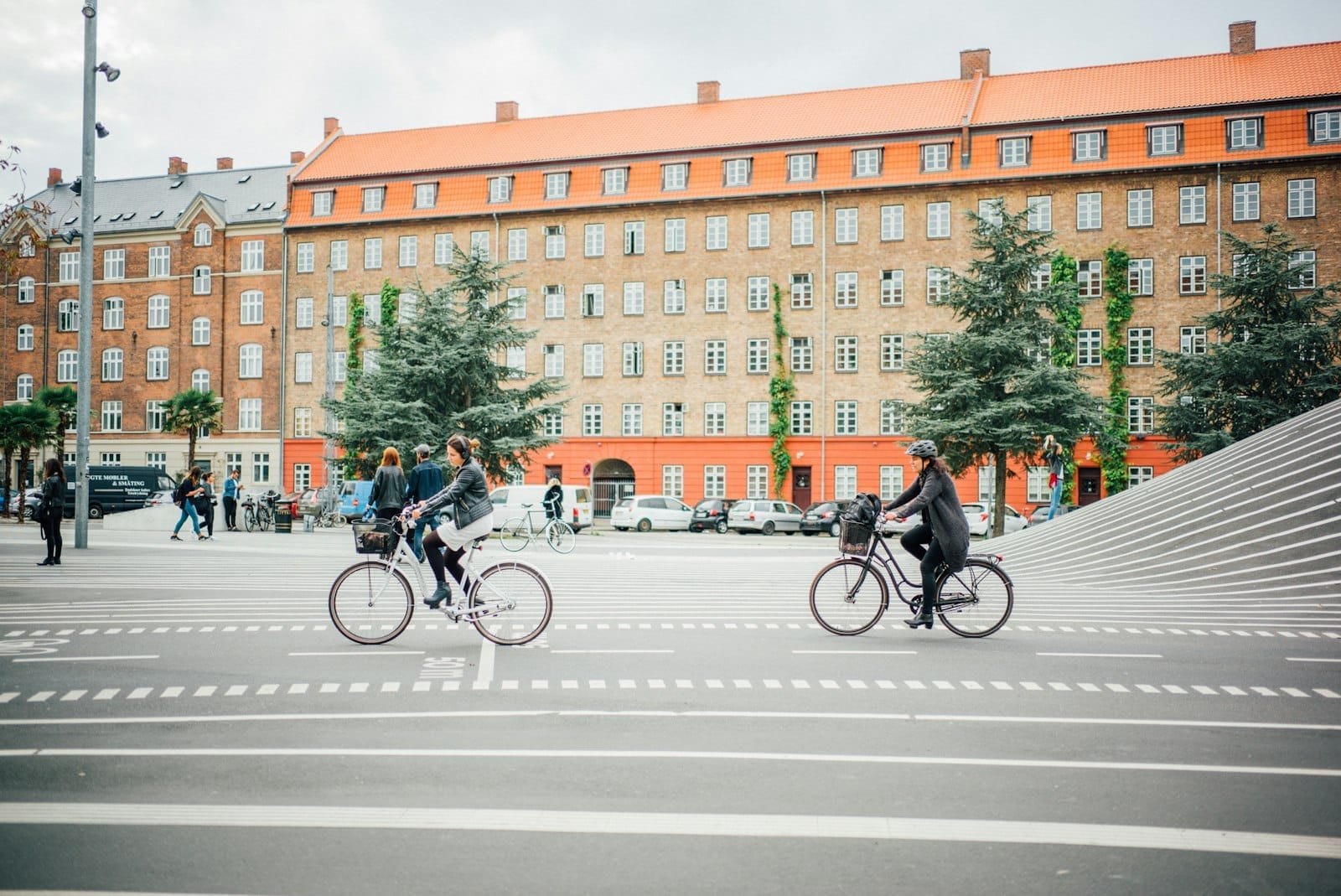
The central zone is paved in black asphalt marked with white topographic lines that make the surface read like a map or technical drawing. This is the section most used for everyday errands and commuting: cyclists pass through steadily, and the benches here fill with people eating lunch or simply waiting. Objects include a Japanese manhole cover set into the ground, an Octopus climbing frame from Japan, and various neon signs. It rewards slow attention. Walk fast and you miss most of it.
The Green Park
The northern section transitions into softer, grassy terrain with gentle undulations. The green zone is the most conventional in park terms, though even here the furniture is anything but standard. Benches, exercise equipment, and play structures were sourced from across the globe and arrived with their original manufacturer markings intact. On summer afternoons, this end of Superkilen fills with families on picnic blankets, teenagers on the grass, and dogs moving between the two.
Tickets & tours
Hand-picked options from our booking partner. Prices are indicative; availability and final rates are confirmed when you complete your booking.
1-hour boat harbour tour in Copenhagen
From 26 €Instant confirmationFree cancellationSmall group 3-hour walking tour in Copenhagen
From 45 €Instant confirmationFree cancellationCopenhagen to Malmo one-day tour
From 56 €Instant confirmationFree cancellationFull-day tour to Forest Tower and Forgotten Giants from Copenhagen
From 110 €Instant confirmationFree cancellation
The Cultural Logic Behind the Design
Nørrebro has long been Copenhagen's most demographically complex neighbourhood: working-class Danish families, immigrants from the Middle East, East Africa, and Southeast Asia, students, and an established community of artists and creatives all share the same streets. This compression has historically created both friction and genuine community, and Superkilen was conceived explicitly in response to that context.
The design process involved direct participation from Nørrebro residents, who were consulted on which objects to import. The process was not simply symbolic. Residents from different backgrounds nominated items that held meaning for their home countries or communities, and SUPERFLEX coordinated the sourcing, transport, and installation of those objects.
This approach to participatory urban design attracted international attention and earned Superkilen the Aga Khan Award for Architecture in 2016, one of the most prestigious prizes in the field. For those interested in how Copenhagen uses design as a social tool, it pairs well with a visit to the Danish Architecture Center, which regularly features exhibitions on Danish public space and urban planning.
How the Experience Changes by Time of Day
Early morning, roughly 7 to 9am, Superkilen is at its most local. Commuter cyclists move through in a steady stream, a few dog walkers cross the green zone, and the light is low enough to make the red paint glow. This is arguably the best time to photograph the park: the surfaces are legible, the colours saturate in soft morning light, and you are not competing with foot traffic for a clear frame.
Midday brings the lunch crowd, especially to the Black Market section where benches face the sun. The park reads as a genuine community space at this hour, not a tourist attraction: people eat, argue, scroll phones, and play. This is the time to simply sit and observe the object collection at your own pace without feeling like you need to move on.
Evenings in summer are particularly lively. The sports areas in the Red Square see extended use into dusk, the neon signs and illuminated features begin to register against the fading sky, and the social texture shifts toward younger visitors. In winter, foot traffic drops sharply and the park takes on a quieter, slightly melancholy character. The colour contrast between the painted surfaces and grey Copenhagen skies is striking in its own way, but the atmosphere is substantially different from the summer version.
💡 Local tip
For photography, visit in the first two hours after sunrise or in the hour before sunset. The painted ground planes respond dramatically to raking light, and the topographic lines in the Black Market section become three-dimensional in low-angle conditions.
Getting There and Moving Through Nørrebro
Superkilen runs along Nørrebrogade, the main artery of the neighbourhood, which is served by several city bus routes. From central Copenhagen, the park is easily reachable by bicycle, which is also the most logical way to approach it given that the park itself incorporates a dedicated cycle track. Copenhagen's cycling infrastructure makes Nørrebro straightforward to reach without a map.
Walking the full 750-metre length takes around 20 to 30 minutes at a slow pace if you stop to read the object labels and plaques. Most visitors combine Superkilen with a broader wander through Nørrebro, which is worth doing. The neighbourhood's main shopping and café strip along Nørrebrogade and the side streets off it offers a reliable range of independent coffee shops, bakeries, and food stalls. The market at Torvehallerne is a 15-minute walk south and makes a natural complement to a morning visit.
If you are visiting Copenhagen for the first time and trying to structure your time, Superkilen fits well into a broader Nørrebro half-day that also includes Assistens Cemetery, a few minutes' walk to the west, where Hans Christian Andersen and Søren Kierkegaard are buried. The combination gives you a clear sense of the neighbourhood's range: a 19th-century burial ground and a 21st-century design experiment within the same postcode.
Honest Assessment: What Works and What Doesn't
Superkilen is genuinely impressive as an idea and as an execution of that idea at urban scale. The object collection is real, not staged, and the participatory process that produced it was substantive. Visitors who engage with the catalogue of objects and understand the reasoning behind the park's structure tend to leave with a stronger impression than those who walk through expecting conventional park amenities.
That said, the park is not without criticism. Some urban designers have questioned whether the collection of objects from 60 countries risks aestheticising cultural difference rather than addressing structural inequality in the neighbourhood. The park is beautiful. Whether it is equitable is a separate question that the design alone cannot answer.
Practically, the park can feel underwhelming in bad weather. The open surfaces offer little shelter, and the painted ground can become slippery when wet. Visitors expecting a conventional green space with shade trees and wildlife will be disappointed: this is an urban design project, not a garden.
⚠️ What to skip
Superkilen has no public toilets on-site. The nearest options are at nearby cafés along Nørrebrogade, which generally require a purchase. Plan accordingly if you are visiting with children.
Practical Notes for Your Visit
Wear comfortable shoes with reasonable grip: the painted surfaces, especially in the Red Square, can be uneven and are best navigated on foot rather than in dress shoes or sandals. There is no entry process, no bag check, and no guided tour infrastructure on-site, though self-guided information is available through the BIG and SUPERFLEX project pages before you arrive.
The park is free and always open, which makes it compatible with a budget-focused Copenhagen itinerary. It also works as a standalone stop of around an hour for visitors with limited time who want to see something beyond the historic centre. For those building a full itinerary, the Copenhagen design and architecture guide covers Superkilen alongside the city's other significant built works.
Cyclists should note that the cycle track through the park is active and shared with commuters, not solely a leisure path. Keep to the right and signal before stopping.
Insider Tips
- Download the SUPERFLEX project documentation before you visit: it includes a full catalogue of the objects with their countries of origin and the stories behind their selection. The plaques in the park give brief labels, but the backstories are considerably more interesting.
- The Red Square's colour is most saturated and visually dramatic in late afternoon when the sun drops toward the west. Morning visits are better for photography without crowds; afternoon visits are better for experiencing the space in full social use.
- Walk the park from north to south if you arrive by bicycle from the city centre. The Green Park end is quieter and eases you in before the more intense Red Square at the southern end near Nørrebrogade.
- The fountain in the Red Square is functional and popular with children on hot days. If you are visiting in July or August with kids, it is a reliable stopping point that requires no planning.
- Superkilen is not heavily promoted in most mainstream Copenhagen tourism materials, which means weekday mornings are genuinely uncrowded. Weekend afternoons attract more visitors, especially in summer, but even then it never approaches the density of the historic centre.
Who Is Superkilen For?
- Architecture and urban design enthusiasts who want to see participatory placemaking at scale
- Photographers looking for bold colour, geometric surfaces, and unusual light conditions
- Families with young children, particularly for the play structures and summer fountain use
- Travellers interested in multiculturalism and urban social policy beyond surface-level tourism
- Cyclists and walkers exploring Nørrebro who want to combine a design landmark with neighbourhood exploration
Nearby Attractions
Other things to see while in Nørrebro:
- Assistens Cemetery
Assistens Kirkegård is simultaneously an active cemetery, a neighbourhood park, and one of Copenhagen's most atmospheric places to walk quietly among history. Free to enter and open year-round, it holds the graves of Hans Christian Andersen, Søren Kierkegaard, and Niels Bohr in the Nørrebro district.