Torvehallerne: Copenhagen's Premier Food Market
Torvehallerne is Copenhagen's most celebrated covered food market, drawing locals and visitors alike with over 60 stalls of fresh produce, artisan bread, Nordic smørrebrød, specialty coffee, and prepared foods. Located steps from Nørreport Station, it sits at the heart of the city with free entry and something genuinely worth eating at every turn.
Quick Facts
- Location
- Frederiksborggade 21, 1360 Copenhagen K
- Getting There
- Nørreport Station (Metro, S-train, regional train)
- Time Needed
- 45 minutes to 2 hours
- Cost
- Free entry; food and drink extra (prices vary by stall)
- Best for
- Food lovers, slow mornings, local produce, Nordic cuisine
- Official website
- torvehallernekbh.dk
What Is Torvehallerne?
Torvehallerne, officially known as TorvehallerneKBH, is a two-hall covered food market that opened in September 2011 on the site of a historic outdoor market square in central Copenhagen. It sits directly adjacent to Nørreport Station, the city's busiest transit hub, which makes it an easy stop to include before or after using the station.
The market spans two large glass-and-steel halls flanking an open outdoor corridor, with stalls and seating in the surrounding square. More than 60 vendors occupy the space, selling everything from fresh organic vegetables and aged cheeses to hand-rolled sushi, craft beer, artisan chocolate, and some of the best coffee in the city. Entry is free at all times.
Torvehallerne fits naturally into a broader morning in the city centre. Pair it with a walk through The King's Garden a few minutes north, or use it as a breakfast stop before heading to Rosenborg Castle nearby. It is the kind of place that rewards those who arrive with no fixed plan.
The Experience: What You Actually See and Taste
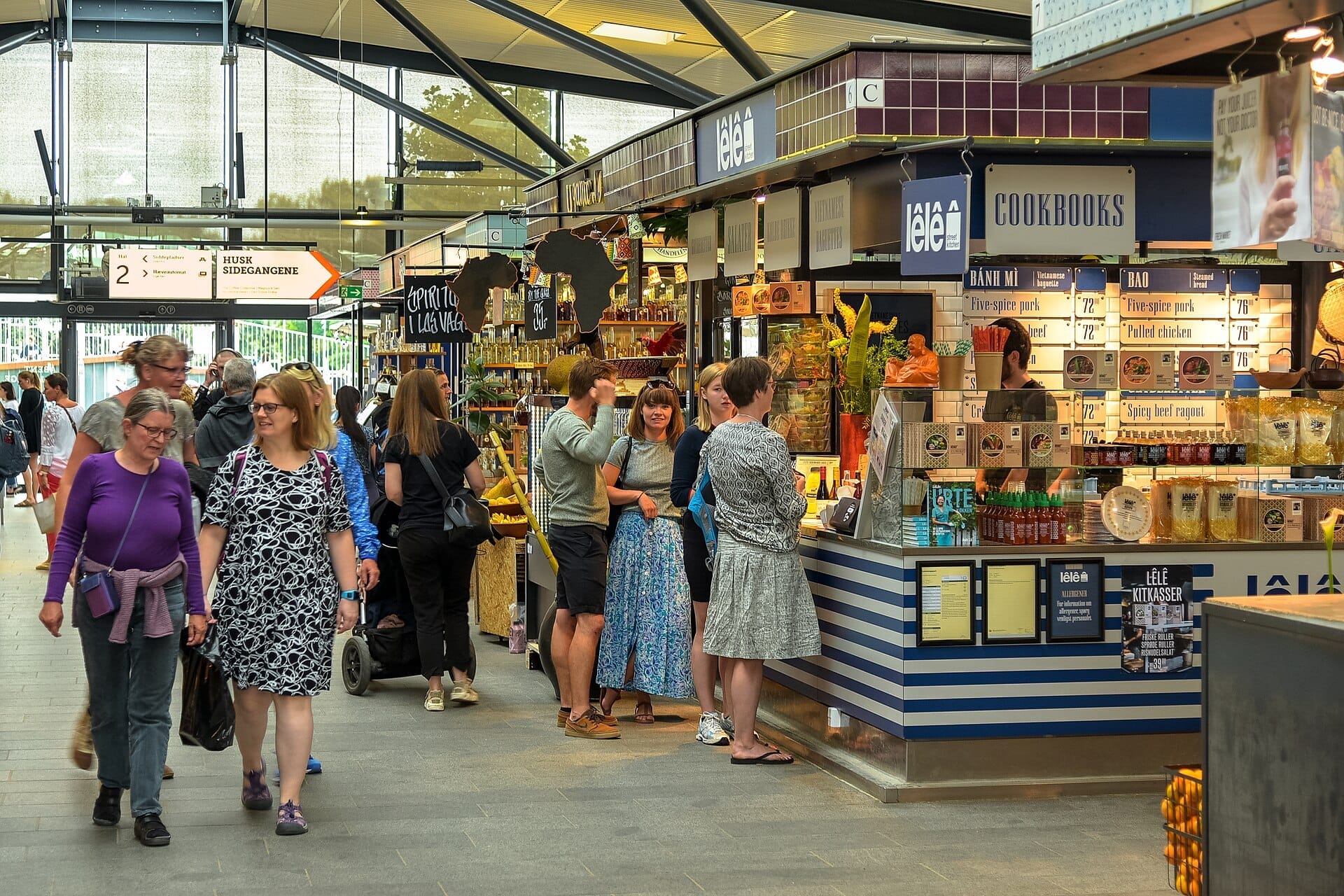
Walking into Torvehallerne, the first thing you notice is the smell: roasted coffee and fresh bread from the bakery stalls near the entrance, followed by something more savory as you move deeper into the hall. The glass ceilings keep the space bright even on overcast days, which in Copenhagen is most of the year, and the layout is open enough that it never feels claustrophobic despite the crowds.
The two halls have distinct personalities. The first hall leans toward prepared foods, takeaway lunches, and specialty drinks. The second focuses more on raw ingredients: seasonal produce, fresh fish, quality meats, and pantry staples from small Danish and Scandinavian producers. Between the halls, outdoor stalls sell flowers, herbs, and seasonal items that shift with the time of year.
Standout categories include the smørrebrød counters, where open-faced rye bread is topped with cured fish, pickled vegetables, and various preparations that reflect both tradition and modern Nordic sensibility. Coffee culture at the market is serious: several stalls compete on specialty roasts and precise preparation methods. A queue is a reliable indicator of quality here.
💡 Local tip
Arrive before 09:30 on weekdays if you want a seat, space to browse, and first pick of the freshest items. Weekend mornings are significantly more crowded by 10:00, especially on Saturdays.
Tickets & tours
Hand-picked options from our booking partner. Prices are indicative; availability and final rates are confirmed when you complete your booking.
1-hour boat harbour tour in Copenhagen
From 26 €Instant confirmationFree cancellationSmall group 3-hour walking tour in Copenhagen
From 45 €Instant confirmationFree cancellationCopenhagen to Malmo one-day tour
From 56 €Instant confirmationFree cancellationFull-day tour to Forest Tower and Forgotten Giants from Copenhagen
From 110 €Instant confirmationFree cancellation
Time of Day: How the Market Changes
Torvehallerne opens at 10:00 most days (with slightly shorter hours on weekends and adjusted hours on certain holidays). The early part of the day is the quietest and arguably the best time to visit. The light through the glass roof has a clarity that disappears once the space fills up, vendors are restocking and chatting freely, and there is no pressure at the coffee bar. It is also when the bread is freshest.
By midday on a weekend, the outdoor corridor fills with people eating standing up, stroller traffic intensifies around the produce stalls, and the popular lunch counters develop queues that can stretch to ten minutes or more. This is not an obstacle, it is the market working as intended. The energy is good, the noise is food-market noise rather than tourist noise, and most people there are genuinely focused on eating.
Late afternoon tends to quiet down again as the lunch rush passes. Some vendors begin to wind down or offer reduced selections in the final hour before closing, so if you want the full range, the window from 08:00 to 14:00 is the most reliable.
⚠️ What to skip
Torvehallerne does not operate on a limited seasonal schedule, but individual stalls and opening hours can vary by day and holiday. Check the official site (torvehallernekbh.dk) before visiting, especially around public holidays, as hours may differ.
Food Worth Seeking Out
If you are using Torvehallerne as an introduction to Danish food culture, it is one of the most efficient places in the city to do it. For deeper context on the broader food scene, the Copenhagen food guide covers neighborhoods, restaurant styles, and what to prioritize across a full trip.
Smørrebrød is the obvious starting point. Several stalls do it at a high level, with toppings that include pickled herring, smoked salmon, roast beef with remoulade, and seasonal variations. The rye bread itself, dense and slightly sour, is a product of craft rather than convenience.
Beyond the Danish classics, the market reflects Copenhagen's current food culture: Nordic-inflected but internationally curious. You will find pasta made to order, a Japanese-influenced rice bowl counter, fresh juice pressed on site, and wine shops with genuine selection rather than tourist markup. Prices are not low, this is central Copenhagen, but most vendors offer quality that justifies the cost.
For those interested in smørrebrød specifically, the Copenhagen smørrebrød guide goes into much greater detail on the tradition, what to order, and where else to find it across the city.
Getting There and Getting Around
Nørreport Station is directly outside the market's main entrance, making Torvehallerne one of the easiest attractions in Copenhagen to reach from many points in the city. The station is served by Metro lines, the S-train network, and regional trains, providing straightforward connections from most neighbourhoods.
Copenhagen's public transit system is efficient and clearly signed in English. If you are planning to use transit extensively during your stay, the Copenhagen Card covers unlimited transit and entry to many major attractions, and may be worth calculating against your planned itinerary.
The market itself is at street level and the surrounding plaza is open and flat, making it manageable with strollers or mobility aids. Inside the halls, passageways between stalls can narrow during peak hours, which is the main practical limitation for those with wider mobility equipment. The outdoor corridor between halls is always spacious.
By bicycle, Torvehallerne is well-served: the surrounding area has bike parking along Frederiksborggade and in the station plaza. On foot from the city's main pedestrian street, it is roughly a 5–10 minute walk north from Strøget, depending on your starting point.
Honest Assessment: Is It Worth Your Time?
Torvehallerne is not overrated. It earns its reputation by being a genuinely functional market rather than a tourist construction. Most people shopping there at 08:00 on a Tuesday are locals picking up produce, coffee, or lunch ingredients. The tourist presence grows as the day progresses, but the market does not bend to it. Standards remain consistent.
That said, it is not a place for budget travelers to graze cheaply. Coffee runs 40 to 60 DKK, a smørrebrød plate can reach 100 to 150 DKK, and the specialty food shops carry prices that reflect their quality. You can visit and spend nothing beyond a coffee, but the fuller experience requires a reasonable food budget.
Travelers who prioritize free activities or are watching spending carefully should know that Torvehallerne is still worth a look even without buying much. For a fuller list of what costs nothing in Copenhagen, the free things to do in Copenhagen guide offers practical alternatives across the city.
Who might skip it: travelers who have no interest in food markets, those on very tight schedules with major museums to cover, or visitors arriving outside the seasonal opening window who have not checked hours in advance. It is also less rewarding in rainy weather when the outdoor corridor between halls loses its appeal.
Insider Tips
- The outdoor stalls between the two halls often feature rotating vendors and seasonal specialties that are not listed on the main website. Walk the full corridor before committing to any single purchase.
- If you want to sit down while eating, arrive before 10:00 on weekdays. Seating inside the halls is limited and fills quickly during the lunch rush. The benches along the exterior plaza are a decent overflow option in dry weather.
- Several stalls offer tasting portions or small sample sizes. Do not hesitate to ask, especially at the cheese and charcuterie counters, where vendors are generally happy to guide an unfamiliar customer.
- The flower stalls at the outdoor market offer some of the most reasonably priced cut flowers in central Copenhagen. Worth knowing if you are staying in an apartment or want to bring something to a local host.
- Weekday mornings between 07:30 and 09:00 are when you will find the most relaxed vendors and the best opportunity for a real conversation about what they sell. That window disappears quickly on weekends.
Who Is Torvehallerne For?
- Food enthusiasts wanting a concentrated introduction to Danish and Nordic flavors
- Slow-morning travelers who want quality coffee and breakfast without a restaurant booking
- Families with children, given the variety of options and the open outdoor space between halls
- Visitors combining a market visit with nearby attractions like Rosenborg Castle or The King's Garden
- Anyone wanting to buy quality local ingredients, artisan goods, or gifts with genuine provenance
Nearby Attractions
Other things to see while in Indre By (Old Town):
- Amalienborg Palace
Amalienborg is the official home of the Danish royal family and one of Copenhagen's most architecturally coherent ensembles. Four near-identical Rococo palaces frame a grand octagonal square, with the Amalienborg Museum open to visitors inside Christian VIII's Palace. The daily changing of the guard at noon is a punctual, unhurried ceremony worth timing your visit around.
- The Black Diamond
The Black Diamond is the modern extension of the Royal Danish Library, clad in polished black granite and angled toward the harbour on Slotsholmen. Entry is free, the atrium is genuinely impressive, and the building rewards visitors who take time to understand what they are looking at.
- Botanical Garden of the University of Copenhagen
Tucked behind Nørreport Station in the heart of the city, the Copenhagen University Botanical Garden is a 10-hectare green sanctuary with a Victorian glasshouse complex, a tranquil lake, and around 8,000 plant species. Entry to the grounds is free, making it one of the most rewarding stops in central Copenhagen for any pace of traveler.
- Christiansborg Palace
Christiansborg Palace sits on the Slotsholmen islet in central Copenhagen, serving simultaneously as the home of the Danish Parliament, the Supreme Court, the Prime Minister's Office, and the Royal Reception Rooms. It is widely described as uniquely housing all three branches of Denmark’s national government under one roof, and its 106-metre tower offers one of the best free panoramic views in the city.