Sun Yat-sen Memorial Hall: Guangzhou's Most Significant Civic Monument
Standing at the heart of Yuexiu District, Sun Yat-sen Memorial Hall is Guangzhou's most architecturally distinctive civic landmark. Built in honor of the founding father of modern China, it combines grand octagonal design with deep historical resonance — and costs almost nothing to enter.
Quick Facts
- Location
- No. 259, Dongfeng Middle Road, Yuexiu District, Guangzhou
- Getting There
- Metro Line 2, Sun Yat-sen Memorial Hall Station (about 5-min walk)
- Time Needed
- 1.5 to 2.5 hours
- Cost
- CNY 10 for main hall; CNY 5 for ages 60–64; free for children and seniors 65+
- Best for
- History enthusiasts, architecture fans, and anyone tracing modern Chinese political culture
- Official website
- http://zs-hall.cn
What Is Sun Yat-sen Memorial Hall?
Sun Yat-sen Memorial Hall (中山纪念堂) is a large commemorative public hall in central Guangzhou, built in memory of Sun Yat-sen, the physician and revolutionary leader widely regarded as the founding father of modern China. He died in 1925, and the hall was constructed on the site of the former presidential office he once used in Guangzhou, making the location itself historically charged before a single brick was laid.
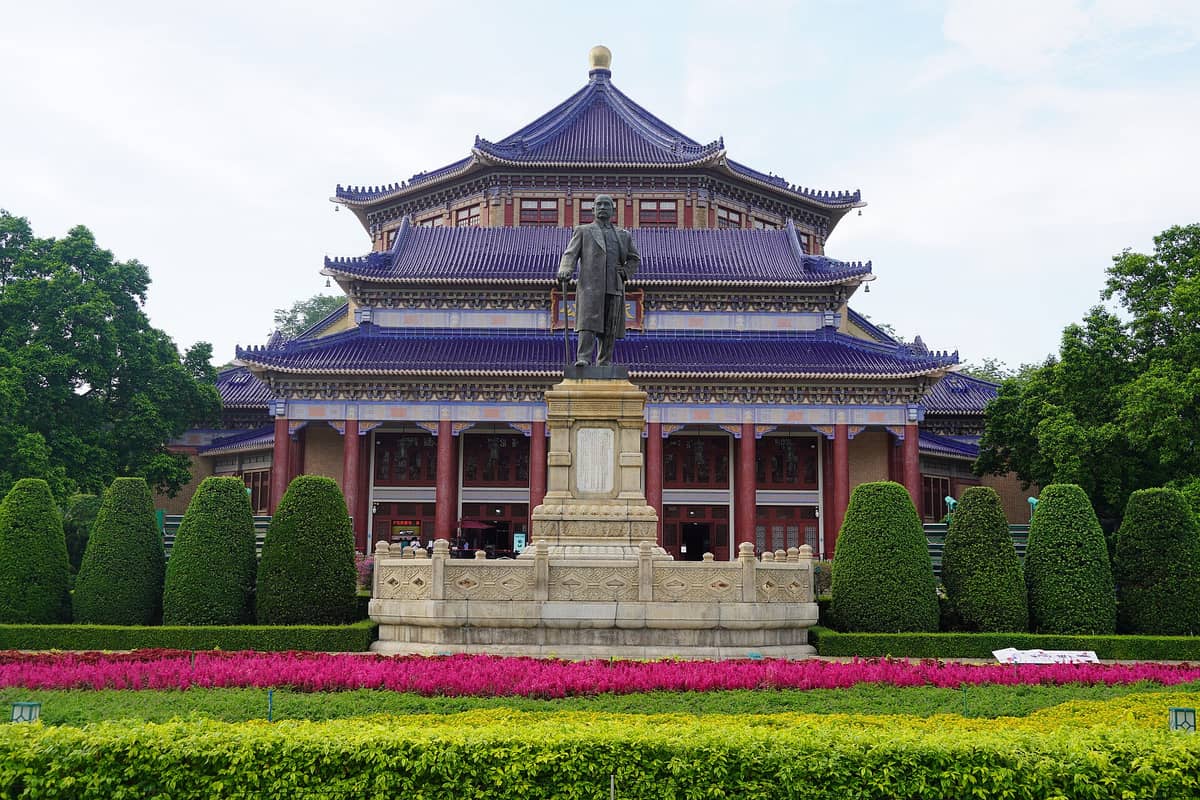
The building is one of the most recognizable structures in Guangdong Province: a monumental octagonal hall topped with a deep blue-glazed tile roof that references traditional Chinese palatial architecture while operating at an almost theatrical scale. It has served multiple civic functions over the decades — political ceremony, public concerts, state performances — and that layered purpose is part of what makes it genuinely interesting to visit rather than a static memorial frozen in one era.
The Architecture: Why the Octagon Matters
The octagonal floor plan is the building's defining feature, and it deserves more attention than most visitors give it. Designed by architect Lü Yanzhi, the hall was completed in 1931. Lü's approach was deliberate: he fused Chinese classical architectural forms, particularly the sweeping upturned eaves and tiled roof systems associated with imperial palace architecture, with a structural ambition that required modern engineering to execute.
The main hall can seat approximately 3,240 people, and when it was built, it achieved this without a single interior support column, relying instead on an innovative steel truss system hidden above the ceiling. For 1931, this was a serious structural achievement. Standing inside, the effect is a single unobstructed interior space of considerable height, which gives the hall an unexpected sense of openness for a building that appears so fortress-like from the outside.
The roof's deep cobalt-blue glaze, a deliberate departure from the imperial yellow associated with dynastic China, is most striking when seen from the surrounding grounds on a clear morning. For broader context on Guangzhou's architectural contrasts, from this colonial-era civic gravity to the gleaming towers of Tianhe, the Guangzhou architecture guide provides useful framing before your visit.
💡 Local tip
The best exterior views are from the front plaza, ideally in the morning when the blue roof tiles catch direct light and foot traffic is lightest. Visit on a weekday to have the forecourt largely to yourself.
Historical Context: Why This Site Was Chosen
The land on which the hall stands was not chosen arbitrarily. It is the former site of the Guangzhou Presidential Office, where Sun Yat-sen led the Guangdong-based republican government during the early 1920s in his effort to unify a fractured China. The location places the memorial directly within the administrative and political core of old Guangzhou, adjacent to Yuexiu Park and close to the city's historic ridge line.
Sun Yat-sen's relationship with Guangzhou was deep and complicated. He made the city a base for his revolutionary movement multiple times, and Cantonese political culture claims a strong connection to his legacy. The decision to build the memorial in Guangzhou, rather than Beijing or Nanjing where he spent significant time, reflects that regional pride. Visitors who have already seen the broader sweep of Guangzhou's political history at the Peasant Movement Training Institute will find the memorial hall a logical continuation of that narrative.
If you want to understand how Sun Yat-sen's legacy sits within Guangzhou's wider revolutionary geography, combining a visit here with stops at the Peasant Movement Training Institute and Yuexiu Park makes for a coherent half-day walk through Yuexiu's civic core.
What to Expect on the Ground
The grounds open at 6:00 AM for non-exhibition areas, so the outer gardens and walkways are accessible to early risers well before the hall itself opens. In the early morning, local residents use the forecourt and surrounding paths for tai chi and walking, which gives the space a lived-in quality that is very different from the midday tourist flow. The sound of morning birdsong from the mature trees flanking the approach path, combined with the relative quiet, makes this one of the genuinely calm pockets in a dense urban district.
The main building and exhibition areas open at 9:00 AM, with the last entry at 4:30 PM and closure at 5:30 PM. Ticket sales stop at 4:30 PM, so arriving after 4:00 PM leaves very little time. The CNY 10 entry ticket covers the main hall. Inside, exhibition content relates to Sun Yat-sen's life, the republican revolution, and the hall's own construction history. The bilingual labeling is adequate but uneven — some panels have solid English translations, others are Chinese-only.
The main auditorium interior is the highlight. The scale is imposing in a way photographs do not fully convey: the ceiling soars, the seating banks sweep upward in all directions, and the central stage area, used for live performances, adds a theatrical quality even when empty. It is not a hushed archive — it functions as a working venue — which means the atmosphere can feel utilitarian during certain hours when maintenance staff are present or equipment is being moved.
⚠️ What to skip
If a public performance or government event is scheduled, parts of the hall may be off-limits to general visitors. Check the official site (zs-hall.cn) before visiting if you specifically want interior access.
The Surrounding Grounds and Gardens
The memorial hall does not exist in isolation. It sits within a broad landscaped precinct that includes mature camphor trees, ceremonial plazas, and pathways connecting to Yuexiu Park. The grounds have the character of a formal civic garden: wide symmetrical paths, stone balustrades, and a statue of Sun Yat-sen positioned to face the main entrance. The spatial composition is deliberate — it was designed to be processional, drawing visitors through increasingly formal spaces before reaching the hall itself.
The trees here are old enough to provide real shade, which matters considerably in Guangzhou's humid subtropical climate from April through October. If you are visiting during the warmer months, plan the outdoor portion of your visit for early morning or late afternoon. For a broader understanding of Guangzhou's seasons and how they affect outdoor attractions, the best time to visit Guangzhou guide offers useful seasonal breakdowns.
Getting There and Practical Logistics
Metro Line 2 stops at Sun Yat-sen Memorial Hall Station, which is the most straightforward way to arrive. The walk from the station to the hall entrance is approximately five minutes and is well-signposted. Multiple bus routes also serve the area, including lines 2, 56, 133, 204, 209, 229, 261, 284, 297, and 518 — useful if you are continuing from a part of the city not directly on Line 2.
The address is No. 259, Dongfeng Middle Road, Yuexiu District. Taxis and ride-hailing via DiDi are straightforward given the central location. Parking exists for private vehicles but navigating it adds unnecessary time for short visits. The surrounding streets are reasonably pedestrian-friendly, though Dongfeng Middle Road itself is a major arterial road — cross at designated crossings.
The memorial hall sits in Yuexiu District, Guangzhou's historic administrative core, which means it is within walking or short transit distance of several other significant attractions. A well-planned day in Yuexiu can cover considerable ground without backtracking.
ℹ️ Good to know
Photography inside the main hall is generally permitted for personal use. The interior lighting is mixed — dramatic in places, flat in others. A wide-angle lens or a phone with a good ultrawide mode handles the scale far better than a standard focal length.
Practical Assessment: Is It Worth Your Time?
At CNY 10, the admission price does not set a high bar to clear, and the hall largely clears it on architectural grounds alone. The octagonal design and the column-free span of the main auditorium are genuinely impressive, and the historical significance of the site is real. However, visitors expecting a richly curated museum experience with extensive English-language interpretation may find the content thinner than they hoped. This is primarily a building worth experiencing as a space, not as an exhibition.
Those with no particular interest in Republican-era Chinese history, and who are already stretched for time in Guangzhou, may find the other major sites in Yuexiu more rewarding. Yuexiu Park, immediately adjacent, offers more varied outdoor experience. The Nanyue King Mausoleum Museum a short distance away provides a more immersive and better-curated historical encounter. But for anyone interested in civic architecture, modern Chinese political history, or the interplay between traditional form and modern engineering, the memorial hall makes a compelling case for an hour of your afternoon.
If you are building a broader Yuexiu itinerary, the Guangzhou museums guide can help you sequence the district's cultural sites efficiently.
Insider Tips
- The grounds open at 6:00 AM for non-exhibition areas, well before the tourist crowds arrive. Arriving early on a weekday gives you the forecourt and gardens almost entirely to yourself, with local residents doing morning exercises under the camphor trees.
- The blue-glazed roof is best photographed from the front plaza in morning light. By midday, the glare flattens the color considerably. Overcast days actually produce more even, saturated tile color than direct sun.
- If you are combining this with Yuexiu Park, enter the park from the north end of the memorial hall grounds rather than doubling back to the main road — the connection is walkable and saves time.
- Ticket sales close at 4:30 PM, but arriving by 4:00 PM is safer if you want more than a rushed look at the main hall. The staff begin winding down noticeably in the final half hour.
- The hall hosts regular public performances, including concerts and ceremonies. Visiting during a scheduled performance is a completely different experience — the space transforms from quiet civic monument to a live venue. Check the official website for upcoming events if this interests you.
Who Is Sun Yat-sen Memorial Hall For?
- Travelers interested in the political and architectural history of modern China
- Architecture enthusiasts curious about the fusion of classical Chinese forms with early 20th-century engineering
- First-time visitors to Guangzhou building a day around Yuexiu District's major civic sites
- Budget travelers: at CNY 10 entry, it is one of the most affordable major landmarks in the city
- Early risers who want a calm, photogenic start to the morning before the city heats up
Nearby Attractions
Other things to see while in Yuexiu:
- Beijing Road Pedestrian Street
Beijing Road Pedestrian Street runs through the historic heart of Yuexiu District, layering modern retail over more than a thousand years of commercial history. Entry is free, the metro drops you right at the door, and the glass-covered archaeological ruins embedded in the pavement are an unexpected highlight worth stopping for.
- Canton Orchid Garden
Tucked inside Yuexiu District, the Canton Orchid Garden is a compact but carefully curated public garden dedicated entirely to orchid cultivation. At RMB 8 entry, it offers a rare pocket of calm in central Guangzhou, best appreciated in the cooler months when the flowers are at their peak.
- Ersha Island
Ersha Island sits in the Pearl River between Guangzhou Bridge and Haiyin Bridge, covering 1.26 square kilometers of parks, cultural venues, and tree-lined promenades. Free to enter and open around the clock, it offers a rare change of pace from the city's commercial core.
- Five Rams Statue
Carved from over 130 pieces of granite and completed in the late 1950s, the Five Rams Statue stands as one of Guangzhou's most recognizable landmarks. Located inside Yuexiu Park, it is free to visit and open daily, and is often best experienced in the early morning when the park is quiet and the light is soft.