St Patrick's Cathedral Melbourne: What to Expect Inside One of Australia's Tallest Spires
St Patrick's Cathedral is the seat of the Catholic Archdiocese of Melbourne and one of the finest examples of Gothic Revival architecture in the Southern Hemisphere. Free to enter and open most days, it rewards visitors who take the time to look up, slow down, and understand what they are actually standing inside.
Quick Facts
- Location
- 1 Cathedral Place, East Melbourne VIC 3002 (a short walk from Melbourne CBD)
- Getting There
- Parliament Station (5-min walk); trams 12 and 109 stop at Stop 11, corner of Albert and Gisborne Streets
- Time Needed
- 30–60 minutes for a self-guided visit; longer if attending a service or choral event
- Cost
- Free entry (no ticket required)
- Best for
- Architecture enthusiasts, history travellers, those wanting a quiet break from the CBD
- Official website
- melbournecatholic.org/st-patricks-cathedral
What St Patrick's Cathedral Actually Is
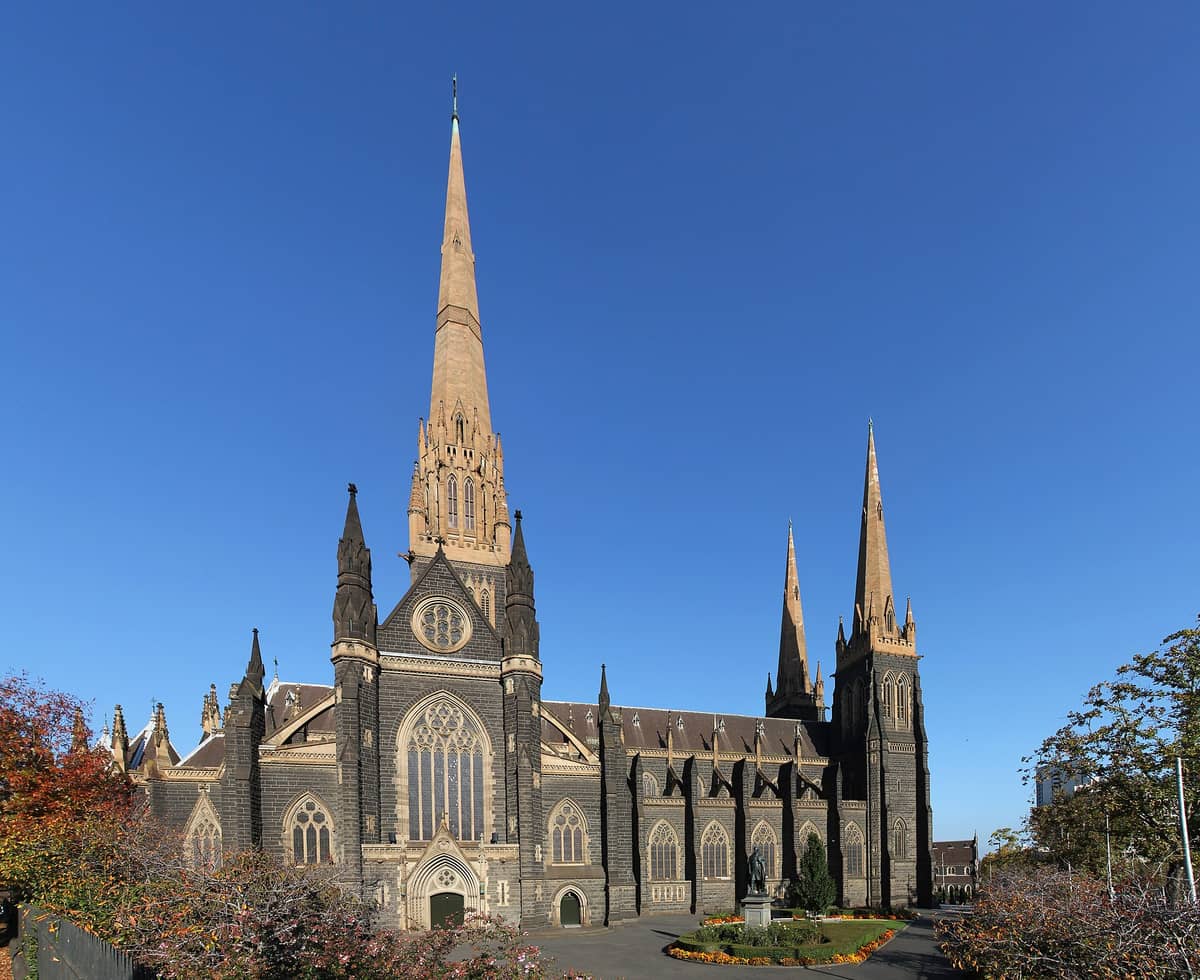
St Patrick's Cathedral is the mother church of the Roman Catholic Archdiocese of Melbourne and one of the largest cathedrals in Australia. It sits on the edge of East Melbourne, a few minutes' walk from the top of the CBD grid, and its three spires are a consistent reference point on the city skyline east of the Fitzroy Gardens. The building is Gothic Revival in style, modelled on the English and French cathedral tradition, and the sheer scale of it is something photographs rarely convey. The central spire reaches 105 metres; the nave runs 103.6 metres from end to end.
Entry is free. There is no guided tour included by default, no audio guide available at the door, and no entry ticket to queue for. You walk in, you look around, and if you want context you will need to read the interpretive panels inside or do some research beforehand. That simplicity is part of the appeal, but it also means the experience is what you make of it.
ℹ️ Good to know
Opening hours: Monday to Friday 6:30 am to 5:30 pm (later when an evening service is scheduled); Saturday and Sunday 7:30 am to 7:30 pm. Visitor access may be restricted during weddings, funerals, and major liturgical events. Check the cathedral website before planning a specific visit time.
A Building That Took 81 Years to Complete
Construction of St Patrick's Cathedral began in 1858, just two decades after European settlement in the Port Phillip district and during the economic boom that followed the Victorian Gold Rush. The architect was William Wardell, an English convert to Catholicism who trained under Augustus Pugin, the man most associated with the Gothic Revival movement in Britain. Wardell's design drew on 13th-century French and English Gothic precedents: pointed arches, ribbed vaulting, flying buttresses, and clerestory windows designed to flood the interior with directed light.
The cathedral was consecrated in 1897, but the three spires were not completed until 1939, eighty-one years after the first stones were laid. That long construction timeline is not unusual for Gothic-style cathedrals of this ambition, but it does mean the building reflects several generations of work, funding drives, and changing priorities within Melbourne's Catholic community. The bluestone used throughout the exterior was quarried locally, which gives the building a distinctly Victorian character even while the architectural language is entirely European in origin.
If you are visiting Melbourne with a particular interest in 19th-century civic and religious architecture, St Patrick's pairs naturally with the Royal Exhibition Building in Carlton and the Parliament House, both of which were conceived during the same period of colonial confidence and ambition.
Tickets & tours
Live prices and dates from our booking partner. If you book, we may earn a commission at no extra cost to you.
Great Ocean Road reverse itinerary tour from Melbourne
From 77 €Instant confirmationFree cancellationGreat Ocean Road bus tour with a forest walk
From 90 €Instant confirmationFree cancellationYarra Valley Bus Wine Tour including lunch with a glass of wine and chocolate
From 107 €Instant confirmationFree cancellationHidden bars of Melbourne guided tour
From 115 €Instant confirmationFree cancellation
Inside the Cathedral: What You Will See
The interior is best described as tall, dark, and deliberately overwhelming. Wardell designed the space to produce a sense of spiritual weight, and it works. The nave rises to around 34 metres at its apex; the columns flanking the central aisle are clustered piers in the Gothic manner, pulling the eye upward rather than forward. The stained glass windows are the dominant visual element once your eyes adjust. Most were made in Munich and Melbourne during the late 19th and early 20th centuries and depict biblical scenes and Irish patron saints, reflecting the community that built and funded the cathedral.
The floor is largely encaustic tile, a decorative Victorian-era ceramic technique that produces geometric patterns in terracotta and cream tones. In the side chapels, smaller stained glass pieces in deeper colours create pools of coloured light on stone floors during the late morning. The high altar at the eastern end is marble and elaborately detailed; the baldachin above it was added in the 20th century and is one of the more ornate elements in the space.
One thing worth noting for photographers: the interior is quite dim. Natural light enters primarily through the clerestory windows high above the nave, and the central space can be challenging to shoot without a tripod or a camera that handles low light well. Early morning on a clear day gives the best light through the stained glass on the south side of the nave. Flash photography is generally not appropriate during services.
💡 Local tip
Photography tip: Visit between 10 am and noon on a sunny day for the best stained glass light. The windows on the south side of the nave glow most intensely in the morning hours. Arrive before any weekday midday service to have the space largely to yourself.
How the Experience Changes by Time of Day
Early weekday mornings are the quietest. Between opening and around 9 am, the cathedral is used primarily by those attending morning Mass, and there may be only a handful of other visitors. The space is cool and the sounds from outside are muffled enough that you can hear the ambient acoustics of a near-empty stone building. It is a genuinely different experience from the midday version.
Weekday afternoons bring more foot traffic: tourists walking from Parliament Station or the Fitzroy Gardens, people seeking a quiet midday break from the CBD, and school groups. The atmosphere is quieter than at comparable city churches, partly because St Patrick's sits slightly off the main tourist corridor. On weekends, particularly Sunday mornings, the building is in active liturgical use and visitor numbers around services can be significant. If attending a service is not your intention, a Saturday afternoon is often a good compromise: the building is open until 7:30 pm, the light through the west-facing windows is warm, and the post-service quiet returns by mid-afternoon.
The Melbourne Symphony Orchestra and other ensembles occasionally perform choral and orchestral concerts inside the cathedral. These events use the acoustic properties of the space intentionally and are worth attending for a completely different encounter with the building. Check the cathedral's event schedule and the MSO program separately.
Getting There and Accessibility
Parliament Station on the City Loop is the most direct public transport option, roughly a five-minute walk south along Spring Street and across Gisborne Street. Trams 12 and 109 stop at Stop 11 on the corner of Albert and Gisborne Streets, which puts you directly adjacent to the cathedral grounds. Both tram routes run from the CBD and are within the Free Tram Zone, so no fare is required if you board within the central city zone.
There is no on-site parking. If you are driving, street parking on nearby streets or the car parks serving the Fitzroy Gardens area are your best options. For general advice on getting around Melbourne's inner suburbs, the getting around Melbourne guide covers tram zones, myki cards, and transit options in detail.
Accessibility has been considered: access ramps are available at each entrance. For visitors using mobility aids, the side entrance nearest the pilgrim path and the Cathedral shop is the recommended access point. As with most heritage buildings of this age, some areas have low lighting and uneven floor surfaces. The main nave and most of the public areas are navigable, but the full interior is not uniformly level.
Context: Where This Fits in Melbourne's Inner East
St Patrick's Cathedral sits between the top of the Melbourne CBD and the leafy residential grid of East Melbourne. It is a ten-minute walk from Fitzroy Gardens and the same distance from the top of Collins Street. The area around the cathedral is calm by inner-city standards: Cathedral Place itself is a low-traffic forecourt, and the surrounding streets are largely residential or institutional.
Combining the cathedral with a broader CBD walking itinerary is straightforward. The State Library of Victoria and the Royal Arcade are both within a fifteen-minute walk, and together they form a coherent half-day introduction to Melbourne's 19th-century civic infrastructure. The cathedral is the architectural high-water mark of that era in terms of ambition and scale.
The surrounding East Melbourne neighbourhood is quiet enough to reward a short walk in either direction. The Fitzroy Gardens, a short walk east, provide an open contrast to the enclosed stone interior of the cathedral. Many visitors combine the two in a single outing.
Who Should Skip This
If you have limited time and are choosing between major Melbourne attractions, it is worth being direct: St Patrick's Cathedral is a beautiful building with genuine historical depth, but it does not offer the interactive or curatorial experience you would get at the Melbourne Museum or the Ian Potter Centre. There is no permanent exhibition about the building's history, no comprehensive audio guide, and no shop of particular note. For travellers whose primary interest is contemporary art, food culture, or the outdoors, this is likely a lower priority.
Travellers who are sensitive to religious environments or who find large church interiors uncomfortable will not find any mitigation here: the building is a working cathedral and is actively used for religious purposes. For a broader overview of Melbourne's architecture without the religious context, the Melbourne architecture guide covers a wider range of building types and periods.
Insider Tips
- Attend a weekday morning if you want the space to yourself. Services typically run at 7 am and 1 pm on weekdays;; arriving at 10 am gives you a long window of quiet between the two.
- The exterior is worth examining before you go inside. Walk around the perimeter to see the bluestone buttresses, the detail on the spire bases, and the scale of the building from the rear. Most visitors enter from the front and miss half the architecture.
- If you hear organ music from outside, go in immediately. The cathedral's pipe organ is one of the larger instruments in Melbourne and is used during some services and rehearsals. Unannounced rehearsals can be a memorable incidental experience.
- The pilgrim path entrance (side access) is also the most practical for anyone with luggage or a pram. The main front steps are steep and there is no ramp at that approach.
- For concert visits, check the Melbourne Symphony Orchestra program separately from the cathedral's own events calendar. MSO concerts held here are popular and tickets should be booked in advance.
Who Is St Patrick's Cathedral For?
- Architecture and history enthusiasts who want to understand the Gothic Revival in an Australian context
- Travellers looking for a free, unhurried cultural stop in the inner city
- Those combining a walking loop of Melbourne's 19th-century landmarks
- Visitors wanting a quiet contrast to the noise and pace of the CBD
- Music lovers attending a choral or orchestral concert in a venue with exceptional acoustics
Nearby Attractions
Other things to see while in Melbourne CBD:
- AC/DC Lane
Renamed in 2004 to honour one of Australia's most iconic rock bands, AC/DC Lane is a compact CBD laneway lined with street art, live music venues, and a raw energy that sets it apart from Melbourne's more polished laneways. Free to visit at any hour, it rewards those who show up after dark.
- Australian Centre for the Moving Image (ACMI)
The Australian Centre for the Moving Image (ACMI) sits at the heart of Federation Square and traces the full arc of screen culture, from silent cinema to interactive digital art. General entry and the permanent exhibition are free, making it one of the most rewarding stops in the Melbourne CBD regardless of your budget or the weather outside.
- Birrarung Marr
Birrarung Marr is a free, open-access riverside park on the northern bank of the Yarra River, a short walk from Flinders Street Station. Built on a former railway yard and opened in 2002, it offers terraced lawns, Indigenous cultural context, city skyline views, and a calendar of public events that transforms the space throughout the year.
- The Block Arcade
Built between 1892 and 1893, The Block Arcade is Melbourne's finest Victorian-era shopping arcade, a covered gallery of mosaic tile floors, ornate plasterwork, and a soaring glazed roof on Collins Street. Free to enter and open daily, it rewards slow exploration and offers one of the CBD's most atmospheric pauses from street-level traffic.
Planning a trip? Discover personalized activities with the Nomado app.