Fitzroy Gardens: Melbourne's Grand Victorian Escape in the Heart of the City
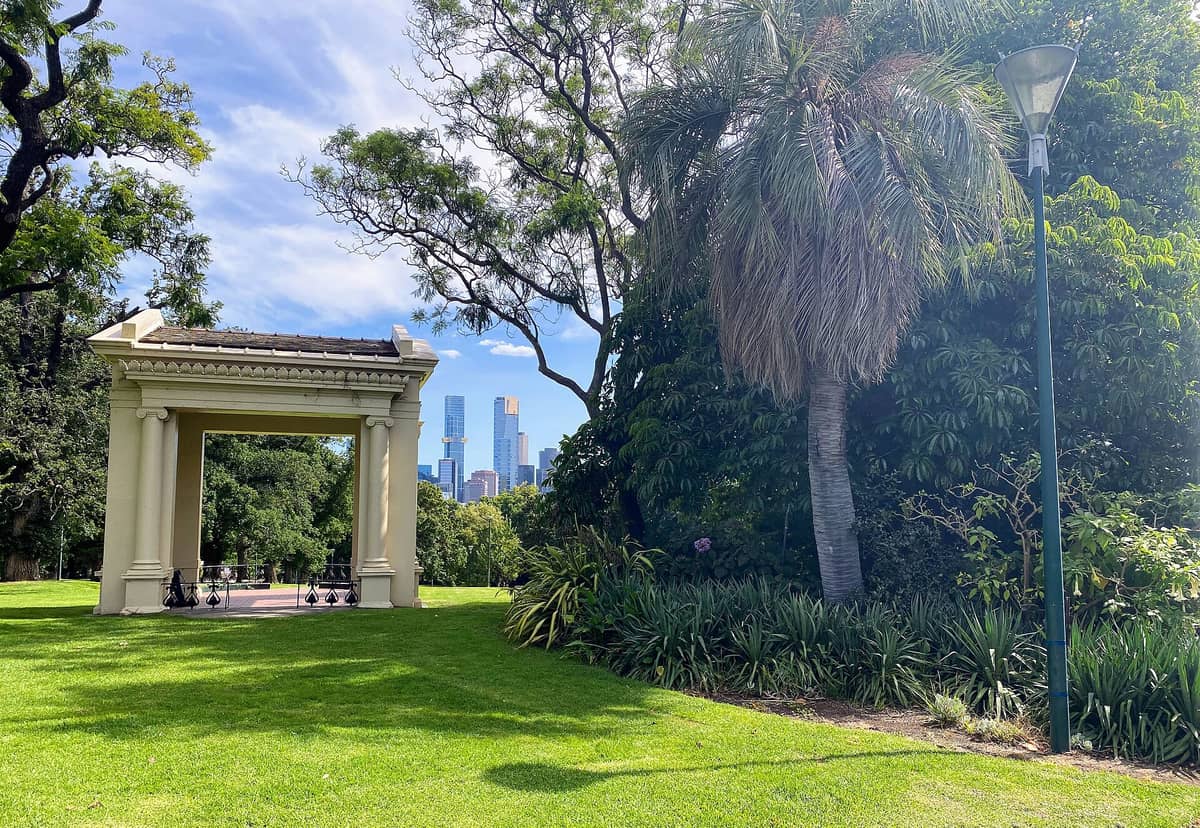
A 26-hectare garden reserve set aside in 1848 and open around the clock at no cost, Fitzroy Gardens sits at the eastern edge of Melbourne's CBD grid. Beyond the sweeping elm avenues, you'll find Cooks' Cottage, a working flower conservatory, fairy tree carvings, and quiet corners that feel genuinely removed from city noise.
Quick Facts
- Location
- Wellington Parade, East Melbourne VIC 3002 — eastern edge of the CBD grid
- Getting There
- Trams 48 or 75 (Wellington Parade stop); Parliament or Jolimont train stations; Free City Circle tram to Spring Street/Treasury Gardens
- Time Needed
- 45 minutes for a loop walk; 2 hours to visit the Conservatory and Cooks' Cottage
- Cost
- Gardens and Conservatory: free. Cooks' Cottage: paid admission (check official site for current pricing)
- Best for
- Morning walkers, families, history seekers, picnickers, photography
- Official website
- www.melbourne.vic.gov.au/fitzroy-gardens
What Fitzroy Gardens Actually Is
Fitzroy Gardens is a 64-acre (26-hectare) public reserve that has shaped the eastern edge of central Melbourne since the land was set aside in 1848. It received its current name in 1862, and The City of Melbourne has managed it since 1917. That long institutional stewardship shows: the grounds are formal in layout, carefully maintained, and dotted with heritage structures that give it a depth most city parks simply don't have.
The bones of the garden are distinctly Victorian in the colonial sense: wide diagonal paths cutting across a Union Jack plan, formal garden beds, and canopy trees planted when the colony was still finding its feet. The dominant feature at any time of year is the double row of English elms lining the main avenue, which form a high green tunnel in summer and a skeletal gothic arch in winter. Melbourne's temperate climate means there is no single 'season' where the gardens look closed or dead, though the elm leaves turning in April and May produce the closest thing the city has to a proper autumn spectacle.
💡 Local tip
The gardens are open 24 hours a day, 7 days a week, and there is no entry fee. The Conservatory is open daily 9am–5pm. Confirm Conservatory and Cooks' Cottage hours at fitzroygardens.com before your visit, as changeover closures are not always announced far in advance. Confirm Conservatory and Cooks' Cottage hours at fitzroygardens.com before your visit, as changeover closures are not always announced far in advance.
How the Garden Changes Through the Day
Early mornings, roughly 6am to 8am, belong to local residents: dog walkers, solo joggers, and office workers cutting through on their way to Parliament or the CBD. The light at this hour comes in at a low angle through the elms, catching the dew on the grass and casting long shadows across the diagonal paths. The sounds are birdsong-dominated, specifically the liquid warbling of Australian magpies and the rapid-fire call of common mynas. The air carries a faint smell of damp mulch and cut grass, especially after rain.
By mid-morning, school groups and families begin arriving, and the area around Cooks' Cottage sees a consistent queue. Midday brings office workers with lunch from nearby CBD cafes, spread across the lawns near the central fountain. If crowds are a concern, visit on a weekday morning before 10am or in the late afternoon after 3pm, when coach tour groups tend to have moved on.
Evenings, particularly in summer, see couples and small groups settling in on the grass with food from local delis. The gardens are lit at night, and the illuminated paths feel genuinely safe and used rather than abandoned, though the Conservatory and Cooks' Cottage will be closed. Weekend afternoons in fair weather can feel fairly crowded near the main fountain, but the outer sections of the reserve stay quiet throughout.
Tickets & tours
Live prices and dates from our booking partner. If you book, we may earn a commission at no extra cost to you.
Sovereign Hill, Botanical Gardens and Melbourne Skydeck Bus Tour
From 116 €Instant confirmationFree cancellationGreat Ocean Road reverse itinerary tour from Melbourne
From 77 €Instant confirmationFree cancellationGreat Ocean Road bus tour with a forest walk
From 90 €Instant confirmationFree cancellationYarra Valley Bus Wine Tour including lunch with a glass of wine and chocolate
From 107 €Instant confirmationFree cancellation
The Conservatory: Small but Worth the Visit
The Fitzroy Gardens Conservatory is a working ornamental glasshouse rather than a large botanical showcase. It is free to enter and runs a rotating schedule of themed flower displays across the year, typically timed to seasonal flowering periods. The interior is warm, humid, and fragrant: stepping inside from a cool Melbourne morning is a genuine sensory shift. The scale is modest, and you can walk through the main display in about ten minutes, but the horticultural detail rewards slower attention.
The Conservatory closes during changeover periods between displays, which can last several days. These closures are not always communicated clearly online in advance. If a Conservatory visit is important to your trip, call or check the Fitzroy Gardens website the day before. The Conservatory houses five floral displays a year, and its displays change periodically. If a Conservatory visit is important to your trip, check the Fitzroy Gardens website before you go.
Cooks' Cottage: History That Earns Its Admission Fee
Cooks' Cottage is the most historically specific attraction within the gardens. The stone cottage was originally built in Great Ayton, Yorkshire, England, in 1755, by the parents of Captain James Cook. In 1934, the cottage was dismantled, transported to Australia, and rebuilt stone by stone in Fitzroy Gardens as part of Melbourne's centenary celebrations. The interpretive displays inside cover both Cook's voyages and the unusual colonial history of the structure itself. For context on how Cook's 1770 voyage fits into Melbourne's broader settler history, the Immigration Museum downtown adds a useful counterpoint.
An admission fee applies to Cooks' Cottage; the gardens' official website lists current pricing, which is not reproduced here as it may change. The cottage is managed separately from the gardens and keeps its own opening hours. Honestly, if pre-colonial and early colonial history interests you, the admission is reasonable for what is a genuinely rare physical artifact. If you are pressed for time or your group is not interested in colonial history, you can skip it without missing the essence of a garden visit.
Other Things Worth Finding in the Gardens
The Fairy Tree is easy to walk past without noticing: an old red gum tree carved with scenes of fairies, pixies, and Australian bush creatures by sculptor Ola Cohn in 1934. It is located in the southwestern section of the gardens and is more charming on inspection than it sounds in description. Children typically respond to it with immediate curiosity; adults often find it quietly remarkable as folk art. It is free to view and uncrowded outside of school holiday peaks.
The model Tudor village, a miniature replica of Tudor-era English streetscapes donated by the UK in 1948, sits near the Visitor Centre. The detail is intricate if you crouch down to look at it closely, which most visitors don't bother to do. There is also a central ornamental lake with ducks, a formal floral clock, and the Visitor Centre itself, which has step-free access, accessible toilets, and an accessible parking bay via a kerb ramp from the footpath.
ℹ️ Good to know
Accessibility note: The Visitor Centre has confirmed step-free, level access and accessible facilities. Garden paths vary in surface and gradient across the 26-hectare reserve. Not all areas are equally accessible for wheelchair users or those with limited mobility. The City of Melbourne publishes an accessibility guide for the Visitor Centre specifically; broader path accessibility is not uniformly documented.
Getting There and Practical Logistics
The address is Wellington Parade, East Melbourne VIC 3002. Tram routes 48 and 75 serve the gardens, with the nearest stop at Jolimont Rd/Wellington Parade, about 100 metres from the Visitor Centre. The Free City Circle tram drops you at Spring Street near the Treasury Gardens, a short walk to Fitzroy Gardens' western boundary. Parliament Station and Jolimont Station are the nearest train options. If you are already exploring the Melbourne CBD, Fitzroy Gardens is an easy 10 to 15-minute walk east from Swanston Street.
Parking is available on surrounding streets and in nearby lots, but it is metered and can be competitive on weekends. Public transport is the most reliable option. If you are combining this with nearby attractions, Parliament House Melbourne is a five-minute walk west along Spring Street, and the Royal Botanic Gardens are a 25-minute walk south through the Domain.
Melbourne's weather is famously changeable. In summer, the gardens can sit under full sun, and temperatures can spike above 35°C on hot northerly wind days. Bring water and sunscreen for summer visits. In winter, the gardens are perfectly usable, and the elm canopy bare of leaves opens up long sightlines across the reserve. Rain happens year-round, so a compact rain jacket is worth keeping in a bag regardless of the season.
Photography: What Works and What Doesn't
The main elm avenue is the standout photographic subject in the gardens, and it works best in low, directional light: early morning or late afternoon. Midday sun flattens the scene and the dappled light becomes harsh through the canopy. In autumn (April to May), the leaves turn yellow and amber, and the avenue is genuinely beautiful at almost any hour. A wide lens captures the tunnel effect well; a longer focal length compresses the tree rows into something more dramatic.
Cooks' Cottage photographs well in the morning before the crowds arrive. The Conservatory interior requires patience with the glass reflections but the flower displays can be striking in detail shots. For wider Melbourne photography context, the best views in Melbourne guide covers elevated perspectives that give Fitzroy Gardens a different kind of presence in the cityscape.
Who Should Think Twice
Fitzroy Gardens is not the right stop if you are specifically chasing Melbourne's contemporary culture scene, street art, or food. The gardens are tranquil and traditional in character, and the surrounding East Melbourne neighborhood is primarily residential and institutional. There are no cafes inside the gardens themselves, so if you need coffee first thing, you will need to sort that out before you arrive or walk back toward the CBD.
If your interest is in larger botanical collections, the Royal Botanic Gardens Victoria offer a much deeper horticultural experience with over 8,500 plant species across 38 hectares. Fitzroy Gardens and the Royal Botanic Gardens serve different purposes: one is a formal urban park with heritage structures, the other is a serious botanical institution. Both are free to enter.
Insider Tips
- The Conservatory closes without much public notice during display changeovers between seasonal shows. If seeing the Conservatory is a priority, check fitzroygardens.com the day before, or call the Visitor Centre directly.
- The section of the gardens nearest the northeastern corner, away from Cooks' Cottage and the main fountain, stays quiet even on busy weekend afternoons. If you want to sit and read or eat without company, head there.
- In autumn (April to May), the elm avenue peak foliage usually lasts only two to three weeks. Melbourne doesn't have a formal autumn foliage tracker, so check recent social posts geotagged at Fitzroy Gardens to gauge timing before planning a dedicated autumn visit.
- The Fairy Tree is easy to miss because it is not prominently signposted. Look for the carved original red gum tree near the Model Tudor Village.
- Trams 48 and 75 serve the gardens on Wellington Parade. Check the PTV app for current fare-zone boundaries before boarding. Confirm the zone boundaries on the PTV app before boarding if you are unsure, as the boundary on this side of the city can be unclear without checking.
Who Is Fitzroy Gardens For?
- Families with young children who want space to move, the Fairy Tree, and Cooks' Cottage without paying a park entry fee
- Walkers and joggers seeking a calm morning route close to the CBD without traffic
- History-focused travelers interested in early colonial Melbourne and Captain Cook's Pacific voyages
- Photography enthusiasts targeting the elm avenue, particularly in autumn or early morning light
- Visitors who want a genuine pause between CBD sightseeing and eastern suburb exploring
Nearby Attractions
Other things to see while in Melbourne CBD:
- AC/DC Lane
Renamed in 2004 to honour one of Australia's most iconic rock bands, AC/DC Lane is a compact CBD laneway lined with street art, live music venues, and a raw energy that sets it apart from Melbourne's more polished laneways. Free to visit at any hour, it rewards those who show up after dark.
- Australian Centre for the Moving Image (ACMI)
The Australian Centre for the Moving Image (ACMI) sits at the heart of Federation Square and traces the full arc of screen culture, from silent cinema to interactive digital art. General entry and the permanent exhibition are free, making it one of the most rewarding stops in the Melbourne CBD regardless of your budget or the weather outside.
- Birrarung Marr
Birrarung Marr is a free, open-access riverside park on the northern bank of the Yarra River, a short walk from Flinders Street Station. Built on a former railway yard and opened in 2002, it offers terraced lawns, Indigenous cultural context, city skyline views, and a calendar of public events that transforms the space throughout the year.
- The Block Arcade
Built between 1892 and 1893, The Block Arcade is Melbourne's finest Victorian-era shopping arcade, a covered gallery of mosaic tile floors, ornate plasterwork, and a soaring glazed roof on Collins Street. Free to enter and open daily, it rewards slow exploration and offers one of the CBD's most atmospheric pauses from street-level traffic.
Planning a trip? Discover personalized activities with the Nomado app.