Parliament House Melbourne: Inside Victoria's Unfinished Grand Chamber
Parliament House of Victoria is one of Melbourne's most significant public buildings, a Greek Revival landmark on Spring Street that has shaped the colony and state since 1856. Free guided tours reveal ornate debating chambers, a fascinating construction history, and the living machinery of Victorian democracy.
Quick Facts
- Location
- Spring Street, East Melbourne VIC 3002 (Melbourne CBD edge)
- Getting There
- Parliament Station (Bourke St exit); Tram 35, 86, or 96 to Bourke St/Spring St
- Time Needed
- 1 to 1.5 hours for a guided tour
- Cost
- Free public tours; no admission charge
- Best for
- History buffs, architecture enthusiasts, civics-minded travellers
- Official website
- www.parliament.vic.gov.au/visit/public-tour
What Is Parliament House Melbourne?
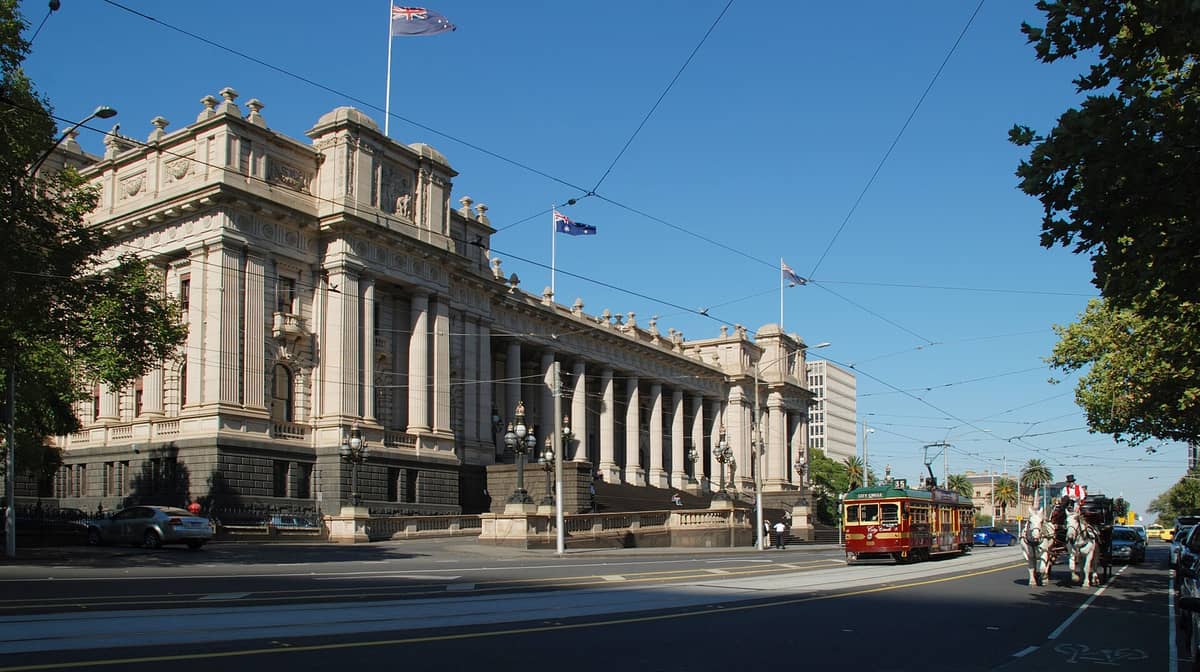
Parliament House of Victoria, the formal name for what most Melburnians simply call Parliament House, sits at the top of Bourke Street on Spring Street and is one of the oldest and most architecturally elaborate legislative buildings in Australia. Construction began in 1856, and The Legislative Council and Legislative Assembly chambers were completed in November 1856, ready for the first Parliament under Victoria's new constitution, officially opened on 25 November. That date is important: the building is not a colonial relic added after the fact, but a founding statement of democratic ambition.
What makes Parliament House genuinely unusual is that it remains unfinished. The original vision called for a dome to crown the building and a more elaborate facade. Neither was ever realised, which means the building you see today is a truncated version of a grand plan, a fact that gives it a curiously honest quality. Architects and history enthusiasts often find this more interesting, not less.
ℹ️ Good to know
The building is open Monday to Friday, 8:30 am to 5:30 pm (last entry 5:00 pm), and closed on weekends and public holidays. Free public tours run on weekdays when Parliament is not sitting; check the Parliament of Victoria website for current tour times and booking information.
The Architecture: Greek Revival on a Colonial Budget
The building's exterior draws on the Greek Revival style that was fashionable for civic buildings in the mid-nineteenth century: a wide Corinthian colonnade, heavy stone steps, and symmetrical massing that conveys permanence and authority. Standing at the bottom of Bourke Street looking up the hill, the colonnade frames the sky in a way that feels deliberately theatrical. At midday in summer, the bluestone steps can be scorching underfoot, so appropriate footwear matters.
The interior is where the design shifts register. The debating chambers are finished in deep greens and golds, with leather benches, timber panelling, and painted ceilings that took considerable craftsmanship to execute. The Legislative Council chamber, which operates as the upper house, has a particularly ornate ceiling that draws most visitors' eyes upward the moment they step inside. If you have an interest in colonial-era interiors, the Parliament House visit pairs naturally with a walk through the Royal Exhibition Building in nearby Carlton, another Victorian-era set piece built to impress.
The building's stonework is Malmsbury bluestone and sandstone. Bluestone, quarried from the volcanic plains west of Melbourne, appears throughout the city's older public buildings and gives them a distinctive grey-blue solidity. Noticing where bluestone ends and sandstone dressing begins is one of the small pleasures of paying close attention during the tour.
Tickets & tours
Live prices and dates from our booking partner. If you book, we may earn a commission at no extra cost to you.
Great Ocean Road reverse itinerary tour from Melbourne
From 77 €Instant confirmationFree cancellationHidden bars of Melbourne guided tour
From 115 €Instant confirmationFree cancellationSecrets of Melbourne guided tour
From 60 €Instant confirmationFree cancellationPenguin Parade Express Guided Tour from Melbourne
From 95 €Instant confirmationFree cancellation
The Free Public Tours: What Actually Happens
Tours are run by the Parliament itself and are staffed by trained guides who know the building and its political history in detail. Tours are run by the Parliament itself and are staffed by experienced guides who know the building and its political history in detail. Tour routes and access to the Legislative Chambers depend on availability, so check current tour information before visiting. Where access is available, visitors may be able to view the chambers at close range.
Guides tend to field questions well, and the tours are more conversational than scripted. If you are visiting with children who have some interest in how government works, this format suits them better than a passive museum display. That said, That said, young children with no interest in politics may find a 45-minute tour of formal rooms a slow experience. Honest assessment: the tour rewards curiosity, and it can feel slow if you arrive without any.
When Parliament is sitting, visitors may be able to watch proceedings from the public galleries; check the Parliament of Victoria website for sitting dates and current visitor requirements before your visit.
💡 Local tip
Check the parliamentary sitting calendar before you visit. Check the parliamentary sitting calendar before you visit. If Parliament is in session, check the Parliament of Victoria website for information about attending proceedings from the public gallery.
Visiting by Time of Day
The building opens only on weekdays, which immediately filters the crowd. Morning visits, particularly before 10 am, tend to be quieter. The foyer and public areas fill somewhat during lunch hours with workers from nearby offices stopping in on self-guided walks, but the building never reaches the crowd levels of outdoor tourist attractions. Afternoon light through the chamber windows is particularly good for photography, especially in the Legislative Council, where the warm tones of the fittings are enhanced by late-afternoon sun.
Spring Street itself is worth a few minutes before or after the tour. The street runs along the eastern boundary of the CBD grid and connects the Parliament at its northern end to the Treasury Building and Treasury Gardens further south. The avenue of plane trees along the pavement provides useful shade in summer. In autumn, the leaf colour is genuine and worth the walk.
The surrounding precinct rewards those who build in extra time. The Fitzroy Gardens are a short walk east, offering a contrast in texture and pace after the formal interior of Parliament House. The gardens were established in the 1850s, making them near-contemporaries of the building itself.
Historical and Cultural Context
Victoria's Parliament has operated from this site continuously since 1856, making it one of the longest-running democratic institutions in the southern hemisphere. During the period of Australian federation from 1901 to 1927, the building also served as the meeting place for the federal Parliament while the national capital was being established in Canberra. That chapter is often underemphasised in popular accounts: for 26 years, this was the meeting place of the Commonwealth Parliament.
Melbourne's broader identity as a civic and cultural capital was shaped significantly by the concentration of grand public buildings constructed during the gold-rush era of the 1850s and 1860s. Parliament House, the Royal Exhibition Building, and the State Library of Victoria all date from this period of rapid wealth and ambition. Seeing them together gives a clearer sense of what the colony was trying to say about itself than any single building can convey alone.
Parliament House also sits on land that is part of the traditional Country of the Wurundjeri Woi-wurrung and Bunurong peoples of the Kulin Nation, whose connection to this place predates the building by tens of thousands of years. The Parliament of Victoria acknowledges this on its official materials, and it is worth holding this context alongside the colonial grandeur of the interior.
Getting There and Practical Notes
Parliament Station and nearby tram stops provide public-transport access to Parliament House; check current PTV information for routes, stops and fare-zone details.
The building address is Spring Street, East Melbourne, just outside the CBD boundary. If you are planning a full day in the area, consider combining the visit with the State Library of Victoria to the west and the Royal Exhibition Building to the north, both free to enter and both within comfortable walking distance. The Melbourne architecture guide covers these connections in more detail.
Accessibility
Step-free access is available via the Spring Street side entrance through the Bali Garden gate, or via the Macarthur Street rear entrance. Accessible toilets are located on the ground and first levels. Tour routes can be adjusted for visitors with mobility requirements; contact the Parliament's visitor services team in advance to arrange this.
⚠️ What to skip
The main entrance involves a significant flight of stone steps. Visitors using wheelchairs or with limited mobility should use the Spring Street Bali Garden gate or the Macarthur Street rear entrance, both of which provide step-free access.
Photography and What to Expect Inside
Photography is permitted at the discretion of the tour guide during public tours, so confirm the rules on arrival. The chambers present a genuine photography challenge: the lighting is warm and atmospheric but not particularly bright, so a phone camera may struggle. If you carry a compact or mirrorless camera, the chamber ceilings and the sweeping view from the visitor gallery down into the debating floor are the frames worth spending time on.
Queen's Hall, the central reception room linking the two chambers, is one of the most photogenic spaces in the building. Its portrait collection lines the walls and provides scale. The hall has hosted state receptions, international visits, and significant civic moments over more than 160 years, and that accumulated weight is palpable in a way that photographs only partially capture.
Insider Tips
- Check the parliamentary sitting calendar before your visit at parliament.vic.gov.au. If Parliament is sitting, you can watch live debate from the public gallery, which is a completely different and often more engaging experience than a standard building tour.
- The Bali Garden, accessible from the Spring Street side entrance, is a quiet courtyard that most visitors walk past without noticing. It is a genuine pause point if the building is busy and you want a few minutes outdoors.
- Late afternoon weekday visits are typically the quietest. Morning groups, including school excursions, are common earlier in the day and can make the chambers feel crowded.
- The view back down Bourke Street from the top of the Parliament steps is one of the better urban vistas in the CBD, with the street grid stretching west toward Docklands. It costs nothing and takes thirty seconds.
- If you want to connect Parliament House to a broader understanding of Melbourne's gold-rush-era civic architecture, build a half-day around Spring Street: start at Parliament House, walk south past the Treasury Building, then cut through the Treasury Gardens to the Fitzroy Gardens.
Who Is Parliament House Melbourne For?
- Architecture and design enthusiasts interested in Victorian-era civic buildings
- History-focused travellers wanting to understand Melbourne beyond its food and arts reputation
- Budget travellers: free entry and no booking fee make this an easy addition to any itinerary
- Civics or politics enthusiasts, particularly if Parliament is in session
- Travellers combining several CBD landmarks into a single walkable half-day
Nearby Attractions
Other things to see while in Melbourne CBD:
- AC/DC Lane
Renamed in 2004 to honour one of Australia's most iconic rock bands, AC/DC Lane is a compact CBD laneway lined with street art, live music venues, and a raw energy that sets it apart from Melbourne's more polished laneways. Free to visit at any hour, it rewards those who show up after dark.
- Australian Centre for the Moving Image (ACMI)
The Australian Centre for the Moving Image (ACMI) sits at the heart of Federation Square and traces the full arc of screen culture, from silent cinema to interactive digital art. General entry and the permanent exhibition are free, making it one of the most rewarding stops in the Melbourne CBD regardless of your budget or the weather outside.
- Birrarung Marr
Birrarung Marr is a free, open-access riverside park on the northern bank of the Yarra River, a short walk from Flinders Street Station. Built on a former railway yard and opened in 2002, it offers terraced lawns, Indigenous cultural context, city skyline views, and a calendar of public events that transforms the space throughout the year.
- The Block Arcade
Built between 1892 and 1893, The Block Arcade is Melbourne's finest Victorian-era shopping arcade, a covered gallery of mosaic tile floors, ornate plasterwork, and a soaring glazed roof on Collins Street. Free to enter and open daily, it rewards slow exploration and offers one of the CBD's most atmospheric pauses from street-level traffic.
Planning a trip? Discover personalized activities with the Nomado app.