Immigration Museum Melbourne: Stories of Arrival in a Landmark Building
Housed in the 19th-century Old Customs Building on Flinders Street, the Immigration Museum tells the layered story of migration to Victoria through personal objects, oral histories, and immersive exhibitions. It is thoughtful, unhurried, and frequently moving — a counterweight to Melbourne's flashier attractions.
Quick Facts
- Location
- 400 Flinders Street, Melbourne CBD (Old Customs Building, beside the Yarra River)
- Getting There
- Trams 48, 58, 70, 75 and City Circle Tram to Flinders & Market St; Flinders Street and Southern Cross stations nearby
- Time Needed
- 2–3 hours for the permanent collection; add 45 min for special exhibitions
- Cost
- Adults A$15, Seniors A$12, Children 16 and under free, Concession-card holders free
- Best for
- History lovers, families with older children, anyone tracing their own migration story
- Official website
- museumsvictoria.com.au/immigrationmuseum
What the Immigration Museum Actually Is
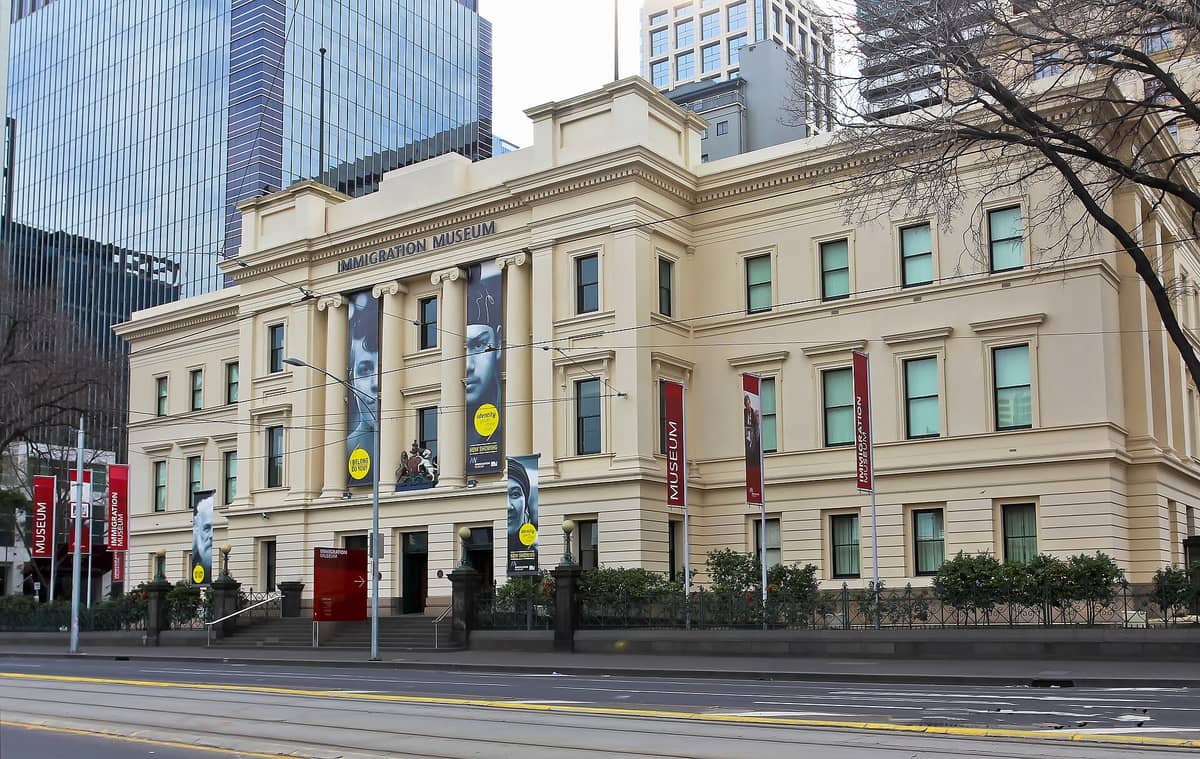
The Immigration Museum occupies one of Melbourne's most significant civic buildings: the Old Customs Building on Flinders Street, completed in 1876. It sits at the edge of the Birrarung (Yarra River), a location that carries its own historical weight — goods and people once arrived at this very precinct before they were officially permitted to enter the colony. The museum, operated by Museums Victoria, opened here in 1998 and has since developed into one of Australia's most substantive institutions focused on migration history.
Unlike a traditional history museum where objects sit at a remove, this institution foregrounds personal testimony. The exhibitions are built around real letters, photographs, suitcases, clothing, and recorded voices — the material culture of displacement and arrival. The result is a place that manages to be simultaneously educational and emotionally direct without being manipulative.
💡 Local tip
Children aged 16 and under enter free, and concession-card holders are also admitted free. Confirm current pricing at museumsvictoria.com.au/immigrationmuseum before your visit, as special exhibitions may carry additional charges.
The Building Itself: Architecture and First Impressions
The Old Customs Building is a statement in Italian Renaissance Revival style, designed by government architect Peter Kerr. Its long stone facade along Flinders Street and the ornate entrance hall — with high ceilings, decorated plasterwork, and a grand Long Room — provide a formal architectural frame that the museum uses deliberately. You enter a space that once processed the colonial economy of Victoria, now repurposed to examine the human cost and complexity of that same history.
The building has been carefully adapted for museum use. Accessible entrances are via Market Street, and lifts and ramps connect the main exhibition levels. Wheelchairs and a mobility scooter are available to borrow free of charge at the entrance. The heritage classification of the building means the front entrance itself is not step-free, so visitors with mobility requirements should use the Market Street access point.
For visitors interested in Melbourne's architectural history more broadly, the Immigration Museum sits within a corridor of significant civic buildings. The nearby Flinders Street Station and the St Paul's Cathedral form part of the same historical streetscape, and the area rewards walking time before or after your museum visit.
Tickets & tours
Live prices and dates from our booking partner. If you book, we may earn a commission at no extra cost to you.
Great Ocean Road reverse itinerary tour from Melbourne
From 77 €Instant confirmationFree cancellationGreat Ocean Road bus tour with a forest walk
From 90 €Instant confirmationFree cancellationYarra Valley Bus Wine Tour including lunch with a glass of wine and chocolate
From 107 €Instant confirmationFree cancellationHidden bars of Melbourne guided tour
From 115 €Instant confirmationFree cancellation
What You Will See: Permanent Galleries
The core permanent gallery traces migration to Victoria from the early colonial period through the present day. It examines waves of movement: gold-rush-era arrivals from China, Europe, and the Americas; post-World War II displaced persons programs; family reunion schemes; and more recent refugee and humanitarian intakes. The chronological sweep is wide, but the exhibition keeps returning to the individual — a specific person, a specific decision to leave, a specific experience of arrival.
One of the most effective recurring elements is the use of reconstructed spaces. Narrow ship berths give a physical sense of the voyages many migrants endured. Waiting rooms and inspection areas from earlier immigration control processes are recreated with enough detail to be genuinely uncomfortable — which is precisely the point. The museum does not soften the history of exclusionary immigration policies, including the White Australia Policy, and this honesty is one of its distinguishing qualities.
The Tribute Garden and the Long Room are two spaces worth pausing in. The Long Room in particular, with its soaring ceilings and the names of migrants inscribed into the installation, creates a cumulative effect that rewards slow reading rather than a quick pass through.
How the Experience Shifts by Time of Day
The museum opens at 10am daily and the first hour tends to be the quietest. Weekday mornings attract school groups, which can make certain galleries loud between roughly 10:30am and midday. If you prefer a contemplative visit, arriving at 10am and heading to the upper galleries first — working against the usual visitor flow — gives you the best chance of space and quiet.
Weekend afternoons can be moderately busy, particularly if a special exhibition is running. Even at peak times, the museum rarely feels overwhelmed. Its layout across multiple floors naturally distributes visitor flow, and the galleries designed around personal stories encourage people to slow down rather than rush. By 3:30pm on most days, numbers begin to thin noticeably. The museum closes at 5pm, and last entry is recommended at least an hour before closing to allow adequate time for the main galleries.
ℹ️ Good to know
The museum is open daily 10am–5pm, closed Good Friday and Christmas Day. Verify current hours and any temporary closures at museumsvictoria.com.au/immigrationmuseum before your visit.
Practical Walkthrough: Getting There and Moving Around
The museum's address is 400 Flinders Street, and it is straightforward to reach from most parts of the Melbourne CBD. Tram routes 48, 58, 70, and 75 all stop at Flinders Street and Market Street. The free City Circle Tram also stops nearby. If you are arriving by train, both Flinders Street Station and Southern Cross Station place you within a 5 to 10 minute walk.
Melbourne's free tram network covers the central city grid, making the museum easy to reach without paying a fare. If you are unfamiliar with the tram system, the City Circle Tram provides a useful orientation loop around the CBD before you commit to a destination. More detail on navigating the network is in the guide to getting around Melbourne.
Parking is available nearby but is paid and subject to time limits. Given the museum's central location and excellent tram access, public transport is the practical choice for most visitors. The riverside setting also means you can combine the visit with a walk along the Yarra foreshore before or after.
Photography, What to Bring, and Who Should Skip This
Photography is generally permitted in the permanent galleries without flash; check signage in any special exhibitions, as restrictions sometimes apply there. The interior of the Long Room photographs well in the early morning light that comes through the high windows. The exterior of the Old Customs Building also warrants a few frames, particularly the Market Street elevation where the sandstone detail is well preserved.
There is a cafe on site, and the museum's central location means dozens of options for lunch and coffee are within a short walk. The nearby laneway precinct between Flinders Street and Collins Street includes several well-regarded coffee spots.
Who might not enjoy this visit: if you are looking for interactivity aimed at young children, this is not the right choice. The exhibitions are text-heavy and emotionally nuanced — better suited to children aged 12 and above who can engage with personal histories. Visitors expecting a light, celebratory take on migration may also find the museum more challenging than anticipated; it confronts difficult policy history directly and without apology. That said, this is not a reason to avoid it. It is a reason to go in prepared.
The museum pairs naturally with a visit to nearby Federation Square and the Ian Potter Centre: NGV Australia, which holds significant works by Australian and First Nations artists. Together, these three destinations form a coherent half-day loop that covers Indigenous history, migration, and Australian visual culture.
Insider Tips
- Arrive at 10am on a weekday and head upstairs first — school groups tend to gather in the ground-floor galleries during mid-morning, so working from the top down keeps you ahead of the crowds.
- The Long Room hosts temporary exhibitions and evening events outside regular hours. Check the museum's event calendar before your visit; these events often offer a different atmosphere in the historic space.
- The accessible entrance on Market Street is actually less crowded than the main Flinders Street approach and gives you a better first view of the building's original stonework.
- If you have a personal connection to migration history — whether your own or your family's — the museum's oral history stations and the database of passenger records and migration documents can be surprisingly specific and worth extra time.
- Concession-card holders enter free, and this is genuine: Medicare card holders, Seniors Card holders, and Health Care Card holders all qualify. Bring the card to show at the door.
Who Is Immigration Museum For?
- Travelers with family ties to immigration who want to trace or contextualize their own history
- History and architecture enthusiasts interested in colonial-era Melbourne
- Visitors who prefer quiet, text-led cultural experiences over interactive spectacle
- School-age children (12+) on educational itineraries covering Australian history
- Anyone interested in how Australia's immigration policies shaped the country's present-day diversity
Nearby Attractions
Other things to see while in Melbourne CBD:
- AC/DC Lane
Renamed in 2004 to honour one of Australia's most iconic rock bands, AC/DC Lane is a compact CBD laneway lined with street art, live music venues, and a raw energy that sets it apart from Melbourne's more polished laneways. Free to visit at any hour, it rewards those who show up after dark.
- Australian Centre for the Moving Image (ACMI)
The Australian Centre for the Moving Image (ACMI) sits at the heart of Federation Square and traces the full arc of screen culture, from silent cinema to interactive digital art. General entry and the permanent exhibition are free, making it one of the most rewarding stops in the Melbourne CBD regardless of your budget or the weather outside.
- Birrarung Marr
Birrarung Marr is a free, open-access riverside park on the northern bank of the Yarra River, a short walk from Flinders Street Station. Built on a former railway yard and opened in 2002, it offers terraced lawns, Indigenous cultural context, city skyline views, and a calendar of public events that transforms the space throughout the year.
- The Block Arcade
Built between 1892 and 1893, The Block Arcade is Melbourne's finest Victorian-era shopping arcade, a covered gallery of mosaic tile floors, ornate plasterwork, and a soaring glazed roof on Collins Street. Free to enter and open daily, it rewards slow exploration and offers one of the CBD's most atmospheric pauses from street-level traffic.
Planning a trip? Discover personalized activities with the Nomado app.