St Katharine Docks: London's Most Atmospheric Marina
Tucked just upstream (west) of Tower Bridge, St Katharine Docks is a beautifully preserved 19th‑century dock and marina complex that trades in a surprising quietness for somewhere so central. Designed by Thomas Telford and opened in 1828, the docks now house restaurants, a working marina, and some of the most photogenic waterside architecture on the eastern edge of central London. Entry is free.
Quick Facts
- Location
- 50 St Katharine's Way, London E1W 1LA, next to the Tower of London and close to Tower Bridge
- Getting There
- Tower Hill (Circle & District lines) or Tower Gateway (DLR), both around 5–8 min walk
- Time Needed
- 45 minutes to 2 hours depending on dining or events
- Cost
- Free to enter the quayside; restaurants and events charge separately
- Best for
- Waterfront walks, photography, casual waterside dining, architecture lovers
- Official website
- www.skdocks.co.uk
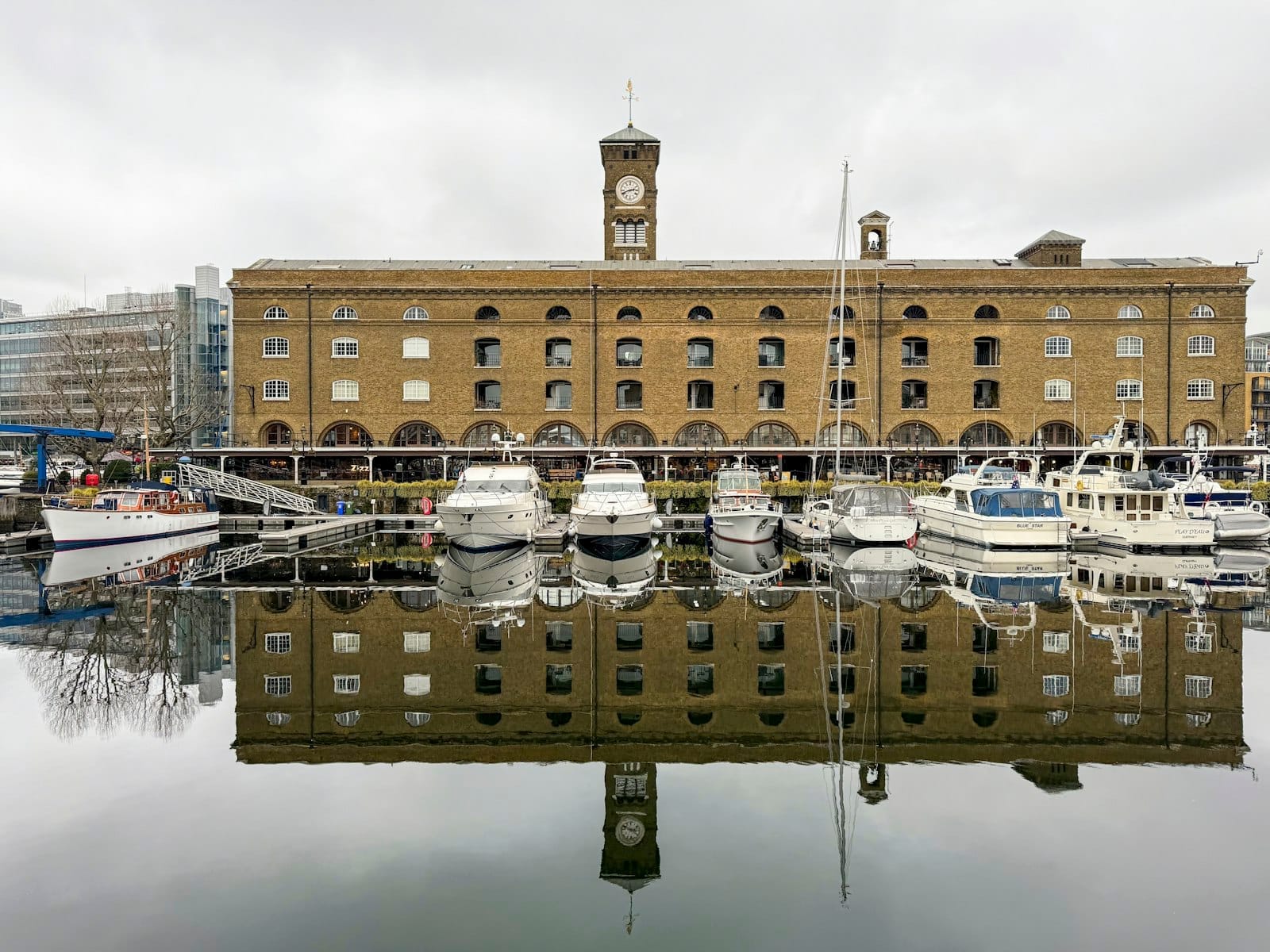
What St Katharine Docks Actually Is
St Katharine Docks is a compact, enclosed marina complex located on the north bank of the River Thames in central London, immediately east of the Tower of London and just west of Tower Bridge. It occupies a site that was once dominated by the medieval Hospital of St Katharine's by the Tower, a religious foundation dating to the 12th century, before being cleared to make way for the new commercial docks. Today the estate is a mix of residential apartments, offices, restaurants, bars, and a working marina that berths yachts and historic vessels year-round.
The docks were designed by the engineer Thomas Telford and opened in 1828, operating as commercial docks for the Port of London until their closure in 1968. The site then sat derelict before becoming one of the earliest projects in the broader London Docklands redevelopment, which transformed it into the leisure and hospitality destination it is today. The overall footprint is small enough to walk in under ten minutes, which makes the experience surprisingly intimate compared to larger riverside destinations.
ℹ️ Good to know
Entry to the quayside and dock walkways is free. There are no gates or timed entry windows. The area is publicly accessible throughout the day and evening, with individual venues keeping their own hours.
The Architecture and Layout
Telford's design created two interconnected basins, the East and West docks (often described today as the eastern and western basins), fed from the Thames through a lock. The warehouse buildings that once lined these basins are now converted into restaurants and commercial spaces, but the bones of the original Victorian dock infrastructure remain clearly visible: iron swing bridges, stone quayside edges, and the lock chamber at the Thames entrance. The water itself stays enclosed and relatively calm, which is why the reflections of moored yachts and surrounding buildings are so sharp here, particularly on overcast days when the light is even and there is no glare.
The Dickens Inn, a prominent timber-framed structure within the complex, draws considerable attention. It was originally an 18th-century warehouse that was dismantled and re-erected on the current site during the redevelopment. It is a pub and restaurant, not a museum, and while the timber construction looks dramatic, visitors should know it was relocated and reconstructed rather than being original to this exact spot. Still, it anchors the eastern basin visually and gives the docks a more characterful feel than a purely modern redevelopment would.
The architecture surrounding the water is layered: Georgian warehouse conversions at ground level, with later residential towers rising behind them. Walking the full perimeter of the two basins on the narrow quayside paths gives you constantly changing angles. The small swing bridges connecting the quaysides are functional, occasionally rotating to allow larger vessels to pass between basins, and watching this happen is one of those small unexpected pleasures the docks offer.
Tickets & tours
Hand-picked options from our booking partner. Prices are indicative; availability and final rates are confirmed when you complete your booking.
Cruise of London's Docklands in a hot tub boat
From 45 €Instant confirmationFree cancellationSoho Instagram a self-guided walking tour to top photo spots
From 6 €Instant confirmationFree cancellationTootbus London by Night: Bus tour
From 32 €Instant confirmationFree cancellationIFS Cloud Cable Car Ride and Uber Boat Hop-on Hop-off 1 Day Ticket
From 38 €Instant confirmationFree cancellation
How It Changes Through the Day
Early mornings at St Katharine Docks are quiet. Before 9am the only people around tend to be marina residents, delivery staff for the restaurants, and the occasional photographer who has figured out that the light and stillness at this hour are hard to replicate later in the day. The water reflects the surrounding stonework and the rigging of moored vessels in near-perfect stillness. There is a faint smell of salt and rope, and the low sounds of halyards tapping against masts carry clearly across the water.
By mid-morning, particularly on weekends, the docks begin to fill with visitors crossing over from Tower Bridge or the Tower of London. Lunch hour on weekdays brings office workers from the surrounding City area, and the restaurant terraces fronting the eastern basin become occupied. By mid-afternoon on a warm day the quayside is busy, with people eating, drinking, and watching the boats. It never reaches the density of, say, Borough Market at peak hours, but it does become a crowd rather than a handful of visitors.
Evenings shift the atmosphere again. The restaurant trade picks up after 6pm, warm lighting reflects off the dark water, and the combination of masted yachts and Victorian stonework produces an environment that feels unexpectedly romantic for a location so close to major tourist infrastructure. If the docks are hosting a sailing event or a food and drink market, the atmosphere on weekend evenings can be quite festive, with music carrying across the water.
💡 Local tip
For photography, arrive before 8:30am on a weekday. The light is often soft, reflections are clearest, and the quayside is largely empty. A polarising filter makes a significant difference to water shots here.
Historical Context: From Port to Pleasure
When the docks opened in 1828, they were a significant engineering achievement. The site required demolishing around 11,000 people's homes and displacing the population of the ancient hospital and surrounding area. The intention was to create a dedicated wet dock close to the City of London that could handle high-value goods efficiently, particularly ivory, wool, sugar, and marble. At their operational peak the docks processed a notable share of London's luxury import trade.
Closure in 1968 came as container shipping made small urban docks commercially unviable. The East London Docklands broadly emptied during this period, and St Katharine Docks sat unused for several years before the redevelopment that produced the current estate. The marina element, operated today in partnership with IGY Marinas, keeps the working waterfront character alive: real vessels come and go, including historic ships that are occasionally moored here on temporary visits.
This location connects naturally to the broader story of London's waterfront transformation. Visitors interested in that history will find useful context at the Museum of London Docklands in Canary Wharf, which covers the rise and fall of the Port of London in considerable depth.
Getting There and Getting Around
The docks are straightforward to reach from central London. Tower Hill station on the Circle and District lines deposits you about a five-minute walk away, and Tower Gateway on the DLR is a similar walking distance. From either station you walk east past the Tower of London and cross or skirt around the road to reach the dock entrance from the west. There is no single formal entrance: the estate opens to the street at several points.
The walk from Tower Bridge itself to the dock entrance takes under three minutes, which makes St Katharine Docks a very natural continuation of a Tower Bridge or Tower of London visit. The Thames Path runs along the south bank opposite, but to reach the docks from there you need to cross one of the bridges, with Tower Bridge being the closest option.
If you are planning a broader riverside walk, the docks fit into an east-facing route that continues toward Canary Wharf and the Docklands via the Thames Path, or can be paired with a visit to the City side via Tower Bridge immediately to the west.
💡 Local tip
St Katharine Docks is not well served by bus routes directly to its entrance. Walking from Tower Hill or Tower Gateway is almost always faster than trying to use buses for this specific location.
Dining, Events, and What to Expect From the Restaurants
The restaurant and bar offering at St Katharine Docks is solid but not destination dining. The quayside terraces are the draw, not the menus. Expect reliable crowd-pleasing food at above-average London prices, with the premium reflecting the waterside setting. The Dickens Inn does standard pub food across multiple floors with views of the eastern basin. Several other venues front the water with outdoor seating that fills quickly in good weather.
The estate hosts periodic events including food markets, sailing regattas, and seasonal celebrations. These can significantly change the atmosphere on the days they run, adding live music and temporary stalls. The official website at skdocks.co.uk is the most reliable source for upcoming events; the schedule varies and is not always announced far in advance.
Visitors expecting high-end destination restaurants will be underwhelmed. The docks serve their purpose as a pleasant place to eat or drink with a view rather than as a culinary focus. If the priority is exceptional food, the City and the South Bank both offer more compelling options nearby.
Practical Notes and Who Should Skip This
The quayside walkways are generally flat and accessible, which makes the docks relatively manageable for pushchairs and wheelchair users across the main public areas. The narrow sections of some quayside paths and the occasional steps down to pontoon level may present difficulties; the official marina management can advise on specific access points. Blue badge parking details and exact accessibility facilities should be confirmed directly before visiting.
Visitors who have already spent a full day at the Tower of London or Tower Bridge may find St Katharine Docks adds a gentle, low-intensity close to the afternoon. It is not the kind of attraction that demands focused attention or significant time investment. Half an hour of walking the quaysides and looking at the boats, combined with a drink at a terrace, is a realistic and satisfying visit.
Travellers focused exclusively on major collection museums, world-class galleries, or high-energy attractions should probably skip St Katharine Docks or treat it only as a fifteen-minute detour. It does not compete on those terms. Its value is atmospheric and contextual: a well-preserved Victorian engineering site that functions as a calm pocket beside one of London's most intense tourist corridors.
If you are building a wider itinerary for the area, the Tower of London is immediately adjacent to the west, and a Thames riverside walk can incorporate the docks naturally as part of a longer east London route.
Insider Tips
- The western end of the dock, closest to Tower Bridge Road, is less visited than the Dickens Inn side. Standing at the lock chamber looking back toward the two basins gives you one of the better architectural photographs of the site, with both warehouse conversions and moored vessels in frame.
- If you visit during a sailing event or historic ship mooring, check skdocks.co.uk beforehand. Occasionally a Tall Ship or a significant historic vessel is berthed in the outer basin and can be viewed from the quayside at no charge, which transforms the character of the visit entirely.
- The swing bridges between basins are small but functional. If you wait, you may see one rotate to let a vessel through. Marina staff operate them manually and the whole process takes only a few minutes, but it is one of those small working-dock moments that larger, more heavily touristed docks have long since eliminated.
- Avoid weekend lunchtimes in summer if you want any sense of the docks' quieter character. The terraces fill completely, and the narrow quaysides become slow-moving. Early morning or a weekday afternoon in spring or autumn gives you the best combination of good light and manageable crowds.
- The docks are an easy five-minute walk from the Tower of London's east entrance, making them a natural decompression space after the intensity of that visit. Use them as a transition rather than a destination in their own right and the visit feels proportionate and satisfying.
Who Is St Katharine Docks For?
- Architecture and urban history enthusiasts interested in Victorian dock engineering and London's Docklands story
- Photographers looking for early-morning reflections and masted yacht compositions close to central London
- Visitors extending a Tower Bridge or Tower of London trip with a low-key, free waterside walk
- Couples wanting a quieter waterfront spot for a drink away from the South Bank crowds
- Travellers on a budget seeking a free, atmospheric stop in a part of London that rewards slow walking
Nearby Attractions
Other things to see while in The City of London:
- Leadenhall Market
Leadenhall Market is a Grade II-listed Victorian covered market in the heart of the City of London, built in 1881 over a site used for commerce since Roman times. With its ornate wrought-iron and glass roof, cobbled walkways, and mix of wine bars, restaurants, and independent shops, it's one of the Square Mile's most atmospheric stops — and it won't cost you a penny to walk through.
- Millennium Bridge
The London Millennium Footbridge is a sleek steel pedestrian span linking the City of London to Bankside, connecting St Paul's Cathedral on the north bank to Tate Modern and Shakespeare's Globe on the south. Free to cross at any hour, it offers some of the most photographed views of the Thames and a front-row look at two of London's most contrasting skylines.
- Sky Garden
Perched 155 metres above the City of London inside the Walkie Talkie building, Sky Garden offers panoramic views across the Thames, St Paul's, and the surrounding skyline — at no cost to visitors. The catch: tickets must be booked in advance, and they go fast.
- St Bartholomew the Great
Founded in 1123 by a courtier of King Henry I, St Bartholomew the Great in Smithfield is London's oldest surviving parish church. It offers free entry, extraordinary Norman architecture, and an atmosphere of genuine antiquity that few places in the capital can match.