St. George's Basilica: Prague's Oldest Church at Prague Castle
Founded in 920 AD by Duke Vratislaus I, St. George's Basilica is the oldest surviving church within Prague Castle and one of the most historically significant buildings in the Czech Republic. Tucked behind St. Vitus Cathedral inside Prague Castle, it contains the tombs of the Přemyslid dynasty and an interior that has remained largely intact for nearly nine centuries.
Quick Facts
- Location
- Náměstí U Svatého Jiří, Prague 1 – Hradčany, inside Prague Castle
- Getting There
- Metro Line A: Malostranská, then walk uphill; Tram stop: Pražský hrad
- Time Needed
- 30–45 minutes for the basilica; 3–5 hours for the full castle circuit
- Cost
- Included in Prague Castle circuit ticket (Standard: CZK 450, Concessions: CZK 300, Family: around CZK 950 — verify before visiting)
- Best for
- History enthusiasts, architecture lovers, travelers interested in early medieval Europe
What Is St. George's Basilica — and Why Does It Matter?
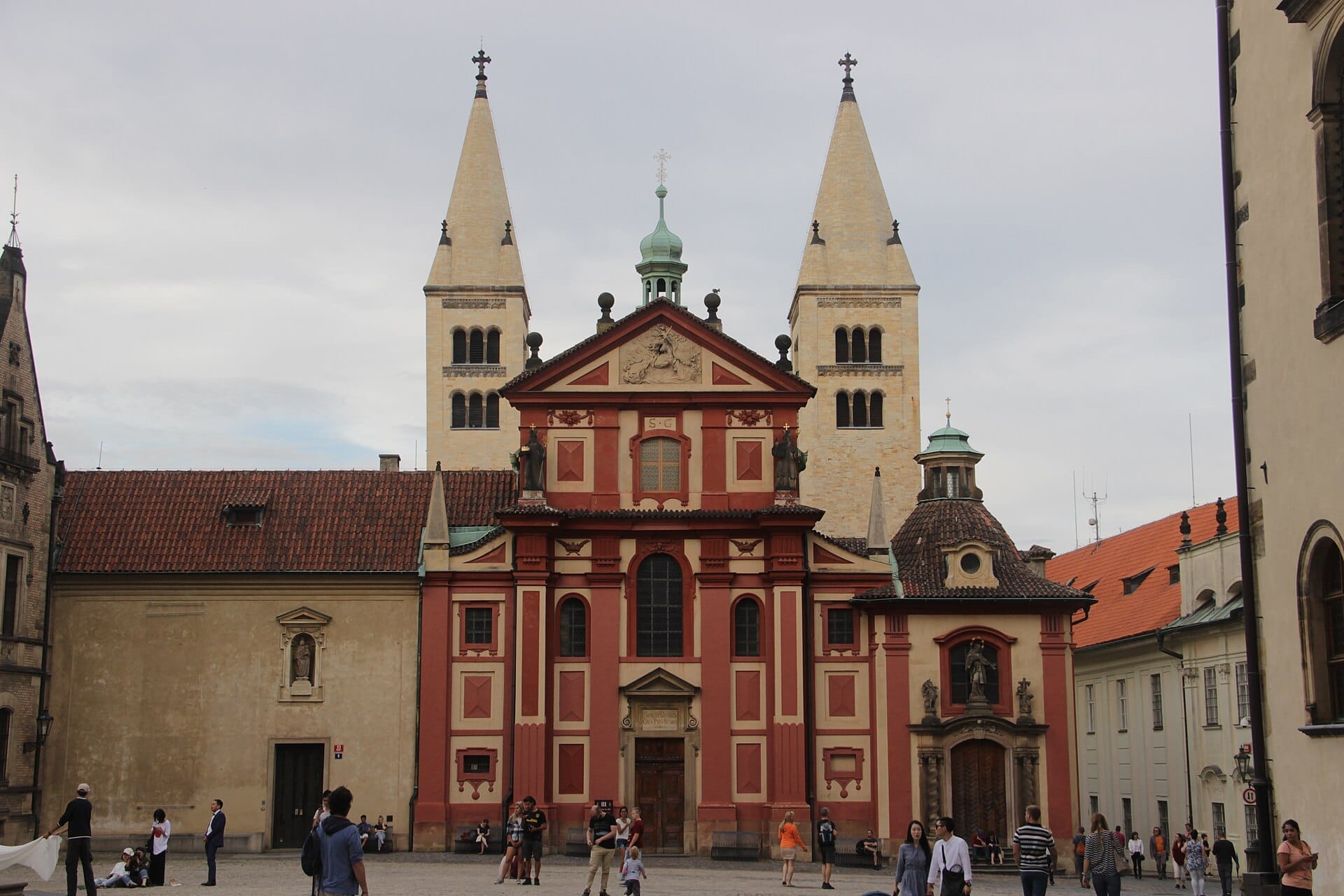
St. George's Basilica (Czech: Bazilika svatého Jiří) is not a decorative stop on the Prague Castle tour. It is one of the oldest surviving Romanesque church buildings in Prague, founded around 920 AD by Duke Vratislaus I of Bohemia. That makes it older than most of the monuments tourists photograph from Charles Bridge. While St. Vitus Cathedral dominates the castle skyline and draws the longest queues, the basilica sits quietly behind it on Jiřské náměstí, its pale stone twin towers rising without fanfare above the castle's second courtyard.
The building you see today took its essential Romanesque form after a fire destroyed much of the original structure in 1142. The reconstruction preserved the characteristic simplicity of the Romanesque style: thick walls, small arched windows, a nave with barrel vaulting, and two asymmetrical towers. A Baroque facade was added in the 17th century, giving the street-facing exterior a more ornate appearance, but step inside and that ornamentation dissolves. The interior is austere, cool, and extraordinarily old.
ℹ️ Good to know
Opening hours follow Prague Castle's seasonal schedule: April–October, 09:00–17:00; November–March, 09:00–16:00. Admission is included in the standard Prague Castle circuit ticket — there is no separate entry fee for the basilica alone.
The Interior: What You Actually See
Entering the basilica from the castle's third courtyard, the first thing most visitors notice is the smell: cold stone and faint dampness, the scent of a building that has been absorbing Czech winters for over a millennium. The nave is narrow and tall relative to its width, with smooth sandstone columns and simple rounded arches dividing the space. There are no baroque altarpieces competing for attention, no gilded ceilings. The restraint is the point.
In the nave, you will find the tomb of Prince Vratislaus I, the basilica's founder, which dates to the early medieval period. The Přemyslid dynasty, who ruled Bohemia from around the 9th century until 1306, used this basilica as one of their main burial sites for generations. Standing near these tombs, you are looking at the physical remains of the family that shaped the earliest chapter of Czech statehood. That context gives the space a weight that no amount of decorative restoration could manufacture.
The crypt, accessible via a staircase to the left of the main altar, is one of the quietest spaces in the entire castle complex. The ceiling is low, the lighting is subdued, and the stone floor is uneven. Most visitors spend only a few minutes here, but it rewards a slower pace. The Romanesque apse at the far end of the nave contains a replica of a striking Baroque statue of St. Ludmila, the patron saint of Bohemia, who was herself later canonized and whose real tomb is in the Church of St. George.
Tickets & tours
Hand-picked options from our booking partner. Prices are indicative; availability and final rates are confirmed when you complete your booking.
Vysehrad Audio Guide with Optional St. Peter and Paul Basilica Entry
From 5 €Instant confirmationFree cancellationBasilica of St James and Minorite Friary 3-hours tour in Prague
From 48 €Instant confirmationFree cancellationSelf guided tour with interactive city game of Prague
From 5 €Instant confirmationFree cancellationPrague by night city tour
From 27 €Instant confirmationFree cancellation
A Brief History of the Building
Duke Vratislaus I founded the church around 920, making it the second church built at Prague Castle and the second oldest surviving church in Prague. Its purpose from the beginning was ceremonial and dynastic: a place for worship, burial, and the demonstration of Přemyslid power. In 973, his daughter Mlada returned from Rome with papal authorization to establish a Benedictine nunnery adjacent to the basilica, the first female religious house in Bohemia. The convent expanded the complex significantly and shaped its layout for centuries.
After the 1142 fire, the Romanesque reconstruction preserved the double-tower design that gives the building its distinctive silhouette. The convent remained active until its dissolution under Emperor Joseph II in 1782. The convent building now operates as part of the Prague Castle complex. The basilica itself has undergone successive restoration phases, the most significant of which took place in the late 19th and early 20th centuries, when restorers aimed to return the interior to its Romanesque character by removing later additions.
How the Experience Changes by Time of Day
The basilica is at its most atmospheric in the early morning, particularly between 09:00 and 10:30. At that hour, the castle crowds are still forming, the light through the small windows is cool and directional, and the nave is often occupied by only a handful of people. The silence is functional, not curated: this is simply what the building sounds like when it is not full of tour groups.
By midday, especially in July and August, the castle's third courtyard fills with visitors, and the basilica sees a corresponding surge. The interior never becomes truly overwhelming, because its layout does not encourage lingering in the way a cathedral museum does, but the meditative quality of the early morning visit is harder to find after 11:00.
Late afternoon, in the hour before closing, offers a second window of relative quiet. The light shifts slightly through the western-facing elements, and tour groups have largely dispersed. For photography, this is a useful time: the natural light in the nave is warmer, and the crypt's artificial lighting appears more balanced without the disruption of flash photography from other visitors.
💡 Local tip
Arrive at Prague Castle gates by 09:00 during peak season (June–August). Head directly to St. George's Basilica before joining any queue for St. Vitus Cathedral — the basilica attracts far fewer visitors in the first hour of opening.
Getting There and Moving Around the Castle
Prague Castle sits on a hill above Malá Strana and is accessible by several routes. The most direct from the city center is the metro to Malostranská (Line A), followed by a steep 15-minute walk uphill through the castle gardens. Tram riders can alight at Pražský hrad for a flatter approach from the northwest. If you are building a full day around the castle and the surrounding Hradčany district, budget at least half a day and wear comfortable shoes — the castle complex is almost entirely cobbled.
St. George's Basilica is located in the third courtyard of Prague Castle, directly behind St. Vitus Cathedral. From the main castle entrance, walk through the first and second courtyards and pass the cathedral on your left. The basilica's Baroque facade faces the small square (Jiřské náměstí). You cannot see the Romanesque towers from the main tourist approach — they are visible only from the eastern side of the castle complex.
The cobbled terrain throughout Prague Castle presents challenges for visitors with mobility limitations. The access routes within the castle have varying gradients and some stepped areas. The Prague Castle administration provides specific accessibility information at the main entrance — check directly with castle services before your visit if step-free access is a requirement. For broader orientation in the neighborhood, the Prague architecture guide covers the historical development of the castle district in useful detail.
Photography Inside the Basilica
Photography without flash is generally permitted in the basilica for personal use. The interior lighting is low, and the small Romanesque windows admit limited natural light, so a camera or phone that handles low-light conditions well will produce significantly better results. The nave's long axis, looking toward the apse, is the most compositionally rewarding angle. The crypt is very dark — bring a phone with a strong sensor or accept that images taken there will need post-processing.
The exterior towers are best photographed from the castle's eastern gardens or from the lane running along the southern facade of the basilica. The contrast between the plain Romanesque towers and the ornate Baroque facade is striking and often overlooked by visitors who approach only from the courtyard side.
What Else to See Nearby
After the basilica, most visitors continue east along the castle's narrow lane known as Golden Lane, a row of tiny medieval houses built into the castle walls that is included in the same circuit ticket. It is compact and atmospheric, and genuinely worth the ten minutes it takes to walk through, though it becomes very crowded by midday.
The St. Vitus Cathedral is immediately adjacent and is on almost every visitor's list. Its Gothic interior is visually overwhelming in contrast to the basilica's restraint, and seeing both in sequence makes the architectural contrast between Romanesque and Gothic particularly legible. The Old Royal Palace is also included in the standard castle circuit and offers a complementary look at medieval secular architecture.
If you are spending a full day in the area, the Strahov Monastery is a 15-minute walk west of the castle and contains one of the finest Baroque library halls in Europe. For a comprehensive itinerary that links the castle district to the rest of Prague, the 3 days in Prague guide provides a practical day-by-day structure.
Who Should Probably Skip It
Travelers who are visiting Prague Castle primarily for the views, the atmosphere of the courtyards, or a quick photo of the cathedral exterior will find the basilica's interior adds meaningful time to their visit without matching the visual drama they are probably looking for. The building does not offer sweeping views, elaborate art collections, or the immersive scale of St. Vitus Cathedral. Its appeal is almost entirely historical and architectural, and it rewards visitors who come with some context about the Přemyslid dynasty or Romanesque ecclesiastical architecture.
Young children may find the interior less engaging than other parts of the castle circuit, though the crypt can spark genuine curiosity. Very large groups tend to move through quickly, which paradoxically makes the experience better for individual visitors who follow immediately after — the nave empties within minutes.
Insider Tips
- Buy your Prague Castle circuit ticket online in advance through the official Prague Castle website. The ticket includes the basilica, St. Vitus Cathedral, the Old Royal Palace, and Golden Lane — buying at the gate during peak season means joining a queue that can exceed 30 minutes.
- The south-facing exterior wall of the basilica retains the warmth of the morning sun well into the afternoon. In cooler months, this is one of the few sheltered, sunny spots to pause for a few minutes inside the castle complex.
- Look up at the ceiling immediately upon entering. The vaulting over the nave is one of the best-preserved examples of Romanesque stone construction in Bohemia, and most visitors walk past it looking straight ahead at the apse.
- The convent building adjacent to the basilica is a separate institution — verify its current exhibition program before your visit, as the space has hosted rotating art exhibitions affiliated with the National Gallery.
- If you are visiting in winter (November–March), the reduced closing time of 16:00 catches many visitors by surprise. Plan the basilica for the first half of your castle visit, not the last, to avoid rushing.
Who Is St. George's Basilica For?
- History travelers interested in Bohemian medieval dynasties and early Czech statehood
- Architecture enthusiasts who want to experience Romanesque design largely free of later alteration
- Photographers looking for interior compositions with natural stone, low light, and minimal decorative clutter
- Visitors doing the full Prague Castle circuit who want to understand each building in sequence rather than rushing between highlights
- Travelers who prefer quieter spaces and find the scale of Gothic cathedrals more overwhelming than illuminating
Nearby Attractions
Other things to see while in Prague Castle District (Hradčany):
- Golden Lane
A row of tiny, brightly painted houses tucked against Prague Castle's northern fortification wall, Golden Lane compresses five centuries of city life into roughly 100 metres. Once home to castle guards, goldsmiths, and briefly Franz Kafka, it is one of the most photogenic and historically layered corners of the entire castle complex.
- Loreto Sanctuary (Loreta)
The Loreto Sanctuary is one of the most elaborately decorated Baroque pilgrimage sites in Central Europe, anchored by a 1626 replica of the Holy House from Loreto, Italy. Located on Loretánské náměstí in the Hradčany district, the complex rewards visitors with a carillon that rings every hour, a surprising treasury of religious art, and an atmosphere that stands apart from the crowds near Prague Castle.
- National Gallery – Schwarzenberg Palace
Schwarzenberg Palace stands on Hradčanské náměstí, directly opposite the main entrance to Prague Castle. Built between 1545 and 1567, its sgraffito-covered facade is one of the most technically accomplished examples of Italian Renaissance architecture in Central Europe. Inside, the National Gallery Prague displays its permanent collection of Czech and Central European Baroque art across three floors of period-appropriate grandeur.
- National Gallery – Sternberg Palace
Tucked just off Hradčanské Square, Sternberg Palace is one of the finest High Baroque buildings in Bohemia and home to the National Gallery Prague's permanent Old Masters collection. Here you'll find European paintings and sculpture spanning the 14th to 18th centuries, from Flemish altarpieces to Italian Renaissance panels, in rooms that feel genuinely unhurried compared to the castle crowds outside.