St. Agnes Convent: Prague's Oldest Gothic Complex and Its Remarkable Medieval Collection
Founded around 1233 by Agnes of Bohemia, the Convent of Saint Agnes is one of Prague's oldest surviving Gothic structures. Today it houses the National Gallery's permanent collection of medieval Bohemian and Central European art, set inside an atmosphere that no purpose-built museum can replicate.
Quick Facts
- Location
- U Milosrdných 17, Prague 1 (Old Town, near Josefov)
- Getting There
- Metro A Staroměstská or Metro B Náměstí Republiky; trams 6, 8, 15, 26 to Dlouhá třída; tram 17 to Právnická fakulta
- Time Needed
- 1.5 to 2.5 hours
- Cost
- CZK 250 general / CZK 140 reduced (verify before visiting; Prague Visitor Pass holders enter free)
- Best for
- Medieval history, Gothic architecture, quiet museum experiences away from the tourist core
What Is St. Agnes Convent?
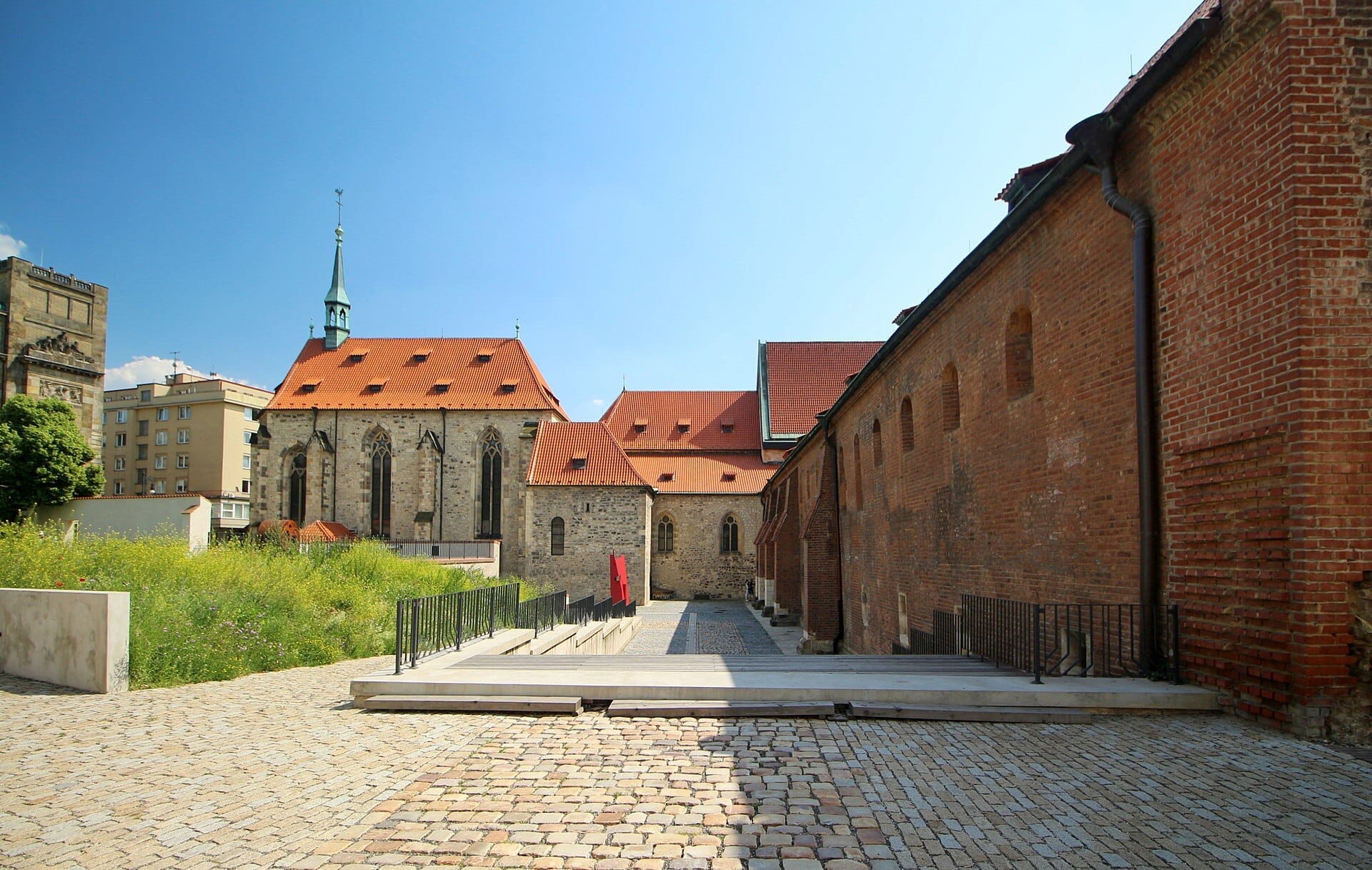
The Convent of Saint Agnes of Bohemia, known in Czech as Klášter sv. Anežky České, is widely considered one of Prague's oldest surviving Gothic complexes. Founded around 1230 to 1231 by Princess Agnes, daughter of King Přemysl Otakar I, the complex originally functioned as a Franciscan friary and Poor Clares convent. Agnes herself took the veil here and was later canonized in 1989 by Pope John Paul II. The building you walk through today is the product of nearly eight centuries of history, including periods of neglect, wartime damage, and a major 20th-century restoration effort.
Since the 1980s, the convent has served as a branch of the National Gallery Prague, housing its permanent collection of medieval art from Bohemia and Central Europe. This pairing of container and content is unusually well matched: early Gothic panel paintings and carved altarpieces displayed inside genuinely medieval vaulted halls carry a weight that no climate-controlled gallery in a modern building could achieve.
ℹ️ Good to know
Opening hours: Tuesday to Sunday, 10:00–18:00. Closed on Mondays. Entrances are on Na Františku Street or Anežská Street. Confirm current prices at ngprague.cz before your visit, as admission fees across National Gallery venues are periodically revised.
The Architecture: Reading the Layers
The convent complex is not one building but a cluster of interconnected structures built and modified across different medieval periods. The Church of the Holy Saviour, the older of the two main church structures, dates to the 1230s and shows the transition from Romanesque solidity to early French Gothic lightness. The Church of St. Francis, added slightly later, has a longer nave and demonstrates how Gothic forms were being absorbed and adapted in Bohemia during the 13th century.
The cloister garden sits at the heart of the complex. Its low stone arcades frame a quiet courtyard that functions as an architectural pause between exhibition rooms. The stonework here has been sympathetically restored without being over-polished: you can still read the wear and repair in the capitals and moldings. In summer, climbing plants soften the walls without obscuring the structural details.
For those working through Prague's architectural history, Agnes Convent represents a crucial early chapter. Most of the city's celebrated Gothic structures came later, in the 14th century under Charles IV. This convent predates that flourishing by over a hundred years and shows a rawer, less confident Gothic idiom that makes the later developments easier to understand.
Tickets & tours
Hand-picked options from our booking partner. Prices are indicative; availability and final rates are confirmed when you complete your booking.
Self guided tour with interactive city game of Prague
From 5 €Instant confirmationFree cancellationPrague by night city tour
From 27 €Instant confirmationFree cancellationPrague city tour with Vltava River cruise
From 38 €Instant confirmationFree cancellationPrague Castle online audio guide
From 5 €Instant confirmationFree cancellation
The Art Collection: Medieval Bohemia at Close Range
The National Gallery's permanent medieval collection here spans roughly the 13th through early 16th centuries. Panel paintings produced for Bohemian churches and chapels are the core. The Master of the Třeboň Altarpiece and the Master of the Vyšší Brod Altar are among the named artistic personalities represented, though for most visitors the works read as anonymous devotional objects rather than attributed masterpieces. That anonymity suits the setting.
Display lighting is measured and deliberately warm, which serves the gold-ground panels well but means you will not see bright colors at their sharpest. Photography is generally permitted without flash in the permanent collection, though this should be confirmed at the entrance. The works are presented with Czech and English labels, and the interpretive text is concise rather than exhaustive. Visitors who want deeper context are better served by reading beforehand rather than expecting gallery signage to do the work.
Sculptural works, including stone reliefs, carved figures from altarpieces, and ecclesiastical metalwork, are distributed through the rooms alongside the panels. The variety keeps the pacing comfortable. A single circuit without lingering takes around 50 minutes; allowing time to sit with individual works extends that significantly.
How the Visit Changes by Time and Season
Tuesday mornings, especially outside July and August, are the quietest periods. By mid-morning on weekends the complex begins to fill, though it rarely reaches the shoulder-to-shoulder density of the Old Town Square or Prague Castle corridors. The convent's relative obscurity on the main tourist circuit is one of its practical advantages.
Natural light enters the church spaces through high windows, which makes the stone interiors feel different across the day. Morning visits catch cooler, lower-angled light that picks out surface texture in the stonework. In the afternoon the spaces read warmer. Neither is objectively superior, but photographers working with ambient light will prefer the morning. The cloister garden is shaded for most of the day and provides welcome cool air during summer visits.
In winter, the complex is genuinely cold in the unheated stone sections. The art is climate-controlled where it needs to be, but the architectural passages between rooms are not insulated in the way a modern museum would be. Bring a layer even if temperatures outside seem mild.
💡 Local tip
If you hold a Prague Visitor Pass, admission is included. If you plan to visit two or more National Gallery venues, check whether a combined ticket covering multiple buildings offers better value than paying per site.
Getting There and the Surrounding Area
The convent sits in the northern edge of Old Town, close to the boundary with Josefov. It is a 10 to 15-minute walk from Old Town Square, passing through quieter residential streets that most day visitors never reach. The neighborhood around Na Františku Street has a noticeably slower pace than the tourist core: fewer souvenir shops, more local cafes, and much less foot traffic.
By metro, Staroměstská on Line A is the most convenient stop, roughly a 10-minute walk. Náměstí Republiky on Line B works if you are coming from the opposite direction. Trams 6, 8, 15, and 26 stop at Dlouhá třída, which puts you about 5 minutes from the entrance on foot. The Jewish Quarter (Josefov) is immediately adjacent, making a combined visit practical if you have a full morning or afternoon free.
Wheelchair access to the main buildings and gardens is available following recent reconstruction work. The cloister and primary gallery rooms are accessible, though the uneven stone floors in some transitional passages may require care. Confirm specific accessibility details with the National Gallery directly before planning around specific mobility requirements.
Honest Assessment: Is It Worth the Visit?
St. Agnes Convent is not a crowd-pleaser in the conventional sense. There are no optical illusions, no rooftop panoramas, and no single famous object that visitors feel they need to photograph. What it offers instead is architectural authenticity and a coherent collection displayed in a space that genuinely corresponds to the art it contains. That combination is rarer in Prague than the density of attractions might suggest.
Travelers who respond well to this kind of experience will find St. Agnes Convent more satisfying than many of the more prominent sites on the standard itinerary. Those who prefer kinetic, visually spectacular attractions should prioritize other stops first. For a broader view of what the National Gallery holds across its various Prague venues, the guide to Prague's best museums puts the convent in useful context alongside the Schwarzenberg Palace, Veletržní Palace, and others.
Visitors constructing a coherent itinerary might pair Agnes Convent with a walk through the Old Jewish Cemetery and the nearby synagogues of Josefov, keeping the morning's theme around medieval and early modern Prague. The Old Town Square is close enough to reach afterward without backtracking, though the tonal shift is considerable.
Insider Tips
- The convent's café and bookshop near the entrance stock National Gallery publications at gallery prices. For serious interest in Czech medieval art, the in-house catalogue for the permanent collection is worth purchasing here rather than searching for it elsewhere.
- The cloister garden is sometimes used for evening cultural events in summer. Check the National Gallery's event calendar before your visit, as these are not widely advertised outside Czech-language channels.
- If you arrive near opening time on a weekday, you may have the first two or three rooms entirely to yourself. The art is displayed at a height and spacing that rewards this kind of uninterrupted attention.
- The stone floors throughout the complex are uneven and occasionally slippery in humid weather. Flat-soled shoes are more practical than sandals or heels, regardless of what the weather outside suggests.
- Prague Visitor Pass holders enter free, but the pass needs to be physically presented at the ticket desk rather than shown on a phone screen. Confirm current acceptance policy when purchasing the pass.
Who Is St. Agnes Convent For?
- Travelers with genuine interest in medieval European art who want context beyond museum labels
- Architecture enthusiasts seeking early Gothic structures predating Prague's more celebrated 14th-century buildings
- Visitors who find the main tourist corridors exhausting and want a quieter, slower-paced cultural stop
- Those already visiting Josefov who want to extend a half-day in the northern Old Town area
- Prague Visitor Pass holders looking to extract full value from their pass at a quality National Gallery venue
Nearby Attractions
Other things to see while in Old Town (Staré Město):
- Church of Our Lady before Týn
The Church of Our Lady before Týn is Prague's most recognizable Gothic landmark, its twin 80-metre spires rising sharply above the rooflines of Old Town Square. Entry is free, but visiting hours are short and the interior tells a story most visitors walk past without ever stepping inside.
- Church of St. Nicholas (Old Town)
Standing in the north-west corner of Old Town Square, St. Nicholas Church is a compact Baroque masterpiece built between 1732 and 1737. Entry is free, the interior is genuinely beautiful, and most visitors walk past it without stopping. Here is why they should not.
- Clementinum
The Clementinum is one of the largest building complexes in Prague, stretching over 2 hectares in the heart of Old Town. Its guided tours take visitors into a breathtaking Baroque library hall and up a narrow tower for panoramic rooftop views over the city's spires.
- Estates Theatre (Stavovské divadlo)
The Estates Theatre in Prague's Old Town is one of the best-preserved 18th-century opera houses in Europe, and one of the surviving venues where Mozart himself conducted. Built in 1783, it staged the world premiere of Don Giovanni and remains an active performance space under the National Theatre umbrella.