Square of Arms (Trg od Oružja): The Beating Heart of Kotor's Old Town
The Square of Arms is Kotor's central gathering place, a broad limestone-paved piazza just inside the Sea Gate where medieval architecture meets everyday life. Palaces, a Napoleonic arsenal, the famous Clock Tower, and pavement cafes all share the same space — making it the natural starting point for any exploration of the old town.
Quick Facts
- Location
- Kotor Old Town, Montenegro — immediately inside the Sea Gate
- Getting There
- Walk from the bus station area or cruise port (15 min on foot). Enter through the Sea Gate on the waterfront.
- Time Needed
- 20–40 minutes for the square itself; allow a full half-day to explore surrounding streets
- Cost
- Free to enter and visit
- Best for
- First-time visitors, architecture lovers, people-watching, and as a launchpad for old town exploration
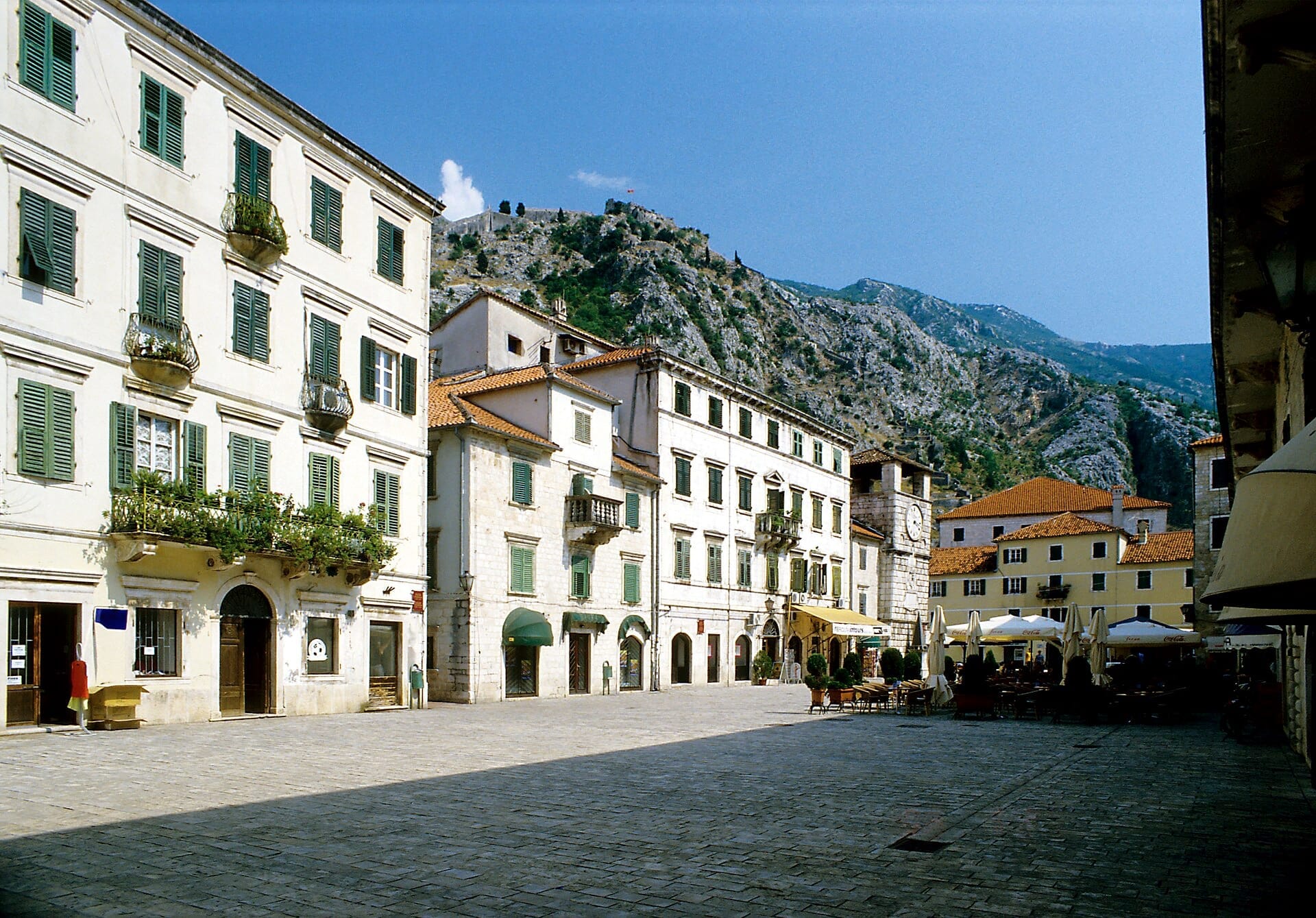
What Is the Square of Arms?
The Square of Arms, known locally as Trg od Oružja, is the largest public square inside Kotor's medieval walls and the undisputed center of gravity for the entire old town. The name references its historical function: this was where weapons were stored and soldiers mustered, a reminder that Kotor spent centuries as a heavily fortified city-state under Venetian rule. Today the military associations have faded, but the square still commands attention the moment you step through the Sea Gate from the waterfront.
The square is broad and open by old-town standards, paved in smooth limestone that catches the light differently at every hour. Three or four pavement cafes spread chairs across it in warmer months, and locals cut through it constantly on their way between neighborhoods. It is not a manicured tourist showpiece — the scale feels genuinely civic, a place where people actually live and move rather than simply pose for photographs.
💡 Local tip
The square is most photogenic in the early morning (before 8 am) when the limestone glows in low light and foot traffic is almost nonexistent. By 10 am on summer days, tour groups from cruise ships fill the space.
The Architecture Around the Square
The buildings that frame Trg od Oružja span roughly five centuries of construction, yet they sit together without visual chaos. The dominant influence is Venetian: Kotor was under the Republic of Venice from 1420 to 1797, and the Republic left a distinctive mark in the form of Gothic-Renaissance palaces with carved stone window frames and coats of arms embedded above doorways.
The most recognizable structure on the square is the Clock Tower, a freestanding campanile built in 1602. Its stone shaft rises above the surrounding rooflines and has become the single most photographed landmark inside the old town walls. At its base sits a small stone pillar historically used as a public pillory. Directly opposite stands the Napoleon Arsenal (Providurova palata), a long administrative building constructed during the brief French occupation of 1807–1814. The French reorganized the old arsenal into a civic building, and it now houses cultural events. For a deeper look at the square's surroundings, the Kotor old town walking tour guide maps out every key building in sequence.
On the northern edge of the square, the Church of Saint Luke (Crkva sv. Luke) dates to 1195, making it one of the best-preserved Romanesque churches in the entire Adriatic region. Unlike many medieval churches that were later heavily remodeled, Church of St. Luke retains its original exterior form almost intact. The interior is small but genuine, with frescoes that survived centuries of earthquake and occupation.
Look up when you cross the square: the walls of the palaces above street level often show carved stone details — family crests, Gothic tracery in window surrounds, and weathered inscriptions — that most visitors walk past without noticing. The textures range from rough-hewn limestone blocks in the older sections to more refined ashlar work on the Venetian-era facades.
Tickets & tours
Hand-picked options from our booking partner. Prices are indicative; availability and final rates are confirmed when you complete your booking.
Half-day Blue Cave adventure
From 45 €Instant confirmationFree cancellationMontenegro Canyons private tour from Kotor
From 68 €Instant confirmationFree cancellationLovćen national park and Budva city full-day private tour
From 150 €Instant confirmationFree cancellationDubrovnik walking tour from Kotor
From 59 €Instant confirmationFree cancellation
How the Square Changes Through the Day
Early morning is a different place entirely. Before the tour groups arrive, local residents cross the square with groceries, cafe owners stack chairs and wipe down tables, and the only sounds are footsteps on stone and the occasional church bell. The low angle of morning light picks out surface details in the limestone that disappear by midday when the sun is overhead.
By late morning in summer, particularly on days when cruise ships are docked, the square fills quickly. Groups follow guides holding colored umbrellas, selfie sticks appear near the Clock Tower, and the cafes fill up. This is the square at its least atmospheric, though it is also the time when you can observe the remarkable contrast between the medieval fabric of the buildings and the thoroughly modern crowd.
Late afternoon brings a shift. The cruise passengers return to their ships, temperatures drop slightly, and the square gradually transitions to local evening use. The cafes stay open and the light turns amber across the stone. This is the most comfortable time to sit at one of the outdoor tables and observe the square without the midday pressure.
⚠️ What to skip
On days when multiple large cruise ships dock simultaneously, the square and surrounding streets can become genuinely overcrowded between 10 am and 3 pm. Check cruise ship schedules for Kotor in advance if crowd avoidance is a priority.
Historical Context: From Arsenal to Town Center
Kotor's strategic position at the innermost point of the Bay of Kotor made it one of the most contested cities on the eastern Adriatic coast. The Kotor city walls, which climb from the square's neighborhood up to the fortress above, were the physical expression of that defensiveness. The Square of Arms was the logistical core of those defenses: weapons were stored, troops assembled, and orders issued from this central space.
Under Venice, the square was also the location of public ceremonies, proclamations, and — less pleasantly — public punishments. The stone pillory at the base of the Clock Tower is a direct artifact of that era. The Venetians maintained firm control over Kotor for nearly four centuries, and the square's architecture reflects the administrative ambitions of the Republic: substantial buildings meant to project permanence and authority.
The Napoleonic period that followed Venetian rule was short but left a physical mark. The French were genuinely interested in urban reorganization, and the conversion of the arsenal building into a civic structure reflects their broader policy of replacing military-feudal functions with administrative ones. That building has hosted a rotating series of uses ever since, most recently as a venue for cultural exhibitions.
Practical Walkthrough: Using the Square as Your Base
The square functions naturally as a navigation anchor for the old town. From Trg od Oružja you can reach every other significant point within the walls in under ten minutes on foot. The Sea Gate is steps away to the west, connecting the square directly to the waterfront promenade. To the east and northeast, a network of narrow lanes leads to the Cathedral of Saint Tryphon, the Maritime Museum, and the quieter residential quarters where tourist density drops noticeably.
If you are planning to hike up to the fortress above the old town, the square is a practical place to hydrate and rest before or after the climb. The fortress wall hike guide explains the route in detail, but the trailhead begins within the walls, close to the square.
Photography from the square works best pointing toward the Clock Tower with the Church of Saint Luke visible to one side, using a standard lens rather than wide-angle to avoid the distortion that makes the buildings look smaller than they are. For elevated perspectives over the old town rooftops, you will need to continue up toward the fortress walls.
ℹ️ Good to know
Public toilets are available near the Sea Gate entrance, a short walk from the square. Given the compact nature of the old town, this is worth knowing before you venture deeper into the residential lanes.
Honest Assessment: What the Square Is and Is Not
The Square of Arms is genuinely important as an architectural ensemble and as the functional core of a UNESCO-listed medieval town. It deserves the attention it receives. But expectations should be calibrated: this is a working public square, not a pristinely preserved open-air museum. Some of the surrounding buildings show their age in ways that are not always photogenic, and the cafe furniture, signage, and ordinary street clutter of a modern town are present.
Visitors who arrive expecting the cinematic perfection of certain other Adriatic squares may find the reality more utilitarian. Visitors who appreciate genuine urban continuity, where medieval stone and daily life coexist without heavy-handed restoration, will find it exactly right. It is also worth noting that the square's appeal is substantially weather-dependent: on a rainy day, with wet stone and closed cafe terraces, the atmosphere is markedly different from a clear summer evening.
Travelers with very limited time in Kotor should treat the square as a 20-minute orientation stop rather than a destination in itself. The deeper rewards are in the lanes that branch off from it, and in attractions like the Cathedral of Saint Tryphon and the Maritime Museum that sit within easy walking distance.
Insider Tips
- Arrive before 8 am for the best photographs and a sense of the square as locals experience it. The difference between pre-cruise-ship morning and midday is stark.
- The stone pillory at the base of the Clock Tower is easy to miss because it sits at ankle height. Look for the small carved column — it is one of the most tangible surviving artifacts of Venetian public justice in the Adriatic.
- The cafe directly adjacent to the Napoleon Arsenal building tends to be slightly less crowded than those on the main square frontage, and the view back across the square is better from that angle.
- Check the small notice boards near the Church of Saint Luke for current cultural events. The Napoleon Arsenal building hosts exhibitions and concerts, often with free or low-cost entry, that are not heavily advertised in tourist channels.
- The square's limestone paving becomes slippery when wet. Rubber-soled shoes are advisable, particularly if you plan to continue through the old town lanes after visiting.
Who Is Square of Arms (Trg od Oružja) For?
- First-time visitors to Kotor who need an orientation point and a first read of the old town's scale and character
- Architecture and history enthusiasts interested in Venetian urban planning and medieval Adriatic civic life
- Photographers working in the early morning or late afternoon light, when the limestone surfaces are at their most expressive
- Families with children, since the open paved space allows movement and the Clock Tower provides an easy focal point for younger travelers
- Anyone using Kotor as a day trip base who wants to understand the old town quickly before branching out to the fortress hike or bay boat tours
Nearby Attractions
Other things to see while in Kotor Old Town (Stari Grad):
- Cats Museum Kotor
Tucked inside Kotor's medieval Old Town, the Cat Museum is a compact, quirky gallery dedicated to the city's beloved cats. It's part souvenir shop, part folk art collection, and wholly representative of why Kotor and cats have become inseparable in the popular imagination.
- Fortress of San Giovanni (Castle of San Giovanni)
Perched 260 metres above sea level on a steep limestone ridge, the Fortress of San Giovanni is Kotor's defining landmark. The climb is demanding, the views are extraordinary, and the medieval fortifications reveal centuries of Venetian, Byzantine, and Ottoman history layered into a single hillside.
- Kotor City Walls
The Kotor City Walls stretch approximately 4.5 kilometers across the steep slopes of Mount St. John, enclosing the UNESCO-listed old town and climbing to the Fortress of San Giovanni above. This is one of the most physically rewarding urban walks in the entire Mediterranean region, combining medieval architecture, sweeping bay views, and a genuine sense of altitude.
- Kotor Clock Tower
Rising above the Square of Arms at the entrance to Kotor's Old Town, the Clock Tower is one of the most photographed landmarks in Montenegro. Small in scale but central to the character of the square, it has marked time here for centuries and remains an essential orientation point for anyone exploring the old town.