St Tryphon's Cathedral: Kotor's Medieval Heart
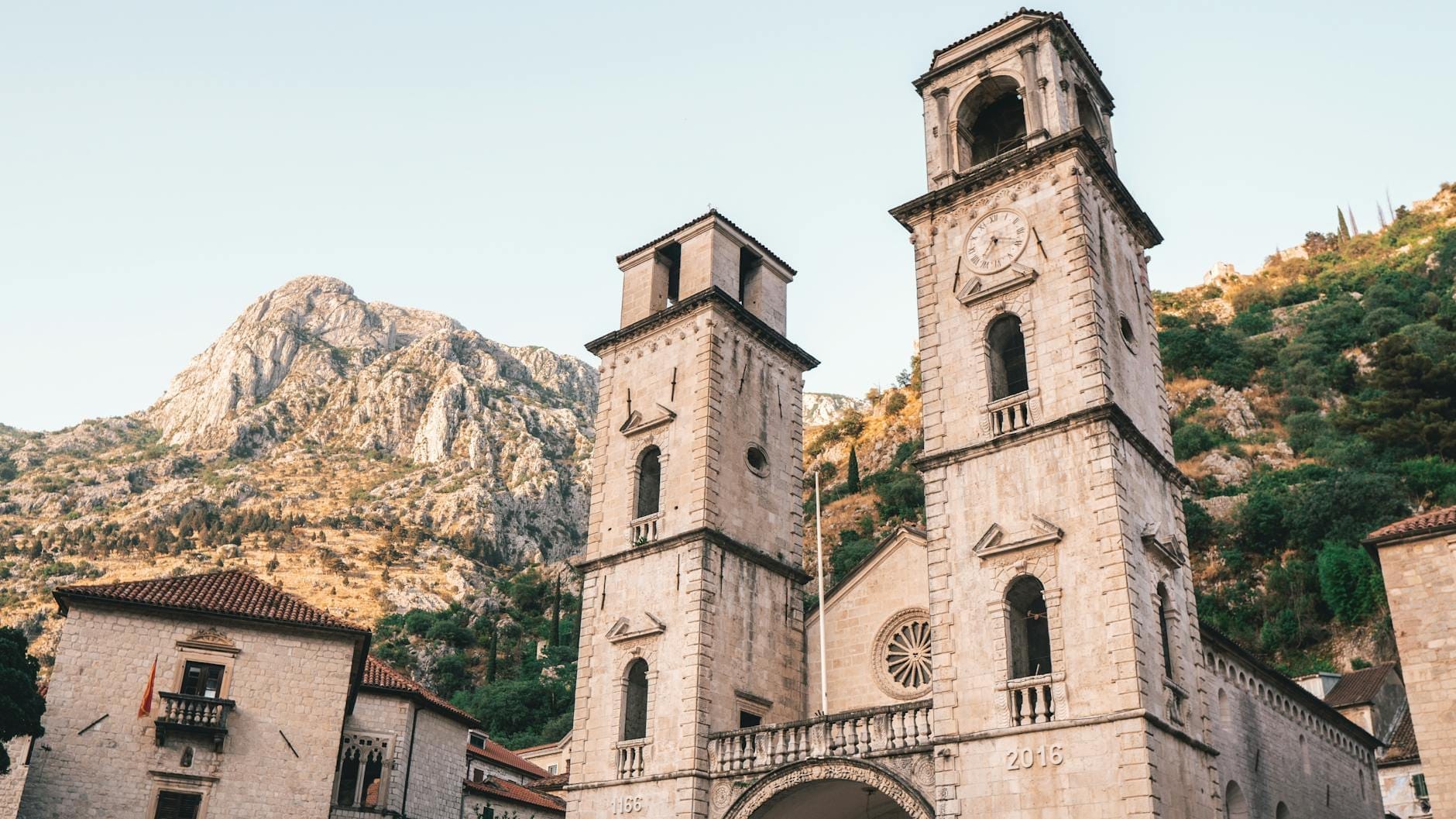
St Tryphon's Cathedral is the defining landmark of Kotor's Old Town, a Romanesque church that has stood since 1166 and survived earthquakes, sieges, and centuries of competing rulers. Inside, Byzantine frescoes, a treasury of medieval silverwork, and the relics of the city's patron saint reward visitors who look carefully. Outside, its twin bell towers frame one of the most photographed facades on the Adriatic.
Quick Facts
- Location
- Cathedral Square, Kotor Old Town, Montenegro
- Getting There
- Enter the Old Town through the Sea Gate; the cathedral is a 3-minute walk straight ahead on the main square
- Time Needed
- 45–75 minutes to do it properly, including the treasury
- Cost
- Small entrance fee applies; treasury has a separate or combined ticket. Verify current prices on arrival
- Best for
- History lovers, architecture enthusiasts, photography, and anyone with a few extra minutes after the city walls
Why St Tryphon's Cathedral Matters
In a city where medieval stonework lines every lane, St Tryphon's Cathedral still manages to stop people in their tracks. The facade, with its pair of mismatched bell towers rising above Cathedral Square, is the visual anchor of Kotor's skyline — and the explanation for why those towers look slightly different from each other is itself a lesson in the city's turbulent past.
This is the oldest Catholic cathedral on the eastern Adriatic coast still in active use, consecrated in 1166 on the site of an even earlier church. The relics of St Tryphon, a Christian martyr from Phrygia, were associated with Kotor in 809 AD, when a small church was built to hold them, decades before the cathedral that would house them was even built. That detail tells you something important about how medieval cities worked: the relic came first, and the architecture followed as a way of honoring it.
If you are planning your time in the Old Town, this cathedral deserves priority over the smaller churches nearby. It is not just historically significant — it is physically impressive in ways that reward attention. For a broader orientation to the Old Town's layout, the Kotor Old Town walking tour guide maps out how the cathedral fits into the surrounding network of squares and lanes.
The Facade and the Bell Towers
The first thing most visitors notice is that the two bell towers do not quite match. The right tower was rebuilt after the catastrophic earthquake of 1667 — the same event that leveled much of Dubrovnik — and the reconstruction was never a perfect copy of its twin. The left tower retains more of its Romanesque character; the right leans toward a plainer, post-earthquake style. Rather than a flaw, this asymmetry is a kind of honest architectural autobiography.
The lower portion of the facade is richly carved limestone in the Romanesque style, with blind arcading and delicate stone tracery framing the main portal. Look at the carved relief above the entrance portal: it dates to the 12th century and depicts St Tryphon himself. The stone has the pale, chalky quality common to Adriatic limestone, which shifts from warm gold in morning light to a cooler grey-white by midday.
💡 Local tip
Arrive at the cathedral in the morning, ideally before 9:30 AM in summer, when the facade catches direct sunlight from the east and the square is still quiet. By 10 AM the square fills with cruise tour groups and the light becomes flatter.
Tickets & tours
Hand-picked options from our booking partner. Prices are indicative; availability and final rates are confirmed when you complete your booking.
Half-day Blue Cave adventure
From 45 €Instant confirmationFree cancellationMontenegro Canyons private tour from Kotor
From 68 €Instant confirmationFree cancellationLovćen national park and Budva city full-day private tour
From 150 €Instant confirmationFree cancellationDubrovnik walking tour from Kotor
From 59 €Instant confirmationFree cancellation
Inside the Cathedral: What to Look For
The interior is a three-nave Romanesque basilica, and the proportions feel deliberate and calm rather than grand. The nave columns are topped with carved capitals, and fragments of Byzantine-style frescoes survive on the upper walls, though they are partially faded and require a moment for your eyes to adjust from the bright exterior light. A ciborium, a canopied altar structure supported on four columns, sits above the main altar and dates to the 14th century — it is one of the finest surviving examples of its type on the Adriatic coast.
The reliquary of St Tryphon is kept in a gilded silver bust behind the altar. On the feast day of St Tryphon (February 3), the bust is carried in procession through the Old Town, a tradition that has continued almost without interruption since the medieval period. If you visit on any other day, the reliquary is visible but you will be looking at it from a respectful distance.
The atmosphere inside is genuinely different from what you feel in the smaller Kotor churches. There is a weight to it — centuries of candlesmoke, cool stone, and the particular silence that very old sacred buildings accumulate. It is not theatrical like some cathedral interiors. It is simply old and serious.
The Treasury: The Real Reason to Pay the Extra Entrance
The treasury, housed in a room accessible from inside the cathedral, contains one of the most significant collections of medieval religious art in the Balkans. The collection includes Byzantine-influenced gold and silverwork, reliquary boxes, processional crosses, vestments embroidered with gold thread, and illuminated manuscripts. Several pieces date to the 14th and 15th centuries and were commissioned by wealthy Kotor merchant families whose names still appear on inscriptions around the Old Town.
The treasury is small, and a single circuit of the room takes perhaps ten minutes — but it repays close looking. The craftsmanship on some of the silverwork is extraordinarily fine for pieces made seven centuries ago. Most labels are in multiple languages, though the information is brief. If you have a serious interest in medieval religious art, budget twenty minutes here rather than ten.
ℹ️ Good to know
The treasury may close earlier than the main cathedral nave, particularly in the off-season. Check closing times when you buy your ticket or arrive at the entrance.
How the Experience Changes Through the Day
Early morning, before the cruise ships arrive, Cathedral Square has a different character entirely. Residents cross it on their way to work. The light is low and warm. A handful of pigeons and cats occupy the same stone that, two hours later, will be crowded with tour groups. If the cathedral is open at this hour — opening times can vary by season — the interior feels genuinely contemplative.
From roughly 10 AM to 2 PM in summer, the square and cathedral receive the heaviest foot traffic, driven almost entirely by cruise passengers on shore excursions. Kotor is one of the most heavily visited cruise stops on the Adriatic. If crowds affect your enjoyment, understanding Kotor's cruise schedule can help you plan around the peak hours.
Late afternoon, after roughly 4 PM, the square quiets considerably as day-trippers return to their ships. The light by 5–6 PM in the warmer months is warmer and lower, and the limestone facade takes on an amber tone that is particularly good for photography. The cathedral itself may be approaching its closing time, so check before committing to a late visit.
Context: Kotor's Cathedral Within the Wider Old Town
St Tryphon's Cathedral sits on Cathedral Square, which connects via lanes and small passages to the broader network of Kotor's Old Town. The Square of Arms, the main entrance piazza just inside the Sea Gate, is about a three-minute walk west of here. Several of the other medieval churches, including the Church of St. Luke and St Nicholas Church, are within a five-minute radius.
The cathedral should ideally be combined with a walk along the Kotor city walls, which begin just a short walk away and offer elevated views down over the cathedral's twin towers. From the lower stretches of the wall walk, the scale and position of the cathedral within the city becomes clear in a way that ground-level exploration does not quite reveal.
For visitors interested in the full range of Kotor's medieval sacred architecture, the cathedral is the obvious starting point, but the smaller churches, each with their own distinct history and patron saints, fill in the picture considerably. Kotor had a tradition of individual guilds and merchant families each sponsoring their own church, which explains why a city of this size has so many of them packed into such a compact area.
Practical Notes and Accessibility
The cathedral entrance is at street level on Cathedral Square and there are no steps at the threshold, but the interior has some uneven stone flooring typical of medieval buildings. The treasury is accessed via a short staircase inside the building. Visitors with mobility limitations should be aware of this before paying for the treasury ticket specifically.
Photography is generally permitted inside, though flash use and photography during active religious services is not appropriate. The cathedral is still an active parish church, and occasional services, particularly on Sunday mornings and feast days, may restrict visitor access temporarily.
⚠️ What to skip
Dress modestly. Bare shoulders and shorts are not appropriate inside the cathedral. A lightweight scarf or layer in your bag solves this quickly — this applies to all visitors regardless of gender.
Insider Tips
- Look up at the 14th-century ciborium above the main altar carefully — it is often overlooked because visitors focus on the reliquary. The carved stone canopy is one of the oldest and best-preserved examples of its type on the Adriatic coast.
- February 3, the feast day of St Tryphon, coincides with the Kotor carnival season. If your travel dates align, the procession through the Old Town is genuinely worth seeing and not a tourist performance — it is a real community event.
- The treasury collection catalog is sometimes available for purchase at the entrance. It is worth the small cost if you have a serious interest, as the room labels provide only brief descriptions.
- Cathedral Square has a small well in the center that appears in many photographs. Arrive early for an unobstructed shot of the facade with the well in the foreground — by mid-morning it is consistently surrounded by people.
- If the cathedral is busy with a tour group when you arrive, spend 10 minutes in the nearby streets and return. Groups move on quickly and the interior empties out surprisingly fast.
Who Is St Tryphon's Cathedral For?
- History and medieval architecture enthusiasts who want to understand the Adriatic's pre-Venetian and Venetian past
- Photographers: the facade provides one of Kotor's most iconic shots, especially in morning or late-afternoon light
- Travelers combining the cathedral with the city walls hike, which starts nearby and gives aerial views of the towers
- Visitors interested in Byzantine and medieval religious art, particularly those who will spend time in the treasury
- Anyone spending more than a half-day in Kotor for whom the cathedral provides essential historical grounding
Nearby Attractions
Other things to see while in Kotor Old Town (Stari Grad):
- Cats Museum Kotor
Tucked inside Kotor's medieval Old Town, the Cat Museum is a compact, quirky gallery dedicated to the city's beloved cats. It's part souvenir shop, part folk art collection, and wholly representative of why Kotor and cats have become inseparable in the popular imagination.
- Fortress of San Giovanni (Castle of San Giovanni)
Perched 260 metres above sea level on a steep limestone ridge, the Fortress of San Giovanni is Kotor's defining landmark. The climb is demanding, the views are extraordinary, and the medieval fortifications reveal centuries of Venetian, Byzantine, and Ottoman history layered into a single hillside.
- Kotor City Walls
The Kotor City Walls stretch approximately 4.5 kilometers across the steep slopes of Mount St. John, enclosing the UNESCO-listed old town and climbing to the Fortress of San Giovanni above. This is one of the most physically rewarding urban walks in the entire Mediterranean region, combining medieval architecture, sweeping bay views, and a genuine sense of altitude.
- Kotor Clock Tower
Rising above the Square of Arms at the entrance to Kotor's Old Town, the Clock Tower is one of the most photographed landmarks in Montenegro. Small in scale but central to the character of the square, it has marked time here for centuries and remains an essential orientation point for anyone exploring the old town.