Kotor Clock Tower: The Stone Sentinel of the Square of Arms
Rising above the Square of Arms at the entrance to Kotor's Old Town, the Clock Tower is one of the most photographed landmarks in Montenegro. Small in scale but central to the character of the square, it has marked time here for centuries and remains an essential orientation point for anyone exploring the old town.
Quick Facts
- Location
- Square of Arms (Trg od Oružja), Kotor Old Town
- Getting There
- Enter through the Sea Gate from the waterfront promenade; the tower is immediately visible ahead
- Time Needed
- 10–20 minutes to appreciate the exterior and square
- Cost
- Free to view from the exterior
- Best for
- Architecture lovers, photographers, first-time visitors orienting themselves in the old town
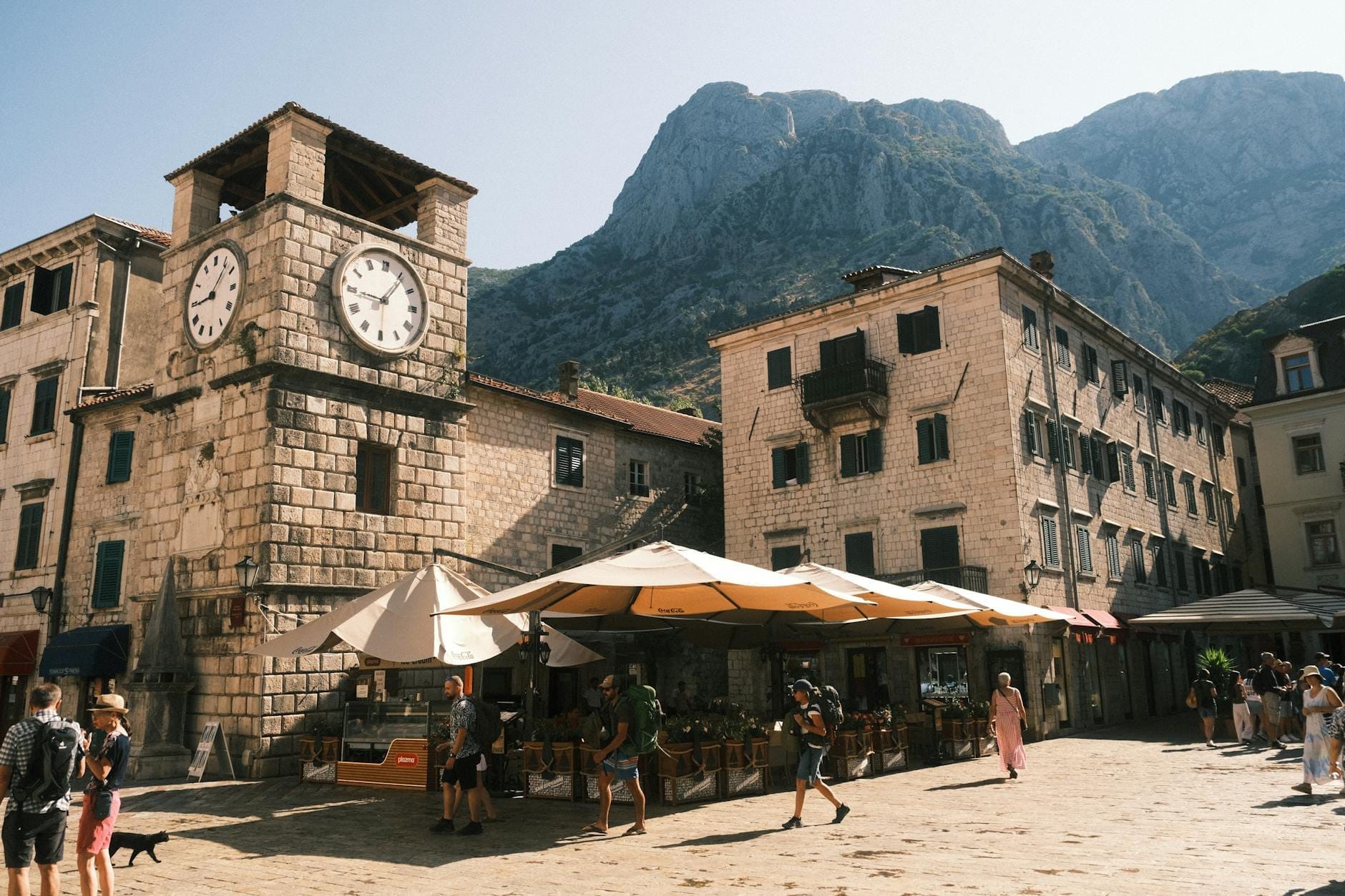
First Impressions: Arriving at the Square of Arms
Step through the Sea Gate and within a few paces the Clock Tower comes into view, rising above the wide flagstone expanse of the Square of Arms. It is not a towering structure by European standards, but its placement is deliberate and effective. The pale stone shaft, topped with a bell turret and clock face, draws the eye immediately and anchors the entire square around it. This is the visual and social center of Kotor Old Town, and the Clock Tower is its punctuation mark.
The Square of Arms itself is the largest open space inside the medieval walls, and arriving here from the narrow Sea Gate passage creates a genuine sense of arrival. The tower stands close to the center of the square, slightly offset from the main axis, surrounded by the facades of the old town's civic buildings. In the morning, the eastern light catches the clock face cleanly. By midday the square fills with visitors and the tower becomes a natural meeting point and photography subject from every angle.
💡 Local tip
The best single photograph of the Clock Tower is taken from just inside the Sea Gate archway, using the arch itself as a natural frame. Early morning, before 8:00 AM in summer, gives you the cleanest shot with almost no foot traffic.
History and Architectural Character
The Kotor Clock Tower dates to the 17th century, constructed during the period of Venetian administration that shaped so much of the old town's architectural character. Venice controlled Kotor from 1420 until 1797, and the civic infrastructure they built, including the tower, reflects a distinctly Mediterranean approach to public timekeeping: practical, visible to the entire square, and designed to outlast generations. The tower was part of a broader effort to organize civic life and commerce around a shared public time reference.
The structure is built from the same pale Adriatic limestone used throughout the old town, giving it a textural unity with the surrounding buildings. The stonework is slightly rough to the touch at ground level, weathered over four centuries of coastal humidity. The clock mechanism has been replaced and restored across the centuries, but the tower's silhouette has remained largely unchanged. A small pillar in front of the tower, known locally as the Pillar of Shame, was historically used to publicly punish wrongdoers, a detail that gives the square a more layered civic history than it first appears to have.
For broader context on the Venetian-era architecture that frames the tower, the Cathedral of Saint Tryphon a few minutes' walk deeper into the old town is the most complete example of Romanesque-Gothic construction in the city and well worth pairing with a visit to the square.
Tickets & tours
Hand-picked options from our booking partner. Prices are indicative; availability and final rates are confirmed when you complete your booking.
Montenegro Canyons private tour from Kotor
From 68 €Instant confirmationFree cancellationDubrovnik walking tour from Kotor
From 59 €Instant confirmationFree cancellationBudva private tour from Kotor
From 58 €Instant confirmationFree cancellationOstrog Monastery private tour from Kotor
From 35 €Instant confirmationFree cancellation
How the Experience Changes Through the Day
Early morning is genuinely different from any other time. Between 7:00 and 9:00 AM, the Square of Arms is quiet. Local residents cross it on the way to work. A handful of cafe chairs are being set out. The clock chimes on the hour with a clean, flat bell tone that carries clearly across the empty stone space. In that context, the tower reads as a civic building rather than a tourist attraction.
From late morning onward, the square transforms. Cruise ship visitors arrive in concentrated waves, particularly between 10:00 AM and 2:00 PM, and the area around the tower becomes crowded. Tour groups gather and photograph it from close range. The atmosphere is lively and photogenic but significantly louder. If your goal is a calm, contemplative visit, the timing matters enormously.
For context on managing cruise ship crowd patterns in Kotor more broadly, the Kotor cruise port guide explains the typical schedule and how it affects visitor density across the old town.
⚠️ What to skip
In summer months (June through August), the square can feel genuinely oppressive by early afternoon. The flagstones radiate heat and there is limited shade near the tower. If you are visiting in summer, the morning window is not just preferable — it is significantly more comfortable.
The Practical Walkthrough
The Clock Tower requires no ticket, no booking, and no special preparation. It is an outdoor civic monument at the center of a public square and can be visited at any hour. Walk around the base of the tower slowly: the stonework up close shows clear evidence of different repair eras, with slightly mismatched stone patching visible on the lower sections. The Pillar of Shame in front is often overlooked by visitors but worth pausing at.
From the square, the tower serves well as a navigation anchor. Kotor's old town is a compact grid of lanes and it is easy to lose your bearings inside, but the tower's chimes and the open expanse of the square provide reliable orientation when you emerge from the narrower streets. Most major landmarks, including the Cathedral of Saint Tryphon, the Church of Saint Luke, and the Maritime Museum, are reachable within a five-minute walk from here.
If you want a structured route through the old town that uses the square and tower as a starting point, the Kotor Old Town walking tour guide provides a logical sequence of stops.
Photography Notes
The Clock Tower photographs well under almost any light condition, but the results differ significantly depending on timing. Morning light from the east catches the clock face and upper sections directly, giving clean detail on the stone texture. Late afternoon light from the west creates warmer tones on the square's buildings but puts the tower face partially in shadow. Golden hour before sunset, when the walls of the surrounding buildings glow amber, produces the most atmospheric wide shots that include the tower as part of the broader square composition.
For a tighter architectural shot focusing on the tower alone, a position about 20 meters back from the base gives a clean vertical composition without excessive distortion. The arch of the Sea Gate as a foreground frame works well for establishing shots that place the tower in the context of Kotor's layered fortification history. A polarizing filter helps cut the glare from the pale limestone on sunny days.
Who Should Skip This (And Who Should Not)
The Clock Tower is not an interior attraction. There is no museum inside, no viewpoint to climb to, and no organized experience beyond observing the structure from the square. Travelers who have already spent time in Venetian-administered Adriatic cities like Dubrovnik or Split will recognize the typology immediately and may find little new here architecturally.
That said, dismissing it entirely would be a mistake for most visitors. The tower is central to understanding how Kotor's public life was organized historically, and the square it anchors is a genuine gathering point that rewards simply sitting with a coffee and watching the old town operate around you. Anyone visiting the old town will pass through the square multiple times. The tower is simply part of that experience, unavoidably and pleasantly so.
For travelers wanting to extend their time in the old town beyond the main square, Kotor's Maritime Museum is one of the most substantive indoor attractions in the city and is a short walk from the Clock Tower.
Insider Tips
- Stand directly in front of the Sea Gate archway looking inward at 7:30 AM in summer for the cleanest, crowd-free photograph of the Clock Tower framed by the gate.
- The Pillar of Shame directly in front of the tower is historically significant but rarely labeled in English. It was used for public punishments in the Middle Ages and is one of the few such pillars still in situ on the Adriatic coast.
- The clock chimes on the hour every hour. If you time your arrival for a few minutes before the hour, you can hear it strike in a relatively quiet square, which is a noticeably different experience from hearing it amid midday crowds.
- The cafe terraces on the western side of the square offer a direct sightline to the tower and are far less crowded than those on the south side closest to the Sea Gate. Better seating, same view.
- The square's flagstones become slippery when wet. If rain is forecast, wear shoes with grip. The polish on the central stones around the tower base is considerable after centuries of foot traffic.
Who Is Kotor Clock Tower For?
- First-time visitors to Kotor using the square as an orientation point before exploring deeper into the old town
- Architecture and history enthusiasts interested in Venetian civic planning on the Adriatic
- Photographers looking for an iconic but accessible subject at different light conditions
- Travelers building a walking route through the old town who want logical starting and finishing points
- Anyone who simply wants to sit in a historic European square and absorb the atmosphere without a ticket or itinerary
Nearby Attractions
Other things to see while in Kotor Old Town (Stari Grad):
- Cats Museum Kotor
Tucked inside Kotor's medieval Old Town, the Cat Museum is a compact, quirky gallery dedicated to the city's beloved cats. It's part souvenir shop, part folk art collection, and wholly representative of why Kotor and cats have become inseparable in the popular imagination.
- Fortress of San Giovanni (Castle of San Giovanni)
Perched 260 metres above sea level on a steep limestone ridge, the Fortress of San Giovanni is Kotor's defining landmark. The climb is demanding, the views are extraordinary, and the medieval fortifications reveal centuries of Venetian, Byzantine, and Ottoman history layered into a single hillside.
- Kotor City Walls
The Kotor City Walls stretch approximately 4.5 kilometers across the steep slopes of Mount St. John, enclosing the UNESCO-listed old town and climbing to the Fortress of San Giovanni above. This is one of the most physically rewarding urban walks in the entire Mediterranean region, combining medieval architecture, sweeping bay views, and a genuine sense of altitude.
- Maritime Museum of Montenegro
Housed in a 18th-century Baroque palace in the heart of Kotor's Old Town, the Maritime Museum of Montenegro tells the story of a city that once commanded the Adriatic. From ornate naval uniforms to model warships and ancient navigational tools, it's one of the most coherent and quietly impressive small museums on the entire Montenegrin coast.