Maritime Museum of Montenegro: Kotor's Seafaring Soul in a Baroque Palace
Housed in a 18th-century Baroque palace in the heart of Kotor's Old Town, the Maritime Museum of Montenegro tells the story of a city that once commanded the Adriatic. From ornate naval uniforms to model warships and ancient navigational tools, it's one of the most coherent and quietly impressive small museums on the entire Montenegrin coast.
Quick Facts
- Location
- Trg Bokeljske mornarice, Kotor Old Town
- Getting There
- Walk from the Sea Gate (main Old Town entrance) in under 5 minutes
- Time Needed
- 45–90 minutes
- Cost
- Adults €6; reduced rates for students and children
- Best for
- History lovers, architecture admirers, hot-day shelter, families with older children
What the Maritime Museum of Montenegro Actually Is
The Maritime Museum of Montenegro is the oldest and most significant museum in the country, begun in about 1880 and opened to the public in 1900, making it well over a century old. It occupies the Grgurina Palace, a handsome three-storey Baroque building that dates from the early 18th century and was once the home of a prominent Kotor naval family. The building alone is worth pausing over before you go inside: its proportions are elegant, the stone weathered to a warm honey-grey, and the carved details above the entrance give a hint of the wealth that maritime trade once brought to this city.
The museum covers the naval and maritime history of the Bay of Kotor (Boka Kotorska) and the broader Adriatic region, from antiquity through to the 20th century. This is not a general history museum that happens to mention the sea. It is focused, specific, and densely informative — which makes it far more rewarding than its modest entrance fee might suggest.
💡 Local tip
The museum is one of the best places in Kotor to take shelter during peak midday heat in summer. Stone walls, high ceilings, and dim lighting make the interior noticeably cooler than the streets outside.
The Building: Grgurina Palace
Before even registering at the desk, take a moment in the courtyard. The internal staircase is a standout piece of Baroque civic architecture, with stone balusters and proportions that speak to the prosperity of 18th-century Kotor. The city was, at the time, part of the Venetian Republic, and the architectural language reflects that: restrained but confident, built to last and to impress.
The three floors of exhibition space flow naturally from one era to the next. Ceilings are high, windows are tall and let in controlled light, and the original room configurations give the displays an intimacy that purpose-built museum spaces often lack. You're walking through someone's home — a home whose family made their fortune at sea.
The palace sits on a small square dedicated to the Boka Navy (Bokeljska mornarica), one of the oldest naval brotherhoods in the world, still active today. The square itself is part of the experience. If you're planning a full walking route through the old town, the Kotor Old Town walking tour guide includes this square as one of the key stops.
Tickets & tours
Hand-picked options from our booking partner. Prices are indicative; availability and final rates are confirmed when you complete your booking.
Montenegro Canyons private tour from Kotor
From 68 €Instant confirmationFree cancellationDubrovnik walking tour from Kotor
From 59 €Instant confirmationFree cancellationBudva private tour from Kotor
From 58 €Instant confirmationFree cancellationOstrog Monastery private tour from Kotor
From 35 €Instant confirmationFree cancellation
What You'll See Inside
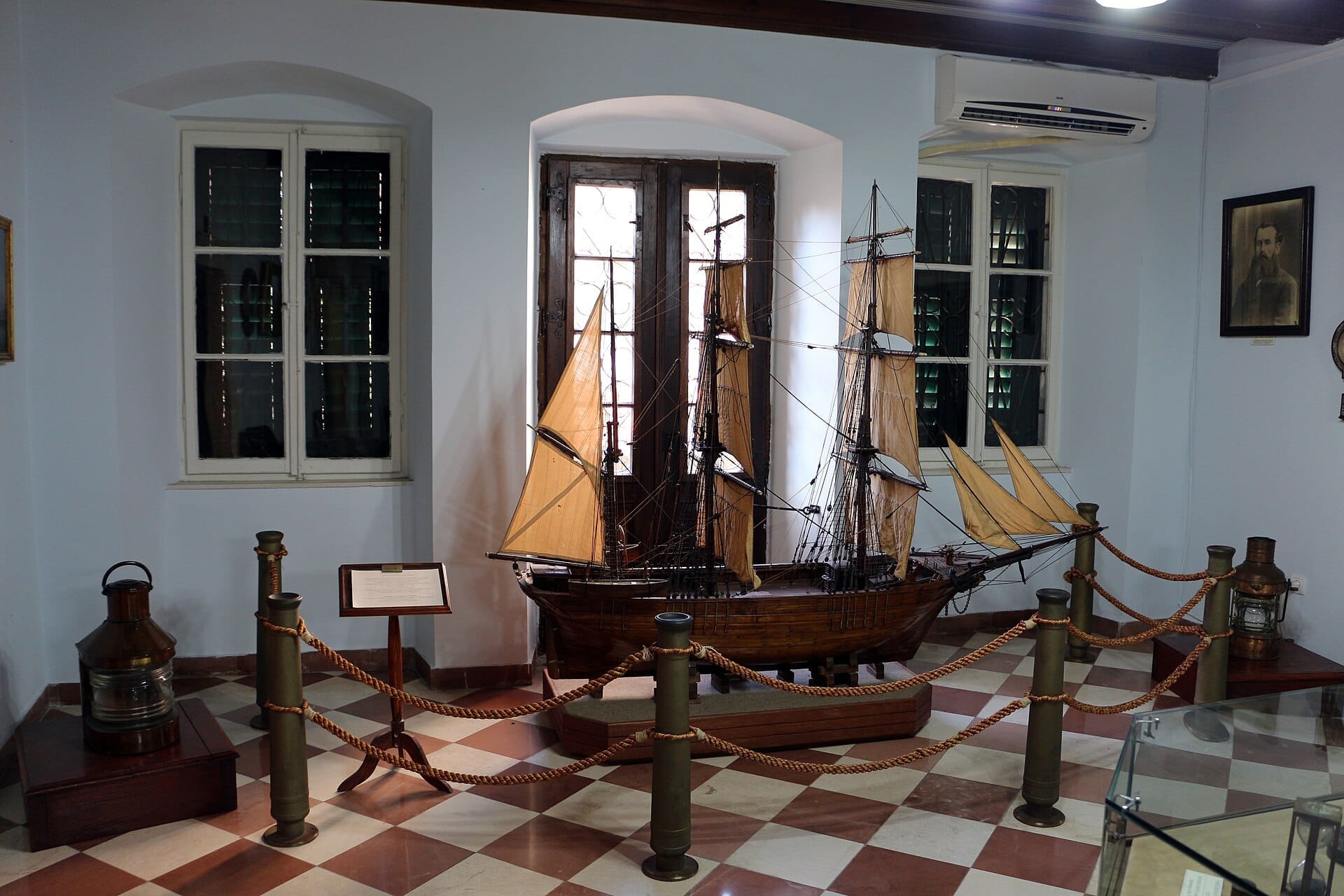
The ground floor and lower levels introduce Kotor's role in Adriatic trade and warfare. Display cases hold navigational instruments — brass sextants, compasses, early charts — alongside weapons, cannons, and anchors recovered from the bay. Scale models of historic vessels are scattered throughout, ranging from small fishing craft to full-rigged warships, and they are detailed enough to be genuinely impressive.
The upper floors shift toward the 18th and 19th centuries, when Kotor was under Venetian, then French, then Austrian rule. This is where the collection becomes particularly striking. Naval uniforms from the Austro-Hungarian period are displayed in glass cases: heavily braided, formally cut, and accompanied by medals, swords, and decorative firearms. The sense of ceremony around maritime service in this era comes through clearly.
There are paintings, portraits, and maps throughout — some quite old, some from the 19th-century genre tradition of maritime scenes. A few pieces stand out: large oil portraits of Boka sea captains in formal dress, surrounded by ships and coastline. These men clearly knew their own importance, and the art commissioned to commemorate them makes that evident.
ℹ️ Good to know
Labels throughout the museum are in Montenegrin and English, which makes independent navigation straightforward for most international visitors. A printed guide in additional languages is sometimes available at the desk.
The Boka Navy: A Living Tradition
One of the most distinctive threads in the collection relates to the Bokeljska mornarica, the Boka Navy. Founded according to some accounts in the 9th century, though the documentary record is clearer from medieval times onward, this brotherhood of sailors has maintained ceremonies, costumes, and a formal structure across centuries of changing rulers. It is recognized by UNESCO as part of Montenegro's intangible cultural heritage.
Their ceremonial dress, the maces and standards used in processions, and the historical records of their activities form a significant part of the museum's collection. If you visit Kotor during the Boka Navy Day celebrations (typically held in late January), you'll see members in full ceremonial costume processing through the same streets outside. The museum collection makes that spectacle significantly more legible — you understand what you're watching.
The bay's maritime culture extends well beyond Kotor itself. The town of Perast, a short drive along the bay, was historically the wealthiest captain's town in the region, and its own relationship to seafaring is worth exploring. A visit to the island church of Our Lady of the Rocks near Perast adds direct context to what you see in the museum.
When to Visit and What to Expect
Morning visits, particularly before 11am, mean you'll often have the rooms largely to yourself. Cruise ship passengers occasionally pass through in groups, but the museum rarely becomes crowded in the way that the city walls or cathedral do. By early afternoon in peak season (July and August), small guided tour groups may be moving through, which can slow progress on the upper floors.
The lighting inside is subdued and relatively consistent throughout the day, which means the experience doesn't change dramatically by hour. That said, mornings are quieter, and the natural light through the tall windows on the upper floor is softer before midday. The building holds the cool of the morning longer than the streets outside.
If you're visiting Kotor with limited time, this museum sits comfortably alongside the cathedral and the city walls in terms of priority. See the full guide to things to do in Kotor for how to combine it with a broader itinerary.
⚠️ What to skip
The museum is closed on certain public holidays and hours can shift in low season (October to April). Confirm current opening hours directly or via the official museum website before making it the focus of a visit.
Photography, Accessibility, and Practical Notes
Photography without flash is generally permitted throughout the museum for personal use. The dim interior and glass cases can make clean shots of smaller objects tricky without a steady hand or higher ISO setting. The architectural details on the staircase and the painted ceilings in some rooms are the most photogenic elements, and natural light helps here.
Accessibility is limited by the building's age and structure. The interior staircase is original stone and has no lift. Visitors with mobility difficulties may find the upper floors inaccessible. The ground floor is reachable from the entrance without major obstacles.
The museum is located very close to several of Kotor's other key sights. The Cathedral of Saint Tryphon is a short walk away, as is the Square of Arms, Kotor's main public square. This cluster of significant sites makes the southern corner of the old town the most information-dense part of the city to explore.
Is It Worth Your Time?
For visitors with a serious interest in Adriatic or Mediterranean history, the answer is a clear yes. The collection is coherent, the building enhances everything in it, and the story it tells — of a small city that trained captains, built ships, and served under a succession of empires while maintaining its own distinct maritime identity — is genuinely compelling.
If you are travelling with young children or have limited patience for display-case museums, it is a harder sell. There are few interactive elements and no significant audiovisual installations. The appeal is primarily intellectual and visual in a traditional sense: objects, labels, context.
Visitors who skip it most often do so because the city walls and cathedral dominate the itinerary. That's understandable. But the Maritime Museum fills in the 'why' behind Kotor's medieval wealth and its remarkable survival as a distinct cultural entity. An hour here makes the rest of the old town more meaningful.
Insider Tips
- Before entering, walk the perimeter of the Grgurina Palace exterior. The carved stone details and the relationship between the palace and the surrounding medieval buildings tell you a lot about how Kotor's merchant class positioned itself within the city's social hierarchy.
- The top floor often has the fewest visitors and the best light. Work your way up first if a tour group arrives after you, then descend at your own pace once they've moved through.
- The Boka Navy square outside the museum occasionally hosts small open-air events, particularly in the lead-up to the carnival season in January. Checking the local calendar before your visit can add an unexpected layer to the trip.
- If you buy a combination ticket that includes other Kotor attractions, the museum is often part of the package. Ask at the first attraction you visit whether a combined pass is available — it can meaningfully reduce overall costs.
- The museum shop near the entrance stocks a small selection of books on Adriatic and Montenegrin maritime history, some in English. These are harder to find elsewhere in the region and make more useful souvenirs than the typical fridge magnets sold in the lanes outside.
Who Is Maritime Museum of Montenegro For?
- History and cultural heritage enthusiasts who want more than surface-level sightseeing
- Architecture lovers interested in Baroque Venetian-era civic buildings
- Visitors looking for a quieter, cooler midday activity away from the main tourist flow
- Travellers who want to understand the context behind the Bay of Kotor's remarkable collection of historic towns
- Older children and teenagers with an interest in naval history, uniforms, or weapons
Nearby Attractions
Other things to see while in Kotor Old Town (Stari Grad):
- Cats Museum Kotor
Tucked inside Kotor's medieval Old Town, the Cat Museum is a compact, quirky gallery dedicated to the city's beloved cats. It's part souvenir shop, part folk art collection, and wholly representative of why Kotor and cats have become inseparable in the popular imagination.
- Fortress of San Giovanni (Castle of San Giovanni)
Perched 260 metres above sea level on a steep limestone ridge, the Fortress of San Giovanni is Kotor's defining landmark. The climb is demanding, the views are extraordinary, and the medieval fortifications reveal centuries of Venetian, Byzantine, and Ottoman history layered into a single hillside.
- Kotor City Walls
The Kotor City Walls stretch approximately 4.5 kilometers across the steep slopes of Mount St. John, enclosing the UNESCO-listed old town and climbing to the Fortress of San Giovanni above. This is one of the most physically rewarding urban walks in the entire Mediterranean region, combining medieval architecture, sweeping bay views, and a genuine sense of altitude.
- Kotor Clock Tower
Rising above the Square of Arms at the entrance to Kotor's Old Town, the Clock Tower is one of the most photographed landmarks in Montenegro. Small in scale but central to the character of the square, it has marked time here for centuries and remains an essential orientation point for anyone exploring the old town.