Church of St. Luke: The Church That Served Two Religions at Once
One of Kotor's oldest surviving churches, the Church of St. Luke stands in the heart of the Old Town as a rare example of a sacred space shared between Catholic and Orthodox congregations. Small in scale but rich in historical layering, it rewards visitors who slow down long enough to read the stones.
Quick Facts
- Location
- Trg Svetog Luke (St Luke's Square), Kotor Old Town
- Getting There
- 5-minute walk from the Sea Gate, the main pedestrian entrance to the Old Town
- Time Needed
- 20–40 minutes
- Cost
- Free entry (donations welcomed)
- Best for
- History enthusiasts, architecture lovers, and curious walkers
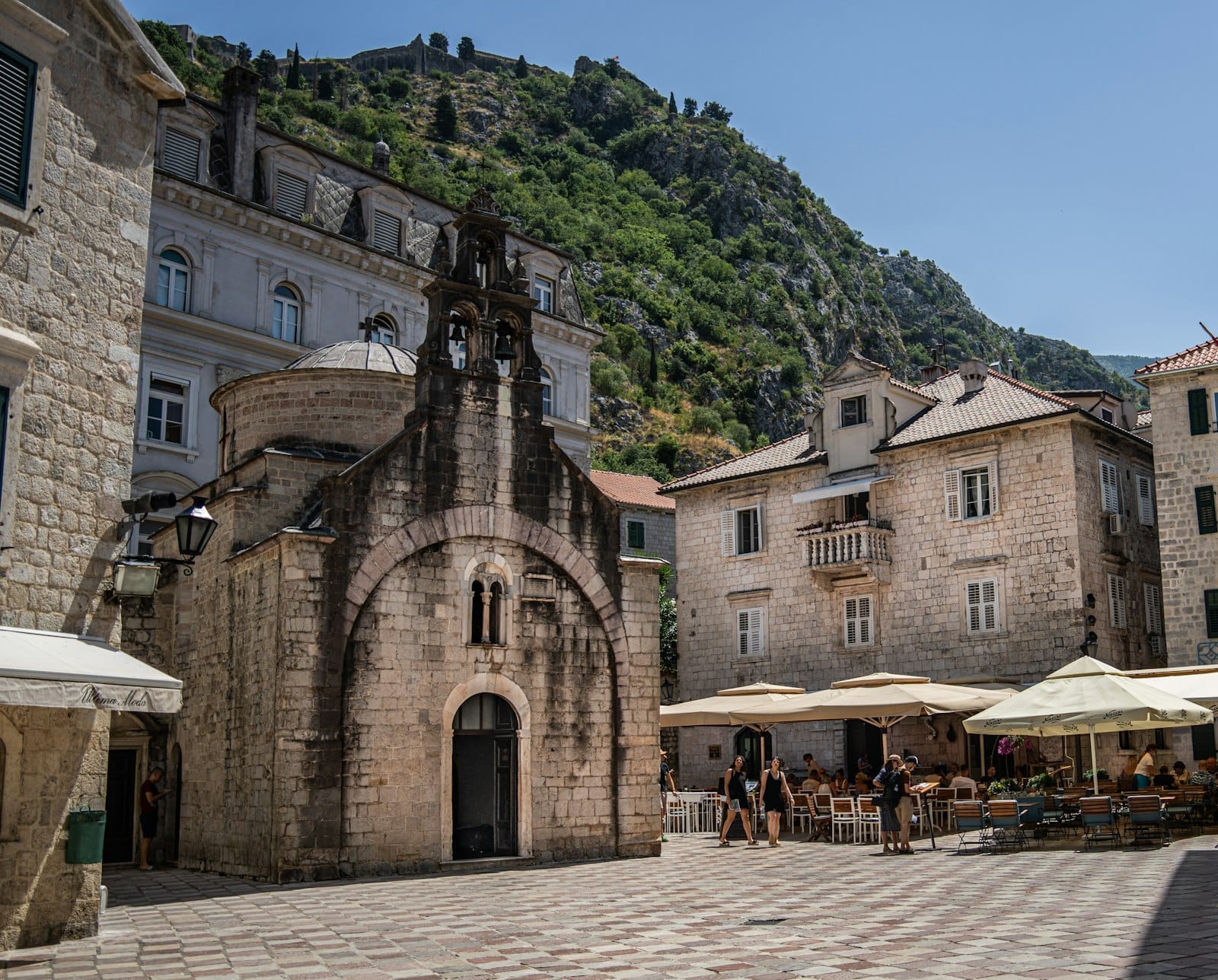
What Is the Church of St. Luke?
The Church of St. Luke (Crkva Svetog Luke) is a Romanesque church in Kotor's UNESCO-listed Old Town, built in 1195 according to an inscription carved above its entrance portal. That date alone makes it a significant survivor. The church predates many of the grand ecclesiastical structures that would later define the Adriatic coast, and it has outlasted sieges, plagues, and earthquakes that erased much of the medieval city around it. Today it still stands in working condition, occupying its own small square close to the city's geographic center.
St Luke's sits near the Square of Arms, Kotor's main piazza, but draws far fewer visitors. Most travelers pass through its square without stopping, drawn toward St Tryphon's Cathedral or the fortress trail. That oversight is worth correcting. The church offers something neither of those landmarks can: the texture of a genuinely ancient building that has been continuously in use, with all the patina and contradiction that implies.
💡 Local tip
Arrive before 10am or after 5pm when the Old Town is quieter. St Luke's Square fills with café tables by midday, which changes the contemplative feel of the space considerably.
A Building That Belonged to Two Faiths
The most remarkable chapter in St Luke's history is not its construction but its adaptation. During the long period of Venetian rule over Kotor, which lasted from 1420 to 1797, the church operated simultaneously as a Catholic and an Orthodox place of worship. Two altars stood inside: one Catholic, one Orthodox. Both communities used the same stone nave at different hours. This arrangement, unusual anywhere in the Christian world, reflects the pragmatic coexistence that defined much of Dalmatian and Montenegrin coastal life under Venetian administration.
That dual identity left physical traces inside the church. Over the centuries, ownership shifted more fully toward the Serbian Orthodox community, and the Catholic altar was eventually removed. But the building's spatial logic, its single nave, its modest semicircular apse, its plain stone walls, still carries the ambiguity of a space designed for more than one kind of devotion. No gilded iconostasis dominates the interior. The decoration is restrained, which paradoxically makes the few surviving frescoes and icons feel more present.
This layered religious identity connects St Luke's to the broader story of Kotor's spiritual geography, which includes St Nicholas Church, the main Orthodox church of the Old Town, and the Catholic St Tryphon's Cathedral, the city's most visited religious site. Together they map the centuries of confessional negotiation that shaped this small city.
Tickets & tours
Hand-picked options from our booking partner. Prices are indicative; availability and final rates are confirmed when you complete your booking.
Half-day Blue Cave adventure
From 45 €Instant confirmationFree cancellationMontenegro Canyons private tour from Kotor
From 68 €Instant confirmationFree cancellationLovćen national park and Budva city full-day private tour
From 150 €Instant confirmationFree cancellationDubrovnik walking tour from Kotor
From 59 €Instant confirmationFree cancellation
The Architecture: What to Look For
From the outside, St Luke's reads as compact and plain, which is partly what makes it so appealing. The facade is unadorned pale limestone, weathered to a warm grey-gold in afternoon light. The entrance portal features a lunette with a carved relief of St Luke, modest in scale compared to the elaborate sculptural programs of larger Romanesque churches, but precise and well-preserved for its age. The bell tower attached to the south side is a later addition, its stonework visibly different from the 12th-century body of the church.
Inside, the proportions are intimate. The ceiling height is low enough to make the space feel sheltered rather than grand, which suits a building that functioned more as a neighborhood chapel than a cathedral in the modern sense. The term 'cathedral' attached to it historically denotes the importance of its patron saint rather than the presence of a bishop's seat. Look for the carved inscription above the entrance that records the church's founding date, and note the variation in stonework at different levels of the walls, evidence of repairs following the catastrophic 1667 earthquake that leveled much of Kotor.
ℹ️ Good to know
Photography inside is subject to the discretion of whoever is present. If a service is in progress, wait outside or return later. The church is small enough that even a handful of people changes the atmosphere entirely.
How the Experience Changes Through the Day
Early morning is the best time to visit St Luke's Square as a whole. Light enters from the east and catches the limestone facade directly, revealing the surface texture of the stone in a way that midday flat light obscures. At this hour the square is largely empty. The chairs outside the neighbouring café have not yet been set out, and the only sounds are distant footsteps echoing through the Old Town's narrow lanes.
By late morning, especially during summer, the square becomes a thoroughfare. Cruise ship visitors moving between the Sea Gate and the city walls tend to pass through on their way to the main piazza. This is not the moment for quiet contemplation, but it is an opportunity to observe how the building reads in relation to its surroundings: it is smaller than you expect, and that contrast with the nearby towers and fortifications says something important about medieval Kotor's sense of scale.
Late afternoon, after the heaviest cruise traffic subsides, is the second good window. The light turns amber and the square regains its calm. If you are following a Kotor Old Town walking tour, this is a natural stopping point between the main square and the quieter northern quarters of the walled city.
Practical Information for Visitors
Entry to the Church of St. Luke is free, though a small donation box near the entrance supports the church's upkeep. Opening hours vary by season and depend on whether religious activities are scheduled, so there is no guarantee of interior access at any specific time. The church is small enough that even brief interior access is worthwhile. If you find it closed, the exterior and surrounding square are worth the short detour from the main square.
Access from the Sea Gate is straightforward: enter the Old Town through the main gate, walk straight along the main lane past the Square of Arms, and follow signs toward the center of the walled city. The church and its square appear within a five-minute walk. Flat stone paving covers the entire route, which is largely accessible for visitors with limited mobility, though the Old Town's uneven surfaces can be challenging in places. Comfortable, flat-soled shoes are strongly recommended throughout the Old Town.
⚠️ What to skip
During Orthodox religious holidays and services, the church interior may be closed to general visitors. If Kotor is on your itinerary during Easter or major feast days, check locally before planning around interior access.
Who Will Appreciate It Most, and Who Can Skip It
Visitors with an interest in Balkan history, early Romanesque architecture, or the complex interplay of Catholic and Orthodox Christianity along the Adriatic coast will find St Luke's genuinely rewarding. The church does not offer a grand interior experience or a collection of treasures, but it offers something rarer: physical evidence of a negotiated religious coexistence that most textbooks flatten into abstraction.
Travelers whose primary interest is Kotor's dramatic scenery and outdoor appeal, and who have already committed time to the Fortress of San Giovanni hike or a Bay of Kotor boat tour, may reasonably allocate only ten minutes here. The exterior alone conveys much of the story, and the square provides a natural rest point between busier sights. But if the words '12th century' and 'dual-faith congregation' mean anything to you, slow down and stay longer.
Insider Tips
- The small square in front of the church (Trg Svetog Luke) is one of the few open spaces in the Old Town where you can sit without being surrounded by souvenir shops. The café there is a reasonable place to pause between sights.
- Look closely at the transition between the original 12th-century stonework and the later repair sections on the exterior walls. The color and cut of the stone changes noticeably at the earthquake-repair line, and this tells you more about the 1667 disaster than any sign.
- If you visit St Nicholas Church later in the same day, compare the interior atmosphere of the two Orthodox spaces. St Luke's restraint and St Nicholas's relative richness illustrate how a single community's wealth and ambitions changed over five centuries.
- The carved lunette above the entrance portal is best photographed in the morning when direct eastern light catches the relief. By afternoon the facade falls into shadow from the surrounding buildings.
- St Luke's tends to be significantly quieter than St Tryphon's Cathedral even when the Old Town is full. If you want a moment of genuine quiet inside a medieval building, this is more reliable than the better-known alternatives.
Who Is Church of St. Luke For?
- Travelers interested in medieval Balkan history and Byzantine-Catholic religious interaction
- Architecture enthusiasts focused on Romanesque construction and post-earthquake adaptation
- Visitors who want a quieter alternative to St Tryphon's Cathedral
- Photography walkers looking for textured stone facades and intimate Old Town squares
- Slow travelers with a full day or more in Kotor who want depth over coverage
Nearby Attractions
Other things to see while in Kotor Old Town (Stari Grad):
- Cats Museum Kotor
Tucked inside Kotor's medieval Old Town, the Cat Museum is a compact, quirky gallery dedicated to the city's beloved cats. It's part souvenir shop, part folk art collection, and wholly representative of why Kotor and cats have become inseparable in the popular imagination.
- Fortress of San Giovanni (Castle of San Giovanni)
Perched 260 metres above sea level on a steep limestone ridge, the Fortress of San Giovanni is Kotor's defining landmark. The climb is demanding, the views are extraordinary, and the medieval fortifications reveal centuries of Venetian, Byzantine, and Ottoman history layered into a single hillside.
- Kotor City Walls
The Kotor City Walls stretch approximately 4.5 kilometers across the steep slopes of Mount St. John, enclosing the UNESCO-listed old town and climbing to the Fortress of San Giovanni above. This is one of the most physically rewarding urban walks in the entire Mediterranean region, combining medieval architecture, sweeping bay views, and a genuine sense of altitude.
- Kotor Clock Tower
Rising above the Square of Arms at the entrance to Kotor's Old Town, the Clock Tower is one of the most photographed landmarks in Montenegro. Small in scale but central to the character of the square, it has marked time here for centuries and remains an essential orientation point for anyone exploring the old town.