Sea Gate (Vrata od Mora): Kotor's Most Dramatic Entrance
The Sea Gate is the primary entrance to Kotor's UNESCO-listed Old Town, a Renaissance triumphal arch built in 1555 that once welcomed Venetian governors arriving by sea. Flanked by carved stone reliefs and a Venetian winged lion, it sets the tone for everything that lies beyond its threshold.
Quick Facts
- Location
- South wall of Kotor Old Town, facing the waterfront promenade
- Getting There
- 5-minute walk from the main bus station; cruise passengers exit the port directly toward the gate
- Time Needed
- 15–30 minutes to observe and photograph the exterior and passage
- Cost
- Free to pass through
- Best for
- History lovers, architecture enthusiasts, photographers, and first-time visitors to Kotor
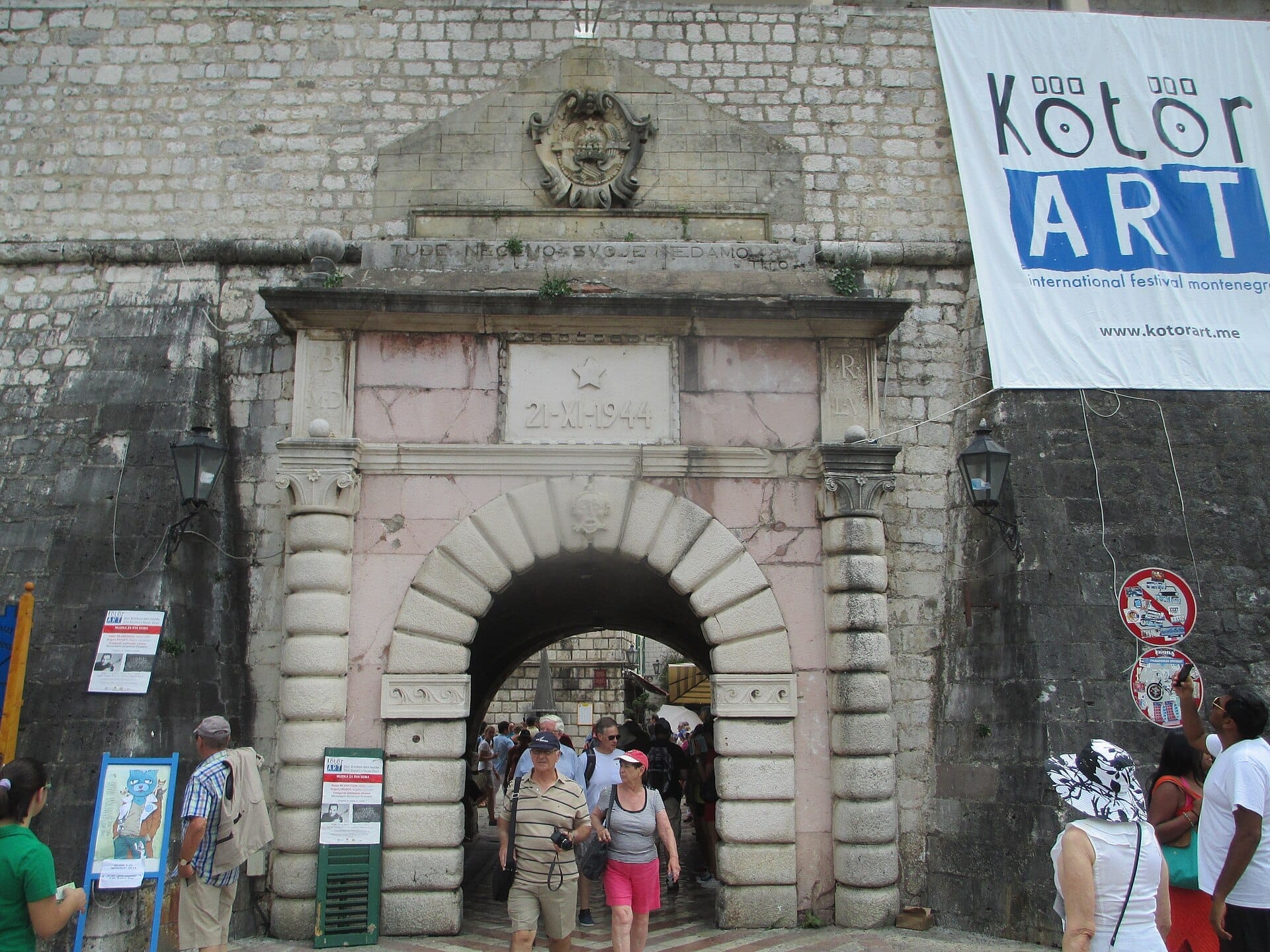
What Is the Sea Gate?
The Sea Gate, known locally as Vrata od Mora, is the southern and most ceremonial of Kotor's three Old Town gates. Built in 1555 during the period of Venetian rule, it was designed as a triumphal arch facing the Bay of Kotor, intended to project the power and prestige of the Serenissima to anyone arriving by water. For roughly 250 years, it served as the primary point of entry for Venetian governors, merchants, and dignitaries stepping off galleys onto Kotor's quay.
Today the gate is the de facto front door of the Old Town for almost every visitor. Whether you arrive on foot along the waterfront promenade, step off a cruise tender, or simply follow the crowds from the marina, the Sea Gate is almost certainly the first piece of medieval stonework you will walk through. That makes it both an architectural artifact and a practical threshold, and it rewards a few minutes of careful attention before you plunge into the lanes beyond.
💡 Local tip
Before entering, turn around and look back toward the bay. The framing of the Venetian arch against the water and the mountains of the Bay of Kotor is one of the best photographs you can take at street level in Kotor — and most visitors miss it entirely because they are already facing inward.
The Architecture: What to Look For
The gate is a single barrel-vaulted passage set into the southern city wall, constructed from the pale limestone that defines virtually every significant structure in Kotor. The arch follows a Renaissance design vocabulary, with clean proportional lines rather than the ornate Gothic carving found on some of the city's churches. The stonework is solid and functional, but three decorative elements elevate it above a simple military gateway.
The most prominent feature is the winged lion of St. Mark, the symbol of the Venetian Republic, carved in high relief above the outer arch. This is a recurring motif across the former Venetian territories of Dalmatia and the Bay of Kotor, but the example here is among the better-preserved. Flanking the lion are carved inscriptions in Latin commemorating the gate's construction date and the Venetian authority that commissioned it. On the inner face of the arch, look for the relief of the Virgin Mary, which was added as a protective devotional symbol, a common practice on city gates throughout the medieval Adriatic.
The gate passage itself is roughly eight metres deep, enough that you pass through a brief tunnel of shadow even in full daylight. The stone overhead retains the marks of centuries of use: sooting from torches, worn edges where cargo was once manhandled through, and a surface texture that shifts from rough-cut blocks to smoother dressed stone depending on which phase of construction you are looking at. Running your hand along the wall tells you more about the gate's age than any photograph.
Tickets & tours
Hand-picked options from our booking partner. Prices are indicative; availability and final rates are confirmed when you complete your booking.
Half-day Blue Cave adventure
From 45 €Instant confirmationFree cancellationMontenegro Canyons private tour from Kotor
From 68 €Instant confirmationFree cancellationLovćen national park and Budva city full-day private tour
From 150 €Instant confirmationFree cancellationDubrovnik walking tour from Kotor
From 59 €Instant confirmationFree cancellation
How the Experience Changes by Time of Day
The Sea Gate is accessible at all hours, and when you visit significantly changes what you find. In the early morning, before 8 a.m., the passage is nearly empty. The light from the east catches the limestone at a low angle, throwing the carved lion and Latin lettering into sharp relief. The bay is calm, local residents are heading to the market, and the smell of salt water from the promenade still dominates over any trace of food or crowds. This is, by any measure, the best time to photograph the exterior and to stand in the passage without being jostled.
By mid-morning, particularly on days when cruise ships are in port, the gate becomes a bottleneck. Hundreds of passengers funnel through the single passage simultaneously, and the experience shifts from contemplative to logistical. The gate handles the volume but the atmosphere is entirely different. If you are visiting Kotor on a cruise day and arriving with the main wave, consider passing through quickly and returning to the exterior in the late afternoon when the ship has departed and the crowds thin dramatically.
⚠️ What to skip
Kotor is one of the most heavily visited cruise ports in the Adriatic. Between roughly 9 a.m. and 2 p.m. on busy days, the Sea Gate passage can be crowded to the point of discomfort. Check the cruise schedule for the day of your visit at the port signage near the marina.
In the evening, the gate takes on a different character. Floodlights illuminate the limestone from below, making the carved relief of the lion appear almost theatrical. The passage smells faintly of restaurant smoke drifting from the nearest lane inside the walls. Couples photograph the gate from the promenade using the mountains across the bay as a backdrop. It is quieter than midday but livelier than dawn, with a pace that suits unhurried exploration.
Historical Context: Kotor Under Venice
Kotor fell under Venetian control in 1420 and remained part of the Serenissima's Adriatic dominion until Napoleon dissolved the Republic in 1797. The Sea Gate was constructed in 1555, well into this long Venetian period, as part of a broader programme of fortification and civic improvement that also produced much of the city wall system that still stands today. The gate's placement facing the sea was not purely symbolic: Kotor was a naval and trading port, and controlling waterborne access was a genuine strategic priority.
The Venetians governed Kotor through appointed rectors who arrived, as the gate's ceremonial design implies, from the sea. The city's fortunes were tied to maritime trade in olive oil, salt, and cloth, and the waterfront was the commercial heart of the settlement. That economic logic is still legible in the urban layout you encounter the moment you step through the gate: the Square of Arms just inside was the civic and commercial centre, where the rector's palace, the clock tower, and the main market all converged within a short walk of the water.
The gate survived multiple earthquakes, including the catastrophic 1667 quake that devastated much of the Adriatic coast, and the severe 1979 earthquake that damaged significant parts of Kotor's Old Town. Each reconstruction phase left traces in the stonework, which is why close inspection reveals subtle differences in block size and cut across the arch. The overall form, however, has remained consistent, making the Sea Gate one of the more faithful surviving examples of Venetian civic architecture in Montenegro.
Walking Through: The Practical Experience
The gate opens directly onto the Square of Arms, Kotor's largest public space and the natural starting point for any walk through the Old Town. From here, the Kotor Old Town walking tour routes fan out toward the Cathedral of St. Tryphon, the Maritime Museum, and the network of smaller churches and palaces that fill the medieval street grid. The gate is impossible to miss and nearly impossible to bypass, which makes it a reliable landmark for orientation throughout your visit.
If you plan to hike up to the Fortress of San Giovanni above the Old Town, passing through the Sea Gate is your entry point to the city. The path to the fortress entrance begins inside the walls, near the north end of the Old Town. Allow yourself a few minutes at the gate on the way in rather than rushing past it in the scramble to start the climb.
ℹ️ Good to know
The Sea Gate is the most photographed single structure in Kotor. For a cleaner shot without strangers walking through the frame, try the 30 minutes immediately after sunrise or the first week of October, when cruise traffic drops significantly.
Getting There and Practicalities
The gate sits directly on the Kotor seaside promenade, the pedestrian walkway that runs along the southern waterfront between the marina and the Old Town walls. From the main bus station, walk south along the waterfront for approximately five minutes. From the cruise port, follow the marked pedestrian path to the waterfront and turn left; the gate is visible within two to three minutes of walking.
There is no admission charge to pass through the gate or to stand on the exterior. Parking in the immediate area is limited, and the surrounding streets are largely pedestrianised, so arriving by car is not practical for most visitors. Taxis can drop you on the waterfront road close to the gate. The surface through the passage is uneven limestone cobblestone, which can be slippery when wet. Flat, closed-toe shoes are recommended, especially if you plan to continue deeper into the Old Town.
The Sea Gate is also a useful orientation point if you are combining an Old Town visit with a trip to the Kotor Marina waterfront or planning a day trip by boat. Bay of Kotor boat tours typically depart from the marina, which is a five-minute walk west along the promenade from the gate.
Who Should Skip This
The Sea Gate is not an experience in the traditional sense: there is no exhibition, no interior to explore, and no guided programme. Visitors expecting an immersive museum-style attraction will find it underwhelming. If you have very limited time in Kotor and your interests lie primarily in the cathedral, the city walls, or the views from the fortress above, the gate is best treated as a passage point rather than a destination in itself. It takes roughly 15 to 20 minutes to photograph properly and observe the stonework; beyond that, the time is better spent elsewhere inside the walls.
Travellers with significant mobility limitations should be aware that the cobblestone surface through the gate and on the promenade immediately outside is uneven. There are no ramps or smooth alternative paths through this section of the city wall.
Insider Tips
- After passing through the gate, immediately look up at the ceiling of the arch. The stone vaulting retains tool marks and patches of older mortar that are rarely noticed at eye level.
- The carved Latin inscription above the outer face reads 'Anno MDLV' (Year 1555) and includes a reference to the Venetian provveditore who oversaw the construction. Photographing this with a zoom lens in morning light makes the lettering legible.
- The gate has a second, less-visited face on the inner side of the wall. The relief of the Virgin on this face is smaller and more worn than the lion on the outer face — most visitors walk straight through without turning back to look.
- On summer evenings, local musicians occasionally set up just inside the gate, playing in the square beyond. The acoustics of the barrel vault carry sound unexpectedly well, and the effect from inside the passage is striking.
- If you want the gate entirely to yourself in a photograph, aim for late September or early October on a weekday morning. Cruise ship frequency drops, temperatures are still pleasant, and the angle of morning light is ideal for the carved stone details.
Who Is Sea Gate (Vrata od Mora) For?
- First-time visitors to Kotor who want to begin their Old Town exploration with a sense of historical context
- Architecture and history enthusiasts interested in Venetian civic building traditions
- Photographers seeking the most iconic exterior shot of Kotor's medieval walls
- Cruise passengers with limited time who want a quick, high-quality historical encounter at the port exit
- Walkers using the Old Town as a base for exploring the surrounding area and waterfront
Nearby Attractions
Other things to see while in Kotor Old Town (Stari Grad):
- Cats Museum Kotor
Tucked inside Kotor's medieval Old Town, the Cat Museum is a compact, quirky gallery dedicated to the city's beloved cats. It's part souvenir shop, part folk art collection, and wholly representative of why Kotor and cats have become inseparable in the popular imagination.
- Fortress of San Giovanni (Castle of San Giovanni)
Perched 260 metres above sea level on a steep limestone ridge, the Fortress of San Giovanni is Kotor's defining landmark. The climb is demanding, the views are extraordinary, and the medieval fortifications reveal centuries of Venetian, Byzantine, and Ottoman history layered into a single hillside.
- Kotor City Walls
The Kotor City Walls stretch approximately 4.5 kilometers across the steep slopes of Mount St. John, enclosing the UNESCO-listed old town and climbing to the Fortress of San Giovanni above. This is one of the most physically rewarding urban walks in the entire Mediterranean region, combining medieval architecture, sweeping bay views, and a genuine sense of altitude.
- Kotor Clock Tower
Rising above the Square of Arms at the entrance to Kotor's Old Town, the Clock Tower is one of the most photographed landmarks in Montenegro. Small in scale but central to the character of the square, it has marked time here for centuries and remains an essential orientation point for anyone exploring the old town.