Spanish Synagogue Prague: The Most Spectacular Interior in Josefov
The Spanish Synagogue is Prague's most architecturally striking house of Jewish worship, completed in 1868 in a lavish Moorish Revival style. Part of the Jewish Museum in Prague circuit, it stands in the historic Josefov quarter and houses a permanent exhibition on Czech Jewish history from the Enlightenment to the post-war era.
Quick Facts
- Location
- Vězeňská 1, Josefov (Prague 1) – near the Franz Kafka statue on Dušní Street
- Getting There
- Metro Line A (green) – Staroměstská stop; or Tram 17 – Právnická fakulta stop
- Time Needed
- 45–90 minutes for the synagogue alone; allow a half-day if visiting the full Jewish Museum circuit
- Cost
- Included in the Jewish Museum combined ticket: 500 CZK standard / 350 CZK reduced. No standalone entry. Verify current prices before visiting.
- Best for
- Architecture lovers, Jewish history, cultural travellers, photography
- Official website
- www.jewishmuseum.cz/en/explore/sites/spanish-synagogue
What the Spanish Synagogue Actually Is
The Spanish Synagogue (*Španělská synagoga*) is the youngest of Prague's surviving historic synagogues and, by most measures, its most visually arresting. Completed in 1868 on the site of the much older Altschul (Old Shul), it was designed in a Moorish Revival style that takes direct architectural inspiration from the Alhambra palace complex in Granada. The name refers not to any Spanish congregation but to this stylistic choice. The previous building, the Altschul, was demolished in 1867 to make way for the current structure. It stands in Josefov, the former Jewish quarter of Prague, now administratively part of Old Town (Prague 1).
The synagogue is one of six sites managed under the Jewish Museum in Prague circuit, and you cannot purchase a standalone entry ticket. The combined ticket covers the Spanish Synagogue, the Old Jewish Cemetery, the Pinkas Synagogue, the Maisel Synagogue, the Klausen Synagogue, and the Ceremonial Hall; the Old-New Synagogue is on a separate ticket. Most visitors treat a full day in Josefov as a single itinerary block, which is the right approach.
ℹ️ Good to know
The Spanish Synagogue is closed on Saturdays and on Jewish holidays. Hours vary significantly by season: in winter (roughly January–March and November–December) the building closes as early as 16:30, in spring and autumn it generally closes around 18:00, and in summer (May–August) it can stay open until 19:00. Always confirm current hours at jewishmuseum.cz before planning your visit.
The Interior: What You Actually See Inside
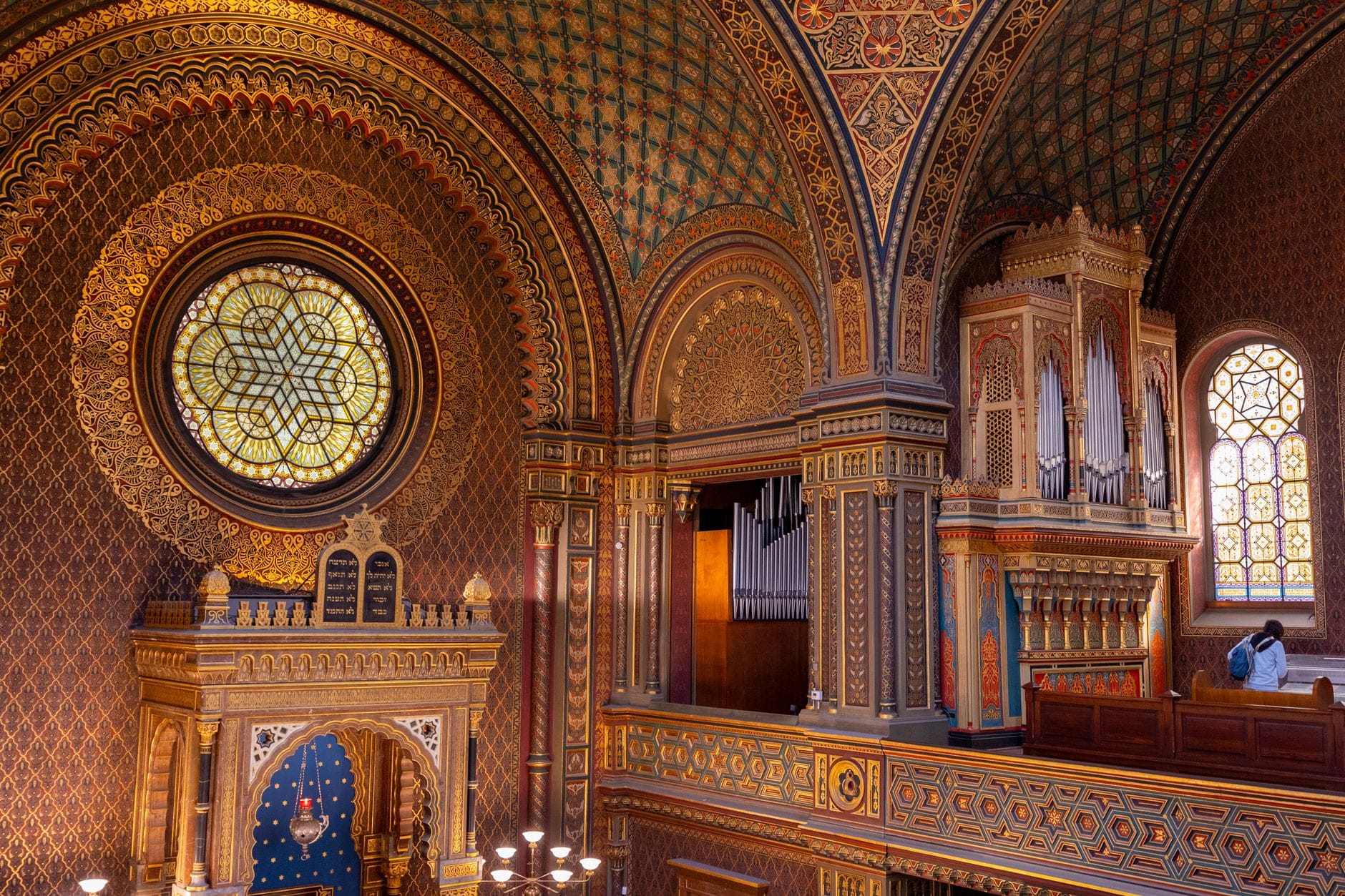
Nothing quite prepares first-time visitors for what is inside. The exterior, while handsome, gives few clues about the scale of decoration within. You enter through a modest doorway and walk into a space where virtually every surface is covered in geometric polychrome ornament: interlocking arabesques in gold, red, blue, and green applied to the walls, the pendentive arches, the galleries, and the central dome. The effect is less like stepping into a synagogue and more like stepping inside an elaborate jewellery box.
The main hall is organized around a central bimah (raised platform) beneath the dome, with two-storey arcaded galleries running around three sides. The organ in the east gallery, installed in the late 19th century, remains in the space and still functions. Natural light enters through stained-glass windows that cast warm, tinted shadows across the patterned floors on sunny mornings, making the early-to-mid morning hours noticeably more photogenic than the afternoon.
The ground floor and galleries also house a permanent exhibition on the history of Czech Jews from the Emancipation period through the late 20th century. The exhibition includes religious objects, historical documents, textiles, and ceremonial silverwork. It is substantive rather than superficial, and adds genuine context to the architectural spectacle. Budget time for both the space itself and the displays.
Tickets & tours
Hand-picked options from our booking partner. Prices are indicative; availability and final rates are confirmed when you complete your booking.
Classical Concert in Spanish Synagogue in Prague
From 39 €Instant confirmationFree cancellationPrague Jewish Quarter guided walking tour with synagogue visits
From 81 €Instant confirmationFree cancellationSelf guided tour with interactive city game of Prague
From 5 €Instant confirmationFree cancellationPrague by night city tour
From 27 €Instant confirmationFree cancellation
Historical Context: Why This Building Exists
Josefov was for centuries the confined Jewish ghetto of Prague, named after Emperor Joseph II following his 1781 Edict of Tolerance, which significantly loosened restrictions on Jewish residents. By the mid-19th century, Jews in Bohemia had gained greater civil rights, and the community had the means and the freedom to build with ambition. The Spanish Synagogue was the result: a deliberate architectural statement, its Moorish Revival style evoking a romanticized memory of Sephardic Jewish culture in medieval Iberia. The style was fashionable across Central Europe in the 1860s for Jewish sacred buildings, appearing in cities from Vienna to Budapest. For the Jewish Quarter of Prague, the Spanish Synagogue represented a confident assertion of cultural identity at a moment of genuine possibility.
The broader context matters: much of the old ghetto was demolished at the end of the 19th and early 20th century under a city sanitation project that replaced medieval alleyways with the Art Nouveau apartment blocks you see along Pařížská street today. The Spanish Synagogue survived. The community that built and used it did not fare as well in the 20th century: the Nazis murdered the majority of Czech Jews during World War II, and the building subsequently served various non-religious purposes before being restored and returned to museum use.
How the Experience Changes by Time of Day
Arrive between 9:00 and 10:30 and you are likely to have the main hall with only a handful of other visitors. The morning light through the stained glass catches the gold ornamentation at low angles, and the space is quiet enough to absorb the scale of the decoration without distraction. By 11:00, tour groups begin arriving in waves, particularly in spring and summer. The hall is not small, but it is not enormous either, and a group of thirty people with a guide speaking at full volume changes the character of the visit considerably.
Midday through mid-afternoon is the peak congestion window. The exhibition panels in the galleries can become difficult to read when foot traffic is high. If you are specifically interested in the exhibition content rather than just the architecture, going early or arriving in the final 90 minutes before closing gives you better conditions.
💡 Local tip
For photography: visit on a sunny morning when light enters from the east through the stained-glass windows. Use a wide-angle lens or phone in ultrawide mode to capture the dome and full gallery height. A tripod is not practical given the crowds, but the interior is bright enough for handheld shots in good light.
Getting There and Practical Logistics
The synagogue is at Vězeňská 1, a short street in the Josefov district. The most straightforward approach is Metro Line A (the green line) to Staroměstská, which takes approximately five minutes on foot through the quarter. Tram 17 to Právnická fakulta is an alternative if you are coming from the riverfront direction. The building is very close to the Franz Kafka statue on Dušní Street, which makes it easy to orient yourself on foot.
The entire Jewish Museum circuit is walkable within Josefov and the surrounding blocks. If you are planning a full day in the area, the Old Jewish Cemetery and the Pinkas Synagogue are among the most emotionally significant stops on the same combined ticket. The Old Jewish Cemetery is one of the most layered and historically dense sites in Prague; the Pinkas Synagogue holds a hand-painted memorial inscription of nearly 80,000 names of Czech Jewish Holocaust victims covering its interior walls.
Visitors with mobility needs should contact the Jewish Museum in Prague directly before visiting, as detailed accessibility information for the Spanish Synagogue is not published on the official website. The building is a heritage structure and specific arrangements may need to be made in advance.
Is the Spanish Synagogue Worth Your Time?
Honestly: yes, for most visitors. The interior is genuinely exceptional and unlike anything else in Prague. That said, the combined Jewish Museum ticket is not cheap, and if you are on a tight budget, you need to weigh whether the full circuit makes sense versus prioritising individual sites. The ticket covers six sites, and the Spanish Synagogue, the Old Jewish Cemetery, and the Pinkas Synagogue are consistently regarded as the three most significant. If Jewish history is a primary interest rather than a secondary one, the full circuit is worth every koruna. For broader Prague history travellers, this is one of the most concentrated stretches of layered historical significance in the city.
Who might skip it: travellers with limited interest in religious or architectural history who are pressed for time and already feeling over-museumed after Prague Castle or the Old Town Hall Tower. The Spanish Synagogue rewards attention and curiosity, but if you are not in the right headspace for an interior exhibition, the impact is reduced. It is not an attraction that works well as a casual walk-through.
The wider neighbourhood of Josefov pairs naturally with a walk along Old Town Square and a look at the Franz Kafka Museum nearby in Malá Strana if Kafka's biography and legacy in Prague interests you.
Insider Tips
- Buy the Jewish Museum combined ticket online in advance, especially in summer. Queues at the on-site ticket points can add 20–30 minutes to your morning, and the online price is currently the same as the door price.
- The Spanish Synagogue also hosts classical music concerts in the evenings, which offer a completely different way to experience the interior with the ornament illuminated by artificial light. Check the Jewish Museum and Prague Classical Concerts websites for schedules.
- If you plan to visit multiple sites on the Jewish Museum circuit in one day, start at the Old Jewish Cemetery when it opens and end at the Spanish Synagogue in the late afternoon. The Cemetery is the most emotionally demanding stop and benefits from being visited with a fresh mind.
- The neighbourhood around the synagogue is heavily touristic at street level, but Vězeňská street itself stays relatively quiet. The Franz Kafka statue a short walk away on Dušní is a genuinely interesting stop that most visitors on package tours walk past quickly.
- The exhibition on the upper gallery level about Czech Jewish history post-Enlightenment is undervisited relative to the main hall. Most people photograph the dome and move on. The silver ceremonial objects and textiles on display are of significant quality and worth slowing down for.
Who Is Spanish Synagogue For?
- Architecture enthusiasts drawn to 19th-century Moorish Revival design
- Travellers with a serious interest in Central European Jewish history
- Photography-focused visitors who want one of Prague's most ornate interiors
- Cultural travellers building a full day around the Josefov Jewish Museum circuit
- Visitors attending one of the evening classical concerts held in the synagogue
Nearby Attractions
Other things to see while in Josefov (Jewish Quarter):
- Maisel Synagogue
Built between 1590 and 1592 for the wealthiest man in Bohemia's Jewish community, the Maisel Synagogue stands at the heart of Josefov as both an architectural landmark and a gateway to ten centuries of Jewish life in Bohemia and Moravia. Today it houses one of the Jewish Museum in Prague's most important permanent exhibitions.
- Museum of Decorative Arts
Housed in a French Neo-Renaissance building completed in 1899 and sitting directly opposite the Rudolfinum in Josefov, the Museum of Decorative Arts in Prague (UPM) is one of Central Europe's most underrated design collections. From Bohemian glass to Art Nouveau furniture and historical textiles, the permanent collection spans centuries of applied craft — all in a building that is itself worth the entry price.
- Old Jewish Cemetery
The Old Jewish Cemetery in Prague's Josefov quarter contains over 12,000 visible tombstones layered up to ten deep across roughly one hectare. In use from 1439 to 1787, it stands as one of the best-preserved medieval Jewish cemeteries in the world and is part of the Jewish Museum in Prague complex.
- Old-New Synagogue
Built around 1270, the Old-New Synagogue in Josefov is not only the oldest surviving medieval twin-nave synagogue in Europe but also a continuously functioning house of worship. Its Gothic brick gables, centuries-old interior, and remarkable survival through Prague's turbulent history make it one of the most significant religious buildings on the continent.