South Downs National Park: Brighton's Backyard Wilderness
South Downs National Park begins where Brighton ends, rising from the city's northern edge into over 1,600 square kilometres of chalk hills, ancient footpaths and open farmland. There is no ticket booth, no fixed opening time, and no single entrance. What you get instead is one of England's most accessible national parks, free to use and rewarding at any season.
Quick Facts
- Location
- Stretches north and east of Brighton; accessible from the city's northern suburbs
- Getting There
- Bus or train to Lewes, Hassocks or Falmer; Stagecoach South bus routes serve village trailheads
- Time Needed
- Half-day for a single viewpoint walk; full day for longer routes such as the South Downs Way
- Cost
- Free to access via public rights of way; some car parks and specific sites charge fees
- Best for
- Walkers, cyclists, families, birdwatchers, stargazers
- Official website
- www.southdowns.gov.uk
What South Downs National Park Actually Is
South Downs National Park is a designated national park covering over 1,600 square kilometres across Hampshire, West Sussex and East Sussex. It was officially designated on 1 April 2010, when the South Downs National Park Authority took full statutory responsibility from that date. That makes it one of England's newer national parks, though the landscape it protects is one of the oldest continuously used by people in Britain.
Unlike a theme park or historic house, there is no perimeter fence, no entrance gate, and no single address. The park is a working, lived-in landscape of farms, villages, chalk ridges and river valleys. You access it through the public rights of way network: footpaths, bridleways and the 160-kilometre (99-mile) South Downs Way long-distance trail that runs from Winchester to Eastbourne. From Brighton specifically, the eastern end of the Downs is on your doorstep.
ℹ️ Good to know
Access to public rights of way across South Downs National Park is free. Car parks, visitor centres and some specific sites charge their own fees. Always check individual venues before travelling.
The Landscape Up Close: What You Will See and Feel
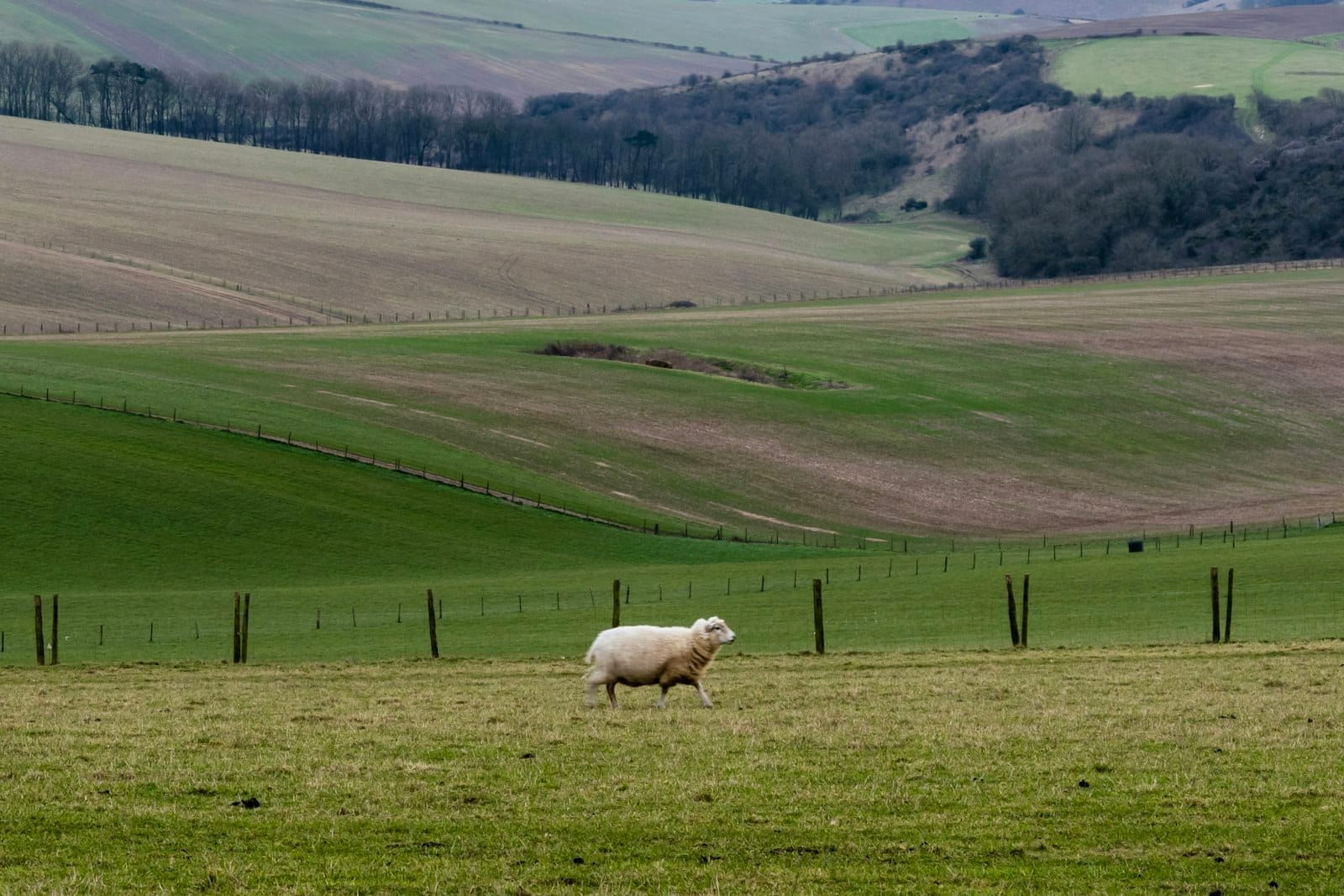
The defining feature of the South Downs is chalk. The hills are made of it, and that geology shapes everything: the short-cropped turf that feels springy underfoot, the pale tracks that cut white lines across green slopes, the way the light on an overcast day gives the hills a silver-grey quality unlike anywhere else in southern England. After rain, the chalk paths become slick and pale mud clings to boots; on a dry summer day, the same paths turn almost white in direct sunlight.
At the ridgeline viewpoints near Brighton, the view opens in two directions. To the south you look across rooftops, down to the English Channel glittering or grey depending on the weather. To the north the land folds into the Low Weald, a patchwork of fields and hedgerows that on clear days extends to the Surrey Hills. The contrast between the urban coast visible behind you and the agricultural quiet in front is striking, and it typically takes under an hour from Brighton city centre to reach it.
The smells change with the seasons. In late spring and early summer, the chalk grassland carries a faint sweetness from wildflowers, including cowslips, orchids and scabious. Late summer brings the dry, slightly dusty quality of harvested fields. In winter, there is little scent at all, only wind and the occasional sharp cold that makes the open ridge feel very exposed.
Tickets & tours
Live prices and dates from our booking partner. If you book, we may earn a commission at no extra cost to you.
History Underfoot: 6,000 Years on the Chalk
The chalk ridgeline of the South Downs has been in use for more than 6,000 years. Neolithic people cleared the forests on the hilltops, and their barrows and earthworks are still visible as bumps in the turf. Bronze Age and Iron Age communities built hill forts on the commanding ridges. Chanctonbury Ring, the Caburn near Lewes, and the earthworks at Cissbury Ring are among the most prominent. You walk through settled, shaped landscape even when it looks wild.
The most significant prehistoric site accessible from Brighton is Devil's Dyke, a dry valley carved by glacial meltwater that creates one of the most dramatic views on the South Downs. It sits about 9 kilometres north-west of Brighton city centre and has been a tourist destination since Victorian times, when a funicular railway and cable car once brought day-trippers up from the city. The infrastructure is long gone, but the place retains the same draw.
The South Downs Way itself follows a route that prehistoric traders, Roman soldiers, medieval pilgrims and drovers all used. Where modern roads have not cut across it, the path retains an ancient character: sunken lanes worn deep into the chalk by centuries of traffic, flanked by hawthorn and elder. Walking even a short section connects you physically to that continuity in a way that a museum cannot replicate.
Getting There from Brighton: Practical Routes
The South Downs begin less than 5 kilometres from Brighton city centre, and several access points are reachable without a car. Trains from Brighton to Hassocks (about 12 minutes) drop you at the foot of the Downs near Ditchling Beacon, one of the highest points in East Sussex at around 248 metres. From Hassocks station, a walk of under 5 kilometres on footpaths brings you to the Beacon summit. The views from there are among the best available from any point accessible by public transport.
Lewes, reached in around 17 minutes by train from Brighton, provides a different entry point via the Ouse Valley and the slopes of Mount Caburn. For Devil's Dyke specifically, Stagecoach South operates a seasonal bus service (check current timetables before travelling, as services can be limited in winter). Cycling is another option: the South Downs Way is designated as a bridleway along its full length, and mountain bikes or gravel bikes are well-suited to the chalk tracks.
💡 Local tip
If you are travelling without a car, Hassocks is the most convenient rail gateway to the open ridge. The path from the station to Ditchling Beacon is well-signposted and avoids main roads for most of its length.
Driving visitors can park at Devil's Dyke car park (charges apply; verify current fees before travelling) or at several National Trust car parks along the ridge. The South Downs National Park Authority's website lists car parks and access points in detail. In summer, car parks near popular viewpoints fill by mid-morning on weekends, so early arrival makes a significant practical difference.
When to Visit: Season by Season
Spring, particularly late April to June, is the strongest season for the South Downs. The chalk grassland comes into flower, the paths are generally dry enough to walk without specialist footwear, and the days are long enough to do a proper half-day or full-day route without rushing. Temperatures at this time are typically in the 11 to 16 degrees Celsius range in the city, cooler on the ridge in a breeze.
Summer brings the heaviest visitor numbers to the most popular spots. Devil's Dyke on a July weekend attracts families, dog walkers, paragliders and picnickers in quantity. If you want the ridge mostly to yourself, walk on a weekday morning. Less frequented sections of the South Downs Way between Pyecombe and Lewes see a fraction of the weekend crowds even in peak season.
Winter visits are legitimate and often rewarding, but require preparation. The chalk paths become slippery after rain, and the ridge is exposed to strong south-westerly winds. On clear winter days, the long views are exceptional and the park is genuinely quiet. The South Downs received International Dark Sky Reserve status in 2016, meaning that on dark winter nights, away from the car parks and villages, stargazing can be excellent. For context on how weather affects your planning, see the best time to visit Brighton guide.
⚠️ What to skip
Chalk paths become genuinely dangerous when wet. Waterproof footwear with grip is recommended from October through March. The open ridge offers no shelter from wind, so carry an extra layer regardless of how warm it looks from the city.
Practical Details: Accessibility, Photography and What to Bring
The South Downs National Park Authority runs a programme called Miles without Stiles, providing a set of routes specifically designed for wheelchair users and people with limited mobility. These routes avoid stiles and gates that cannot be opened from a wheelchair, and are surfaced or graded for accessible use. Route information is available on the park authority's website and is detailed enough to plan a visit in advance.
For photography, the ridge at sunrise and in the hour before sunset offers the strongest light, particularly in spring and autumn when the sun's angle is lower. Early morning visits also avoid the haze that builds on hot summer days and can flatten coastal views. A wide-angle lens or phone in landscape mode captures the sweeping downland well, but the most interesting images tend to be close-ups of the chalk path texture, wildflowers, or the physical contrast between the city visible in the distance and the empty turf of the ridge.
The park sits within easy reach of other Brighton attractions for a combined day. You can pair a morning walk on the Downs with an afternoon at Brighton Beach or the Royal Pavilion. The contrast between the open hills and the dense, decorated interiors of the Pavilion is sharper than you might expect and makes for a satisfying day with two very different registers.
Who Might Not Enjoy This
The South Downs is not a theme park, and it does not perform for visitors. There are no cafes every kilometre, no information boards every 500 metres, and no guarantee of mobile signal on the ridge. If your idea of a good half-day is a structured indoor experience with clear signposting and shelter, a walk on the Downs is likely to feel underwhelming or logistically uncertain.
Visitors who want to spend their time in Brighton primarily exploring art, food and culture will find the city itself has plenty to offer without leaving the streets. The North Laine and The Lanes both reward slow exploration and do not require walking boots or weather awareness.
Insider Tips
- Ditchling Beacon, reached on foot from Hassocks station, gives views comparable to Devil's Dyke but sees a fraction of the weekend visitors. The car park there is relatively small, which naturally limits the crowd.
- The South Downs Way is a bridleway along its full length, making it legally open to cyclists. A gravel or mountain bike turns a half-day walk into a full ridge route covering far more distance than you could on foot.
- The International Dark Sky Reserve designation means the park has genuine low-light areas. A clear night in late autumn or winter, away from car park lighting and village glow, can make the Milky Way visible in a way that is impossible from within Brighton itself.
- The park's Miles without Stiles route map is available as a PDF from the South Downs National Park Authority website and is worth downloading before you travel rather than searching for signal on the ridge.
- Parking at popular spots like Devil's Dyke fills fast on summer weekends. Arriving before 9am means you avoid both the parking pressure and the midday heat on exposed chalk paths.
Who Is South Downs National Park For?
- Walkers looking for open-air exercise within reach of an urban base
- Cyclists who want off-road bridleway routes with sea views
- Families wanting free outdoor space with dramatic scenery and room to roam
- Stargazers taking advantage of the International Dark Sky Reserve designation
- Visitors pairing a morning outdoors with an afternoon exploring Brighton's city attractions
Nearby Attractions
Combine your visit with:
- Booth Museum of Natural History
Founded in 1874 by naturalist Edward Thomas Booth, the Booth Museum of Natural History is Brighton's free natural history collection housed in a Grade II listed Victorian building on Dyke Road. With over 525,000 specimens, from British birds to butterfly drawers and dinosaur bones, it is one of the most significant natural history collections in southern England. Note: closed to the public since 20 April 2025 for essential works; special event days only, with reopening targeted for later 2026 or early 2027.
- Brighton Racecourse
Perched on Whitehawk Hill roughly a mile from the coast, Brighton Racecourse is one of England's most unusual flat racing venues. The horseshoe-shaped track, open from April to October, offers panoramic views across the city and out to the English Channel, alongside a race day atmosphere that ranges from relaxed midweek afternoons to packed summer festivals.
- Devil's Dyke
Perched around 215 metres above sea level on the South Downs, Devil's Dyke is a National Trust countryside site just north of Brighton. Claimed to be the longest, deepest and widest dry valley in Britain, it offers panoramic views stretching from the English Channel to the Surrey Hills, free access year-round, and walking routes ranging from a gentle ridge stroll to a steep valley descent.
- Preston Manor
Preston Manor is a Grade II* listed historic country house museum in Brighton, open seasonally beside Preston Park. With rooms preserved as they were in 1905 and a history recorded in the Domesday Book, it offers a rare glimpse into upper-middle-class Edwardian life — a world away from the seafront crowds.
Planning a trip? Discover personalized activities with the Nomado app.