Devil's Dyke: Brighton's Dramatic Hilltop Valley and Its Sweeping South Downs Views
Perched around 215 metres above sea level on the South Downs, Devil's Dyke is a National Trust countryside site just north of Brighton. Claimed to be the longest, deepest and widest dry valley in Britain, it offers panoramic views stretching from the English Channel to the Surrey Hills, free access year-round, and walking routes ranging from a gentle ridge stroll to a steep valley descent.
Quick Facts
- Location
- Devil's Dyke Road, near Brighton, BN1 8YJ, West Sussex, England
- Getting There
- Brighton & Hove Breeze Bus from Brighton city centre (seasonal service). By car via Devil's Dyke Road with a National Trust pay-and-display car park on site.
- Time Needed
- 1 to 3 hours, depending on how far you walk into the valley
- Cost
- Free entry to the countryside. Car parking charges apply for non-National Trust members (verify current tariff at nationaltrust.org.uk).
- Best for
- Walkers, families, photographers, anyone wanting big open-air views without going far from Brighton
- Official website
- www.nationaltrust.org.uk/visit/sussex/devils-dyke
What Devil's Dyke Actually Is
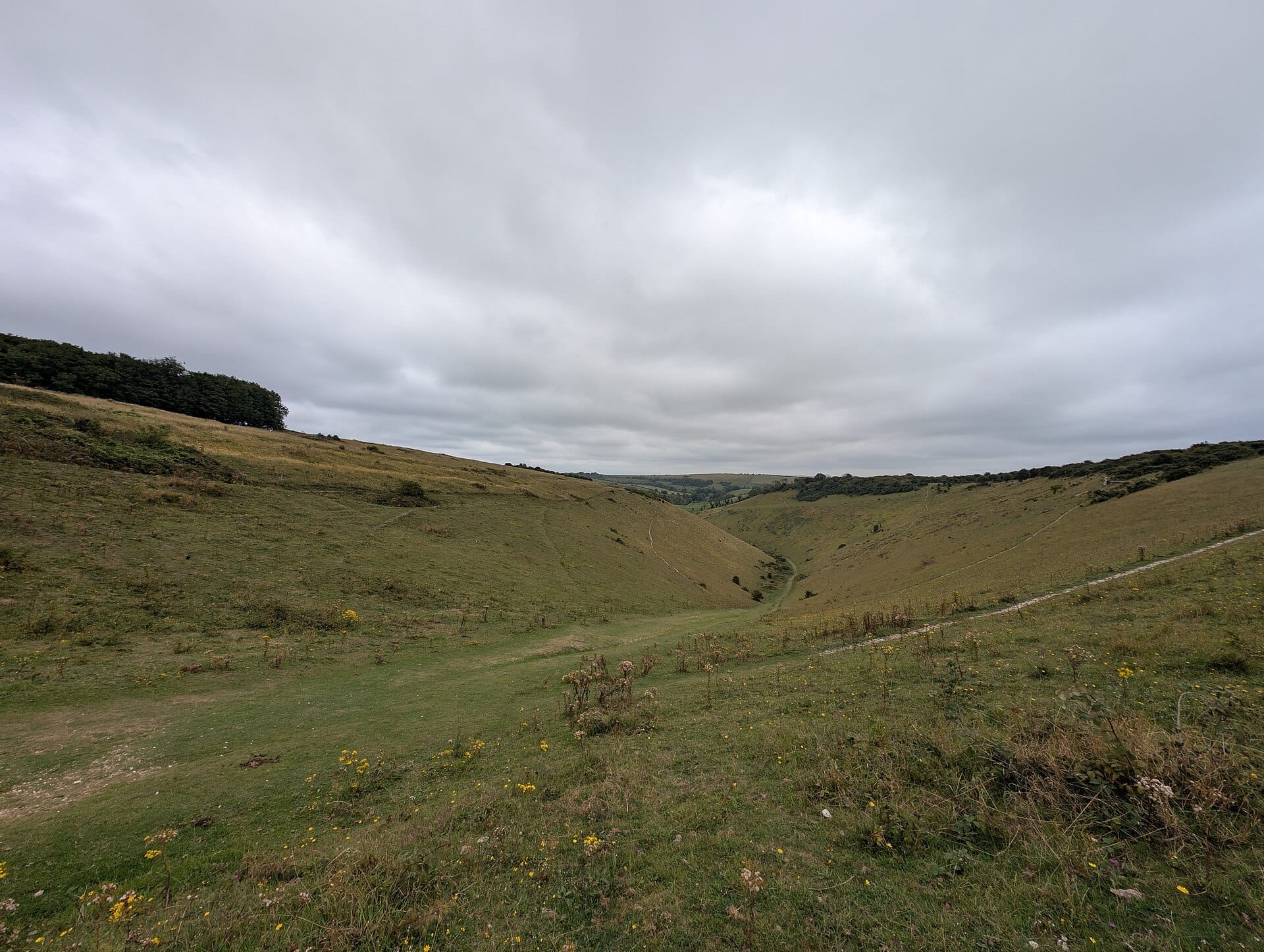
Devil's Dyke is a dry valley on the South Downs, approximately 5 miles north of Brighton city centre, managed by the National Trust. The valley is around 1 kilometre (0.6 miles) long and is described as the longest, deepest and widest dry valley in Britain. At its hilltop edge, you stand at roughly 215 metres (705 feet) above sea level, with the land falling sharply away on the northern flank in a way that takes most first-time visitors by surprise.
Geologically, the valley formed through periglacial erosion during the last Ice Age, around 20,000 years ago, when frozen ground prevented water from draining normally and seasonal meltwater carved the chalk hillside. The result is a deep, smooth-sided trough that cuts dramatically into the Downs, its sides steep enough to make the walk down and back genuinely challenging. There is no river here now: the valley is completely dry, its formation visible as a quirk of the landscape rather than an ongoing process.
Despite the rugged surroundings, this is not a remote wilderness experience. There is a pub, the Devil's Dyke, sitting right at the top of the valley with a car park alongside it. The site fits neatly into a visit to the South Downs National Park, and the viewpoint itself is only a short walk from the car park, meaning it draws a very wide mix of visitors.
💡 Local tip
National Trust members park free here when they scan their membership card. If you are planning several National Trust visits during a UK trip, membership may offset costs quickly.
The View: What You Actually See
The view north from the hilltop is the main event, and it earns its reputation. On a clear day the panorama takes in the Surrey Hills, the Weald, and on exceptional days glimpses of the North Downs, with patchwork farmland rolling out beneath you in a way that feels quite unlike the city you left behind 20 minutes ago. The sky dominates here: the Downs have no tree canopy at the summit, so you get the full arc of weather from every direction.
To the south, the English Channel appears as a silver-grey band beyond the rooftops of Hove and Brighton. On summer mornings when mist still sits in the Weald below, the hilltop can feel elevated above the whole landscape in a way that photographs rarely capture accurately. The light shifts meaningfully across the day: morning sun catches the eastern chalk faces of the valley while evening light turns the north-facing slopes warm, making late afternoon one of the more rewarding times for photography.
The interior of the valley itself reads differently. Looking down into it from the rim, you see steep chalk grassland slopes with the narrow floor below. Descend into it and the panoramic views disappear, replaced by an enclosed, quieter atmosphere where the wind drops and the scale of the chalk walls becomes apparent. This is where the walk repays the effort.
Tickets & tours
Hand-picked options from our booking partner. Prices are indicative; availability and final rates are confirmed when you complete your booking.
Brighton city lights flight with welcome drink
From 21 €Instant confirmationCycle along the beachfront with Brighton Beach Bikes hire
From 7 €Instant confirmationFree cancellationTour Brighton's highlights with an exploration game mobile app
From 10 €Instant confirmationFree cancellationExplore Brighton self-guided walking tour using an app
From 11 €Instant confirmation
When to Visit and How the Experience Changes
Spring and early summer bring out the chalk grassland wildflowers that make the slopes botanically interesting: the thin chalky soil supports plants that cannot survive on richer ground, and the grassland has a fine, slightly hazy texture rather than the lush green of lowland fields. Skylarks are audible from spring through summer, sometimes in numbers that feel incongruous this close to a city of nearly 300,000 people.
Summer weekends are busy, particularly in the afternoon. The car park fills early on sunny Bank Holidays and the pub terrace becomes crowded. If you are coming specifically for the walking rather than the view from the car park, arriving before 10am puts you well ahead of the peak. Weekday mornings in June or July, with the dew still on the grass and the light still low, are when the site is at its best for the fewest people.
Winter is genuinely underrated here. The Downs in December or January are largely empty, and the views north over bare farmland can be stark and impressive. The chalk paths become slippery when wet, and the wind on the exposed hilltop is unfiltered: temperatures at the summit feel several degrees colder than in Brighton below, and wind chill is a real factor. Come prepared with a proper jacket regardless of what the city-level forecast says.
⚠️ What to skip
The valley slopes are steep and the chalk paths turn slick after rain. Proper footwear with grip is essential if you plan to descend into the valley rather than staying on the ridge. Sandals or flat-soled shoes are a poor choice on a wet day.
Victorian Tourism and a Surprising History
Devil's Dyke was one of the most visited leisure sites in Victorian England, and this history is easy to overlook when you are standing on what now feels like open countryside. In its late 19th and early 20th century heyday, the hilltop supported a hotel, a funicular railway descending into the valley, a cable car crossing the valley (an early public cable car, installed in 1894), and a steep gradient railway up from Poynings village. Brighton day-trippers arrived in their thousands.
All of those structures are gone. The cable car closed in 1909, the funicular shut not long after, and the railway line that served the hilltop from Brighton closed in 1939. What remains is the landscape itself, the pub building (which has older origins), and the earthwork of an Iron Age hill fort at the valley's northern end. The fort dates from around the first millennium BC, predating the Victorian tourist era by more than two thousand years, and its ramparts are still faintly visible as low ridges in the grass.
This layering of history, from prehistoric settlement to Victorian entertainment complex to National Trust countryside site, gives the place more depth than a casual visit suggests. If you find this kind of landscape archaeology interesting, it pairs well with other Sussex sites managed for similar reasons. The story of Brighton's architectural and cultural development across the same period adds useful context.
Walking Routes and What to Expect Underfoot
The South Downs National Park describes a circular walk from the car park that descends into the valley, follows the valley floor, and climbs back via the opposing slope. The route is not long, but the gradient is significant in both directions, and the chalk and flint surface underfoot requires attention. Allow at least 90 minutes for a proper loop that includes time in the valley, rather than just a walk to the rim and back.
For those wanting a longer walk, the South Downs Way long-distance path runs along the ridge and can be followed east toward Fulking or west toward Truleigh Hill without retracing your steps. This suits walkers who have arranged a return bus or a car shuttle. The ridge walking is largely on well-maintained chalk track and is less technically demanding than the valley descent, offering sustained views throughout.
Visitors with limited mobility should know that the viewpoint at the valley rim is reachable from the car park without significant gradient, making the key view accessible even if the valley descent is not possible. The valley interior itself is not accessible without managing steep, uneven ground.
ℹ️ Good to know
Printed walk leaflets for Devil's Dyke circular routes are sometimes available at the National Trust car park. The South Downs National Park also publishes route information online at southdowns.gov.uk.
Getting There from Brighton
By bus, the Brighton & Hove Breeze Bus service runs to Devil's Dyke from Brighton city centre during the warmer months. The Breeze Buses are seasonal services designed specifically to connect urban Brighton with countryside destinations on the Downs; check Brighton & Hove Buses for current routes, timetables and fares before travelling, as schedules vary year to year. By car, Devil's Dyke Road runs directly north from the city and the National Trust car park sits adjacent to the pub at the top.
Brighton railway station, served by Southern and Thameslink trains, is the arrival point for visitors coming from London and the wider south-east. The train journey from London Gatwick Airport to Brighton typically takes around 30 minutes. From Brighton station, the Breeze Bus or a taxi connects you to the Dyke. For more on navigating the city once you arrive, the guide to getting around Brighton covers bus, rail and walking options in detail.
Photography, Kite Flying, and Other Practical Details
The hilltop is a known spot for kite flying and paragliding: the reliable westerly winds that cross the Downs make the ridge a good location for both, and on weekend afternoons you will often see kites overhead and occasionally paragliders launching from the slopes. For photographers, the ridge gives unobstructed horizons in almost every direction, with the valley itself providing foreground interest if you position along the rim. A wide-angle lens rewards you here; the channel-to-Weald panorama is genuinely difficult to compress into a standard field of view.
Dogs are welcome at Devil's Dyke, and it is a popular destination for dog walkers from Brighton throughout the year. There are no formal catering facilities beyond the pub, so if you are planning a picnic rather than a pub lunch, bring what you need from the city. The Brighton food scene includes plenty of options for assembling a good picnic before you head north.
Insider Tips
- The Breeze Bus is the most enjoyable way to arrive: it drops you at the top without the stress of parking on a busy summer day, and the ride itself gives you a feel for how quickly the landscape changes from city to open countryside.
- For the best light, visit on a late afternoon in autumn when the sun is low and north-facing. The chalk grassland glows in a way that mid-summer midday light completely flattens.
- The Iron Age hill fort earthworks at the north end of the valley are easy to miss because they are subtle: look for low, rounded ridges in the turf to the north of the main viewpoint. Most visitors walk straight past them.
- If the weather is clear, look due south from the rim. On the right day you can see individual buildings along the Brighton seafront and trace the line of the coast into Worthing. The Brighton i360 observation tower is immediately identifiable as a vertical spike.
- Avoid peak arrival times of 11am to 2pm on sunny Bank Holiday weekends. The car park queues can back up along Devil's Dyke Road, and the viewpoint area becomes crowded enough to take away from the sense of open space.
Who Is Devil's Dyke For?
- Walkers wanting a proper half-day outing from Brighton with significant gradient and chalk grassland terrain
- Families with children old enough to manage uneven slopes and who will enjoy the open space and kite-flying
- Photographers looking for wide panoramic views and good morning or evening light on the Downs
- Dog owners wanting a large, open area away from the seafront crowds
- Anyone curious about Sussex geology, prehistoric history, or the Victorian tourist trade
Nearby Attractions
Combine your visit with:
- Booth Museum of Natural History
Founded in 1874 by naturalist Edward Thomas Booth, the Booth Museum of Natural History is Brighton's free natural history collection housed in a Grade II listed Victorian building on Dyke Road. With over 525,000 specimens, from British birds to butterfly drawers and dinosaur bones, it is one of the most significant natural history collections in southern England. Note: closed to the public since 20 April 2025 for essential works; special event days only, with reopening targeted for later 2026 or early 2027.
- Brighton Racecourse
Perched on Whitehawk Hill roughly a mile from the coast, Brighton Racecourse is one of England's most unusual flat racing venues. The horseshoe-shaped track, open from April to October, offers panoramic views across the city and out to the English Channel, alongside a race day atmosphere that ranges from relaxed midweek afternoons to packed summer festivals.
- Preston Manor
Preston Manor is a Grade II* listed historic country house museum in Brighton, open seasonally beside Preston Park. With rooms preserved as they were in 1905 and a history recorded in the Domesday Book, it offers a rare glimpse into upper-middle-class Edwardian life — a world away from the seafront crowds.
- Preston Park
Preston Park is Brighton's largest public park, spanning 63 acres north of the city centre and open every day at no charge. Opened officially in 1883, it offers sports facilities, formal gardens, open lawns, and a rare sense of genuine local life away from the tourist trail.