Shoes on the Danube Bank: Budapest's Most Haunting Memorial
Sixty pairs of cast-iron shoes line the edge of the Danube in central Budapest, marking the spot where Arrow Cross militiamen executed Jewish men, women, and children in 1944–1945. Free to visit at any hour, this outdoor memorial is both a precise piece of historical testimony and one of the most quietly devastating public spaces in Europe.
Quick Facts
- Location
- Id. Antall József rkp., 1054 Budapest (Pest side, about 300 m south of the Hungarian Parliament)
- Getting There
- Kossuth Lajos tér (Metro M2); Tram 2 (Kossuth Lajos tér stop)
- Time Needed
- 20–40 minutes
- Cost
- Free, no ticket required
- Best for
- History travelers, those visiting the Parliament, quiet reflection
What You're Looking At
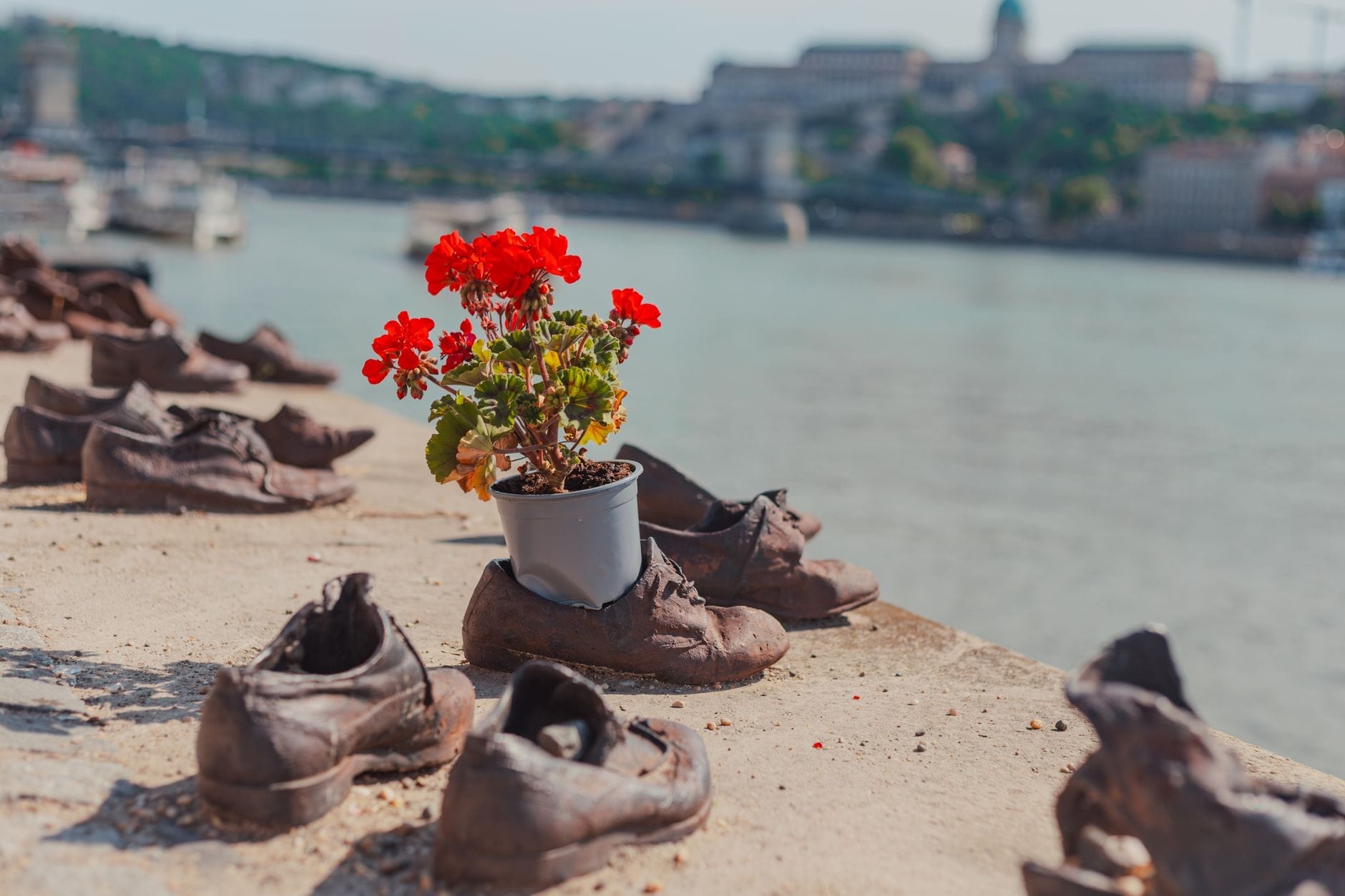
The Shoes on the Danube Bank memorial is a row of 60 pairs of cast-iron shoes fixed directly onto the stone embankment, their toes pointing toward the water. Created by film director Can Togay and sculptor Gyula Pauer, the memorial was unveiled on 16 April 2005. The shoes represent the Jews ordered by Arrow Cross militiamen to remove their footwear before being shot into the Danube during the winter of 1944 to 1945. Shoes had real value in wartime; killing people barefoot meant their shoes could be taken and sold.
The selection of shoe types is deliberate and specific: men's lace-up dress shoes, women's heels, children's small boots, a baby's rounded shoe. Cast in iron rather than softer material, they carry weight literally and symbolically. The surface oxidation gives them a rust-brown patina that makes them look aged, almost excavated from the ground itself. They are bolted close to the water's edge, which means at certain water levels the Danube laps only centimeters below them.
ℹ️ Good to know
The memorial is located on the Pest-side embankment, roughly halfway between the Chain Bridge and Margaret Bridge, about 300 metres south of the Hungarian Parliament building. It sits at the base of the riverfront promenade, one level below the main road. Look for the steps leading down to the lower walkway.
The Historical Context
Budapest's Jewish community numbered around 200,000 in 1944, the largest surviving Jewish population in occupied Europe at that point in the war. After the German occupation of Hungary in March 1944, mass deportations to Auschwitz-Birkenau began. By October 1944, when the Hungarian fascist Arrow Cross party seized power, a different kind of killing had begun: local militia members dragged people from homes, hospitals, and forced-labor columns to the riverbank and shot them directly into the Danube. This was improvised murder, carried out without the administrative machinery of the camps.
Estimates of those killed at the Danube in this period range into the tens of thousands across multiple sites in Budapest. The exact location of the memorial, near the parliament building at Id. Antall József rkp., was one such site. For deeper historical context, the Terror Háza museum on Andrássy Avenue documents both the Nazi and Soviet occupations through evidence and testimony, and is a strong companion visit for anyone engaging seriously with this period.
The choice to mark the site with shoes rather than a conventional plaque or statue was conceptually precise. The shoes are not symbolic stand-ins; they are facsimiles of the very objects taken. Standing in front of them, you are not looking at an abstract monument to suffering. You are looking at a recreation of the last thing these people touched.
Tickets & tours
Live prices and dates from our booking partner. If you book, we may earn a commission at no extra cost to you.
Budapest Guided E-Scooter Tour by Night
From 60 €Instant confirmationFree cancellation4 Course Dinner cruise with Operetta and Folk show
From 81 €Instant confirmationFree cancellationBudapest City Sightseeing hop-on hop-off bus tour
From 41 €Instant confirmationFree cancellationOrientation walking tour of Budapest
From 30 €Instant confirmationFree cancellation
How the Experience Changes by Time of Day
The memorial is accessible around the clock, and the hour you visit shapes the experience considerably. In the middle of the day, particularly in summer, the embankment promenade draws tourists, joggers, and locals eating lunch on benches. The area is not quiet. The memorial sits in this ordinary flow of city life, which can feel jarring at first, but is arguably appropriate: these killings happened in full view of a functioning city.
Early morning, before 8am, the promenade is nearly empty. The light is low and flat, the Danube is grey-blue, and the cast-iron shoes have a stillness that is harder to access when tour groups are present. This is the time most visitors who have been before tend to return.
After dark, the shoes are softly lit. The iron catches the ambient glow from the Parliament building across the way, and the effect is stark and minimal. Visiting at night is entirely safe; the embankment is well-trafficked even late in the evening. Some visitors leave flowers, candles, or small stones on and around the shoes, a tradition drawn from Jewish mourning practice. On significant dates, particularly around Holocaust Remembrance Day in late April and on Yom HaShoah, the memorial is often crowded with organized groups and there may be formal ceremonies.
💡 Local tip
If you want to visit without crowds, aim for a weekday morning before 9am, or after 9pm on any evening. Midday in high season (July–August) brings the largest tourist volumes to this stretch of the embankment.
Getting There and Walking the Embankment
The most direct route is to take Metro M2 to Kossuth Lajos tér, exit toward the Danube, and walk south along the embankment for roughly 5 minutes. Tram 2, one of the most scenic tram routes in the city, also stops at Kossuth Lajos tér and runs directly along the Pest riverfront. The memorial is at street level on the lower embankment walkway, below the road. There are steps down at several points; look for the walkway running alongside the water.
The stretch of riverfront here is worth walking in both directions. To the north, the Hungarian Parliament Building dominates the skyline with its neo-Gothic spires. To the south, the Chain Bridge frames the view toward Buda Castle on the opposite bank. This section of the Danube embankment carries a density of historical and architectural significance that few European waterfronts match.
⚠️ What to skip
The lower embankment walkway can be slippery when wet, and occasionally floods during high water periods, making the memorial temporarily inaccessible. Check local conditions if you are visiting after heavy rain or in early spring when snowmelt raises river levels.
Photography and Practical Considerations
The shoes photograph well in almost any light, but the most effective images tend to come from a low angle, crouching down to shoot along the row with the river and the Buda hills in the background. Wide-angle lenses capture the full sequence of 60 pairs; a tighter focal length on a single shoe, especially a child's, tends to produce more affecting images. Avoid shooting when large groups are standing directly in front of the shoes; the composition loses all its space.
There is no barrier between visitors and the memorial. People crouch beside the shoes, reach out to touch them, place objects on them. The iron surface, given its location at the water's edge, is often damp and sometimes slick with moss at the base. Wear shoes with some grip if you are walking the lower embankment in wet weather. There are no facilities, no staff, no ticket booth, no audio guide. What you bring to this place, you bring yourself.
Accessibility to the lower walkway depends on the steps. There is no dedicated ramp access at the immediate memorial site, though the upper promenade level is accessible via standard paved paths. Visitors with mobility considerations should check current conditions, as the embankment infrastructure does change.
Placing It in a Broader Budapest Itinerary
The Shoes on the Danube Bank works well as part of a half-day on the Pest riverfront. Combine it with the exterior or interior of the Parliament, a walk down to the Chain Bridge, and, if your schedule allows, a tram ride south along the Danube. For those building a Holocaust-focused day in Budapest, the Great Synagogue on Dohány Street is the logical next stop, about 15 minutes on foot or one tram stop, and its adjacent memorial garden and Jewish Museum provide significant additional historical depth.
If you are working through a broader Budapest history itinerary, the Budapest history guide covers the full arc from Roman Aquincum through the Ottoman period, the Habsburg era, and the 20th century in a way that gives the Danube memorial its proper context. Visiting without that background is still meaningful, but with it, the significance of what you are looking at sharpens considerably.
Who Should Know Before Going
This is not an attraction in the conventional sense and it does not perform like one. There is no audio, no exhibition, no interpretive signage beyond a modest marker. Visitors who need narrative scaffolding to engage with a site may find it underwhelming. Those who expect the weight of the place to be explained to them will leave unsatisfied.
Families with young children can visit; many do. Whether to explain what the memorial represents is a parenting decision, not one the site makes for you. The memorial is not graphic. But it is unambiguous about what it marks, and children old enough to understand absence and loss will understand this.
Visitors with no particular interest in 20th-century European history or the Holocaust may find the memorial passes quickly without registering its full significance. That is an honest limitation of outdoor memorials with minimal interpretation. Coming prepared, even with 10 minutes of reading beforehand, changes the experience substantially.
Insider Tips
- Bring something small to leave if you wish to mark your visit: a stone, a flower, a candle. The practice of leaving objects on the shoes is ongoing and observed; it is not an intrusion.
- The memorial is easier to photograph from the water-level perspective, so crouch low and shoot along the row toward the Parliament to get the most striking composition.
- Visit on a weekday between October and April for the fewest crowds and the most sober atmosphere. Summer midday is the worst time for quiet reflection.
- Tram 2 is one of the most scenic public transit routes in Budapest and runs along the Pest embankment near the memorial; board it at Kossuth Lajos tér and ride south toward the Chain Bridge to see the whole Pest embankment from river level.
- Yom HaShoah (Holocaust Remembrance Day) typically falls in late April or early May. The memorial hosts organized commemorations on this date; check the date annually if you want to attend or avoid a crowd.
Who Is Shoes on the Danube Bank For?
- Travelers with a serious interest in 20th-century European history and the Holocaust
- Those combining a visit with the Hungarian Parliament Building and the Danube embankment walk
- Visitors building a Budapest history day alongside the Great Synagogue and Terror Háza
- Photographers looking for a distinctive, rarely-replicated composition on the Danube
- Anyone seeking a moment of genuine quiet in a city with a very full itinerary
Nearby Attractions
Other things to see while in Pest City Center (V. District):
- Central Market Hall (Nagy Vásárcsarnok)
The Central Market Hall, known locally as Nagy Vásárcsarnok, is Budapest's largest historic covered market hall. Built in 1897 to a design by architect Samu Petz, it fills three floors with fresh produce, Hungarian specialties, folk crafts, and street food. Entry is free, and it sits steps from the Liberty Bridge in the heart of Pest.
- Chain Bridge (Széchenyi Lánchíd)
The Széchenyi Chain Bridge (Széchenyi lánchíd) is one of the oldest and most recognizable bridges in Budapest, linking the historic Pest riverfront with the foot of Castle Hill. Free to cross at any hour, it rewards visitors with sweeping Danube views and a walk through 175 years of Hungarian history.
- Hungarian National Museum
The Hungarian National Museum is the oldest national history museum in Hungary, tracing the country's story from prehistoric times through the 20th century. Housed in a commanding neoclassical building from 1847, it anchors Budapest's Pest district and offers one of the most complete windows into Hungarian identity available to visitors.
- Hungarian Parliament Building
Rising from the Pest bank of the Danube in a symphony of Gothic spires and terracotta stone, the Hungarian Parliament Building is the defining landmark of Budapest. Built between 1885 and 1904, it houses the Holy Crown of Hungary and opens its gilded interior to guided tours on most days. This guide covers everything you need to visit well.
Planning a trip? Discover personalized activities with the Nomado app.