Schönbrunn Palace Gardens: Vienna's Royal Parkland
Covering 120 hectares in Vienna's 13th district, the Schönbrunn Palace Gardens are one of Europe's finest surviving Baroque landscapes. Free to enter year-round, the park offers fountains, clipped hedgerows, hilltop monuments, and a UNESCO-listed setting that rewards both a quick stroll and a half-day exploration.
Quick Facts
- Location
- Schönbrunner Schloßstraße 47, 1130 Vienna (13th district)
- Getting There
- U4 line to Schönbrunn station, then 5-minute walk
- Time Needed
- 1.5 to 3 hours for the gardens alone; half-day if combining palace interior
- Cost
- Park entry free; ticketed extras include the Maze, Zoo, Palm House, and Privy Garden
- Best for
- Morning walkers, architecture lovers, families, photography
- Official website
- www.schoenbrunn.at
What the Gardens Actually Are
The Schönbrunner Schlosspark, the formal name of the Schönbrunn Palace Gardens, is a 120-hectare Baroque park that stretches roughly 1.2 kilometres east to west and about one kilometre north to south behind the Schönbrunn Palace. Opened to the public around 1779 under Emperor Joseph II, it has served as Vienna's most ceremonial green space for nearly two and a half centuries. In 1996, the palace and gardens were jointly inscribed as a UNESCO World Heritage Site, recognising both the architectural composition and the extraordinary state of preservation of the landscape design.
The gardens are managed by Bundesgärten, the federal authority responsible for Austria's imperial parks. Entry to the main park is free of charge during all opening hours, which makes it one of the most significant free attractions in Vienna. Several enclosed garden areas and attractions within the grounds, including the Maze and Labyrinth, the Privy Garden (Kronprinzengarten), the Orangery Garden, the Palm House, and the Zoo, charge separate admission.
ℹ️ Good to know
Free entry applies to the main park only. The Maze, Zoo, Palm House, Privy Garden, and Desert House each require a separate ticket. Check current prices at schoenbrunn.at before visiting, as they are updated seasonally.
The Layout: How the Park Is Organised
The gardens are structured around a clear central axis that runs from the palace facade uphill to the Gloriette, the triumphal arcade that crowns the ridge above the park. This axis is flanked by symmetrically planted parterre beds, low clipped hedges, and gravel paths. The effect is deliberately theatrical: standing at the palace terrace, the Gloriette appears to float above the greenery on the hillside, framing the view in a way that feels calculated to impress. It was.
The path to the Gloriette takes roughly 15 to 20 minutes of steady uphill walking from the palace. At the summit, the panorama opens across the entire park below, with the palace in the foreground and Vienna's roofline extending to the east. On clear days, the spire of St. Stephen's Cathedral is visible. The walk itself passes the Neptune Fountain, one of the park's largest sculptural features, positioned at the base of the slope.
To either side of the main axis, the park spreads into quieter zones. The western section contains the Tiergarten Schönbrunn, one of the world's oldest zoos, established in 1752. The eastern side holds the Kronprinzengarten (Privy Garden), a more intimate walled garden historically reserved for the imperial family. The Orangery and the Palm House, a 19th-century iron and glass structure housing tropical plants, sit closer to the palace complex itself.
Tickets & tours
Hand-picked options from our booking partner. Prices are indicative; availability and final rates are confirmed when you complete your booking.
Skip-the-Line Entrance with Guide to Schonbrunn Palace and Gardens
From 45 €Instant confirmationFree cancellationSchonbrunn Palace and gardens guided tour
From 43 €Instant confirmationFree cancellationSkip-the-Line Schonbrunn Palace and Gardens with Guide in Italian
From 53 €Instant confirmationFree cancellationSkip-the-Line Schonbrunn Palace and Gardens with Guide in French
From 53 €Instant confirmationFree cancellation
How the Gardens Change by Time of Day
Early morning, roughly between 6:30 and 8:30, is when the gardens belong to their regular users: Vienna residents on morning runs, dog walkers, older visitors completing their daily walk along the gravel paths. The light in spring and summer is low and angled at this hour, catching the dew on the formal hedgerows and turning the gravel paths amber. Tour groups have not yet arrived. The fountains are often not yet running. It is the quietest and most atmospheric version of the park.
By mid-morning, particularly between 10:00 and 13:00, the character shifts. School groups arrive in organised columns. The main central axis becomes the primary thoroughfare for tour parties moving toward the Gloriette, and the palace-side paths fill quickly. If you are visiting on a weekend between May and September, expect significant crowds along the central promenade. The experience is still worthwhile, but the serenity is gone.
Late afternoon, around 16:00 to 18:00, offers a second quieter window, especially on weekdays. The light from the west angles across the hedgerows and the palace facade takes on a warmer tone. This is also when the gardens feel most like a city park rather than a tourist site: families with children, couples, people sitting on benches reading. The park closes seasonally, so in winter the late afternoon window is very narrow, with gates closing at 17:30.
💡 Local tip
Arrive before 8:30 on summer mornings to photograph the parterre gardens and central axis without crowds. The park opens at 06:30 daily.
Seasonal Opening Hours
- November to February: 06:30 to 17:30
- March: 06:30 to 19:00
- April: 06:30 to 20:00
- May to July: 06:30 to 21:00
- August to September: 06:30 to 20:00
- October: 06:30 to 19:00
These are gate closing times for the main park. Individual attractions within the gardens (Zoo, Palm House, Maze) operate their own hours, which are shorter and vary by season. The Hietzinger Tor on Maxingstraße provides an alternative entrance to the park on the western side, useful if you are combining a visit with the Zoo or coming from the Hietzing U4 station.
What to See Inside the Gardens
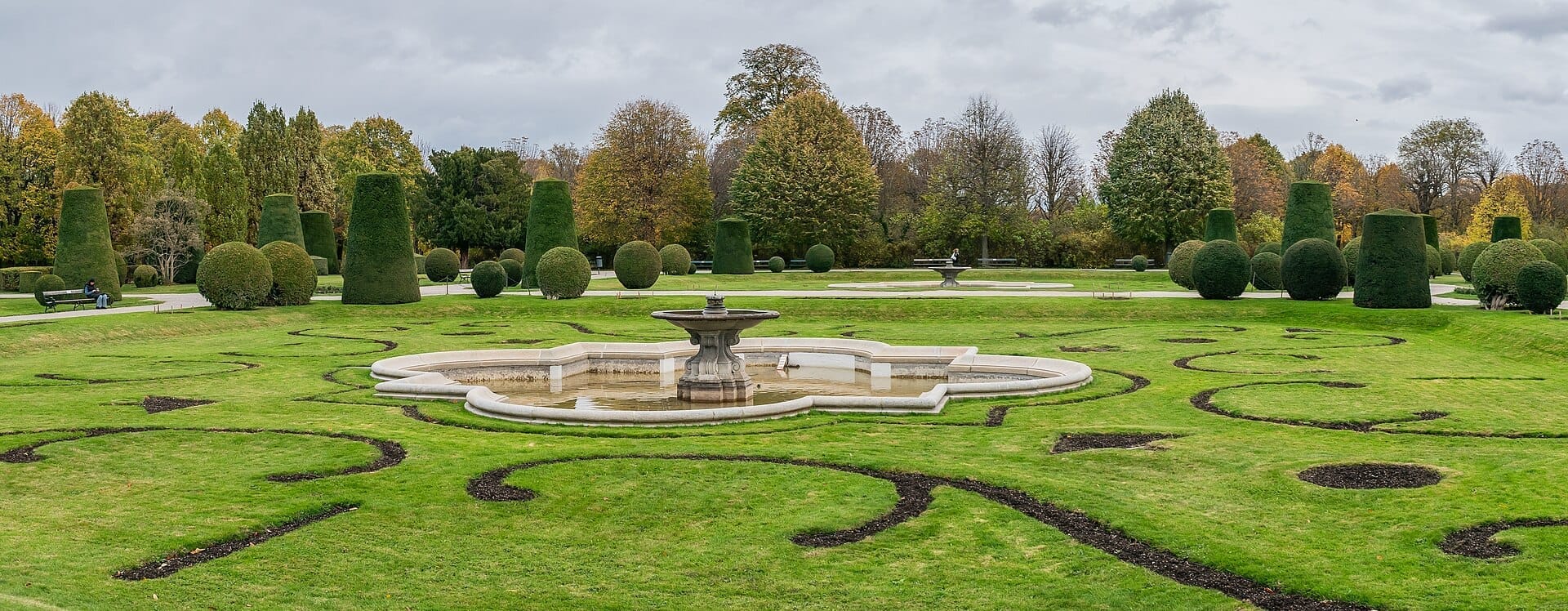
The central parterre, the flat formal garden area directly behind the palace, is the most photographed zone. The geometric flower beds are maintained with seasonal plantings and are most colourful in late spring and early summer. Flanking the parterre are long hedgerow corridors, tall enough to create shaded alleys, where you can walk in relative cool even on hot days. Vienna's summers regularly reach above 30°C, and these corridors provide genuine relief. For more on planning around Vienna's heat, see the guide to visiting Vienna in summer.
The Tiergarten Schönbrunn, founded in 1752 as an imperial menagerie, is often considered the world's oldest continuously operating zoo. It sits in the western section of the park and requires a separate admission ticket. Families with children tend to spend two to three hours here. The zoo's historic baroque pavilion at its centre is architecturally notable even if you are not visiting the animals.
The Palm House (Palmenhaus) is a large Victorian-era glasshouse built between 1880 and 1882 and contains over 4,000 tropical and subtropical plant species. It is worth the separate admission on a rainy day or in winter, when the contrast between the cold park and the warm, humid interior is particularly striking. The adjacent Desert House focuses on arid-climate plants and is smaller but similarly atmospheric.
The Maze and Labyrinth, located north of the main axis near the Hietzinger Tor entrance, is aimed primarily at children and families. It is genuinely entertaining for younger visitors and not particularly challenging for adults, but the surrounding hedge garden includes areas for games and is well-maintained.
Getting There and Moving Around
The most direct route from central Vienna is the U4 metro line to the Schönbrunn station. From the station exit, the main palace gate is approximately a five-minute walk. The U4 also stops at Hietzing, one stop further west, which is closer to the Hietzinger Tor entrance and the Zoo. If you are planning to combine the gardens with other sites in the 13th district or the Belvedere, check the Vienna public transport guide for the best routing.
Within the park, the gravel paths are wide and level on the lower sections near the palace. The slope up to the Gloriette is moderate, not steep, but the surface is loose gravel, which makes it uncomfortable in heeled shoes or sandals without ankle support. The full climb takes 15 to 20 minutes at a walking pace. Paved routes and ramped access are available for visitors with mobility considerations; the Bundesgärten website provides current accessibility information.
⚠️ What to skip
The paths to the Gloriette are unpaved gravel on a slope. Visitors with limited mobility or those pushing strollers will find the climb difficult. The lower parterre gardens are flat and largely accessible.
Historical and Cultural Context
The gardens at Schönbrunn evolved over roughly a century, shaped most decisively under Empress Maria Theresa in the mid-18th century and her son Joseph II, who opened the park to the public in 1779. The layout follows French Baroque principles of strict geometry and axial symmetry, though later romantic additions softened some sections. The palace and gardens together are inseparable from the history of the Habsburg dynasty, which ruled the Austrian Empire until 1918. For the broader story of this dynasty and how it shaped Vienna's urban form, the Habsburg imperial history guide provides useful context.
The Schönbrunn Palace itself, separate from the gardens, requires paid admission. The palace interiors, state rooms, and the Sisi Museum devoted to Empress Elisabeth are major draws in their own right. The Schönbrunn Palace page covers ticketing, tour options, and what to prioritise inside.
The UNESCO inscription in 1996 recognised the ensemble as an outstanding example of the Baroque Gesamtkunstwerk, the concept of a total artwork, in which architecture, garden design, sculpture, and landscape are unified into a single composition. Walking the gardens with this framing in mind, rather than simply ticking the Gloriette view off a list, produces a more rewarding experience.
Photography Notes
The classic shot, palace facade from the central parterre, is best in morning light when the sun is behind the photographer (coming from the east). By mid-morning the palace faces into shadow from this angle as the sun moves. The reverse view, from the Gloriette looking down over the park and palace, works well in the afternoon when the palace facade catches the western light. In winter, when the trees are bare, the geometric structure of the gardens becomes more visible and the Gloriette stands out more starkly against the sky.
Drone photography is not permitted in the park without prior authorisation from Bundesgärten. Standard photography for personal use is unrestricted in the open garden areas. Interior spaces such as the Palm House have their own photography rules; check at entry.
Insider Tips
- The Kronprinzengarten (Privy Garden), tucked behind a wall on the eastern side of the park, is rarely mentioned in guidebooks. It is smaller and more intimate than the main parterre, and usually far less crowded. Check current ticket availability on the official site.
- If visiting in summer and planning to climb to the Gloriette, bring water. There are no drinking fountains on the uphill path, and the snack kiosk at the top operates seasonally with limited hours.
- The Hietzinger Tor entrance on Maxingstraße is significantly less busy than the main palace-side entrance and puts you closer to the Maze, the Zoo, and the Palm House. Use the Hietzing U4 station rather than Schönbrunn station if these are your priorities.
- In winter, the lower park is often dusted with frost or light snow and is nearly empty by 09:00. The combination of the snow-covered parterre and the baroque hedgerows is one of Vienna's most underrated visual experiences. Dress warmly; the open park is cold and windier than the surrounding streets.
- The park is a legitimate running circuit for locals. The outer perimeter path is roughly 3.5 kilometres and largely flat. Morning runners will find it well-used but not overcrowded before 08:00.
Who Is Schönbrunn Palace Gardens For?
- Early risers and photographers who want grand Baroque scenery without the tour-group density
- Families combining the free gardens with the ticketed Zoo or Maze for a full half-day
- Architecture and history enthusiasts studying the Habsburg legacy in situ
- Visitors seeking free, high-quality green space in a city where most major attractions charge admission
- Winter visitors looking for a serene, frost-covered landscape rarely seen in travel photography
Nearby Attractions
Other things to see while in Schönbrunn & Hietzing (13th District):
- Imperial Carriage Museum (Kaiserliche Wagenburg)
Housed within the grounds of Schönbrunn Palace, the Imperial Carriage Museum preserves around 170 vehicles once used by Habsburg emperors and empresses. From gilded coronation coaches to simple children's sleighs, the collection offers a concrete, often surprising window into court life across four centuries of Austrian imperial history.
- Lainzer Tiergarten
Covering 24.5 square kilometres on Vienna's western fringe, the Lainzer Tiergarten is a walled nature reserve where wild boar roam ancient oak forests and the Habsburg Hermesvilla rises unexpectedly from the trees. Entry is free, the crowds are thin, and the silence is genuine.
- Palmenhaus Schönbrunn
Built for Emperor Franz Joseph in 1882, the Palmenhaus Schönbrunn is one of Europe's largest and most architecturally striking glasshouses. Stretching 111 metres across the Schönbrunn Palace Gardens, it shelters tropical and subtropical plants beneath nearly 5,000 square metres of glass. Whether you visit in summer heat or winter chill, the interior world it contains feels genuinely removed from the city outside.
- Schönbrunn Gloriette
Perched on the ridge above Schönbrunn Palace, the Gloriette is a triumphal colonnade built in 1775 that offers the widest, most unobstructed panorama over central Vienna. You earn the view with a climb up 76 steps, and the reward is a rooftop terrace that stretches the full width of the structure. It is the visual anchor of the entire Schönbrunn estate.