Lainzer Tiergarten: Vienna's Wild Forest Reserve You Can Walk Into for Free
Covering 24.5 square kilometres on Vienna's western fringe, the Lainzer Tiergarten is a walled nature reserve where wild boar roam ancient oak forests and the Habsburg Hermesvilla rises unexpectedly from the trees. Entry is free, the crowds are thin, and the silence is genuine.
Quick Facts
- Location
- Lainzer Tor, Hermesstraße, 1130 Wien (13th district, Hietzing)
- Getting There
- U4 to Hietzing, then bus 56B to Lainzer Tor; or tram 60/62 to Speising/Hermesstraße then bus 56B
- Time Needed
- 2 to 5 hours depending on route and pace
- Cost
- Free entry to the reserve; Hermesvilla has a separate admission fee
- Best for
- Hikers, families, wildlife watchers, anyone wanting genuine urban escape
- Official website
- www.wien.gv.at/freizeit/lainzer-tiergarten
What the Lainzer Tiergarten Actually Is
The Lainzer Tiergarten is a protected nature reserve and former imperial hunting ground covering 24.5 square kilometres in Vienna's 13th district. Roughly 80 percent of that area is forested, mostly with oak and beech. The whole reserve is enclosed within a 25-kilometre stone wall, a boundary the Habsburgs built in 1781 to keep game in and poachers out. Today, that wall keeps the 21st century at a respectful distance.
The reserve originated in 1561 under Emperor Maximilian II, who fenced off this tract of Vienna Woods for imperial hunts. For nearly four centuries it was closed to the public. Since 1919, it has been open to all, free of charge, and it remains one of the largest protected natural areas within any European capital city.
ℹ️ Good to know
Entry is free at all gates. The reserve is open daily from 8:00, with hours extending to 21:00 until at least 26 July 2026. Check the City of Vienna's official page for current seasonal hours before you go, as gate times and facility schedules can vary.
The Experience on the Ground
Step through the Lainzer Tor on a weekday morning and the contrast with the rest of Vienna is immediate. The traffic noise drops away within a few hundred metres. The path surfaces shift from pavement to compacted earth to leaf litter. In autumn, the smell of damp oak leaves is strong enough to stop you mid-stride. In early summer, the meadow clearings hold a particular stillness that feels borrowed from somewhere much further from a city of two million people.
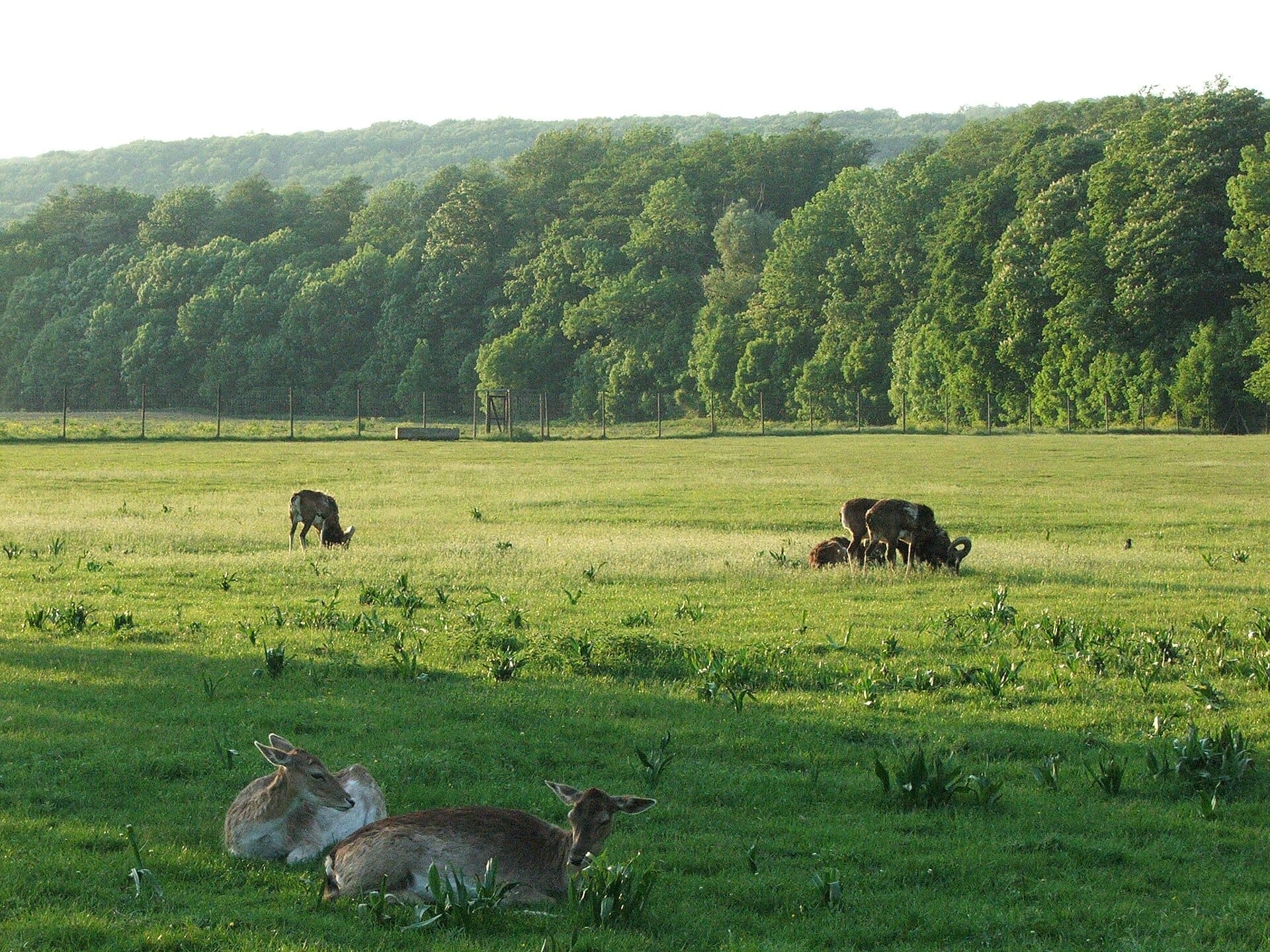
Wild boar are the reserve's most famous residents. Sightings are common, particularly in the early morning and around dusk, when groups of sows and juveniles move through the undergrowth parallel to the main paths. Red deer and mouflon sheep also roam freely. This is not a zoo arrangement: the animals are genuinely wild, and official signage asks visitors to keep a respectful distance and never feed them. Parents with small children should be aware that boar with young can behave defensively if approached.
⚠️ What to skip
Wild boar in the Lainzer Tiergarten are not tame. Keep at least 30 metres of distance, never feed them, and do not place yourself between a sow and her piglets. Dogs must be kept on a lead throughout the reserve.
The trail network is extensive. Paths range from broad, flat gravel promenades suitable for pushchairs to steep, root-crossed forest tracks that require proper footwear. Most visitors arriving at the Lainzer Tor follow the main path toward the Hermesvilla, a 45-minute walk through forest that opens onto a manicured lawn in front of the villa. Longer loops take in the Kaltbründlberg and Rohrhaus meadow areas, where the views back toward Vienna's skyline are particularly clear in autumn when the leaf canopy thins.
Tickets & tours
Hand-picked options from our booking partner. Prices are indicative; availability and final rates are confirmed when you complete your booking.
Imperial Vienna 72-hour hop-on hop-off bus
From 55 €Instant confirmationFree cancellationSkip-the-Line Entrance with Guide to Schonbrunn Palace and Gardens
From 45 €Instant confirmationFree cancellationLuggage Storage in Vienna
From 6 €Instant confirmationFree cancellationStrauss Dinner Show
From 99 €Instant confirmationFree cancellation
The Hermesvilla: An Imperial Retreat in the Trees
At the centre of the reserve stands the Hermesvilla, a late 19th-century imperial hunting lodge commissioned by Emperor Franz Joseph I as a gift to Empress Elisabeth, known as Sisi. The villa was completed in 1886 and designed by Karl von Hasenauer, the same architect behind the Kunsthistorisches Museum and the Naturhistorisches Museum on the Ringstrasse. It is a compact but elaborately decorated building, its interior featuring ceiling paintings by Hans Makart and Gustav Klimt.
The Hermesvilla now operates as a branch of the Wien Museum and hosts changing historical exhibitions alongside the permanent display of imperial interiors. Admission is charged separately from reserve entry. If you have an interest in Habsburg history or Klimt's early work, it is worth factoring into your visit. For more on Vienna's Habsburg legacy, the Habsburg imperial history guide provides useful context before you arrive.
How the Reserve Changes Through the Day and Seasons
Early mornings, particularly on weekdays, offer the reserve at its quietest. The gates open at 8:00, and for the first two hours the paths belong almost entirely to local dog walkers and joggers who know the trails by heart. Wildlife is most active in this window. By 10:00 on a weekend, families with children begin arriving in numbers at the Lainzer Tor, and the main path to the Hermesvilla sees steady foot traffic through midday.
Spring and autumn are the most rewarding seasons for the forest itself. In April and May, the understorey flowers and the light through new beech leaves is almost luminous. October brings the deer rut, and the distant sound of stags calling through the trees is something that genuine city parks simply cannot offer. Summer is comfortable in the forest shade even on hot days, though the meadow sections become dry and the wildlife retreats deeper into the woods. Winter is quieter still: the leaf-off forest reveals the stone wall in sections, and frost on the paths requires solid footwear.
💡 Local tip
Visit on a weekday in October for the best combination of manageable crowds, autumn colour, and the possibility of hearing or seeing red deer during the rut. Wear waterproof shoes regardless of the forecast: forest paths stay damp.
Getting There and Moving Around
The most straightforward approach uses U4 to Hietzing station, then bus 56B directly to the Lainzer Tor stop. The journey from central Vienna takes around 25 to 30 minutes. Tram 60 or 62 to the Speising / Hermesstraße stop connects to the same bus 56B for those coming from the Mariahilfer Strasse corridor. There is limited parking near the main gate for those arriving by car, but public transport is consistently easier.
The reserve has six open gates: Lainzer Tor, Gütenbachtor, Pulverstampftor, Nikolaitor, St. Veiter Tor, and Laaber Tor. The Lainzer Tor is the main visitor entry point and the most convenient for first-time visitors. Arriving at a secondary gate is an option for those combining the Tiergarten with a walk through the surrounding Wienerwald, Vienna's broader wooded hills that extend beyond the reserve wall.
The internal paths are not universally signposted, and the reserve is large enough to cause genuine disorientation. Download a trail map from the City of Vienna's official site before arriving, or pick up a printed version at the Lainzer Tor gate house. Mobile signal is inconsistent in the denser sections of the forest.
Accessibility Considerations
The main path between the Lainzer Tor and the Hermesvilla is broad and relatively level, and is manageable with a robust pushchair. Beyond this central route, many paths are unpaved and uneven. The City of Vienna does not publish detailed wheelchair accessibility information for the trail network as a whole, so visitors with mobility requirements should plan to stay on the primary route and contact the City of Vienna parks authority for specific current information before visiting.
Photography and Practical Logistics
The reserve photographs best in the two hours after opening: low-angle morning light cuts through the oak canopy along the main path, and the meadow clearings around the Hermesvilla hold mist on cool mornings. Wildlife photography requires patience and silence rather than specialized equipment; boar and deer tend to appear near the path edges in the first hour of the day. The Hermesvilla lawn, with the building's late-19th-century facade framed by old trees, is the most composed shot in the reserve.
There are no convenience stores inside the reserve. A kiosk near the Hermesvilla is open seasonally. Bring water and food for anything beyond a short loop. The nearest cafes are back in Hietzing, a few minutes from the U4 station, in a neighbourhood that also serves as a quiet residential contrast to the more tourist-heavy parts of Vienna.
If you are planning a full day in this part of Vienna, Schönbrunn Palace and its grounds are accessible from Hietzing U4 in the opposite direction, making it straightforward to combine both in a single itinerary. The Tiergarten Schönbrunn, Vienna's zoo within the Schönbrunn complex, is a completely different experience but suits families who want guaranteed animal sightings without the uncertainty of a wild reserve.
Honest Assessment: Who This Is For, and Who Should Reconsider
The Lainzer Tiergarten rewards visitors who want actual nature rather than a manicured city park. The wildlife is real, the forest is extensive, and the absence of entry fees removes any pressure to perform the visit at speed. It is not an attraction in the conventional sense: there are no queues, no audio guides, no gift shop at the exit. What it offers is space, quiet, and the specific pleasure of a large animal appearing unexpectedly from the undergrowth.
Travellers with only one or two days in Vienna and a list of cultural highlights to cover should probably prioritise the city's museums and palaces first. The Lainzer Tiergarten is most valuable for visitors who already have the standard itinerary covered, or who are staying long enough to want a day that feels nothing like the Innere Stadt. It also suits return visitors to Vienna who have done the palace circuit and want to see the city from a different angle, quite literally, from the wooded hillsides to its west.
Anyone expecting a zoo-style guaranteed wildlife encounter may leave disappointed: the animals move on their own schedule and have 24.5 square kilometres to do so. Winter visits without warm, waterproof layers are uncomfortable. If weather is poor, the paths become muddy and the forest loses most of its visual appeal.
Insider Tips
- Enter through the Gütenbachtor or Pulverstampftor on weekends if you want to avoid the family crowds that concentrate around the main Lainzer Tor. These secondary gates see a fraction of the foot traffic and lead into equally good forest.
- The Rohrhaus meadow, accessible on a longer loop from the Lainzer Tor, is the best open viewpoint in the reserve with clear sight lines back toward the Vienna skyline. It takes about 90 minutes to reach from the gate at a comfortable pace.
- Boar sightings are most reliable in the 30 minutes after the 8:00 opening, especially on weekday mornings. Arrive at the gate slightly before opening and walk slowly and quietly along the main path's edges rather than the centre.
- The Hermesvilla's Klimt ceiling paintings are relatively early works and not widely publicised. If you visit the villa, the bedroom ceiling is the detail most worth lingering over.
- Download the City of Vienna's official PDF trail map before you arrive. The in-reserve signage at path junctions is sparse, and mobile data for live mapping is unreliable in the interior sections of the forest.
Who Is Lainzer Tiergarten For?
- Hikers and trail walkers who want genuine woodland rather than a groomed park circuit
- Families with children interested in seeing wild animals in a natural setting
- Photographers looking for forest light, wildlife, and an imperial villa with serious architectural character
- Repeat visitors to Vienna who have covered the main cultural sites and want contrast
- Anyone visiting in autumn who wants to experience the deer rut in a Vienna city context
Nearby Attractions
Other things to see while in Schönbrunn & Hietzing (13th District):
- Imperial Carriage Museum (Kaiserliche Wagenburg)
Housed within the grounds of Schönbrunn Palace, the Imperial Carriage Museum preserves around 170 vehicles once used by Habsburg emperors and empresses. From gilded coronation coaches to simple children's sleighs, the collection offers a concrete, often surprising window into court life across four centuries of Austrian imperial history.
- Palmenhaus Schönbrunn
Built for Emperor Franz Joseph in 1882, the Palmenhaus Schönbrunn is one of Europe's largest and most architecturally striking glasshouses. Stretching 111 metres across the Schönbrunn Palace Gardens, it shelters tropical and subtropical plants beneath nearly 5,000 square metres of glass. Whether you visit in summer heat or winter chill, the interior world it contains feels genuinely removed from the city outside.
- Schönbrunn Gloriette
Perched on the ridge above Schönbrunn Palace, the Gloriette is a triumphal colonnade built in 1775 that offers the widest, most unobstructed panorama over central Vienna. You earn the view with a climb up 76 steps, and the reward is a rooftop terrace that stretches the full width of the structure. It is the visual anchor of the entire Schönbrunn estate.
- Schönbrunn Palace
Schönbrunn Palace is Vienna's most visited historic site and one of Europe's finest examples of Baroque architecture. With 1,441 rooms, 120 hectares of free gardens, and centuries of Habsburg history layered into every room, it rewards both a quick morning visit and a full day of exploration.