Schönbrunn Palace: Vienna's Imperial Baroque Landmark
Schönbrunn Palace is Vienna's most visited historic site and one of Europe's finest examples of Baroque architecture. With 1,441 rooms, 120 hectares of free gardens, and centuries of Habsburg history layered into every room, it rewards both a quick morning visit and a full day of exploration.
Quick Facts
- Location
- Schönbrunner Schloßstraße 47, 1130 Vienna (Schönbrunn-Area, 13th District)
- Getting There
- U4 to Schönbrunn (approx. 7-min walk to main entrance); U4/U6 to Hietzing also nearby
- Time Needed
- 2–5 hours depending on tour type and garden exploration
- Cost
- Palace tours from €18 (Imperial Tour) to €26+ (Grand Tour); palace park entry free. Prices vary — verify at schoenbrunn.at before visiting.
- Best for
- History lovers, architecture enthusiasts, families, and first-time visitors to Vienna
- Official website
- www.schoenbrunn.at/en
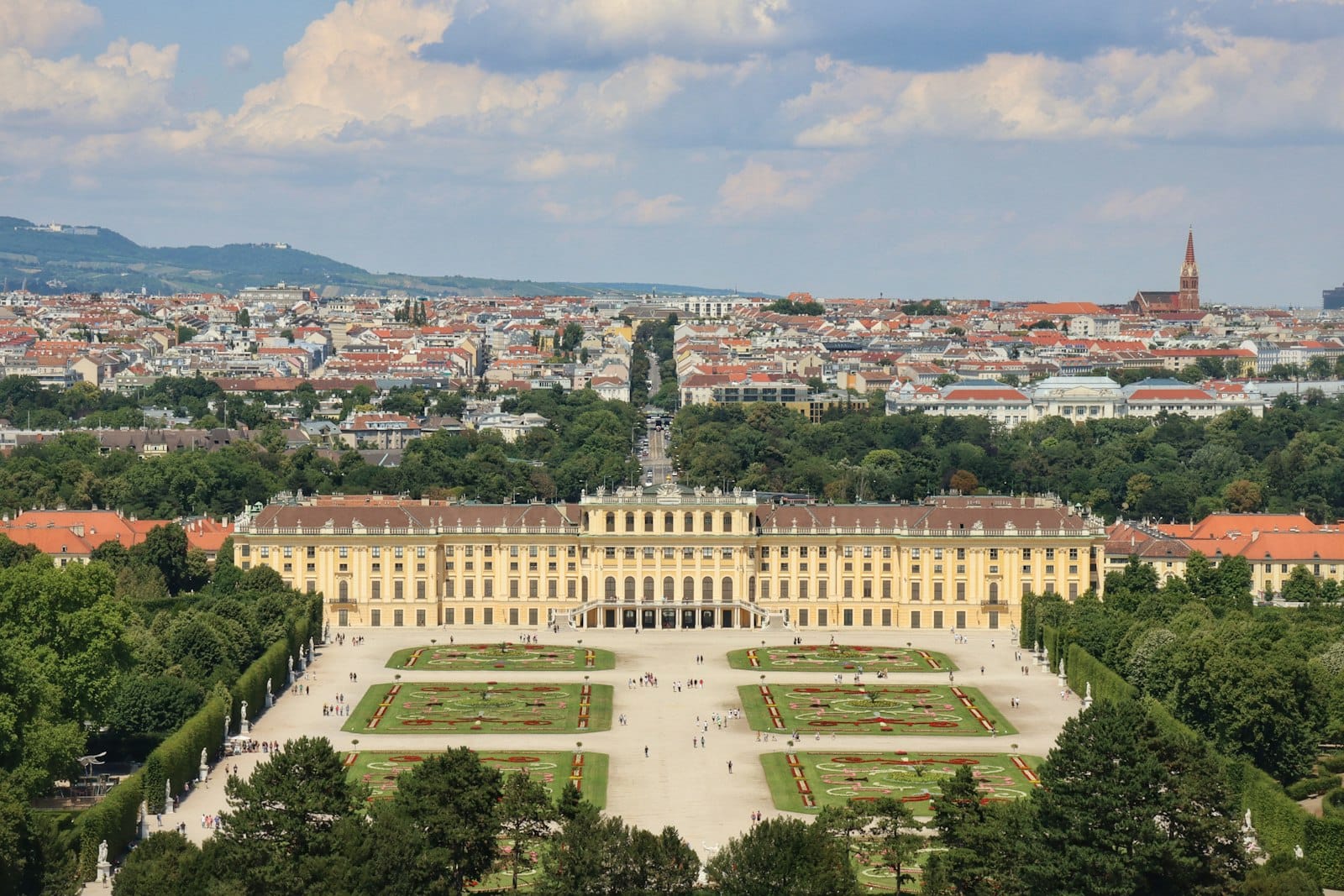
What Schönbrunn Palace Actually Is
Schönbrunn Palace, or Schloss Schönbrunn in German, is the former summer residence of the Habsburg imperial family and the largest palace in Austria. It sits in Vienna's 13th district, about 4 kilometres southwest of the city centre, surrounded by 120 hectares of formal Baroque gardens that remain free to enter any day of the year. The palace itself contains 1,441 rooms, of which roughly 45 are open to the public as part of guided or audio-guided tours.
This is not a roped-off relic behind glass. Schönbrunn is a working cultural institution with an active concert programme, a world-class zoo on the grounds, a palm house, a maze, an imperial carriage museum, and one of Vienna's best elevated viewpoints at the Gloriette. Visiting the palace building is just one option inside a much larger complex.
ℹ️ Good to know
The palace park is open daily from around 06:30 and is free of charge. If you only want the gardens and Gloriette views, you can visit without buying any ticket at all. Many Vienna residents do exactly this on weekend mornings.
A Brief History Worth Knowing Before You Go
The estate's origins trace back to the 14th century under the name Katterburg. The name Schönbrunn, meaning 'beautiful spring,' first appeared in records in 1642, attached to a pleasure palace built by Eleonore von Gonzaga. The Baroque complex visitors see today began taking shape in 1696, but the palace reached its current form primarily after 1743 under Empress Maria Theresa, who transformed it into the political and cultural centrepiece of the Habsburg Empire.
Maria Theresa's imprint is everywhere: the distinctive ochre-yellow facade, the formal French-style garden layout, and the interiors that shift between Rococo exuberance and Habsburg pragmatism. The palace hosted Napoleon twice as a military headquarters, and the six-year-old Mozart performed here for Maria Theresa in 1762. Emperor Franz Joseph I, who ruled Austria for 68 years, was born here in 1830 and died here in 1916. The end of the Habsburg dynasty was signed at Schönbrunn in November 1918, when Emperor Karl I renounced participation in state affairs, effectively ending over 600 years of Habsburg rule.
For the broader imperial story across Vienna, the Vienna Habsburgs imperial history guide provides essential context that makes a Schönbrunn visit considerably more meaningful.
Tickets & tours
Hand-picked options from our booking partner. Prices are indicative; availability and final rates are confirmed when you complete your booking.
Skip-the-Line Entrance with Guide to Schonbrunn Palace and Gardens
From 45 €Instant confirmationFree cancellationSchonbrunn Palace and gardens guided tour
From 43 €Instant confirmationFree cancellationClassic Vienna guided bike tour
From 47 €Instant confirmationFree cancellationSelf-guided grand tour of Schonbrunn Palace entrance ticket
From 45 €Instant confirmation
Inside the Palace: What You Actually See
Tickets are sold as the Imperial Tour (22 rooms) or the Grand Tour (45 rooms), both with audio guides included. The rooms span a wide stylistic range: the Hall of Mirrors where Mozart played, the Chinese Cabinets decorated with lacquered panels and porcelain, the Great Gallery used for imperial banquets, and the comparatively austere bedroom and study of Franz Joseph I, which tells its own story about the emperor's famously spartan personal habits despite ruling from one of Europe's most opulent palaces.
The pacing of the tour is comfortable. Rooms are numbered and the audio guide tracks your location. Crowds can compress into bottlenecks in the most famous rooms, particularly the Hall of Mirrors and the Great Gallery, where tour groups tend to pause longest. Morning visits between 08:30 and 10:00 are noticeably less congested. By 11:00, particularly on summer weekends, the entrance queues and interior corridors fill substantially.
💡 Local tip
Book tickets online in advance at schoenbrunn.at. Walk-up queues at the ticket hall can add 30–45 minutes during peak summer months. Pre-booked tickets allow you to go directly to the entrance gates.
Palace opening hours are generally 08:30 to 18:00 daily, though these vary seasonally. Always verify current hours on the official site before your visit, as hours shorten during winter months.
The Gardens: The Part Most Visitors Underestimate
The 120-hectare park behind the palace is the real surprise for first-time visitors who treat the gardens as an afterthought. The formal parterre directly behind the palace is a carpet of geometric hedgerows and seasonal flower beds stretching toward the central fountain, with the Gloriette colonnade visible on the hill above. Early morning, before 09:00, the park is almost silent. Joggers circle the gravel paths. The sound is mostly birds and gravel underfoot. By contrast, a summer afternoon here feels like a public park in full use, with families, school groups, and tourists all sharing the space.
The Schönbrunn Palace Gardens deserve their own planning time. The Gloriette, perched at the top of the hill behind the palace, offers one of the clearest panoramic views over Vienna's rooftop skyline, and there is a café inside if you want to sit with that view. The Neptune Fountain, the Obelisk Fountain, and the Roman Ruin folly are all worth seeking out rather than sticking only to the main axis.
The Crown Prince Garden and the Orangery Garden charge separate admission. The Maze and Labyrinth section is a genuine draw for families with children. The park is open from around 06:30 daily, closing at approximately 21:00 in peak season, with earlier closing times in winter.
How the Experience Changes by Time of Day and Season
Mornings before 10:00 are categorically the best time to visit the palace interior. The light through the tall windows falls across the parquet floors at a low angle, the audio guides are easier to hear without crowd noise, and the sense of space in rooms like the Great Gallery is intact. After midday, particularly from June through August, the palace becomes genuinely crowded and the sensory experience shifts from contemplative to logistical.
In winter, the atmosphere changes entirely. The gardens are bare but still formally beautiful, and the palace interior feels more intimate with fewer visitors. Schönbrunn hosts a popular Christmas market in the palace forecourt from mid-November through late December, with mulled wine, roasted chestnuts, and craft stalls set against the illuminated yellow facade. This is one of Vienna's more atmospheric seasonal markets.
Spring and early autumn represent the most comfortable visiting conditions: moderate temperatures, the gardens in seasonal colour, and shorter queues. For a broader sense of when to time your trip, the best time to visit Vienna guide covers seasonal trade-offs across the city.
⚠️ What to skip
Summer afternoons in the palace can feel warm and close, especially in rooms without direct ventilation. If you are sensitive to heat, visit in the morning or choose a cooler day. The gardens provide shade primarily in the wooded upper sections near the Gloriette hill.
Other Attractions Within the Schönbrunn Estate
The Tiergarten Schönbrunn, founded in 1752, is the world's oldest continuously operating zoo and is located at the western end of the estate. It requires a separate ticket but integrates naturally into a full-day visit. The Palmenhaus (Palm House) is a striking iron-and-glass greenhouse from 1882 containing tropical plants, and the adjacent Desert House covers arid ecosystems. Both charge separate admission and are operated by the same estate management.
The Imperial Carriage Museum (Kaiserliche Wagenburg) sits at the east end of the estate and holds one of Europe's finest collections of historic royal carriages, including the coronation coach of Charles VI. It is a quieter alternative if the main palace is at peak capacity.
The Schönbrunn Gloriette at the top of the garden hill is viewable for free from the outside. Paying to go up to the roof terrace provides a marginally better angle, but the view from the base of the colonnade is already excellent and free.
Practical Details and Getting There
The U4 metro line stops at Schönbrunn station, which is approximately a 7-minute walk to the main palace entrance. Alternatively, Hietzing station (served by both U4 and U6) is at the side gate of the park, which some visitors find more convenient depending on their itinerary. Trams and buses also serve the surrounding streets. The estate is large enough that entering from different gates affects how you experience the grounds, so it is worth looking at a map before arriving.
Accessibility provisions include lift access to parts of the palace and barrier-free routes through portions of the gardens. The official site provides an accessibility section with specific information, and the palace recommends contacting them in advance for visitors with particular mobility requirements, as not all sections of a historic building of this scale can be made fully accessible.
If Schönbrunn is part of a longer Vienna stay, it pairs logically with the Upper Belvedere on the same day or the following one, since both are imperial properties with significant art collections and formal gardens. For families planning the full day, the Vienna with kids guide includes specific Schönbrunn planning advice alongside the zoo and maze.
Who Should Reconsider and Honest Caveats
Schönbrunn is genuinely impressive, but it can disappoint visitors expecting an intimate or under-the-radar experience. On a summer afternoon, the forecourt and main courtyard feel like a large airport during boarding: organized but very busy. The audio guide tour through 22 or 45 rooms is well-produced but moves at the pace of the slowest group in the corridor. If you have already visited several major European palaces, notably Versailles or the Peterhof, you may find the interior familiar in format if different in detail.
Visitors with limited mobility should be aware that the gardens involve significant uneven gravel paths and gradients, particularly toward the Gloriette. The palace interior is more manageable with the available lifts, but the sheer size of the estate means considerable walking regardless of which sections you choose.
Insider Tips
- The palace grounds are at their most atmospheric in the hour after opening at 06:30. Joggers, dog walkers, and almost no tourists. The main paths are fully accessible and the light on the facade at this hour is excellent for photography.
- The Neptune Fountain and the Roman Ruin folly in the upper park are rarely crowded even at peak times. Most visitors stick to the central garden axis and miss these entirely.
- If you plan to visit the zoo, the Palm House, and the palace in one day, buy the combination ticket in advance. The individual admissions add up quickly, and the combination ticket offers better value. Verify current combination ticket options at schoenbrunn.at before visiting.
- The café inside the Gloriette colonnade is significantly less crowded than the cafés near the palace entrance. It is also the only place on the estate where you can sit down with an unobstructed view over the city skyline while having coffee.
- The Christmas market in the palace forecourt (typically mid-November to late December) runs into evening hours, when the yellow palace facade is lit up and the atmosphere is considerably more pleasant than the daytime crowds suggest.
Who Is Schönbrunn Palace For?
- First-time visitors to Vienna who want a single site that captures the depth of Habsburg imperial history
- Families with children, given the zoo, maze, and large open grounds for movement between ticketed attractions
- Architecture and garden design enthusiasts who want a complete Baroque ensemble rather than just a building
- Visitors in Vienna for Christmas who want a market with genuine visual drama behind it
- Early risers who want to experience one of Europe's grand palaces without the usual crowds
Nearby Attractions
Other things to see while in Schönbrunn & Hietzing (13th District):
- Imperial Carriage Museum (Kaiserliche Wagenburg)
Housed within the grounds of Schönbrunn Palace, the Imperial Carriage Museum preserves around 170 vehicles once used by Habsburg emperors and empresses. From gilded coronation coaches to simple children's sleighs, the collection offers a concrete, often surprising window into court life across four centuries of Austrian imperial history.
- Lainzer Tiergarten
Covering 24.5 square kilometres on Vienna's western fringe, the Lainzer Tiergarten is a walled nature reserve where wild boar roam ancient oak forests and the Habsburg Hermesvilla rises unexpectedly from the trees. Entry is free, the crowds are thin, and the silence is genuine.
- Palmenhaus Schönbrunn
Built for Emperor Franz Joseph in 1882, the Palmenhaus Schönbrunn is one of Europe's largest and most architecturally striking glasshouses. Stretching 111 metres across the Schönbrunn Palace Gardens, it shelters tropical and subtropical plants beneath nearly 5,000 square metres of glass. Whether you visit in summer heat or winter chill, the interior world it contains feels genuinely removed from the city outside.
- Schönbrunn Gloriette
Perched on the ridge above Schönbrunn Palace, the Gloriette is a triumphal colonnade built in 1775 that offers the widest, most unobstructed panorama over central Vienna. You earn the view with a climb up 76 steps, and the reward is a rooftop terrace that stretches the full width of the structure. It is the visual anchor of the entire Schönbrunn estate.