Schönbrunn Gloriette: The Hilltop Colonnade with Vienna at Your Feet
Perched on the ridge above Schönbrunn Palace, the Gloriette is a triumphal colonnade built in 1775 that offers the widest, most unobstructed panorama over central Vienna. You earn the view with a climb up 76 steps, and the reward is a rooftop terrace that stretches the full width of the structure. It is the visual anchor of the entire Schönbrunn estate.
Quick Facts
- Location
- Schönbrunner Schlossstraße, 1130 Wien, Austria — on the hilltop ridge behind Schönbrunn Palace
- Getting There
- U4 Schloss Schönbrunn; tram lines 10 and 60; bus 10A — all stop at Schloss Schönbrunn
- Time Needed
- 45–90 minutes including the walk up from the palace
- Cost
- Rooftop terrace: approx. €15 adults, €10 children (verify current prices before visiting)
- Best for
- Panoramic photography, Habsburg history, outdoor walks, couples, architecture enthusiasts
- Official website
- www.schoenbrunn.at/en
What the Gloriette Actually Is
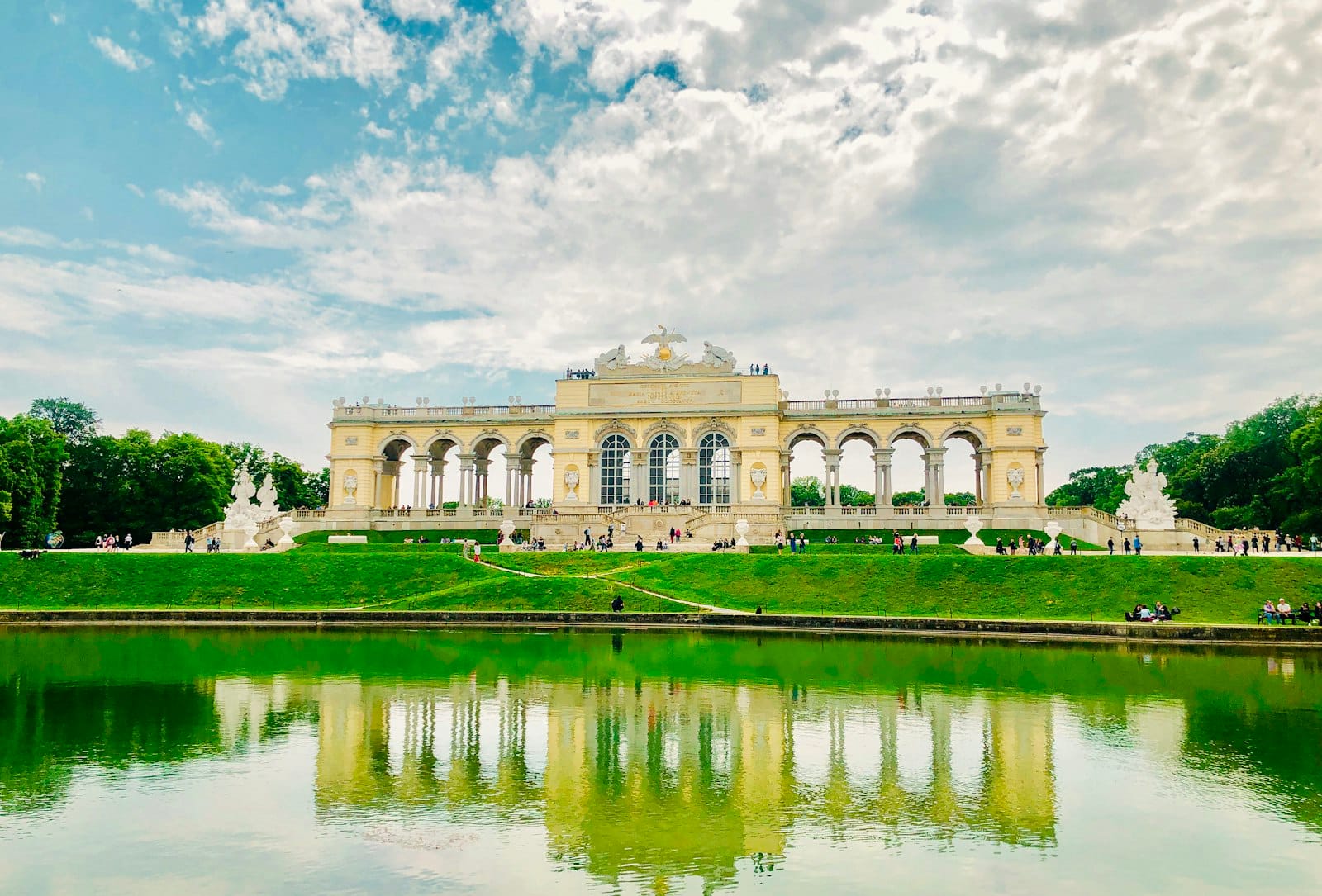
The Gloriette is a ceremonial colonnade completed in 1775 as the crowning feature of the redesigned Schönbrunn palace gardens. It sits on the crest of the hill directly behind the palace, positioned so that the building reads as a formal backdrop when viewed from the palace windows below. In neoclassical terms, it functions as an eye-catcher: a structure designed to give a landscape composition its focal point.
The name comes from the French and Italian traditions of garden architecture, where a 'gloriette' denotes a small ornamental pavilion or open structure set within formal grounds. Vienna's version is grander than most: the full arcade stretches across the hilltop with a central arched hall flanked by symmetrical colonnaded wings. The central section was originally used as a breakfast room and reception space by the imperial family. Eagles carved in stone decorate the parapet, and the entire structure is executed in pale stone that takes on a warm golden tone in afternoon light.
The Gloriette belongs to the broader Schönbrunn estate, which is listed as a UNESCO World Heritage Site. Visitors exploring the palace itself should be aware that the Gloriette requires a separate ticket for the terrace. If you plan to combine it with the palace rooms, the Schönbrunn Palace and Gloriette are best treated as a half-day rather than an hour's visit.
The Walk Up and What You Pass Along the Way
Reaching the Gloriette is part of the experience. From the main palace forecourt, the formal garden stretches uphill in a straight axis: clipped hedges, fountains, gravel paths, and the Neptune Fountain at the base of the slope. The climb from the palace level to the Gloriette takes roughly 10 to 15 minutes at a moderate pace. The incline is steady rather than steep, and the gravel paths are well-maintained.
As you walk up, the palace facade recedes behind you and the scale of the formal garden becomes clear. On clear days, the spire of St. Stephen's Cathedral is visible above the rooftops before you even reach the top. The Schönbrunn Palace Gardens are free to enter, so the walk itself costs nothing. The ticket for the rooftop terrace is purchased at the Gloriette's own ticket office, which involves 25 steps from ground level.
⚠️ What to skip
Accessibility note: The ticket office requires 25 steps from ground level, and the rooftop terrace requires 76 steps total. The terrace doorway is 101 cm wide. There is no lift. A wheelchair-accessible restroom is available approximately 50 metres west in the park. Visitors with significant mobility limitations should consider whether the gardens themselves, viewed from the lower park, offer a satisfactory alternative.
Tickets & tours
Hand-picked options from our booking partner. Prices are indicative; availability and final rates are confirmed when you complete your booking.
Skip-the-Line Entrance with Guide to Schonbrunn Palace and Gardens
From 45 €Instant confirmationFree cancellationSchonbrunn Palace and gardens guided tour
From 43 €Instant confirmationFree cancellationClassic Vienna guided bike tour
From 47 €Instant confirmationFree cancellationSelf-guided grand tour of Schonbrunn Palace entrance ticket
From 45 €Instant confirmation
The Rooftop Terrace: What the View Delivers
The terrace wraps across the full width of the Gloriette's roof and delivers a 180-degree panorama facing north over central Vienna. On a clear day the view extends to the Vienna Woods on the western horizon and, in the opposite direction, to the lowlands stretching toward the Danube. The palace itself sits directly below, framed by its symmetrical garden parterre, and the city spreads out behind it in a density that reveals Vienna's compact, low-rise profile.
The terrace surface is stone and the parapet is low enough to feel open without compromising safety. Photography is excellent in both morning and late afternoon. In the middle of the day, the south-facing stone reflects heat and the light is flat for photography, though the view remains fully clear. On summer afternoons the terrace can become warm with little shade, so water is worth bringing.
There is a café inside the central hall of the Gloriette, which operates during the terrace opening season. It offers a place to sit after the climb and look out through the arcade arches toward the city. The interior is less photogenic than the terrace itself but is a practical rest stop, especially with children.
💡 Local tip
Timing tip: Arrive shortly after opening (09:30) for the clearest light on the palace facade below and the lowest crowd density on the terrace. By 11:00 on summer weekends, the terrace fills quickly with tour groups descending from the upper park.
How the Experience Changes by Time of Day and Season
Morning visits between 09:30 and 10:30 offer the most rewarding combination of light and quiet. The low eastern sun catches the palace facade at an angle that brings out the ochre paint in detail, and the gardens below are sharp and calm. The sound from the city is muted at this hour; the main sounds on the terrace are wind through the colonnade and the distant hiss of the fountains below.
By midday in July and August the upper park draws large numbers of visitors, and the terrace becomes crowded. Groups move quickly and the atmosphere shifts from contemplative to transactional. Late afternoon, from around 16:00 onward, brings the light back into a useful angle and thins the crowds again as tour groups complete their schedules. The gardens in September have the particular quality of warm afternoon light with noticeably smaller crowds than midsummer.
The terrace is open seasonally: from 2 April through 26 October in 2024, with closing times ranging from 16:00 in late October to 18:30 in July and August. The Gloriette does not open in winter months, and the upper park paths can be icy and less maintained between November and March. Always verify the current season's hours before visiting, as these dates shift year to year.
Historical and Architectural Context
The Gloriette was completed in 1775 under Empress Maria Theresa as part of a comprehensive redesign of the Schönbrunn grounds. The choice of the hilltop location was deliberate: by placing the structure at the highest point of the park's central axis, the architects reinforced the visual hierarchy of the entire estate, with the palace at the base and the Gloriette providing the terminus. It was a statement of ordered imperial power expressed through landscape design.
The structure incorporates architectural elements and stone salvaged from the demolished Neugebäude Palace, an earlier Habsburg hunting lodge. This reuse gave the Gloriette a historicist quality even at its creation. The broader Habsburg story, including the personalities who used Schönbrunn across generations, is explored in depth in the Habsburg imperial history guide, which provides useful background before a visit to the estate.
For visitors interested in Vienna's wider legacy of imperial architecture, the Gloriette connects naturally to a broader pattern of monumental construction across the city. The Vienna architecture guide covers how the Habsburg building programme shaped the city's skyline from Schönbrunn to the Ringstrasse.
Practical Walkthrough: Getting There and Planning Your Visit
The most straightforward approach is via U4 to Schloss Schönbrunn station, which places you at the main palace gate within a two-minute walk. Tram lines 10 and 60, and bus 10A, all stop at the same named stop. From the gate, follow the central garden axis uphill: signage within the park is clear. The Hop On Hop Off Yellow Line also stops here for visitors using that format.
Wear comfortable shoes with grip. The gravel paths are uneven in sections, and the steps inside the Gloriette are stone and narrow in places. In wet weather, both the path up and the terrace surface can be slippery. A light layer is worth carrying even on warm days: the terrace is exposed and wind can make it considerably cooler than the gardens below.
Photography from the terrace is unrestricted. A wide-angle lens or the wide setting on a phone camera captures the full sweep of the view, including both the palace and the city skyline. The arched openings of the colonnade make natural frames for portrait shots. There are no designated photography platforms; the entire terrace is usable.
Visitors with more time can combine the Gloriette with a walk through the wider upper park, which includes the Roman Ruin folly and the Obelisk Fountain. Families with children may also want to consider the Tiergarten Schönbrunn, Europe's oldest zoo, which is located within the palace grounds at the western edge of the park.
Who Will Enjoy This and Who Might Not
The Gloriette suits anyone with an interest in the view over Vienna rather than specific museum content. It rewards people willing to walk up from the palace and take their time on the terrace. Architecture enthusiasts will find the colonnade itself worth studying closely. Photographers will get results here that are difficult to replicate anywhere else in the city, because the viewpoint sits above rather than within the urban grid.
Visitors with mobility limitations face real barriers here: the steps are not avoidable and there is no lift. This is worth acknowledging plainly rather than minimizing. The garden paths below the Gloriette are accessible and the view of the structure from the garden level is still worthwhile, but the terrace experience itself is not available to everyone.
Those who are primarily interested in Habsburg interiors, imperial furnishings, or detailed historical exhibitions will find more to engage with inside the palace or at the Sisi Museum in the Hofburg. The Gloriette is architecture and view, not a collection. It does not suit visitors who want to move quickly through a site: the walk up and down accounts for most of the visit, and the terrace rewards standing still more than it rewards rushing.
Insider Tips
- The gardens around the Gloriette are free to enter even when the terrace is closed or out of season. The walk to the top still gives an excellent vantage point from ground level and the structure itself is fully visible without a ticket.
- On overcast days with cloud above the city, the view from the terrace can still be striking: the palace roofline and garden geometry read clearly without harsh shadows, and the city behind takes on a moody, silvery quality that photographs well.
- If you arrive at the base of the garden hill early and walk up the western side path rather than the central axis, you pass the Roman Ruin folly, which most visitors skip entirely. It takes only a few minutes extra and is genuinely unusual: a constructed ruin with a reflecting pool, built as a romantic garden feature.
- The café inside the Gloriette hall opens at the same time as the terrace. In early morning it is often empty and provides a quiet place to sit with coffee while looking through the arcade toward the city before the tour groups arrive.
- Children who have been patient through palace interiors tend to respond well to the open terrace here: the scale, the wind, and the ability to point out recognizable landmarks in the city below make it a tangible reward. Build it in at the end of a Schönbrunn visit rather than the beginning.
Who Is Schönbrunn Gloriette For?
- Photographers seeking Vienna's widest unobstructed city panorama
- Architecture and garden design enthusiasts interested in Habsburg landscape planning
- Couples looking for a scenic open-air destination away from indoor crowds
- Visitors combining a full Schönbrunn estate visit who want a satisfying endpoint to the garden walk
- Travellers on a first visit to Vienna who want geographic orientation over the city
Nearby Attractions
Other things to see while in Schönbrunn & Hietzing (13th District):
- Imperial Carriage Museum (Kaiserliche Wagenburg)
Housed within the grounds of Schönbrunn Palace, the Imperial Carriage Museum preserves around 170 vehicles once used by Habsburg emperors and empresses. From gilded coronation coaches to simple children's sleighs, the collection offers a concrete, often surprising window into court life across four centuries of Austrian imperial history.
- Lainzer Tiergarten
Covering 24.5 square kilometres on Vienna's western fringe, the Lainzer Tiergarten is a walled nature reserve where wild boar roam ancient oak forests and the Habsburg Hermesvilla rises unexpectedly from the trees. Entry is free, the crowds are thin, and the silence is genuine.
- Palmenhaus Schönbrunn
Built for Emperor Franz Joseph in 1882, the Palmenhaus Schönbrunn is one of Europe's largest and most architecturally striking glasshouses. Stretching 111 metres across the Schönbrunn Palace Gardens, it shelters tropical and subtropical plants beneath nearly 5,000 square metres of glass. Whether you visit in summer heat or winter chill, the interior world it contains feels genuinely removed from the city outside.
- Schönbrunn Palace
Schönbrunn Palace is Vienna's most visited historic site and one of Europe's finest examples of Baroque architecture. With 1,441 rooms, 120 hectares of free gardens, and centuries of Habsburg history layered into every room, it rewards both a quick morning visit and a full day of exploration.