Santa Maria sopra Minerva: Rome's Gothic Secret Behind the Pantheon
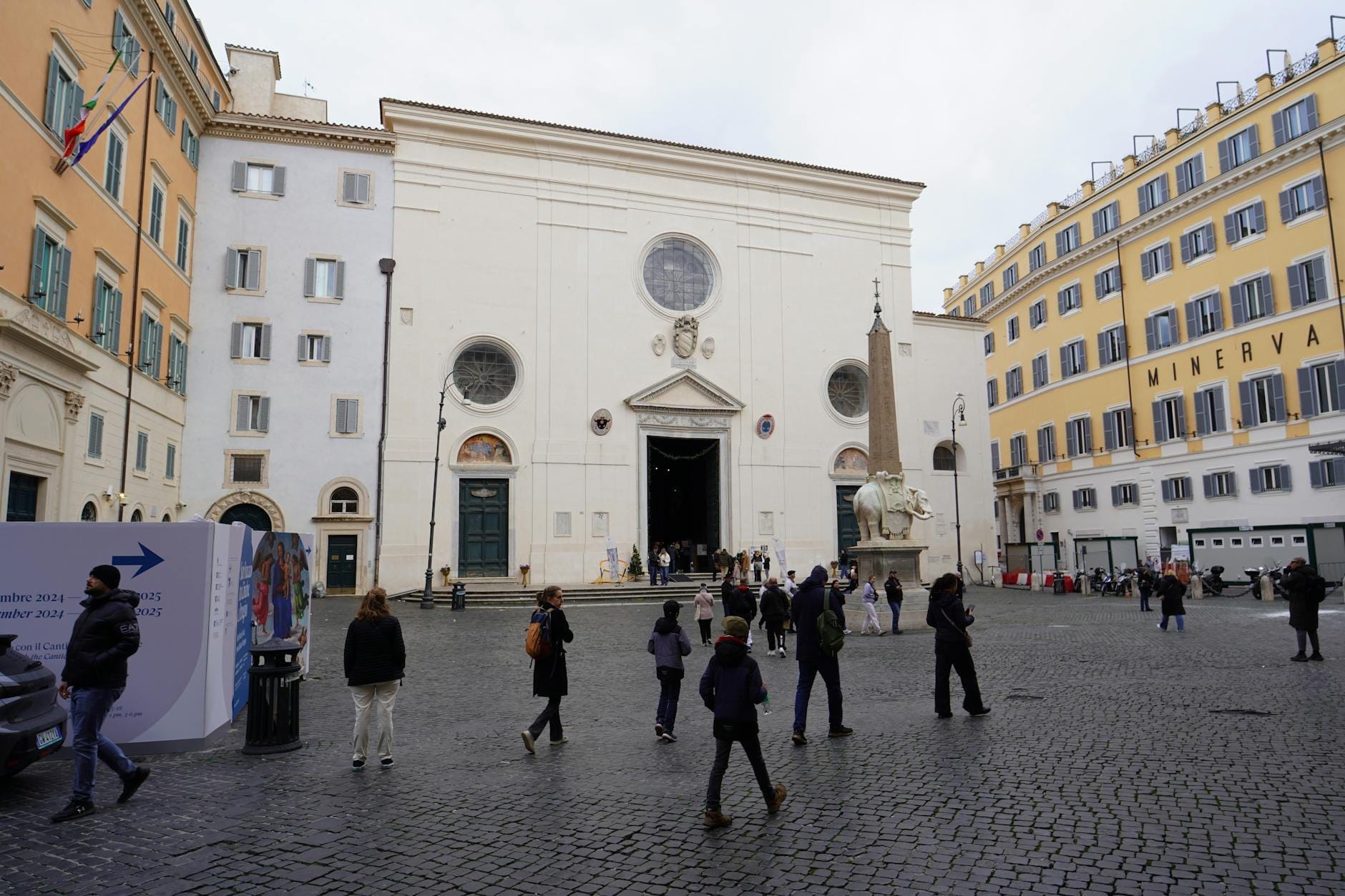
The Basilica di Santa Maria sopra Minerva is Rome's sole surviving Gothic church, built by Dominican friars beginning in the late 13th century (1280) over the ruins of a temple to the Egyptian goddess Isis (long misattributed to Minerva). Inside, it holds Michelangelo's Christ the Redeemer, vivid frescoes by Filippino Lippi, and the tombs of two popes and Fra Angelico. Outside, Bernini's charming elephant obelisk anchors the piazza. Entry is free.
Quick Facts
- Location
- Piazza della Minerva 42, 00186 Rome (Centro Storico, steps from the Pantheon)
- Getting There
- No metro stop nearby; bus lines to Largo Argentina (C3, 40, 46, 62, 64) then 5-min walk
- Time Needed
- 45–75 minutes for a thorough visit
- Cost
- Free entry; bring €0.50–€1 coins for illuminated chapel lighting
- Best for
- Art lovers, history enthusiasts, anyone wanting a calm counterpoint to the Pantheon crowds
- Official website
- www.santamariasopraminerva.it/en
What Makes This Church Worth Your Time
The Basilica di Santa Maria sopra Minerva stands roughly sixty meters from the Pantheon, yet it draws a fraction of the crowd. That contrast is one of the most useful facts about visiting this part of Rome. While thousands queue or press into the Pantheon's rotunda, the Minerva's interior stays genuinely quiet for much of the day, which matters when you are trying to look carefully at a Michelangelo sculpture or read the expression on a Filippino Lippi fresco.
This is not a church that overwhelms you with scale. It is Gothic in structure, which in Rome is a rare thing, and that makes the proportions feel different from the domed baroque interiors that dominate the city. The nave is tall and narrow, with ribbed vaulting painted a deep cobalt blue and scattered with gold stars. The color scheme was a 19th-century restoration decision that not everyone approves of, but it gives the interior a singular character that is unlike anything else in the centro storico.
💡 Local tip
Bring small coins. The chapels along the side aisles are dim, and coin-operated lights (€0.50–€1) illuminate the altarpieces and frescoes properly. Without them, the Lippi frescoes in the Carafa Chapel are hard to read.
History Built in Layers
The church's name explains its location. An early Christian oratory was established here directly above the remains of a temple to the Egyptian goddess Isis (long attributed to Minerva). The site was part of an ancient Roman temple complex in what is now the Piazza della Minerva. The prefix "sopra" in Italian means "above" or "over," so the full name simply acknowledges what is underneath. Archaeological excavations have confirmed the Roman-era foundations beneath the floor.
The current Gothic structure was raised from 1280 onward by Dominican friars—specifically brothers Sixtus and Ristoro—who modeled it on Santa Maria Novella in Florence. It is the only major Gothic church in Rome to have survived without being rebuilt in the baroque style, which is why it occupies a singular position in the city's architectural history. The Dominican order maintained it as an intellectual and spiritual center for centuries. Galileo Galilei appeared before the Inquisition here in 1633, and the great medieval painter Fra Angelico, a Dominican friar himself, is buried in a chapel to the left of the high altar.
The church sits at the heart of what was the administrative and religious center of ancient and medieval Rome. The surrounding Centro Storico still carries that layered quality, where Renaissance palaces stand beside medieval alleys and ancient column drums protrude from street corners.
Tickets & tours
Live prices and dates from our booking partner. If you book, we may earn a commission at no extra cost to you.
Santa Maria Maggiore Dome entrance ticket with downloadable audioguide
From 26 €Instant confirmationFree cancellationBasilica of Santa Maria Maggiore audio tour and skip-the-line ticket
From 15 €Instant confirmationFree cancellationSanta Maria Maggiore Basilica audio guide and Underground entry ticket
From 30 €Instant confirmationFree cancellationSanta Maria Maggiore and panoramic dome entry ticket
From 22 €Instant confirmationFree cancellation
What to Look at Inside
The Carafa Chapel (Right Transept)
This is the visual highlight of the church for most visitors. Cardinal Oliviero Carafa commissioned Filippino Lippi to fresco the chapel walls between 1488 and 1493, and the result is one of the best-preserved Renaissance fresco cycles in Rome. The scenes depict the Annunciation, the Assumption of the Virgin, and episodes from the life of Thomas Aquinas, the Dominican scholar whose theology underpins much of Catholic doctrine. Lippi's figures are expressive and his spatial compositions are confident, mixing Roman architectural backdrops with crowded narrative scenes. The chapel also contains the tomb of Pope Paul IV.
Michelangelo's Christ the Redeemer
To the left of the high altar stands one of Michelangelo's less-discussed sculptures: Cristo Portacroce, or Christ Bearing the Cross, started around 1521. The marble figure shows a nude Christ embracing the cross, his body in a contrapposto stance that reflects Michelangelo's ideal of physical and spiritual beauty in tension. A later bronze loincloth was added for modesty. It is not as celebrated as the Pietà or the Moses, but up close the surface modeling of the torso and the softness of the drapery are worth standing with for a few minutes.
The Tomb of Fra Angelico
The Florentine painter Guido di Pietro, known as Fra Angelico, died in Rome in 1455 and was buried in the church at his own request. His tomb, marked by a simple 15th-century effigy slab, is in the Alessi Chapel to the left of the high altar. Pope John Paul II beatified Fra Angelico in 1982, recognizing him as Beato Angelico. For anyone who has spent time with his altarpieces in Florence or his frescoes in the Vatican, standing at this tomb has a quiet gravity to it.
Papal Tombs and Other Works
The church contains the tombs of two Medici popes: Leo X and Clement VII, both marked by monuments near the high altar. There are also works by Antoniazzo Romano and a remarkable series of funerary monuments distributed throughout the nave chapels. The sheer density of significant art here is something the church's relative obscurity makes easy to overlook.
The Piazza and Bernini's Elephant
Before or after entering the church, pause in the small piazza in front of it. At the center stands one of Bernini's most charming works: a small marble elephant carrying an ancient Egyptian obelisk on its back. The obelisk dates from the 6th century BC and was discovered during excavations near the site. Pope Alexander VII commissioned Bernini to design the base, and the result is a sculpture that balances wit and learning. An inscription on the base, drafted by the pope's librarian, states that a strong mind is needed to support solid wisdom, the elephant being a symbol of strength and intelligence in Renaissance iconography.
The elephant has been nicknamed "Pulcino della Minerva" (the Minerva's chick) by Romans over the centuries. It is modest in scale compared to Bernini's Fontana dei Quattro Fiumi in Piazza Navona, but it rewards close inspection. The detail of the elephant's harness and the confident posture of the animal are easy to miss if you only glance at it in passing.
When to Visit and What to Expect
The church is open most mornings starting at 7:00 AM on weekdays, which makes it one of the few major sights in Rome's historic center accessible before the tourist wave builds. Arriving between 7:30 and 9:00 AM on a weekday means you may have the nave almost to yourself. The early morning light enters from the upper windows and hits the gilded chapels at a low angle, which improves photography considerably.
Midday brings more visitors, particularly tour groups coming directly from the Pantheon. The church gets noticeably more crowded between 10:30 AM and 1:00 PM. If you visit then, the Carafa Chapel can become difficult to view at your own pace. Saturday and Sunday hours are more restricted, with closures during morning masses, so check current times before building your itinerary around a weekend visit.
⚠️ What to skip
Dress code is enforced: shoulders and knees must be covered. This applies year-round. In summer, carry a scarf or light layer if you are wearing sleeveless clothing. Guards at the door do turn visitors away.
If you are planning a longer day in this part of Rome, the church pairs naturally with the Pantheon next door and the Campo de' Fiori a short walk south. The area around Largo Argentina, a few minutes away, also has the remains of four Republican-era temples worth seeing if you are interested in layered Roman history.
Photography and Accessibility
Photography without flash is permitted inside. The main challenge is the low overall light level, especially in the side chapels. A fast lens or a camera that handles high ISO well is an advantage. The coin-operated lights in the chapels do help, though they switch off after a few minutes. Tripods are generally not allowed.
The church is wheelchair and stroller accessible via the main entrance. The floor is mostly even stone pavement with no significant steps inside the nave. The piazza outside is cobblestoned but manageable. There is no audio guide available from the church itself; independent apps or a printed guide from a bookshop nearby can fill that gap.
ℹ️ Good to know
Official hours (verify before visiting): Monday–Friday 7:00 AM–7:00 PM; Saturday 10:30 AM–12:30 PM and 3:30–7:00 PM; Sunday 8:00 AM–12:30 PM and 3:30–7:00 PM. Hours can shift around masses and religious events.
Who Might Want to Skip It
Visitors with very limited time in Rome who have already committed to the Vatican and the Colosseum complex may find the Minerva hard to fit in. It is not the kind of attraction that works on a ten-minute pass-through. To do it justice, you need at least 45 minutes and the patience to let your eyes adjust to the interior light. Anyone primarily interested in panoramic views or open-air Rome will find more to engage them at the Gianicolo Hill or the Pincio Terrace. But for anyone with a genuine interest in Renaissance art, Dominican history, or the unusual fact of Gothic architecture surviving intact in Rome, this is one of the more rewarding stops in the entire centro storico.
For a broader sense of what Rome's historic churches offer, the guide to the best churches in Rome covers the range from San Clemente's underground layers to the mosaics of Santa Maria Maggiore.
Insider Tips
- The weekday 7:00 AM opening is not widely known among tourists. Arriving in the first hour means you can stand in front of the Michelangelo and the Lippi frescoes without anyone else in the frame.
- The small sacristy shop near the entrance sometimes stocks a well-illustrated booklet on the church's art history for a few euros. It is more useful than most church guides sold in Rome and covers the iconography of the Carafa Chapel properly.
- Look up at the vaulting near the high altar: the blue and gold star ceiling extends the full length of the nave and is most visible from the crossing. Most visitors focus on the chapels and miss how dramatic the Gothic structure is overhead.
- The piazza in front of the church is a useful meeting point and a quiet place to sit in the morning before the Pantheon queue builds. The café on the corner of Via del Cestari gets you a proper espresso standing up at the bar for the standard Italian price.
- If you visit on a weekday afternoon, the late slant of light through the upper clerestory windows falls directly on the Carafa Chapel between roughly 4:00 and 5:30 PM, making it the best natural light moment of the day for viewing Lippi's frescoes.
Who Is Santa Maria sopra Minerva For?
- Art historians and Renaissance art enthusiasts who want a serious fresco cycle without the crowds of the Vatican
- Travelers combining the Pantheon visit with something quieter and less photographed immediately next door
- Anyone interested in Dominican history, the Inquisition period, or the biography of Fra Angelico
- Early-morning visitors who want a significant interior to themselves before the centro storico wakes up
- Photographers looking for Gothic architecture and Baroque sculpture in the same compact visit
Nearby Attractions
Other things to see while in Centro Storico:
- Ara Pacis
Commissioned in 13 BC to celebrate Augustus's campaigns in Gaul and Spain, the Ara Pacis Augustae is one of the best-preserved monuments of ancient Rome. Today it sits inside a striking modern pavilion on the Tiber's east bank, offering an unusually intimate encounter with imperial-era marble carving at near eye level.
- Campo de' Fiori
Campo de' Fiori is one of Rome's most recognizable piazzas, running a daily produce and flower market Monday through Saturday before reinventing itself as a lively social square after dark. Its paving stones have witnessed public executions, papal power, and centuries of commerce.
- Capitoline Hill
Capitoline Hill sits at the symbolic center of Rome, where Michelangelo's perfectly proportioned piazza crowns a site inhabited since the Bronze Age. Today it holds the world's oldest public museums, Rome's city hall, and some of the most striking views over the Roman Forum in the city.
- Capitoline Museums
Perched atop Capitoline Hill overlooking the Roman Forum, the Musei Capitolini hold some of antiquity's greatest sculptures and paintings across three interconnected palaces. Founded in 1471, they predate the Louvre by more than three centuries and reward visitors with both iconic works and panoramic views that few Rome attractions can match.
Planning a trip? Discover personalized activities with the Nomado app.