Samuel Beckett Bridge: Dublin's Calatrava Masterpiece on the Liffey
Opened in 2009, the Samuel Beckett Bridge is a cable-stayed swing bridge designed by Santiago Calatrava that crosses the River Liffey in Dublin's Docklands. Free to cross at any hour, it rotates 90 degrees to allow ships through and is widely considered the most architecturally distinctive bridge in the city.
Quick Facts
- Location
- Sir John Rogerson's Quay to North Wall Quay, Docklands, Dublin
- Getting There
- Mayor Square–NCI (Luas Red Line, ~4 min walk); Spencer Dock (~5 min walk)
- Time Needed
- 15–30 minutes to cross and photograph; longer if combining with a Docklands walk
- Cost
- Free, 24 hours a day
- Best for
- Architecture lovers, photographers, cyclists, evening walkers
What the Samuel Beckett Bridge Actually Is
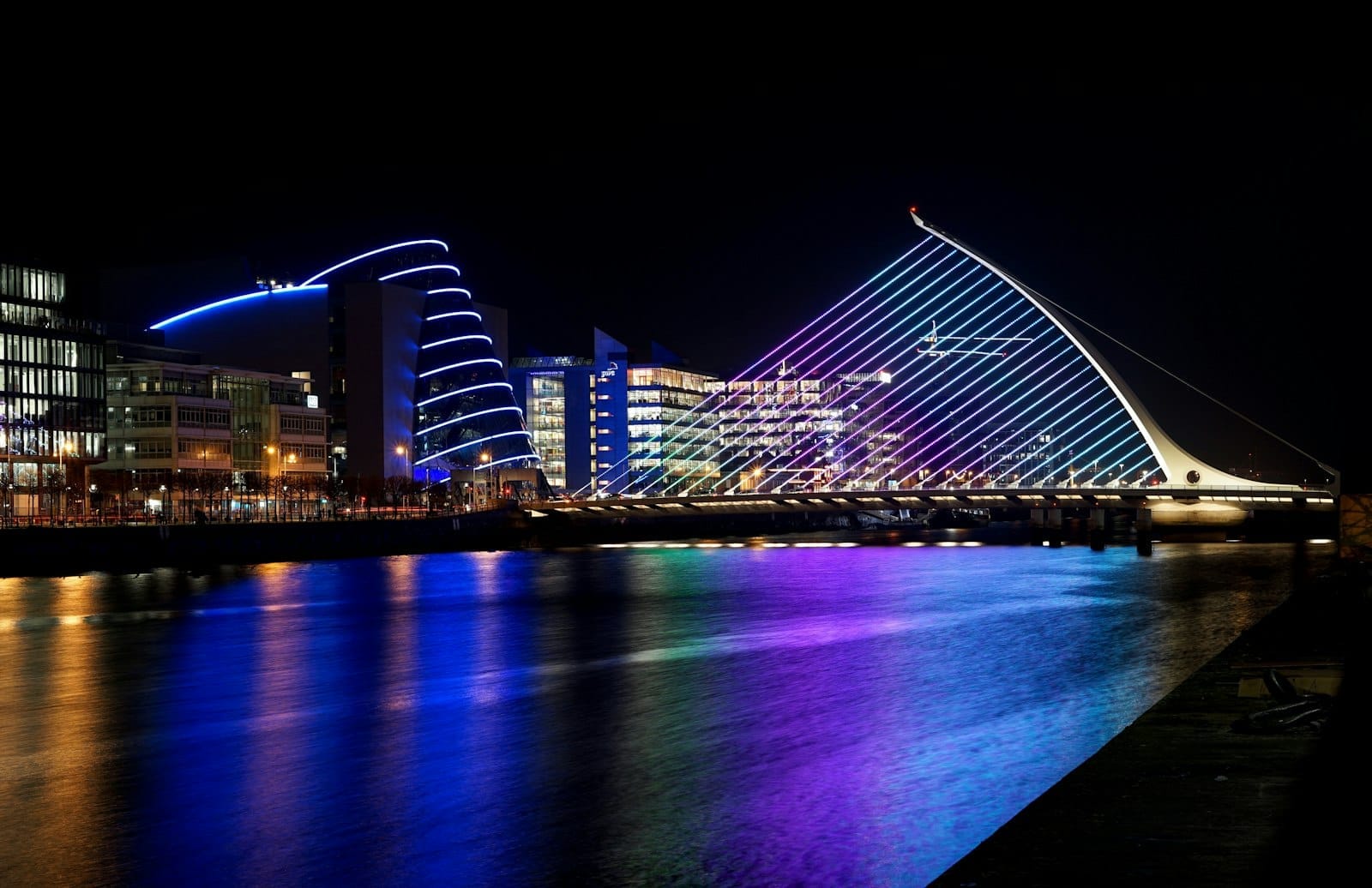
The Samuel Beckett Bridge is a cable-stayed swing bridge spanning the River Liffey in Dublin's Docklands district, connecting Sir John Rogerson's Quay on the south bank with Guild Street and North Wall Quay on the north. Designed by Spanish architect Santiago Calatrava and opened to pedestrians on 10 December 2009, it carries road traffic, a dedicated cycle lane, and a pedestrian walkway. The entire structure is 120 metres long, with a pylon rising 46 metres above the river. It can rotate 90 degrees on a central pivot to allow ships to pass through, a capability managed by Dublin City Council as part of live traffic operations.
The bridge was named after Samuel Beckett, the Nobel Prize-winning playwright and novelist born in Foxrock, County Dublin in 1906. It is one of several Liffey crossings named after Irish cultural figures, but it stands apart from the others on visual grounds alone. Where most of the city's bridges are unremarkable road crossings, this one reads as a deliberate public artwork.
ℹ️ Good to know
The bridge rotates to allow ship passage through the Docklands. Exact opening times are managed operationally by Dublin City Council and are not published on a fixed schedule. If you arrive to find the bridge mid-rotation, it typically takes only a few minutes to return to position.
The Architecture: What Calatrava Built and Why It Matters
Santiago Calatrava's design is immediately readable from either bank. A single white pylon leans out over the water at a sharp angle, anchoring a web of 31 stay cables that fan downward to support the bridge deck. The overall silhouette is widely described as resembling a harp, an intentional echo of the national symbol of Ireland. From certain angles, particularly from the south bank looking northwest toward the Custom House, the form is clean enough to photograph without obstruction.
Calatrava is a polarising figure in architecture circles, with several of his projects attracting criticism for cost overruns and structural complications. The Samuel Beckett Bridge, by contrast, tends to be considered one of his more successful civic commissions. It fits its setting without overwhelming it, and the white structural steel reads well against both grey overcast skies and the occasional sharp Dublin sunlight. For context on the broader architectural character of the city, the Georgian Dublin architecture guide covers how the historical built fabric contrasts with newer additions like this one.
Up close, the bridge deck is wider than it first appears. The pedestrian walkways run along both outer edges, separated from traffic by low barriers. The cables above are tensioned and almost entirely silent in calm weather, though in a strong easterly wind off Dublin Bay you can sometimes hear a faint vibration. The underside of the deck, visible from quayside level, shows the curved hull form that reinforces the nautical references built into the design.
Tickets & tours
Hand-picked options from our booking partner. Prices are indicative; availability and final rates are confirmed when you complete your booking.
Bridges of Dublin walking tour
From 28 €Instant confirmationFree cancellationGiant's Causeway, Dark Hedges, and Belfast Tour from Dublin
From 85 €Instant confirmationFree cancellationDublin self-guided audio tour
From 10 €Instant confirmationBird of Prey, Cliffs of Moher and Aillwee Cave from Dublin
From 201 €Instant confirmationFree cancellation
How the Experience Changes by Time of Day
Early morning, roughly between 7 and 9am on weekdays, the bridge carries a steady flow of cyclists commuting from the south Docklands and the Grand Canal Dock area into the north Docklands and the financial district. At this hour the light from the east catches the white pylon at a low angle and the river surface is often calm enough to produce clean reflections. Pedestrian traffic is purposeful and sparse, which makes it the best time for photography without managing around other people.
Midday brings delivery vehicles, office workers, and tourists in roughly equal measure. The bridge is functional rather than atmospheric at this hour and there is no particular reason to time a visit here. Late afternoon, from about 4pm onward, the south-facing pedestrian path catches any remaining sunlight and the shadows cast by the cables lengthen dramatically across the deck. This is when the structure looks most three-dimensional.
After dark, the bridge is illuminated in white, with the cables lit from below. The reflection in the Liffey is cleanest on still nights with little wind. This is also when the surrounding Docklands architecture, particularly the theatre and residential towers along the Docklands waterfront, reads well together as a composition. Night photography here is straightforward: the lighting is consistent, and a wide-angle lens from the quayside gives you the full span.
Walking the Bridge: A Practical Walkthrough
Most visitors approach from the south, either walking east along the quays from the city centre or arriving via the Grand Canal Dock area. From the Luas Mayor Square–NCI stop, the bridge is about a four-minute walk west along North Wall Quay on the north side, or you can cross via the bridge itself from Sir John Rogerson's Quay. Spencer Dock station on the same Luas Red Line is approximately five minutes away.
The crossing takes under three minutes at a normal walking pace. The pedestrian path is paved, level, and wide enough to pass cyclists comfortably. There are no steps on the main crossing, and the approaches from both banks are flush with the quayside footpath, making it practical for pushchairs and wheelchair users. There are no barriers, gates, or admission points of any kind.
If you are combining this with a longer walk, the natural extension on the south side is along Sir John Rogerson's Quay toward the Grand Canal Dock, where the theatre, tech campuses, and waterfront squares form a distinct cluster worth exploring. On the north side, the quays lead west toward the Custom House, one of Dublin's finest 18th-century buildings, about a 10-minute walk.
💡 Local tip
For the cleanest photographs of the full bridge, position yourself on the north quayside and face south-southeast. This gives you the pylon, the full cable array, and the south bank buildings without the sun directly behind you during most of the day.
Context: The Docklands Regeneration and the Bridge's Role
The Samuel Beckett Bridge was not built in isolation. It was commissioned as part of the broader regeneration of Dublin's Docklands, a process that transformed derelict port land east of the city centre into a mixed commercial and residential district from the 1990s onward. The bridge provided a new crossing point to serve the expanding population and workforce on both banks, replacing a reliance on the older bridges further west.
The Docklands district now contains some of Dublin's most architecturally self-conscious buildings alongside converted industrial structures. The Bord Gáis Energy Theatre, designed by Daniel Libeskind, sits a short walk south of the bridge. The contrast between the Calatrava structure and the older brick warehouses along the quays gives the area a layered quality that is genuinely interesting to walk through, rather than a uniform redevelopment.
It is worth being direct about the broader picture: the Docklands regeneration has attracted consistent criticism in Dublin for its uneven outcomes, with high-value office and residential development coexisting with significant social deprivation in adjacent communities. A visitor crossing the bridge for photographs is engaging with an area that has a contested recent history. This does not diminish the bridge as a structure, but it provides useful context for anyone spending time in the area.
Photography, Weather, and What to Bring
The bridge photographs well in almost any light, but flat overcast conditions, which are common in Dublin, tend to wash out the white structural steel and reduce contrast. Partly cloudy days with moving light produce the most dramatic results. Rain does not prevent a crossing, but it creates significant spray from passing vehicles on the road lanes, so keep camera equipment protected.
Dublin's maritime climate means wind is a frequent factor here, particularly in autumn and winter. The bridge is exposed to westerly and southwesterly winds funnelled along the Liffey corridor. A waterproof layer is practical year-round. In winter, the shorter daylight window, roughly 8 hours around the solstice, means that golden-hour light arrives in mid-afternoon rather than evening, which can work in a photographer's favour.
For those visiting Dublin in the colder months specifically, the Dublin in winter guide covers what the city looks and feels like when the tourist numbers thin out, which is also when the Docklands area is noticeably quieter and easier to photograph without crowds.
Insider Tips
- The bridge rotates for ship passages, and if you happen to be on it or nearby when this occurs, it is worth pausing to watch. The mechanism is slow and quiet, and it is one of the more unusual things you can see on the Liffey without any planning.
- The best single viewpoint for the full span is from the south bank, standing on Sir John Rogerson's Quay about 40 metres east of the bridge. From here you get the pylon, cables, and the Custom House dome visible in the background on a clear day.
- Early weekday mornings bring a high proportion of cyclists, many of them regular commuters who know the crossing well. If you are cycling, the dedicated lane is well-marked and gives you separation from vehicle traffic throughout.
- The bridge's illumination at night is consistent in colour and intensity, which makes it unusually easy to hand-hold a smartphone shot from the quayside without needing a long exposure. The reflection in the Liffey is sharpest in the hour before high tide when the water surface is smoothest.
- If you are walking east from the Ha'penny Bridge area, allow roughly 20 to 25 minutes on foot along the south quays to reach the Samuel Beckett Bridge. The walk itself passes the Jeanie Johnston tall ship mooring and the EPIC Irish Emigration Museum, so it is worth doing slowly.
Who Is Samuel Beckett Bridge For?
- Architecture enthusiasts who want to see Calatrava's engineering at close range for free
- Photographers looking for a distinctive structural subject with good reflections and changing light
- Cyclists using the Docklands as a commuter or leisure route across the Liffey
- Walkers combining a Docklands loop with nearby cultural attractions like the Grand Canal Dock or Custom House
- Anyone visiting Dublin on a tight budget who wants a genuinely striking experience at zero cost
Nearby Attractions
Other things to see while in Docklands & Grand Canal Dock:
- Bord Gáis Energy Theatre
Designed by Daniel Libeskind and opened in 2010, the Bord Gáis Energy Theatre is Ireland's largest theatre, anchoring the regenerated Grand Canal Square in the Docklands. From West End transfers to opera and live music, it draws major international productions to one of Dublin's most architecturally striking buildings.
- Custom House
The Custom House is Dublin's most accomplished neoclassical building, standing on the north bank of the River Liffey since the 1780s, with its construction completed in 1791. Designed by James Gandon, burned in 1921, and carefully restored, it holds two centuries of Irish administrative and political history behind a 100-metre Portland stone facade. Visitor Centre tickets start at €3 for child/student self-guided entry.
- EPIC The Irish Emigration Museum
EPIC The Irish Emigration Museum occupies the stone vaults of the 200-year-old CHQ Building on Custom House Quay. Across 20 immersive gallery rooms, it traces the journeys of Irish emigrants from medieval times to the present day, examining how a small island shaped science, politics, sport, and culture across every continent.
- Grand Canal Dock
Once the largest dock in the world and later left derelict for decades, Grand Canal Dock is now one of Dublin's most architecturally impressive public spaces. The basin, quays, and surrounding plazas are free to explore and offer a quieter, more contemporary side of the city.