Bord Gáis Energy Theatre: Dublin's Premier Performing Arts Venue
Designed by Daniel Libeskind and opened in 2010, the Bord Gáis Energy Theatre is Ireland's largest theatre, anchoring the regenerated Grand Canal Square in the Docklands. From West End transfers to opera and live music, it draws major international productions to one of Dublin's most architecturally striking buildings.
Quick Facts
- Location
- Grand Canal Square, Docklands, Dublin 2, D02 PA03
- Getting There
- Grand Canal Dock DART station (5-min walk); Luas Red Line stops at George's Dock/Spencer Dock/The Point (15–20-min walk)
- Time Needed
- 2.5–3 hours for a performance; 20 min to see the exterior and square
- Cost
- Tickets from approx. €30–€42 depending on production; no walk-in admission fee (verify current pricing)
- Best for
- Theatre-goers, architecture enthusiasts, couples, Docklands evening visits
- Official website
- www.bordgaisenergytheatre.ie
What Is the Bord Gáis Energy Theatre?
The Bord Gáis Energy Theatre is Ireland's largest theatre, with approximately 2,000 seats arranged across a main auditorium designed for large-scale productions. Completed in 2010 and originally known as the Grand Canal Theatre, it was designed by the Polish-American architect Daniel Libeskind, whose practice is better known internationally for projects like the Jewish Museum Berlin and the master plan for Ground Zero in New York. In Dublin, the result is one of the city's few genuinely contemporary landmark buildings.
The programme runs the full range of what a major receiving house offers: West End and Broadway transfers, opera and ballet, large-scale musicals, comedy, and occasional concerts. It is not a producing theatre in the traditional sense. Productions arrive here after touring, which means the quality of what reaches the stage is generally high, though the calendar has gaps between major runs.
ℹ️ Good to know
The theatre operates on an event-based schedule, not fixed daily opening hours. Check the official website for show listings and confirm your specific performance time before travelling. Doors typically open around 1 hour before curtain for larger productions.
The Architecture: A Building Worth Seeing Before the Show
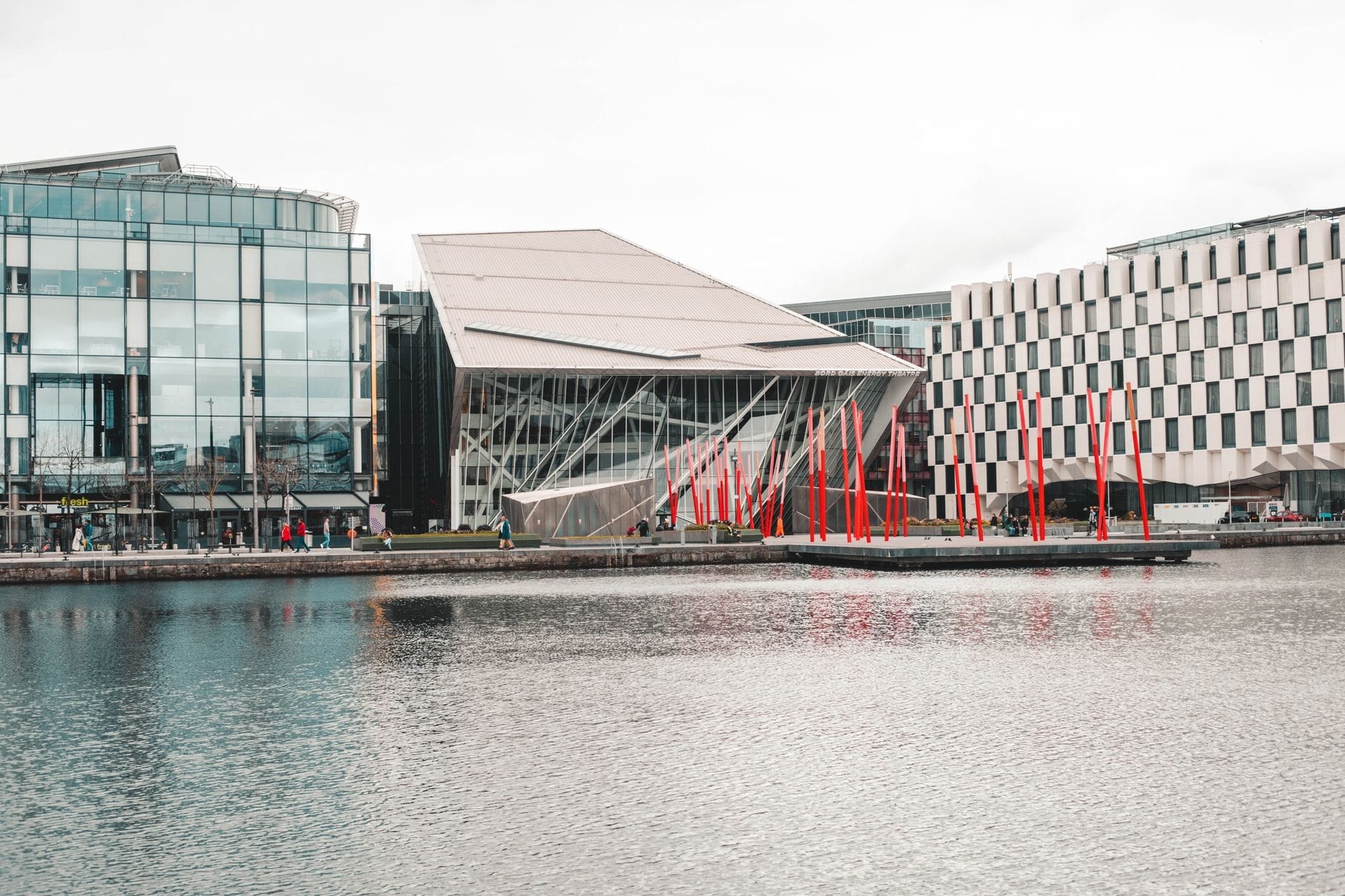
Even if you have no ticket, the exterior of the Bord Gáis Energy Theatre is worth a deliberate look. Libeskind's design wraps the building in angular, folded surfaces clad in glass and steel, creating a jagged silhouette that catches both daylight and the reflections off Grand Canal Dock differently at every hour. The south-facing facade leans outward at a pronounced angle, as if the building is pressing forward toward the water.
Grand Canal Square itself was designed by American landscape architect Martha Schwartz as an integrated part of the same development. The plaza combines red resin-covered inclined planes with a grid of tall red lighting masts that glow at night, creating a distinctive public space that is genuinely unlike anywhere else in Dublin. On a clear evening before a major show, the square fills with theatregoers, and the combination of the lit masts, the reflective water of the dock, and the angular building creates one of the city's better urban photographs.
The theatre sits at the heart of the broader Dublin Docklands regeneration zone, a precinct that transformed former industrial waterfront land into a mixed-use district of offices, apartments, hotels, and cultural venues over the course of the 2000s. The theatre is the cultural anchor of that project, and its presence explains why the surrounding streets feel more like a planned European waterfront district than a typical Dublin neighbourhood.
Tickets & tours
Hand-picked options from our booking partner. Prices are indicative; availability and final rates are confirmed when you complete your booking.
Giant's Causeway, Dark Hedges, and Belfast Tour from Dublin
From 85 €Instant confirmationFree cancellationDublin self-guided audio tour
From 10 €Instant confirmationBird of Prey, Cliffs of Moher and Aillwee Cave from Dublin
From 201 €Instant confirmationFree cancellationGame of Thrones Studio tour with return transfer from Dublin
From 63 €Instant confirmationFree cancellation
The Experience: What to Expect Inside
Inside, the theatre is polished and efficient in the way that purpose-built large-capacity venues are. The lobby is wide and airy, with bars on multiple levels. Pre-show drinks service is quick and the sight lines in the auditorium are good from most parts of the house, which is designed in a traditional horseshoe configuration despite the unconventional exterior. The acoustics are strong for amplified productions and hold up well for orchestral and operatic work.
The seating is tiered across stalls, dress circle, and upper levels. If you are buying tickets without insider knowledge: stalls seats toward the front offer proximity and immersion; the dress circle gives a clean sightline to the full stage; and the upper tiers are the best value option if the production is visually led, as in large musicals or ballet. For spoken-word heavy productions, the stalls or dress circle are worth the premium.
💡 Local tip
Pre-order interval drinks at the bar before the show starts. On sold-out nights, bar queues during the interval can be long enough to eat into the 20-minute break.
The crowd at the Bord Gáis Energy Theatre skews toward a general Dublin theatre audience: a broad age range, often well-dressed but not formally so. On musical theatre nights the audience tends to be younger and more vocal; opera and ballet nights bring a quieter pre-show atmosphere. Either way, the venue handles large audiences smoothly and the building empties efficiently after a show.
The Docklands at Night: The Theatre in Context
Arriving at the Bord Gáis Energy Theatre in the evening is half the experience. The Docklands after dark is quieter than the city centre and less chaotic than Temple Bar, and the walk from Grand Canal Dock DART station along the waterfront takes about five minutes through a genuinely attractive stretch of the city. The dock water reflects the theatre's lit facade and the red masts of the plaza. In dry weather, the area has a calm, almost formal quality before a show.
If you arrive early, Grand Canal Dock is directly adjacent and worth a few minutes of attention: the scale of the water, the Samuel Beckett Bridge visible to the north, and the surrounding office buildings give the area a coherent waterfront character. There are several restaurants and cafes within a short walk of the theatre, ranging from casual to formal, which makes pre-show dinner straightforward to arrange.
For visitors covering more of Dublin's east side, the Samuel Beckett Bridge is a short walk north and is the most photographed piece of infrastructure in the Docklands. Named after the Nobel Prize-winning Dublin playwright, it was designed by Santiago Calatrava and has become something of a visual symbol for the regenerated waterfront.
Practical Information: Getting There and Planning Your Visit
The most direct way to reach the theatre by public transport is the Grand Canal Dock DART station, which is approximately a five-minute walk from Grand Canal Square. DART trains run at regular intervals between the city centre and coastal suburbs; the stop is one station south of Tara Street on the city-centre side. The Luas Red Line also serves the Docklands area, though it requires a slightly longer walk to the theatre than the DART.
Several Dublin Bus routes serve the surrounding area, and taxis and ride-hailing services operate to Grand Canal Square without difficulty. Driving and parking are possible but the Docklands road network is complex on event nights; public transport is the simpler option. For broader orientation, the getting around Dublin guide covers transport options across the city in more detail.
Ticket prices start at approximately €30–€42 for some productions, but vary significantly by show, seat category, and date. There is no general admission fee to enter the building outside of ticketed events. Booking through the official website or box office is recommended over third-party resellers. The theatre's phone line is +353 (0) 1 677 7999; accessibility enquiries can be directed to justask@bgetheatre.ie. The venue, completed in 2010 to modern building standards, provides accessible seating and facilities, but visitors with specific needs should confirm arrangements directly with the venue before attending.
⚠️ What to skip
Ticket prices and availability change by production. Always verify current pricing and scheduling on the official website at bordgaisenergytheatre.ie before booking. Some high-demand shows sell out weeks in advance.
Is It Worth Your Time? An Honest Assessment
The Bord Gáis Energy Theatre is worth visiting if you have a specific production in mind. As a building and public space, it is one of the most architecturally coherent parts of modern Dublin, and the plaza is worth seeing regardless of whether you have a ticket. As a theatre experience, it offers the kind of large-scale production values that smaller Dublin venues cannot accommodate, and the interior is comfortable and well-designed.
If you are looking for the texture of Dublin's older cultural life, smaller venues like the Abbey Theatre offer a very different experience: productions rooted in Irish literary and dramatic tradition, in a building with historical weight. The Bord Gáis Energy Theatre is a modern European-style receiving house. It is very good at what it does, but what it does is serve large touring productions, not originate work. First-time visitors to Dublin with limited time should probably only build their itinerary around the theatre if there is a specific show they want to see.
Those who will not enjoy the experience: visitors expecting an intimate or informal atmosphere, anyone who dislikes large-venue crowd management, or travellers coming purely to see the building without a ticketed event (the interior is not open for general browsing). The Docklands neighbourhood, while visually distinctive, is quieter than the city centre and can feel sparse if you are looking for a lively pre-or post-show street atmosphere.
Insider Tips
- The upper tiers of the auditorium offer some of the best value seating in the house for visually spectacular productions like large musicals or ballet. The sightlines are clean and the price difference compared to stalls can be significant.
- Grand Canal Square's red resin-covered plaza looks its best in the 30 minutes after sunset on a clear evening when the lighting masts are lit and the dock reflects both the theatre facade and the sky. If you want a photograph of the building at its most dramatic, time your arrival accordingly.
- The DART from Tara Street or Pearse Street stations to Grand Canal Dock takes only a few minutes and drops you a short flat walk from the theatre entrance. It is by far the least stressful arrival option on busy show nights.
- For accessibility requirements including wheelchair spaces, companion seating, or audio-description services, contact the venue directly at justask@bgetheatre.ie well in advance. The theatre does provide these services but popular shows allocate accessible seats quickly.
- If you are combining the theatre visit with dinner, the area around Grand Canal Square has several restaurant options. Book in advance for any restaurant on a Friday or Saturday show night, as the area fills quickly before curtain.
Who Is Bord Gáis Energy Theatre For?
- Theatre and musical fans wanting to see major touring productions in a purpose-built large-capacity venue
- Architecture enthusiasts interested in Daniel Libeskind's only Irish building and the integrated Martha Schwartz plaza design
- Couples looking for a polished evening out in a neighbourhood that feels calmer than the city centre
- Visitors who want to explore the Dublin Docklands regeneration zone as part of a broader city itinerary
- Families attending large-scale family-friendly musicals or shows that regularly appear in the programme
Nearby Attractions
Other things to see while in Docklands & Grand Canal Dock:
- Custom House
The Custom House is Dublin's most accomplished neoclassical building, standing on the north bank of the River Liffey since the 1780s, with its construction completed in 1791. Designed by James Gandon, burned in 1921, and carefully restored, it holds two centuries of Irish administrative and political history behind a 100-metre Portland stone facade. Visitor Centre tickets start at €3 for child/student self-guided entry.
- EPIC The Irish Emigration Museum
EPIC The Irish Emigration Museum occupies the stone vaults of the 200-year-old CHQ Building on Custom House Quay. Across 20 immersive gallery rooms, it traces the journeys of Irish emigrants from medieval times to the present day, examining how a small island shaped science, politics, sport, and culture across every continent.
- Grand Canal Dock
Once the largest dock in the world and later left derelict for decades, Grand Canal Dock is now one of Dublin's most architecturally impressive public spaces. The basin, quays, and surrounding plazas are free to explore and offer a quieter, more contemporary side of the city.
- Jeanie Johnston Tall Ship & Famine Museum
Moored on Custom House Quay in Dublin's Docklands, the Jeanie Johnston Tall Ship & Famine Museum is a full-scale replica of the original 1847 barque that carried more than 2,500 Irish emigrants to North America without a single loss of life. Guided tours take visitors below decks into the cramped quarters where those passengers lived, making the scale of the Great Famine feel immediate and personal.