Jeanie Johnston Tall Ship & Famine Museum: Dublin's Most Affecting History Experience
Moored on Custom House Quay in Dublin's Docklands, the Jeanie Johnston Tall Ship & Famine Museum is a full-scale replica of the original 1847 barque that carried more than 2,500 Irish emigrants to North America without a single loss of life. Guided tours take visitors below decks into the cramped quarters where those passengers lived, making the scale of the Great Famine feel immediate and personal.
Quick Facts
- Location
- Custom House Quay, Dublin 1, D01 KF84 (Docklands)
- Getting There
- Luas Red Line: George's Dock or Mayor Square – NCI (approx. 3-min walk)
- Time Needed
- 1 to 1.5 hours for the guided tour
- Cost
- Adults from €16 | Seniors/Students from €13 | Children (6–12) from €10.50 | Under 5s free | Combo ticket with EPIC from €34
- Best for
- History enthusiasts, Irish diaspora, families with older children, anyone moved by migration stories
- Official website
- jeaniejohnston.ie
What the Jeanie Johnston Is — and Why It Matters
The Jeanie Johnston Tall Ship & Famine Museum is not a standard maritime attraction. It is a carefully reconstructed piece of grief, resilience, and survival, moored on the River Liffey at Custom House Quay. The original Jeanie Johnston was a three-masted barque built in 1847 in Quebec, Canada, by shipbuilder John Munn. Between roughly 1847 and 1855, it made 16 emigrant voyages from Tralee, County Kerry to ports in North America, carrying more than 2,500 people fleeing the Great Famine. In an era when Atlantic crossings regularly claimed lives to disease and shipwreck, the Jeanie Johnston arrived at every destination with every passenger alive. That record was extraordinary, and it defines the ship's significance to this day.
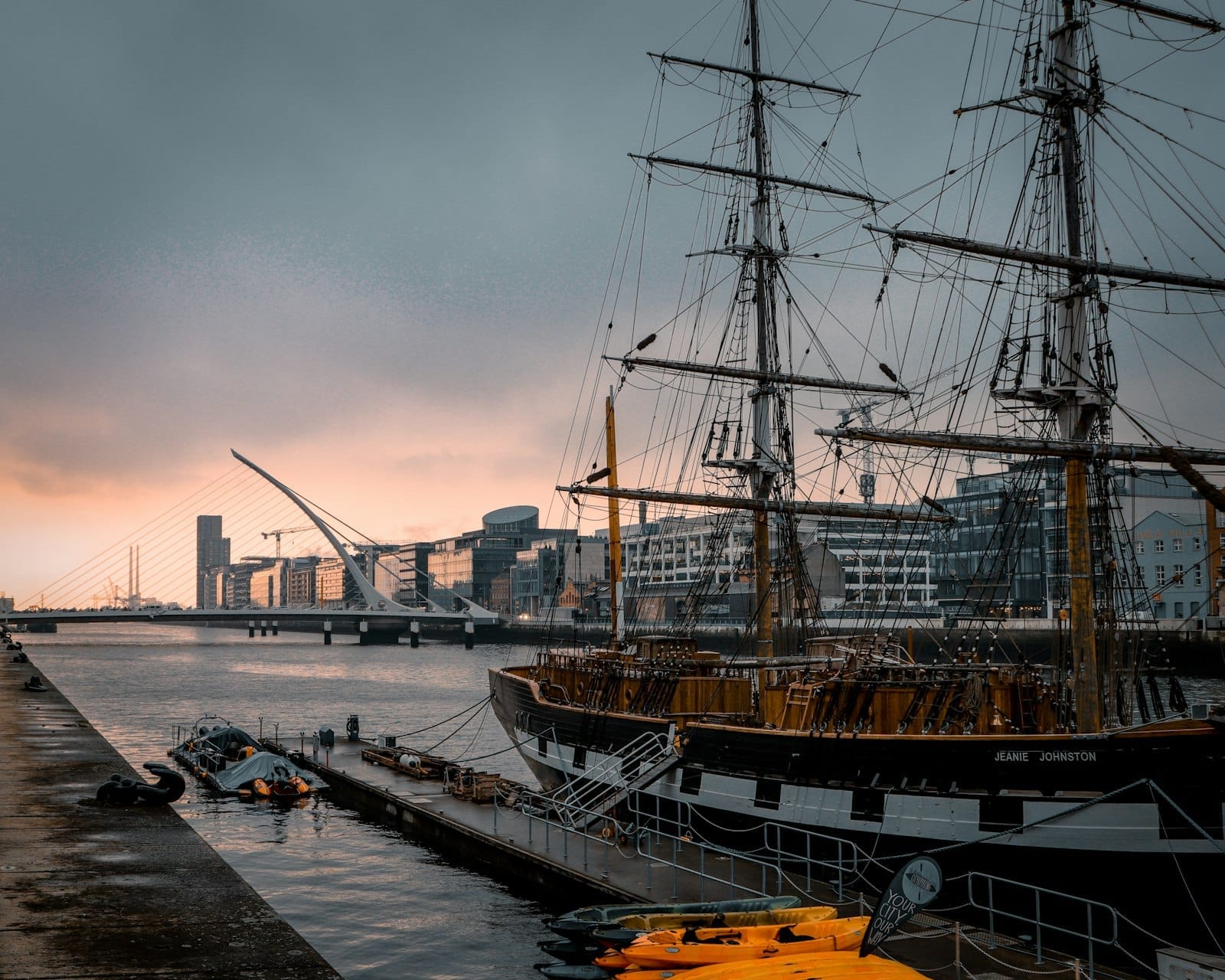
The vessel in the Docklands is a full-scale replica, completed in the early 2000s after roughly nine years of construction. It subsequently sailed as a working sail-training vessel before taking up its current role as a permanently moored museum ship. Seeing it from the quay, the three masts rise well above the surrounding modern architecture of the Docklands, making it impossible to miss and striking against the glass facades behind it.
💡 Local tip
Guided tours run daily and depart at regular intervals from 10:00. The last tour is at 16:30. Check current tour times directly at jeaniejohnston.ie before you visit, as third-party listings sometimes carry outdated schedules.
The Tour Experience: What Actually Happens Below Decks
Access is via a gangway from the quay onto the main deck, where the scale of the ship becomes real in a way photographs do not prepare you for. The hull is broad and deep, but the emigrant quarters below deck are shockingly confined. Bunk frames are stacked close together, with ceiling height that would have made standing upright impossible for many adults. The guides, who are knowledgeable and consistently draw on specific passenger records and medical logs from the original voyages, use this space to explain what 200 or more people living in it for weeks at sea would have looked and smelled like.
The tour moves through the ship systematically, from the main deck and rigging down through the hold and passenger quarters, finishing in areas dedicated to the captain. The guides give the medical story and shipboard discipline proper weight. The combination of physical space and human story makes this one of the more emotionally resonant history experiences in Dublin.
Groups are kept to a manageable size per tour, which means the experience does not feel crowded inside the ship. The guides read the room well, adjusting the pace and depth for groups that include children versus groups of adults. Tours typically last around 50 minutes to one hour.
Tickets & tours
Hand-picked options from our booking partner. Prices are indicative; availability and final rates are confirmed when you complete your booking.
An Irish Famine Story, the Jeanie Johnston Entrance and Tour
From 15 €Instant confirmationFree cancellationDublin cruise ship shore excursion with hop-on hop-off and transfer
From 34 €Instant confirmationFree cancellationDublin tall tales and treetop trails full-day tour
From 238 €Instant confirmationFree cancellationGiant's Causeway, Dark Hedges, and Belfast Tour from Dublin
From 85 €Instant confirmationFree cancellation
The Ship at Different Times of Day
Morning tours, particularly the first departure at 10:00, tend to be quieter. The light on the quay at that hour is softer, and the Docklands foot traffic is mostly office workers rather than tourists. If you want a calmer experience with a smaller group, the 10:00 or 10:30 slot is worth booking specifically.
Midday tours draw more visitors, particularly in summer when cruise passengers and tour groups arrive in volume. The ship is never overwhelmingly crowded in the way some of Dublin's flagship attractions can become, but the 12:00 to 14:00 window will feel noticeably busier. Afternoon tours toward 15:30 or 16:00 pick up again in summer as independent visitors wrap up their days in the Docklands.
The exterior of the ship is photogenic at almost any hour, but the golden late-afternoon light in summer, when the sun angles across the Liffey from the west, is particularly good for photographing the hull and rigging. From the opposite bank or from the Samuel Beckett Bridge, the ship reads as a dramatic contrast against the contemporary Docklands skyline.
Historical Context: The Great Famine and the Emigrant Voyage
The Great Famine of 1845 to 1852 killed approximately one million people in Ireland and caused the emigration of at least another million over the famine years. By the mid-1850s, the population of Ireland had fallen drastically. The Jeanie Johnston operated at the peak of this crisis, departing from Tralee, a port in the southwest where famine conditions were severe.
The crossing to North America, typically to Quebec or Baltimore, took weeks under favorable winds and longer in poor conditions. Passengers were allocated minimal rations and lived in conditions that made disease spread rapidly on most vessels of the era. 'Coffin ships', as many emigrant vessels became known, could lose significant proportions of their passengers to typhus, dysentery, and starvation. Understanding the Jeanie Johnston's record in that context is what gives this museum its weight. For visitors who want to broaden this story beyond a single ship, the EPIC The Irish Emigration Museum sits almost directly across the quay and covers the full sweep of Irish emigration history from the famine era to the present day. A combo ticket covering both attractions offers genuine value and makes for a natural full-day itinerary in the Docklands.
Getting There and Navigating the Docklands
The ship is moored at Custom House Quay, Dublin 1. The Luas Red Line stops at George's Dock and Mayor Square – NCI, both roughly a three-minute walk from the gangway. Several Dublin Bus routes also serve the quays. If you are coming from the south side of the city, the Samuel Beckett Bridge nearby offers a scenic crossing on foot.
The surrounding Docklands neighborhood has changed substantially in recent decades. What was once a working industrial port is now a district of glass office towers, apartment blocks, and cultural venues. The contrast between the tall ship and its contemporary surroundings is part of what makes arriving here feel deliberate rather than accidental. Budget time to walk the quays before or after your tour.
⚠️ What to skip
The Jeanie Johnston is a multi-deck tall ship accessed via steep, narrow stairways. Visitors with limited mobility, wheelchair users, or those with prams should contact the attraction directly before booking. The outdoor gangway and below-deck areas are not fully accessible. This is a genuine constraint, not a minor inconvenience.
What to Bring and Practical Considerations
The tour moves outdoors and below decks, so dress for the weather rather than a climate-controlled museum. Dublin's weather is variable year-round, with rain possible even in summer. A light waterproof layer is sensible. Below decks, the ship can be close and warm when full, so layers work better than a single heavy jacket.
Photography is permitted throughout the tour, and the below-deck quarters, with their low ceilings, wooden bunks, and soft interior lighting, reward a phone camera with wide-angle capability. Flash is unnecessary and distracting in group settings. On deck, the rigging and masts make for strong compositional lines against the sky.
Booking tickets in advance via the official website is advisable in high season (June to August) and around school holiday periods. Walk-up tickets are generally available outside peak windows but the first and last tours of the day can fill quickly. If you are planning a broader Dublin history itinerary, combining this visit with the Glasnevin Cemetery Museum or Kilmainham Gaol creates a coherent thread through Dublin's most significant historical experiences.
Honest Assessment: Is It Worth the Ticket Price?
At €16 for adults, the Jeanie Johnston sits in the middle range of Dublin attraction pricing. The experience is entirely guided, which means you are dependent on the quality of your specific guide. Most accounts consistently praise the guides as engaged and well-informed, but any guided experience carries this variability. If you visit on a busy day with a large group, the intimacy of the below-deck sections diminishes, though the ship's physical constraints mean groups are kept reasonably small.
This is not an attraction that tries to be entertaining. It does not have interactive screens, theatrical effects, or gamified elements. It is a preserved ship with a guided narrative, and the power of the experience comes from the physical reality of the space and the specific human stories the guides bring to it. Visitors looking for a passive, self-guided wander will find it less satisfying than those who engage directly with the tour.
For anyone with Irish heritage or a genuine interest in the famine period and its global consequences, this ranks among the most affecting experiences Dublin offers. It complements rather than duplicates the EPIC museum across the quay, and together they make a case for the Docklands as the most coherent destination in Dublin for understanding Irish emigration history. Travelers interested in the broader literary and cultural story of Irish identity might also explore the Dublin Literary Trail as a natural follow-on.
Insider Tips
- Book the 10:00 or 10:30 tour slot for an early start and a more personal experience. Midday tours fill up fastest in summer and the dynamic changes noticeably with larger crowds below deck.
- The combo ticket with EPIC The Irish Emigration Museum across the quay saves money and creates a genuinely complementary full-day experience. Visit Jeanie Johnston first so the EPIC museum's broader narrative feels like context rather than repetition.
- Wear rubber-soled shoes. The deck can be slippery after rain and the below-deck stairs are steep and worn smooth in places.
- Ask your guide about the ship's medical care and passenger conditions. The guides can usually expand on the ship's record and what life below deck was like.
- From the far bank of the Liffey or from the upper level of the Samuel Beckett Bridge, you get the best exterior view of the ship with the Docklands skyline behind it. Worth the five-minute detour for photographers before boarding.
Who Is Jeanie Johnston Tall Ship & Famine Museum For?
- Visitors with Irish heritage tracing family connections to the famine emigrations
- History and maritime enthusiasts who want a physically immersive rather than screen-based museum experience
- Families with children old enough to engage with difficult historical themes
- Travelers pairing this with EPIC The Irish Emigration Museum for a full Docklands history day
- Anyone who finds large, crowded Dublin attractions overwhelming and prefers a smaller, guided group format
Nearby Attractions
Other things to see while in Docklands & Grand Canal Dock:
- Bord Gáis Energy Theatre
Designed by Daniel Libeskind and opened in 2010, the Bord Gáis Energy Theatre is Ireland's largest theatre, anchoring the regenerated Grand Canal Square in the Docklands. From West End transfers to opera and live music, it draws major international productions to one of Dublin's most architecturally striking buildings.
- Custom House
The Custom House is Dublin's most accomplished neoclassical building, standing on the north bank of the River Liffey since the 1780s, with its construction completed in 1791. Designed by James Gandon, burned in 1921, and carefully restored, it holds two centuries of Irish administrative and political history behind a 100-metre Portland stone facade. Visitor Centre tickets start at €3 for child/student self-guided entry.
- EPIC The Irish Emigration Museum
EPIC The Irish Emigration Museum occupies the stone vaults of the 200-year-old CHQ Building on Custom House Quay. Across 20 immersive gallery rooms, it traces the journeys of Irish emigrants from medieval times to the present day, examining how a small island shaped science, politics, sport, and culture across every continent.
- Grand Canal Dock
Once the largest dock in the world and later left derelict for decades, Grand Canal Dock is now one of Dublin's most architecturally impressive public spaces. The basin, quays, and surrounding plazas are free to explore and offer a quieter, more contemporary side of the city.